
The Numbers That Don't Add Up
She stands at the center of the wedding ceremony, draped from head to toe in gold — bangles stacked to the elbow, necklaces layered thick, earrings heavy enough to pull. Every piece will soon be transferred to the groom's family as dowry. This isn't decoration. It's a transaction with cosmological roots, and understanding it is the key to understanding one of the most misread economies on earth.
India is the world's most gold-hungry nation. Private households hold an estimated 25,000 tonnes — roughly 30 times the Reserve Bank of India's official reserves, and comparable in volume to the combined gold holdings of all the world's central banks. When gold prices surge, the question naturally arises: are Indians getting rich?
The data answers that question quickly and bluntly. Fewer than 10% of Indian households own a car. Fewer than half own a motorcycle — meaning that a motorcycle owner has already outpaced half the country. Refrigerator penetration sits at around 38%. Air conditioning, 8%. More than 10% of households still have no toilet. Nearly 90% of the working population earns below the income tax threshold. An estimated 200 million people live in urban slums.
By every conventional measure, this is not a wealthy country.
And yet India's personal consumption expenditure accounts for roughly 60% of GDP. The United States — the global benchmark for consumer excess — sits at approximately 70%. The United Kingdom around 65%. More savings-oriented economies like Germany come in below 50%. India, with its poverty, its gold hoarding, its thin middle class and underdeveloped credit system, presents the statistical profile of a mature, consumption-driven economy.
That is the paradox. Resolving it requires looking at the architecture beneath the numbers — at religion, caste, capital immobility, and a pattern of development that has skipped entire stages while still producing impressive headline growth.
Gold as Theology
The gold at that wedding isn't a financial decision. It is, at its core, a theological one.
In Hinduism, gold occupies a unique metaphysical position: it is the purest of all physical materials — incorruptible, untarnishable, immune to the pollution that attaches itself to everything else in the mortal world. This purity isn't metaphorical; it operates within a comprehensive cosmological framework in which objects, foods, occupations, and people are all classified along a spectrum from pure to polluted.
Women, in traditional Hindu ritual hierarchy, have historically occupied an ambiguous position — frequently associated with impurity in ceremonial contexts, their status contingent on the approval of the families they married into. The dowry system evolved, in part, as a mechanism of social insurance: a transfer of wealth — most durably expressed in gold — that offered a woman some material security in a household where she had no independent claim.
Today, gold ownership in India has acquired a layered identity. It functions simultaneously as cultural obligation, inflation hedge, and status signal. But its ritual soul remains intact. Gold prices rising? Buy. Prices falling? Better time to buy. The logic is circular because it was never fundamentally about price discovery — it was about purity, insurance, and belonging.
The aggregate result is staggering. Gold represents approximately 15% of the average Indian household's total asset portfolio, making it the second-largest store of household wealth in the country, by a margin that is nearly without parallel globally.
The largest? Real estate.
High Homeownership, Low Quality of Life
India's residential homeownership rate sits at approximately 87% — a figure that consistently surprises observers accustomed to associating ownership rates of that magnitude with affluence. The explanation is structural rather than prosperous. A significant portion of India's housing stock has been inherited through family lineages, informally acquired through long-term occupation of land, or transferred through village and community social structures. Meanwhile, India's rental market has been severely distorted by decades of strict rent control legislation and tenant-protection rules so aggressive that landlords routinely refuse to rent at all — effectively making owner-occupation a rational default rather than an aspirational choice.
High ownership says nothing, however, about habitability. Mumbai's skyline contains both Asia's most expensive private residence and some of the continent's most expansive slums, visible in the same field of view as a commercial aircraft descends. Approximately a third of India's population lives in homes built from mud, thatch, or semi-permanent materials. Fewer than 60% of households cook with clean fuel. In Mumbai and Delhi, it is routine for two generations of a working-class family to share less than 200 square feet.
Credit, meanwhile, functions as almost no driver of household wealth. India's household debt-to-disposable-income ratio sits below 50% — among the lowest in any major economy. Mortgage penetration remains under 10%, with most residential property purchases financed through accumulated savings and informal borrowing from family networks. Credit card penetration, while doubling in the past five years, still sits below 10% nationally. Total household debt amounts to roughly 20% of household assets.
The resulting balance sheet for a typical Indian household looks something like this: over 70% of wealth locked in gold and property, both structurally illiquid, neither generating compounding productive returns. Enormous capital sitting still, in a country that needs capital to move.
The Operating System Beneath the Surface
To understand why this structure exists — and why it persists — one must engage seriously with the purity doctrine that forms the structural foundation of Hinduism, not as cultural flavor but as a comprehensive social operating system.
Roughly 80% of India's population practices Hinduism. The concept of ritual purity runs through every domain of existence. Objects, occupations, foods, and people are classified along a spectrum from pure to polluted, and these classifications have concrete, observable behavioral consequences.
Eating, for instance, must be done with the right hand — because the right is pure and the left is not. Cooking utensils, by transmitting impurity, should ideally be bypassed in favor of bare hands. Indoor toilets, within this logic, introduce a source of pollution into the sanctified domestic space; the appropriate domain for bodily impurity is outside the home. When the Indian government launched an ambitious national sanitation program in 2014, targeting universal toilet access, a meaningful segment of households declined installation even when offered free of charge. The Western public health framework — confining human waste to indoor plumbing — and the Hindu ritual purity framework operate on entirely different and structurally incompatible premises.
But the deepest, most economically consequential expression of purity doctrine is the institution that has organized Indian society for three thousand years.
The Caste System: Three Millennia of Locked Hierarchy
The caste system is, at its origin, the projection of Hindu purity hierarchy onto human social organization. Its roots trace to the arrival of Indo-Aryan peoples in the Indian subcontinent more than three thousand years ago, who brought a hierarchical taxonomy mapping ritual purity onto hereditary occupational groups. What followed was centuries of reinforcement — including systematic exploitation by successive waves of colonial administration, who found the caste architecture extraordinarily convenient for the maintenance of control. It sorted people clearly, assigned them stable roles, and naturalized hierarchy through religious authority.
The varna structure — Brahmins (priests and scholars) at the apex, Kshatriyas (warriors and rulers), Vaishyas (traders and merchants), Shudras (servants and laborers), and Dalits positioned entirely outside the system — bound status, occupation, marriage eligibility, educational access, and physical geography within a village to hereditary birth. Your caste was your destiny, and the system was designed to make that destiny feel not arbitrary but cosmologically ordained.
Caste discrimination was formally abolished in India's 1950 constitution. The reality is considerably more complicated than that legal fact implies. Millennia of encoded hierarchy does not dissolve in seven decades of legislation. Public discrimination now carries legal penalties, and enforcement has genuinely improved in formal corporate environments. But the system's underlying logic operates — now quietly rather than overtly. Social networks, marriage markets, hiring decisions, and neighborhood composition continue to reflect caste patterns with remarkable consistency.
According to the most recent census containing caste data, high-caste groups — Brahmins, Kshatriyas, and commercially oriented Vaishya families — represent fewer than 15% of the total Indian population. India plans to conduct a new caste-inclusive census in 2026–2027, a move that itself signals how unresolved the question remains in contemporary policy and social life.
The Half-Population Sitting Still
Within this hierarchy, women have historically been associated with ritual impurity — particularly around reproductive biology, which in Hindu ceremonial practice carries connotations of pollution at specific life stages. A daughter, in many traditional household frameworks, represents a future liability: the dowry obligation. Families with limited means face the prospect of that obligation being unpayable at competitive levels. The rational response, within the system's own internal logic, has been to underinvest in female children — to forgo education, skill development, and professional cultivation in favor of the one investment that will ultimately matter: the accumulation of gold for the marriage payment.
The macroeconomic consequences are severe and systematically underweighted in "India growth story" analyses. Female labor force participation among women aged 25 to 45 sits below 30%, placing India last among all major economies globally. The comparable figure in the United States consistently exceeds 70%; across Western Europe, it is broadly similar. Among Indian women over 15, the illiteracy rate is approximately 30%. Fewer than half complete secondary education.
Male outcomes are modestly better but remain structurally weak: male illiteracy over 15 runs around 20%, with just over half completing high school.
The standard narrative about India's "demographic dividend" emphasizes the country's youthful age structure — a median age around 28, versus an aging Europe or Japan. What it consistently underweights is the quality of that demographic. A young workforce in which half the participants are structurally excluded from economic life through a combination of cultural expectation, legal vulnerability, and educational deprivation is not the same growth asset as a young, educated, broadly participating labor force. South Korea's economic transformation in the second half of the 20th century was built on exactly that foundation — universal secondary education, female workforce participation, and disciplined public investment in human capital. India's demographic profile is younger; its demographic quality is not comparable.
The IT Escape Hatch — and Its Structural Ceiling
There is one domain where caste has largely lost its grip: technology.
The software industry emerged in India too recently to have been assigned a position in the traditional purity hierarchy. There is no hereditary varna for software engineers. This occupational vacuum allowed talent from across the caste spectrum — including, notably, Dalits — to enter the profession without the social penalties that accompany low-status work in traditional sectors. The Indian government's aggressive push into software export development beginning in the 1990s accelerated this dynamic, and major technology employers adopted explicit anti-caste-discrimination policies, motivated by a combination of progressive corporate culture and meaningful legal and reputational exposure in international markets. When a discrimination case involving a Dalit software engineer surfaced in Silicon Valley in 2020, it triggered an industry-wide policy review.
The results have been genuinely impressive. IT and software services now account for roughly 60% of India's service exports and represent the country's most dynamic and internationally competitive economic sector. The leaders of some of the world's most valuable technology companies are Indian by origin — predominantly, it should be noted, of Brahmin heritage, though the pipeline is broadening.
But the structural ceiling is real. Skill-intensive service industries do not absorb labor at scale. Writing software, managing technical outsourcing relationships, and providing business process services require English fluency, secondary and tertiary education, and cognitive competencies that the majority of India's working-age population does not yet possess. Services represent 54% of Indian GDP while providing only 31% of employment. Manufacturing, at 17% of GDP, generates 22% of jobs.
The arithmetic is unambiguous: India's most successful sector is structurally incapable of solving India's most urgent problem. For the roughly 85% of the population without access to quality education, without functional English, and without the social networks that caste privilege confers — the IT boom is visible but unreachable.
Why Manufacturing Never Happened
Manufacturing is the mechanism through which most economies have elevated large working-class populations out of poverty. It absorbs workers across a wide range of skill levels, creates domestic supply chains, and generates the broad-based income growth that eventually produces genuine consumer demand. Japan, South Korea, and Taiwan each followed this model. The empirical record is substantial and consistent.
India has not followed it. Manufacturing has been stuck at roughly 17% of GDP for decades, dramatically below where comparable economies were at similar stages of development.
The reasons are interlocking.
Federal fragmentation. India is a federal system in which each of its 28 states maintains distinct labor laws, land acquisition rules, and business licensing procedures. Establishing a factory may require clearing 70 or more separate government approvals. Cross-state operations demand restarting this process from scratch under entirely different regulatory regimes, making national-scale supply chain integration punishingly difficult and expensive.
Anti-scale incentives embedded in law. For decades, Indian labor law prohibited companies above a certain headcount from conducting layoffs without state government approval — a threshold initially set at 100 employees and only recently raised to 300. The intent was to protect workers. The consequence was to make business growth beyond that threshold financially risky, discouraging entrepreneurs from scaling. Approximately 90% of Indian employment remains in the informal sector. Only 10% of workers hold formal jobs. Much of this distribution is a direct result of deliberate decisions by businesses to remain sub-scale.
Cultural barriers to factory work. In a society where occupations carry ritual significance, industrial labor — operating machinery, handling materials, working production lines — falls toward the impure end of the spectrum. A survey by an Indian human development research institution found that only about 6% of parents wanted their children to enter manufacturing. This isn't purely about wages; it reflects identity, social standing, and family aspiration operating within a framework where the purity of one's occupation has social meaning extending beyond the paycheck.
India did not skip manufacturing by accident. It was blocked by a combination of policy design, administrative dysfunction, and cultural attitudes that don't reverse quickly in response to government incentives.
The Consumption Paradox, Resolved
We can now address the original question directly.
Standard economic accounting breaks national output into three drivers: domestic consumption, investment, and net exports. India's apparent consumption strength is largely a function of structural weakness in the other two legs — particularly net exports.
India imports approximately 85% of its crude oil. The bulk of this energy supports domestic consumption, transportation, and electricity generation rather than industrial production. This is the energy import profile of a services-and-subsistence economy, not a manufacturing powerhouse.
Gold imports constitute the second major structural drain. Tens of billions of dollars annually flow out of the productive financial system into private vaults, family safes, and temple treasuries — not into factories, infrastructure, or research and development. Capital that could generate compounding productive returns is ceremonially removed from circulation.
The result of chronic trade deficits — persistent underperformance in goods exports, persistent overperformance in both energy and gold imports — is that consumption's share of GDP is arithmetically inflated. It isn't that Indians are consuming more; it's that investment and net exports are so structurally weak that consumption dominates by residual. India's consumption-to-GDP ratio once peaked close to 70% and has only recently declined as public infrastructure investment has scaled up. That moderation represents genuine policy progress. The underlying structural diagnosis, however, stands: this is not the robust internal demand of a high-income consumer society underpinned by strong credit and high wages. It is the statistical residual of an economy that has not yet built the foundations that would justify the number.
The smartphone bought on installment finance in Bengaluru coexists with mud-brick homes in Bihar. The urban professional with a mutual fund account coexists with the neighbor who still cooks over open flame. Neither is anomalous. Both are accurate portraits of the same distorted structure.
The Stock Market That Belongs to a Minority
Against this backdrop, India's equity market presents a narrative that superficially resembles triumph.
Over the past decade, the Nifty 50 — India's primary benchmark index — delivered total returns exceeding 180%, representing annualized gains above 11%. That outperforms the S&P 500 over the same period (approximately 155% in total return) and substantially outpaces most emerging market peers. India's total stock market capitalization exceeded $5 trillion by the end of 2024, placing it fourth globally. Forward price-to-earnings multiples have consistently exceeded 20x — above European markets, competitive with US technology benchmarks, and substantially above what fundamental economic conditions would typically support.
Read against everything examined above — caste rigidity, absent manufacturing, regulatory friction, an underdeveloped credit system, and a population where 90% work informally — these valuations seem hard to justify. Two structural mechanisms explain them.
The first is systematic forced investment. India's Employees' Provident Fund — a mandatory retirement savings scheme broadly analogous to the 401(k) system in the United States — requires formal-sector employees to contribute 12% of wages monthly, with equivalent employer matching. These flows enter equity and bond markets continuously, regardless of market conditions, creating a structural bid that doesn't depend on sentiment. In parallel, urban middle-class households have adopted systematic monthly contributions to mutual funds at considerable scale, with long lock-in periods. Because Indian markets are relatively illiquid — public float is limited and institutional ownership is concentrated — even moderate, consistent inflows can substantially move prices.
The second is international capital allocating to the "next growth market" thesis. India's sustained 6%-plus GDP growth rate, its young population, and its geopolitical appeal as an alternative to more concentrated supply chain exposure elsewhere have attracted persistent foreign institutional investment. In markets where liquidity is thin, foreign capital amplifies valuation multiples significantly beyond what domestic fundamentals would support in isolation.
But the beneficiaries of this market performance are a specific, narrow demographic: the approximately 10% of workers holding formal employment — disproportionately urban, educated, upper-caste, and financially literate. The provident fund and mutual fund infrastructure that creates the structural long bid is, by design, inaccessible to the 90% in informal work. For the majority of India's working population, the decade-long equity bull market is statistical information about a different economy, not a wealth-building mechanism available to them.
The complete picture of Indian wealth accumulation: elite households build through real estate, gold, and equities. The formal middle class accumulates slowly through mandatory retirement contributions. The vast informal majority accumulates through gold and informal real estate — high illiquidity, no leverage, no compounding financial assets.
The Ceiling on the Story
India's constraints are structural, but they are not immutable. A 6%-plus sustained growth rate represents genuine development; it is lifting real incomes in absolute terms even where distribution remains highly unequal. The IT sector has demonstrated compellingly that when caste barriers are neutralized — whether by the novelty of the industry, by explicit anti-discrimination policy, or by the discipline of international corporate standards — Indian talent competes at the highest global levels. The manufacturing opportunity created by global supply chain diversification is real and is beginning to attract serious capital. Public infrastructure investment has accelerated meaningfully in recent years, and the statistical effects are visible in the investment-to-GDP ratio's gradual improvement.
But the ceiling is set by forces that don't respond rapidly to policy initiative. A three-thousand-year-old ritual hierarchy that governs wealth storage, marriage economics, labor dignity, and social mobility is not overturned by legislation in a generation. A gender participation gap that sidelines hundreds of millions of economically capable people costs India incalculably in productivity and human capital. A regulatory architecture that structurally penalizes business scale will continue suppressing manufacturing competitiveness until reform reaches the state level and achieves genuine depth. And a savings culture that converts household surpluses into non-productive gold reserves will continue to drain the investment capacity that industrialization requires.
The leaders of Microsoft, Google, and IBM are Indian. They are also, largely, Brahmin. That is not coincidental — it is the caste system's meritocratic surface layer functioning as designed, elevating an extraordinarily capable elite while the structural barriers facing the remaining 85% remain substantially in place.
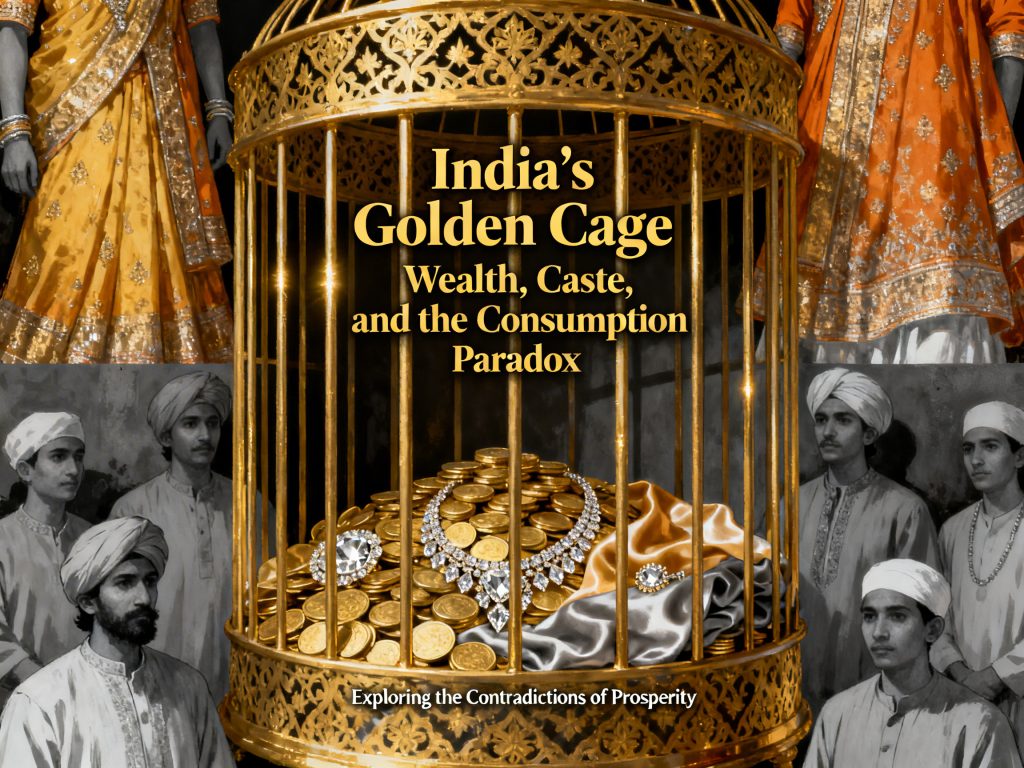
India's story of growth is real. Its story of structural inequity is equally real. And the golden cage — the interlocking system of religious doctrine, hereditary hierarchy, capital immobility, and institutional friction — is not easily opened from outside, and not easily dismantled from within.
Reading about a $5 trillion stock market and the "next major consumer economy," it is worth pausing to ask: whose consumer economy, exactly? And of the 1.4 billion people standing behind that headline, how many are actually in the frame?
References
[^1]: World Gold Council. (2024). Gold demand trends: Full year 2023. https://www.gold.org/goldhub/research/gold-demand-trends/gold-demand-trends-full-year-2023
[^2]: National Sample Survey Office, Ministry of Statistics & Programme Implementation, Government of India. (2023). Key indicators of household consumer expenditure in India (NSS 78th Round). https://mospi.gov.in/publication/nss-report-household-consumer-expenditure
[^3]: World Bank. (2024). Household final consumption expenditure (% of GDP) — India. https://data.worldbank.org/indicator/NE.CON.PETC.ZS?locations=IN
[^4]: International Labour Organization. (2024). ILOSTAT: Labour force participation rate, female (% of female population ages 15+), India. https://ilostat.ilo.org/topics/labour-force-participation
[^5]: UNESCO Institute for Statistics. (2023). Literacy rate, adult female (% of females ages 15 and above) — India. https://data.worldbank.org/indicator/SE.ADT.LITR.FE.ZS?locations=IN
[^6]: National Stock Exchange of India. (2024). Nifty 50 index report: Annual performance summary 2024. https://www.nseindia.com/products-services/indices-nifty50-index
[^7]: Reserve Bank of India. (2024). Annual report 2023–24: Sectoral deployment of credit and household financial savings. https://www.rbi.org.in/Scripts/AnnualReportPublications.aspx
[^8]: Employees' Provident Fund Organisation, Ministry of Labour & Employment. (2023). Annual report 2022–23: Coverage statistics and corpus data. https://www.epfindia.gov.in/site_en/Annual_Reports.php
[^9]: Thorat, S., & Newman, K. S. (Eds.). (2010). Blocked by caste: Economic discrimination in modern India. Oxford University Press.
[^10]: McKinsey Global Institute. (2020). India's turning point: An economic agenda to spur growth and opportunity. McKinsey & Company. https://www.mckinsey.com/mgi/our-research/indias-turning-point-an-economic-agenda-to-spur-growth-and-opportunity
[^11]: International Monetary Fund. (2024). India: Article IV consultation staff report 2024 — GDP composition and trade balance. https://www.imf.org/en/Publications/CR/Issues/2024
[^12]: Office of the Registrar General & Census Commissioner, India. (2013). Primary census abstract: Scheduled castes and scheduled tribes (2011 census). https://censusindia.gov.in/census.website/data/census-tables