
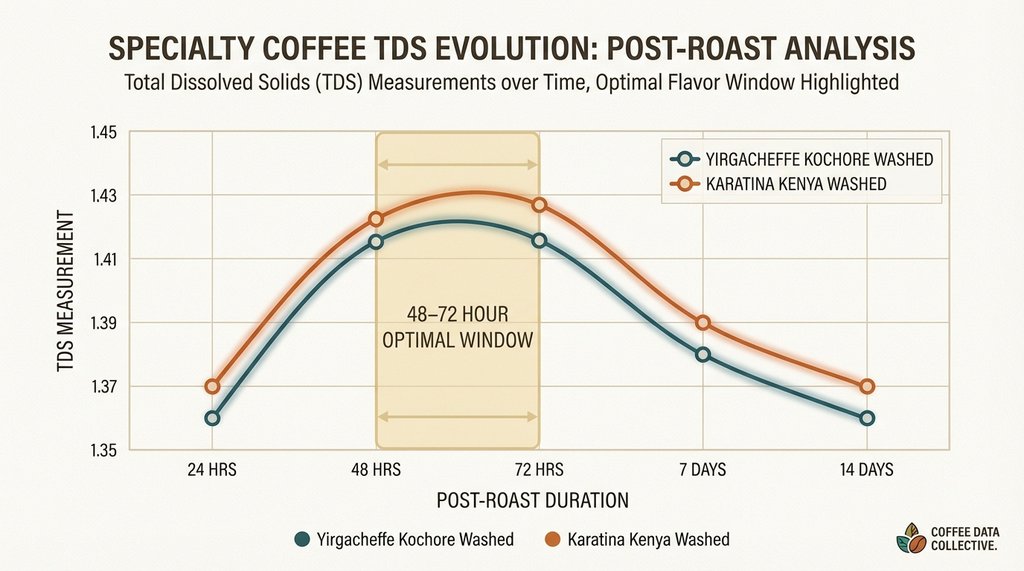
Forty-eight hours off roast, I pulled a V60 of a Yirgacheffe Kochore that I’d been sitting on since it came off the drum. No particular plan — I was just running a calibration brew before the weekend retail batches, using leftover grinds from a density sort. The TDS came back at 1.41, extraction at 21.3%, and the cup had this uncut stone fruit clarity I hadn’t tasted from that lot since the importer’s pre-ship sample. I brewed it again at day seven, following my own standard rest protocol. TDS and yield were nearly identical. The fruit was there, technically, but it had retreated behind a layer of roast integration that made the whole thing feel more assembled than alive.
That was eighteen months ago, and I’ve been chasing that 48-hour cup ever since.
The conventional wisdom in specialty coffee has calcified around the “rest at least five to seven days” rule, and for espresso on medium-to-dark roasts, that guidance is basically sound. CO2 produces channeling, disrupts puck integrity, and creates those aggressive sour-bright notes that get misread as acidity. Waiting it out makes sense when your extraction environment is nine bars of pressure. But pour-over at atmospheric pressure through a 20–22% target? The math stops working the same way, and for washed single origins specifically, the gas dynamics are doing something that most of us have been treating as a problem when it’s actually the signal.
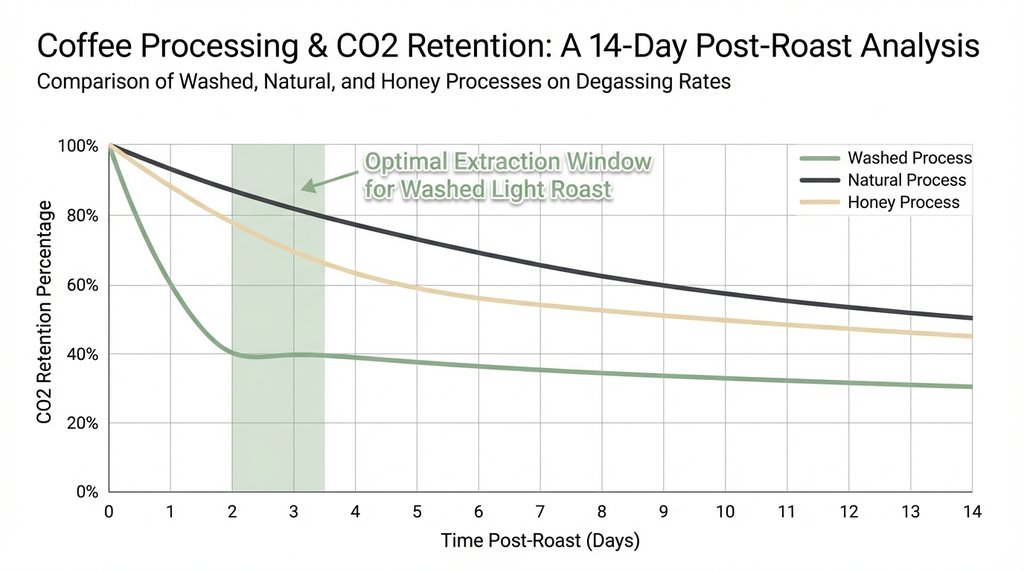
Here’s what’s actually happening in that first window. Washed coffees, because fermentation-derived mucilage has been removed before drying, tend to have a more uniform cellular structure after roasting. The CO2 produced during first crack and roast development is stored primarily in the bean’s internal gas pockets and cell walls, and the rate of outgassing is faster and more predictable than in naturals or honeys where residual sugars and fermentation byproducts create a more heterogeneous matrix. That means washed light roasts hit their CO2 threshold — the point where enough has off-gassed to allow even water contact and extraction — sooner than we’ve been assuming. The general timeline gets imported from medium roast espresso protocols and applied universally. It shouldn’t be.
I started tracking this systematically about a year ago across a set of Ethiopian and Kenyan washed lots that all came in within the same two-week window from the same importer. Same roaster profile template, same target development time ratio (20.5–21%), same batch size (8kg on a Loring S15), roasted within 36 hours of each other. I ran controlled V60 brews at 24, 48, 72, 96 hours, and then day 5, 7, 10, and 14, holding everything else constant: 93°C, 1:17 ratio, 30-second bloom with 2x coffee weight in water, total draw-down targeting 3:20–3:40.
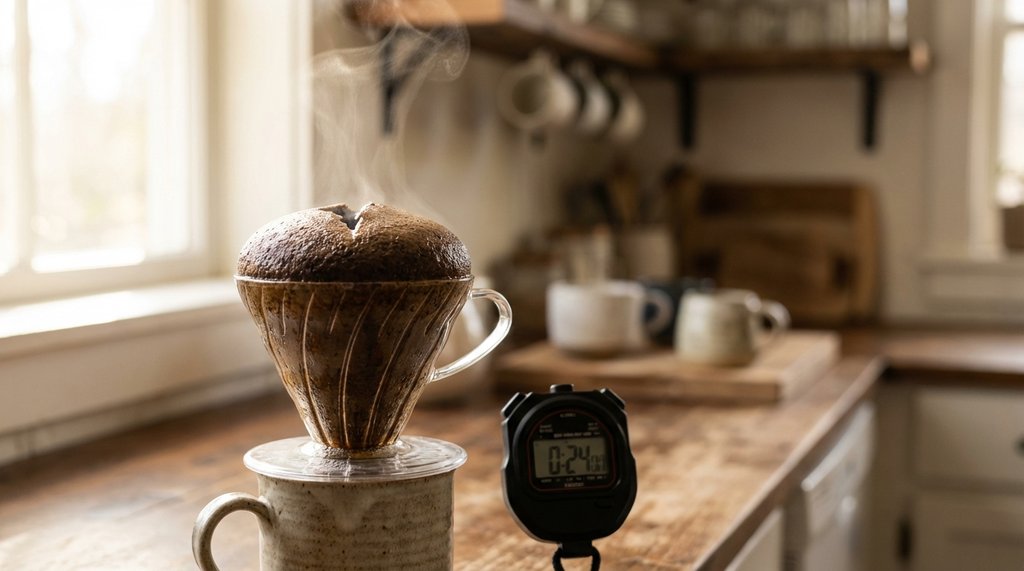
The 24-hour brews were predictably rough on the Kenyan — a Karatina cooperative lot — but the two Ethiopian washed coffees (Kochore and a Guji natural-washed hybrid from a washing station doing a short 12-hour ferment) were extracting cleanly by hour 36. Bloom behavior was my indicator: at 24 hours, the bloom dome held for 45-plus seconds, still actively releasing. By 48 hours, the Kochore bloom peaked and collapsed inside 25 seconds, which in my experience tracks with a CO2 content that’s low enough to stop disrupting water infiltration uniformity but high enough that it’s still actively participating in agitation during the pour phase.
The extraction curves over the following days told the story clearly. Peak TDS and clarity were clustered at 48–72 hours for washed Ethiopians, then showed a measurable drop — not catastrophically, but consistently. At day 10, the Kochore was running at 1.38 TDS versus 1.41–1.43 at 48–72 hours, using identical parameters. I crosschecked on a refractometer calibrated to 20°C, ran each brew in triplicate, and the pattern held across all three iterations.
The part I got wrong for an embarrassingly long time was conflating degassing behavior with aromatic stability. These are not the same curve.
I assumed that because CO2 carries volatile aromatics out of the bean during off-gassing, waiting longer would preserve more of those compounds in solution during brewing. The logic seemed sound: slower degas = more CO2 still in the bean = more aromatic compounds protected until extraction. This is roughly how the argument gets made in favor of long rests, and it works when the volatiles you’re protecting are roast-derived — caramelization compounds, Maillard products, the darker sweet notes.
But for washed coffees with high floral and fruit-acid volatile profiles, those compounds are not primarily CO2-associated in the same way. They’re stored in the lipid phase and the cellular matrix. The CO2 isn’t protecting them from dissipating — it’s actively displacing them during prolonged outgassing. I came across a 2019 study from the Coffee Science Foundation’s extraction work (Michael Batali et al.) and a separate set of GC-MS analyses from WCR that pointed toward this, though neither framed it precisely this way for washed single origins specifically.
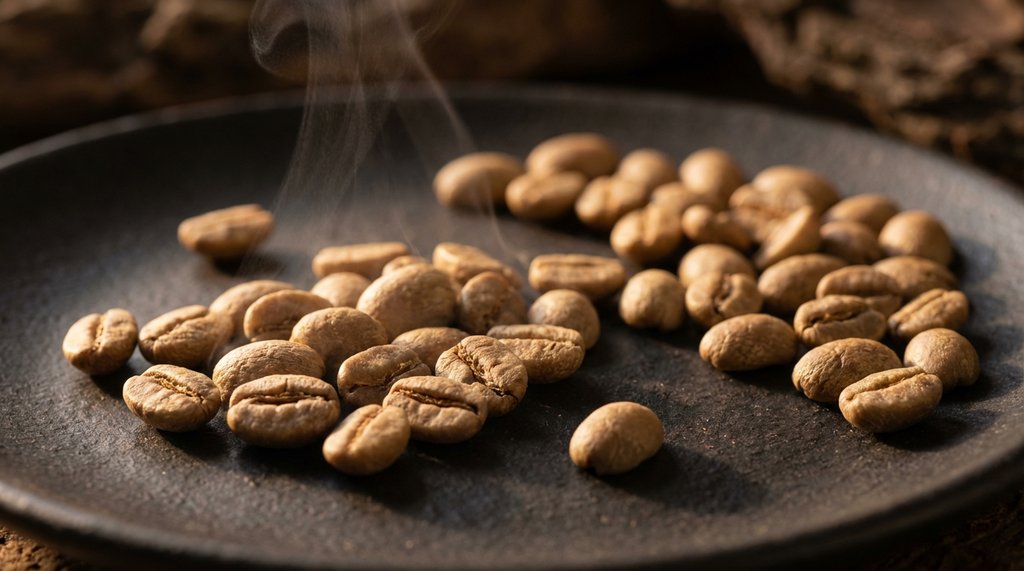
The practical result: the aromatic intensity of jasmine, bergamot, and ripe yellow plum in a well-processed washed Ethiopian peaks somewhere between 36 and 72 hours post-roast in most ambient storage conditions (I store in sealed Airscape containers at 68–70°F, 45–55% RH), and then begins a slow decline as those specific volatile groups migrate out of the bean structure. By day 10, you’ve got more extraction consistency — the CO2 is largely gone, water contact is even — but you’re also brewing a slightly quieter version of the coffee’s potential range.
This is not a universal finding. I want to be direct about the conditions under which this holds:
Roast level matters enormously. This applies to light roasts targeting City+ and lighter, roughly 395–405°F drop temperature on the Loring profile I’m running. Take it darker and you’re back in the standard rest window, because roast-derived compounds start to dominate the flavor architecture and they need time to integrate.
Process specificity is real. Naturals and honeys have fermentation compounds that create interference patterns during early extraction. I’ve never successfully replicated this window effect on a natural process coffee. It might be achievable — I just haven’t found the right conditions.
Grinder matters more at this stage than later. At 48 hours, the bean is slightly more brittle than at day seven, because some moisture redistribution is still happening. I dial my EK43 about half a click coarser than my standard day-seven setting for early brews, or I get a fines spike that looks like over-extraction on the TDS but tastes thin. That took me three bad batches to figure out.
The 72-hour ceiling is also softer than I initially framed it. It’s more accurate to say there’s a transition zone between 60 and 84 hours where I’ve seen the character shift depending on the specific lot. Some Kenyan AB lots I’ve worked with — particularly from Nyeri washing stations — seem to have a slightly denser cellular structure and the window pushes to 72–84 hours. The way I test for readiness now is a bloom timer rather than a calendar: if the bloom dome collapses inside 20–28 seconds under my standard pour, I’ll brew it. If it’s holding longer than 30 seconds, I wait.
This is probably the most useful operational heuristic I can pass on from this whole exercise, because it adapts to ambient temperature, storage conditions, and roast-specific variation in ways that a fixed-day rule doesn’t. Cold storage dramatically slows outgassing — if you’re keeping freshly roasted coffee at 45°F in a retail cooler, add 36–48 hours to every interval I’ve described.
The frustrating part of this whole inquiry is that the professional cupping protocol most of us use — SCAA/SCA standard calls for coffee between 8 and 24 hours post-roast for sensory evaluation, and roasters typically cup their own lots at 24–48 hours for QC — inadvertently places professionals right inside this window all the time. We’re tasting the coffee at its most expressive, writing tasting notes based on that experience, and then telling customers to wait ten days before they brew it at home. The disconnect is real and I’ve started attaching brewing windows on the bag alongside roast dates, which has generated exactly the kind of confused customer feedback you’d expect.
The pushback I get most often is from espresso-focused shops, and they’re not wrong for their application. CO2 at nine bars behaves differently, and I’m not trying to collapse a protocol that works for their context. But for filter coffee on washed single origins from high-altitude African lots, the assumption that more rest is always better is costing people the specific thing they paid a premium for.
Brew it at 48 hours, at least once, before you decide it needs more time. The bloom won’t be polite about it if the coffee isn’t ready. But if the dome falls, trust it.
4 thoughts on “Washed Coffee Degassing: The Missing 24-72 Hour Window”