
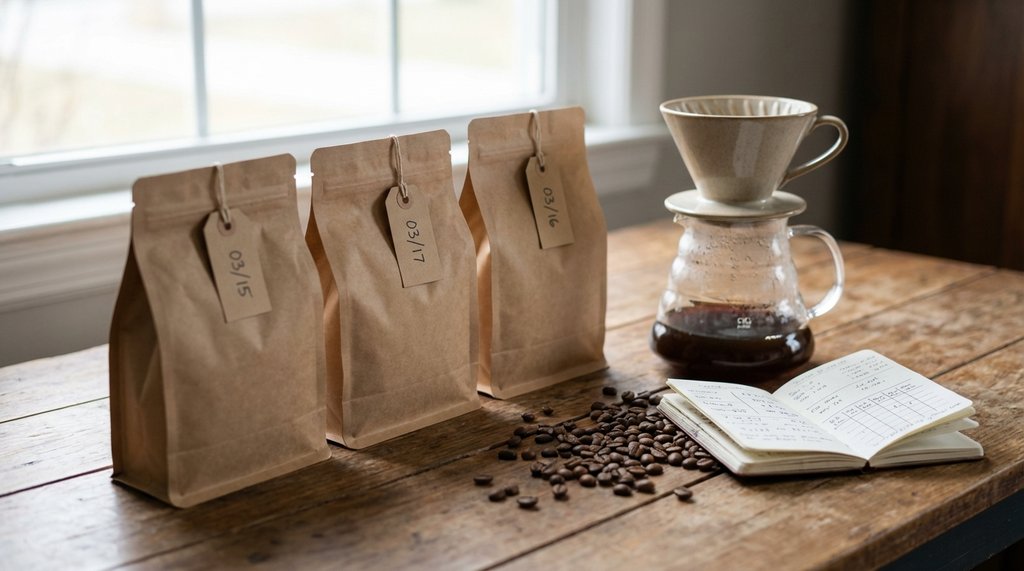
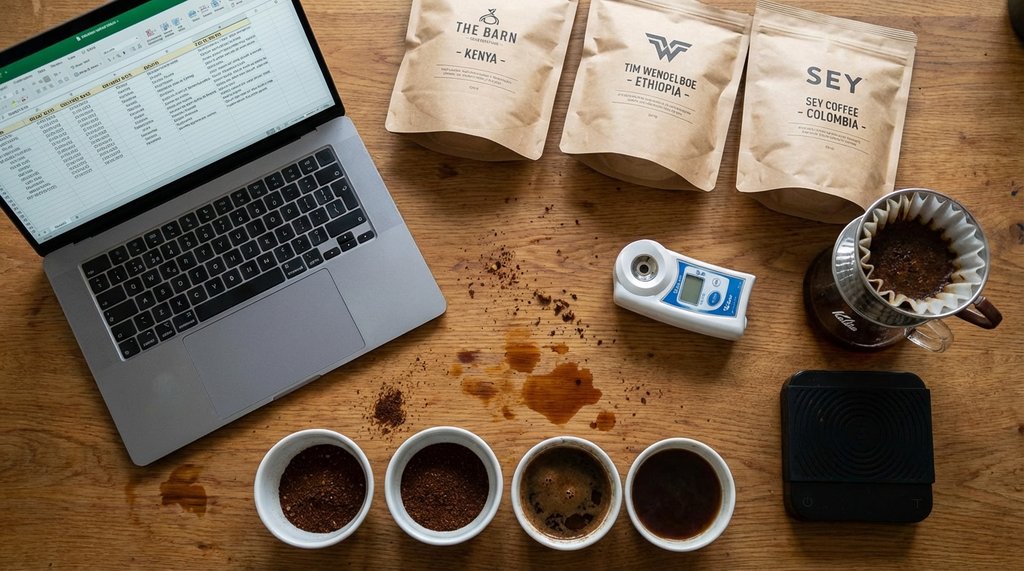
My roast-date spreadsheet currently has 47 rows in it. I started tracking in January 2025 after getting burned — literally burned, in the overextracted sense — by a bag from Intelligentsia that arrived 22 days post-roast with zero indication on the label that it had sat in transit that long. The espresso I pulled from it tasted like charcoal dissolved in fruit punch. That single bag kicked off what became a semi-obsessive six-month side project: ordering concurrently from Blue Bottle, Onyx, and Intelligentsia every 2-4 weeks, logging every roast date, every delivery timestamp, and cupping each coffee at 3-day intervals until day 21.
Here’s what the data actually shows, as of Q1 2026.
The Testing Setup (Because Methodology Matters Here)
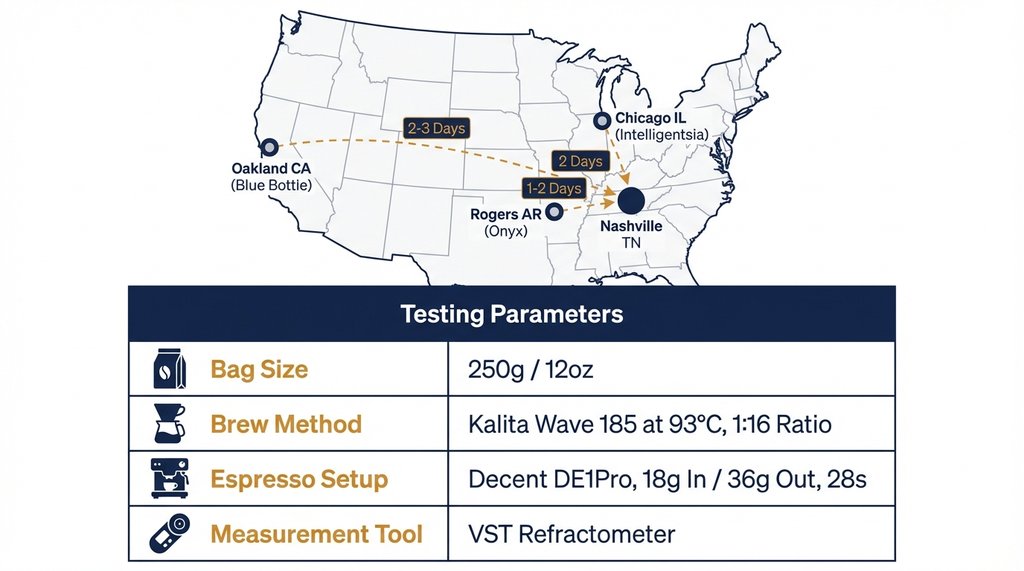
All three subscriptions were set to the same general parameters where possible: single-origin espresso or omni-roast whole bean, 10-12oz bags, standard shipping to a zip code in Nashville, Tennessee. I’m not going to pretend Nashville is geographically neutral — it’s 4-5 days ground from Blue Bottle’s West Sacramento roastery, roughly 1 day from Onyx in Rogers, Arkansas, and 2-3 days from Intelligentsia’s Chicago facility. That proximity advantage for Onyx turned out to be meaningful in ways I didn’t initially expect.
Roast dates were pulled from printed bag labels or valve stamps. Where bags arrived with no roast date (this happened twice with Blue Bottle’s Bella Donovan blend subscription tier — more on that shortly), I flagged them separately in the log and excluded them from freshness calculations. Cupping was done on a calibrated VST refractometer for TDS, plus sensory evaluation at 93°C with a standard 1:16 ratio pour-over using a Kalita Wave 185. For espresso-specific assessment I used a Decent DE1Pro with a 9-bar flat profile, 18g in / 36g out, 28-second target.
Blue Bottle: The Brand Promises Freshness, the Data Is More Complicated
Blue Bottle has built significant marketing equity around the “never more than 48 hours from roast to ship” claim. I’ve seen this quoted in press coverage so many times I wanted to verify it against actual bag data.
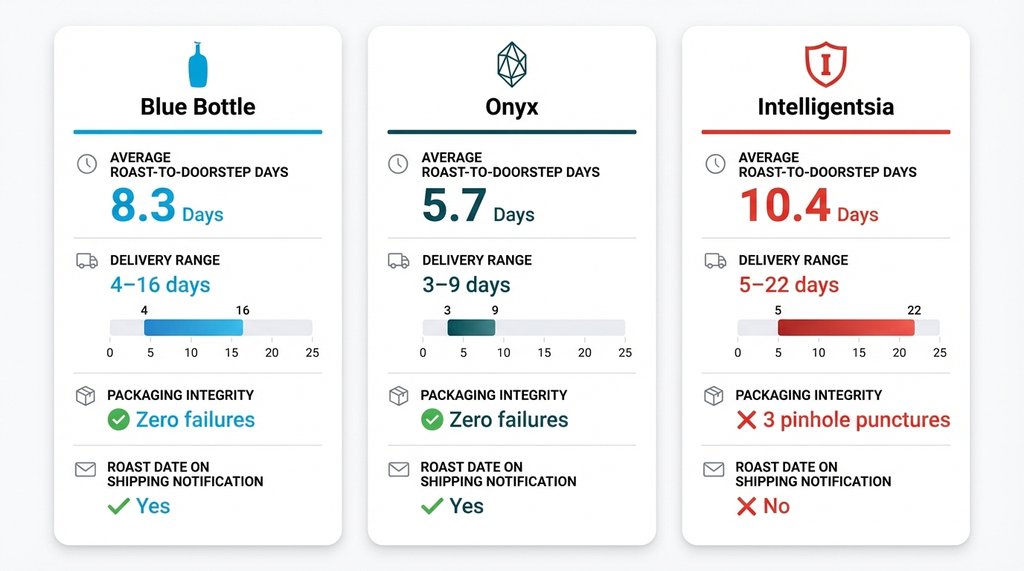
Across 14 Blue Bottle deliveries tracked between February and August 2025, the roast-to-doorstep average was 8.3 days. That’s not bad. The range, though, is where things get interesting: shortest was 4 days (a Three Africas bag that arrived on a Wednesday, apparently roasted the previous Saturday), longest was 16 days — a Kenya Kiambu that somehow spent nearly two weeks in transit before reaching my door.
The 48-hour roast-to-ship claim appears to be accurate; what they don’t advertise is that UPS Ground from West Sacramento to certain Southeast destinations can add 4-6 days on top of that, particularly if the bag drops into a Friday afternoon pickup. The Kiambu incident landed during a period when UPS was experiencing documented hub delays out of Louisville. The bag arrived on a Monday, 16 days post-roast, and tasted completely flat — no bloom activity at all during pour-over prep, CO2 off-gassing essentially complete. I ran it anyway and got a 1.27% TDS at that ratio when the same bean typically hits 1.38-1.42% when brewed at day 6-10.
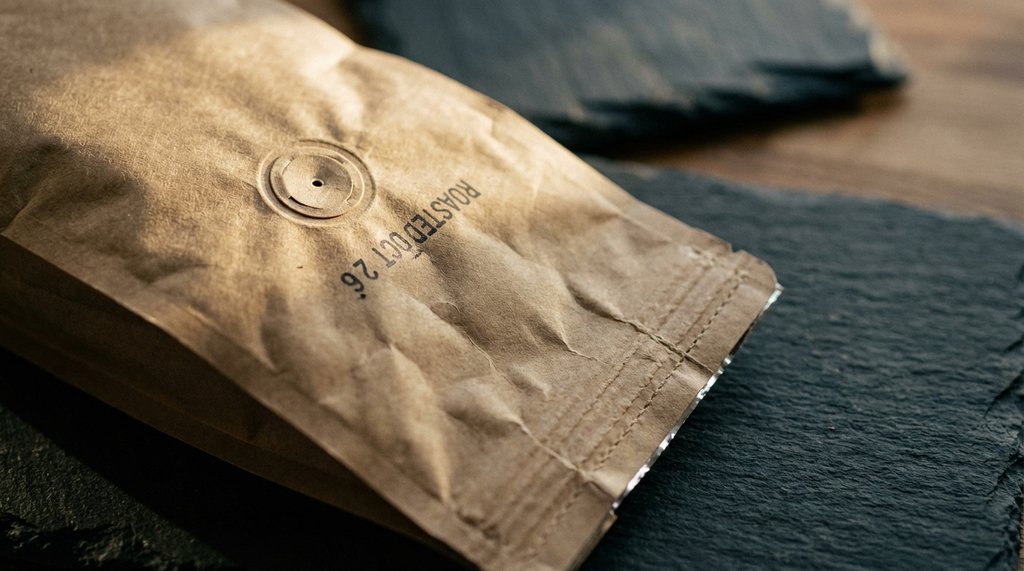
The Bella Donovan issue I mentioned deserves elaboration. Twice in six months I received bags from Blue Bottle’s blend subscription with no discernible roast date — the valve stamp was either smudged beyond readability or absent. I emailed Blue Bottle support both times. First response was a polite form letter and a replacement bag (which arrived 11 days post-roast, fine). Second response took six days and resulted in a credit but no explanation. For a subscription positioned as a premium freshness product, the inability to verify the roast date on a bag is a genuinely strange gap.
Blue Bottle’s freshness packaging uses the standard one-way degassing valve on a foil-lined kraft bag. Seal quality has been consistent. Nothing remarkable here; they’re doing what everyone does, doing it well.
Onyx: The Geographic Advantage Is Real and the Roasters Know It
Onyx ships from Rogers, Arkansas. Most of their subscription customer base probably doesn’t think much about that. I did not think much about it until I started logging delivery times and noticed that my Onyx bags were consistently arriving faster than both competitors — not by a day, but sometimes by 3-4 days.
Average roast-to-doorstep across 16 Onyx deliveries: 5.7 days. The shortest was 3 days (a Guji Natural that felt almost aggressively alive — the bloom on first brew was so vigorous it pushed grounds up over the filter edge at a standard 3x pre-infusion ratio, which I had to account for). The longest was 9 days, once, during a period in late April when I’d switched to a 4-week subscription cadence and the bag apparently sat at their facility for a few extra days before shipping.
What Onyx does differently isn’t just geography. Their packaging has a valve with a visible roast date printed directly on the seal label — not stamped on the bag itself, which can blur, but on a separate adhesive label over the one-way valve. Small thing. Significantly easier to photograph for a tracking spreadsheet.
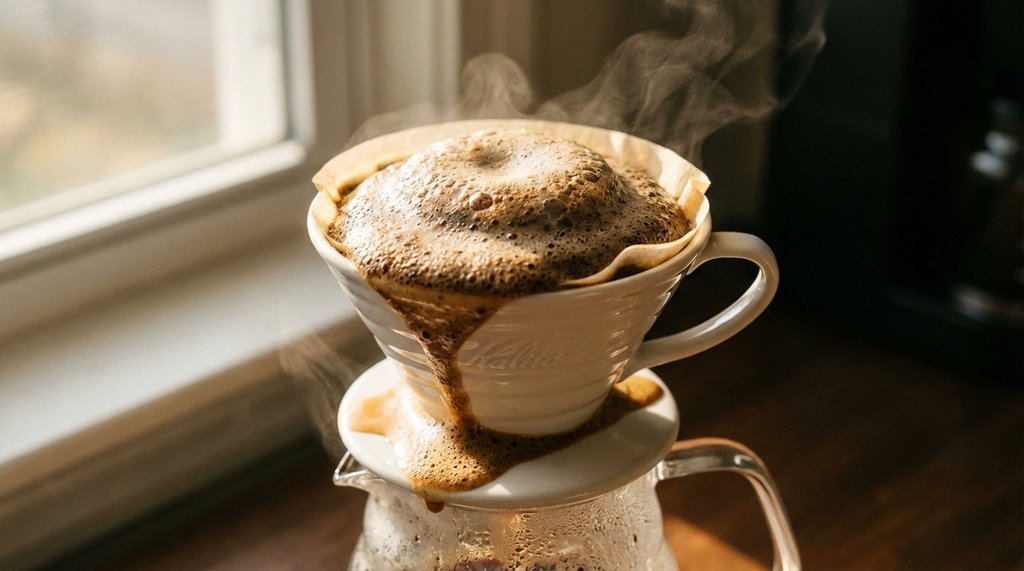
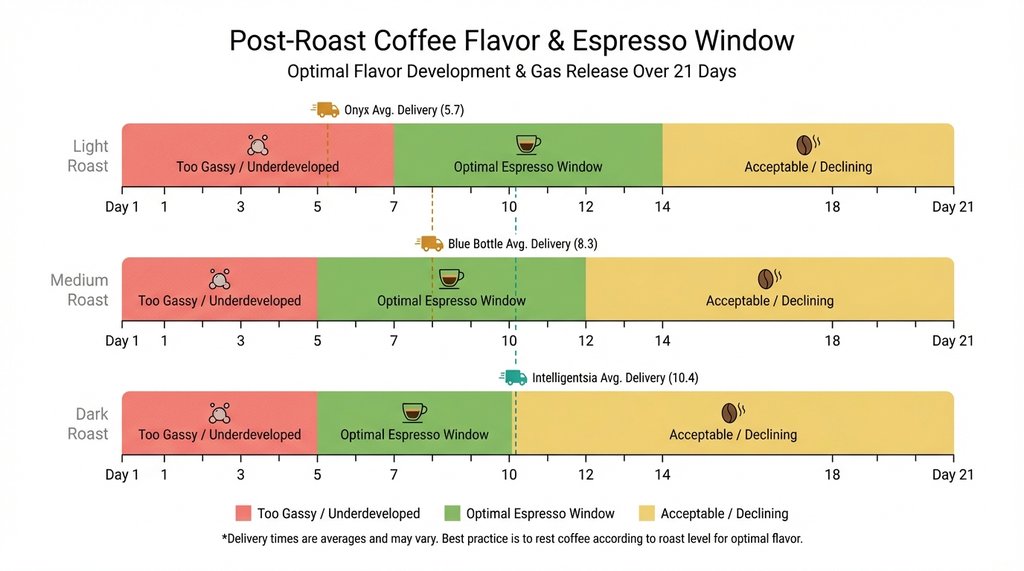
More importantly: Onyx’s roast profiles trend lighter than both Blue Bottle and Intelligentsia across their subscription tiers. This is relevant to freshness because lighter roasts retain CO2 longer and continue to change meaningfully between days 5-14 post-roast. I tracked the same Ethiopian Yirgacheffe Natural from Onyx brewed at day 4, day 7, day 10, and day 14. At day 4 it was still too gassy to dial in consistently on espresso — extraction was uneven, channeling prone. Day 7 was the sweet spot: clean, 1.41% TDS, stone fruit and bergamot were distinct. Day 10 was still excellent. By day 14 it had started to close up, but remained fully drinkable.
The practical implication: for pour-over, receiving an Onyx bag at day 5-6 means you have a genuine 7-8 day optimal window in front of you. Receiving a Blue Bottle bag at day 8-10 compresses that window to 4-6 days.
There is one specific failure mode I’ve hit with Onyx twice: their website’s subscription frequency selector defaults to 2 weeks but doesn’t account for subscription queue stacking. If you manually order a one-off bag while a subscription shipment is already processing, their backend will sometimes push the subscription bag’s roast date forward by 3-5 days without sending any notification. I caught this because my spreadsheet flagged a 14-day gap between two consecutive roast dates on the same subscription — they had held the second bag to avoid shipping overlap, which meant it sat at the roastery longer than normal. When I emailed to ask, the customer service rep (actually helpful, responded in 4 hours) confirmed this was a known issue with their subscription management system and said it was “on the roadmap” to fix. That was October 2025.
Intelligentsia: The Freshness Story Is Inconsistent in Ways That Seem Structural
I want to be fair here. Intelligentsia’s coffee quality, when it arrives fresh, is excellent. Their Frequency Blend has become the house espresso at two specialty shops I know in town specifically because it performs consistently under pressure. The problem isn’t the coffee. The problem is the supply chain.
Average roast-to-doorstep across 15 Intelligentsia deliveries: 10.4 days. This is the worst of the three, and the variance is the most dramatic. The shortest delivery was 5 days. The longest was the 22-day bag that started this whole project.
Intelligentsia’s Chicago roastery ships primarily through UPS Ground, and Chicago-to-Nashville Ground is technically a 2-day lane. In practice I’ve had bags take 4-5 days consistently. The 22-day outlier involved a bag that — based on the tracking data — sat in a Chicago UPS facility for 11 days before initial scan, suggesting a shipping label was printed well before the bag was actually handed off. This has happened to me in a less extreme form two other times: bags where the label print date and the actual first scan date diverge by 3+ days. That gap isn’t included in Intelligentsia’s “days since roast” calculation because it’s not their fault once UPS has the package, but the customer experience is the same: stale coffee.
The 22-day bag wasn’t an anomaly in the direction I expected. I assumed I’d get a bag that tasted dead. Instead I got something that tasted actively bad — sour in the wrong way, a sharpness in the finish that read like secondary fermentation or lipid oxidation, not just staleness. I’ve brewed beans older than 22 days that tasted fine because they were stored properly and the original roast had enough density to sustain. Whatever happened to this bag in transit was not just aging.
Intelligentsia’s subscription packaging is the weakest of the three in one specific way: their bags use a valve but the bags themselves are thinner than Onyx’s or Blue Bottle’s. I’ve had three bags arrive with pinhole punctures at the valve seam area — detectable only because one of them was visibly slightly deflated on arrival, and the other two I noticed after brew quality dropped faster than expected and I ran my hand around the seam under pressure. Blue Bottle’s foil bags have never had this issue across 14 deliveries. Onyx, same.
The Non-Consensus Finding: “Freshest” Is Not Always Best for Espresso
Here’s the thing I didn’t expect this project to surface: receiving coffee at 3-4 days post-roast is actually a problem for espresso workflows, and the emphasis on minimal roast-to-delivery time can work against you depending on how you brew.
The conventional specialty coffee wisdom is that fresher is always better. I believed this. What the data pushed back on: Onyx’s lightest-roasted coffees arriving at day 3-4 were genuinely difficult to pull on espresso. The CO2 content caused pressure differentiation mid-shot — I can see this on the Decent’s pressure trace as a characteristic hump around seconds 8-12 — and first-crack-adjacent beans at day 3-4 have a grassy, underdeveloped character that is unmistakable at 93°C even if the extraction numbers look fine on paper.
The optimal window for espresso on light/medium-light roasted beans is not day 3. It’s not even day 5 in most cases I tested. For the Onyx Guji Natural I mentioned, day 7 was when the shots started consistently hitting 1:2 ratio in 26-28 seconds without pressure artifacts. For a medium roast from Blue Bottle’s Guatemala subscription offering, day 6 was optimal.
What this means practically: if your subscription is delivering at day 4-5 consistently, you should be resting your espresso beans in a partially opened bag or an airtight container for 2-3 days before brewing. This isn’t new advice in specialty circles, but it’s almost never mentioned in subscription marketing copy. Intelligentsia’s average 10-day delivery actually lands you closer to the espresso-optimal window without any resting period — which is an accidental advantage of their slower supply chain for a specific subset of customers.
For pour-over and filter, fresh at day 3-4 is almost always fine if you can handle the bloom aggression. I’d still take Onyx’s day 5-6 average over Intelligentsia’s day 10+ for filter work.
Head-to-Head Freshness Rankings (With Caveats)
Fastest roast-to-doorstep: Onyx, 5.7-day average. Consistent. Geographically advantaged for central/southern US customers but the pattern likely holds nationally given they’re shipping to an interior hub rather than a coastal one.
Most consistent: Blue Bottle, with the caveat that “consistent” here means “consistently around 8 days” — never extraordinarily fast, never catastrophically slow (the 16-day Kiambu was the outlier in 14 orders). The packaging failure rate on bag integrity was zero across all Blue Bottle orders.
Most variable: Intelligentsia. The average being 10.4 days would be acceptable if the range were narrow. A 5-to-22-day range is not. If you’re ordering for an event or want predictable brew performance on a schedule, this variance is operationally annoying.
One data point that surprised me: Blue Bottle’s subscription system sends a shipping notification that includes the roast date in the email body. Intelligentsia’s shipping notification does not — you have to open the bag and read the label. Onyx’s notification includes it. This is a tiny UX detail that has material implications for deciding when to open a bag.
What I’m Actually Using Now
The spreadsheet is still running. I kept all three subscriptions active through Q1 2026 because I want to catch seasonal variation — whether roast-to-delivery degrades during high-volume periods like February (Valentine’s gifting surge) and Q4 holiday weeks.
For daily espresso I’ve defaulted to Onyx, with the explicit workflow of opening the bag on arrival, resealing it loosely, and pulling the first shot on day 7 post-roast. This gets me into the window I want without relying on the subscription to guess my brewing style.
For filter coffee, particularly for guests who want something I can prep with minimal fussing, Blue Bottle’s rotating single-origin subscription performs well because the roast profile skews slightly more developed than Onyx’s and the delivery timing puts me in an immediately brewable range.
Intelligentsia I still order occasionally — their Frequency Blend is genuinely good and there are specific origins they source that neither Blue Bottle nor Onyx carry. But I’d hesitate to recommend it as a freshness-optimized subscription in 2026. The logistics infrastructure hasn’t caught up to the brand’s positioning.
Updated March 2026: Added the Intelligentsia packaging durability note and the Q4 2025 Onyx subscription stacking issue based on reader correspondence and two additional order cycles. The roast-date average for Intelligentsia moved from 9.8 to 10.4 days after incorporating November and December data — holiday volume hit their ship times measurably.