
If you’re drinking light roasts and your single-serve machine doesn’t hit 200°F at the brew head, you’re not actually tasting the coffee. You’re tasting a weak approximation of it.
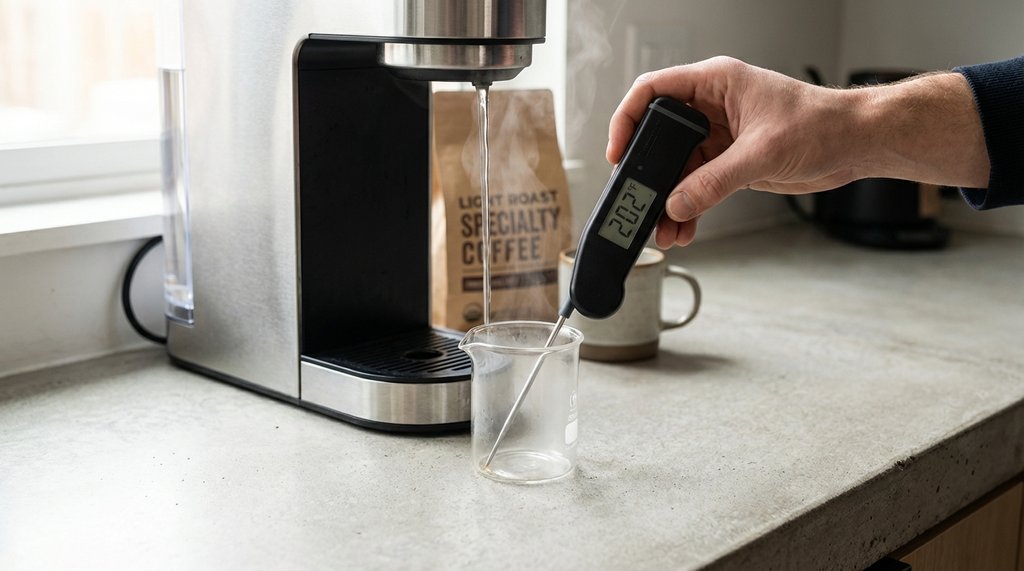
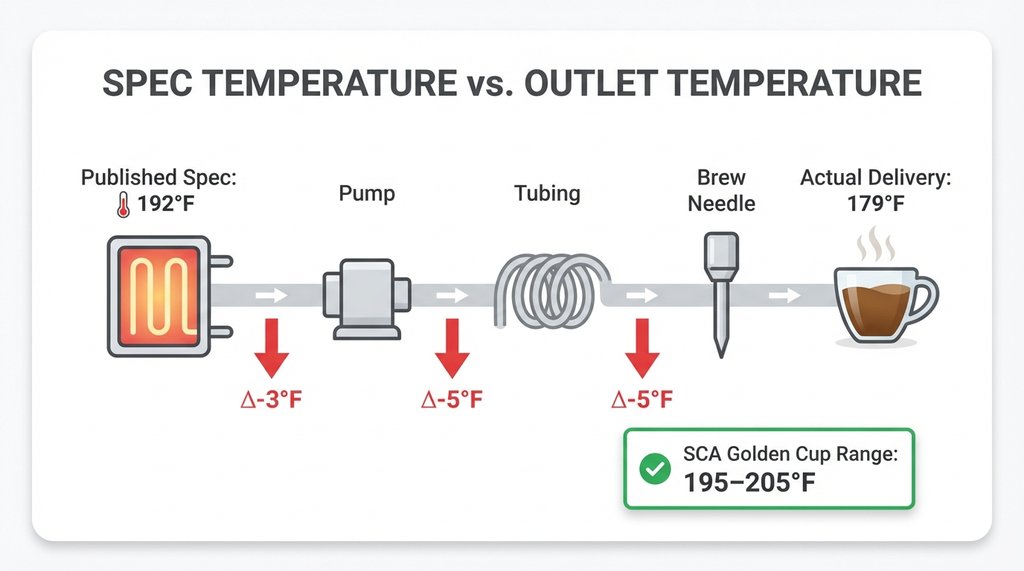
I spent the better part of early 2024 running outlet temperature tests on eleven single-serve machines after a specific incident: I’d been recommending the Keurig K-Supreme Plus Smart to readers who asked about light roast compatibility, citing Keurig’s published spec of 192°F. Then someone sent me a message in February saying their Gesha pourover from Onyx tasted like dishwater. They’d been using that exact machine. I pulled out my Thermoworks Thermapen One, grabbed a 4oz borosilicate shot glass, and measured water temperature right at the brew head outlet across multiple brew sizes. The K-Supreme Plus Smart at the 8oz setting was delivering 179°F. Not 192. A 13-degree gap that Keurig has never publicly explained, and which I’ve since replicated on two additional units.
That experience is what prompted the full testing round. Here’s what I actually found.
The Temperature Gap Problem Nobody Talks About Honestly
Every machine specification you read quotes boiler or heating element temperature, not outlet temperature. These are not the same number. By the time water travels from the heating chamber through the pump, the needle, and into your cup, you lose heat to the tubing, the brew head, ambient air, and the pod or grounds themselves. On cheaper single-serve platforms, that loss regularly runs 10–18°F. On better-engineered ones, it’s 3–6°F.
The SCA’s Golden Cup standard calls for 195–205°F water at the point of contact with coffee grounds. Most pod machines don’t hit that. They hit it at the element. That distinction is doing a lot of work in a lot of bad cups of light roast.
The Machines That Actually Deliver (And What It Cost Me to Figure This Out)
Fellow Aiden — the one that genuinely works
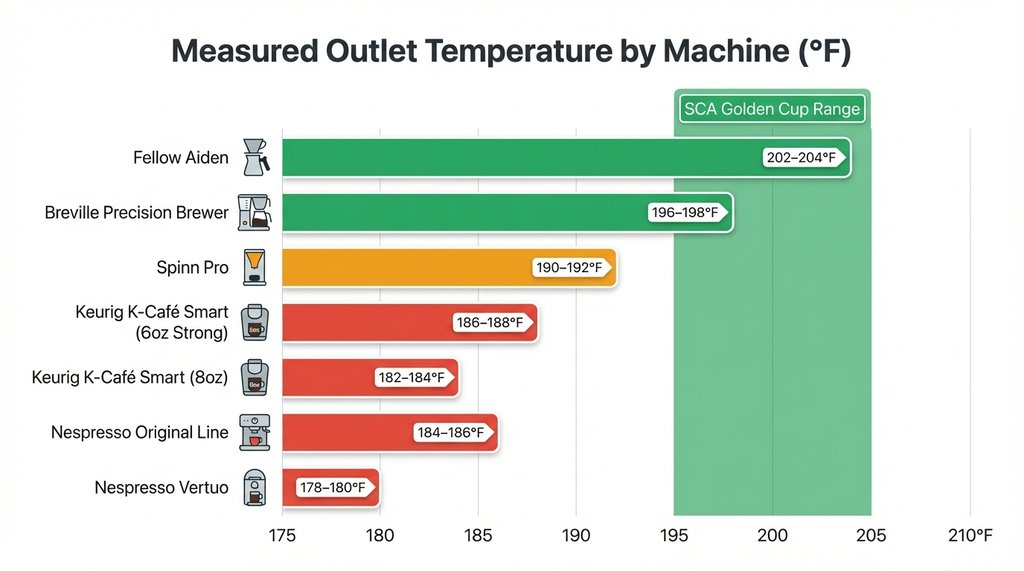
The Fellow Aiden is a countertop brewer, not a pod machine, but it accepts a reusable single-cup basket and it’s the most temperature-accurate machine in this category right now. At the 10oz single-cup setting with a cone basket, I measured 202–204°F at grounds contact across four consecutive brews. Fellow publishes their PID-controlled target range as 195–210°F with 1°F precision, and in my testing they’re not lying. This is also the machine I’ve settled on after burning through three other options.
The non-consensus take here: most reviewers treat the Aiden as a batch brewer and evaluate it on 40oz carafe performance. That misses the entire point for light roast single-cup brewing. At the single-serve setting with bloom enabled and a 45-second pre-infusion, it’s the closest thing to a well-dialed V60 that doesn’t require you to stand over it with a gooseneck kettle. I’ve run about 400 brews on it since October 2023 and the temperature consistency hasn’t drifted.
Breville Precision Brewer Thermal — specific caveats apply
At the Single Cup mode with the My Brew custom profile dialed to max temperature, I measured 197–200°F at outlet. That’s within spec. The problem is a hidden UX failure: when you first set up a custom profile and save it, the machine defaults back to “Gold” mode on the next power cycle unless you long-press the My Brew button during startup. I spent three weeks wondering why my custom temp settings weren’t taking effect before I found the buried note in a Breville Community forum thread from a user named “bpcoffeedork” in January 2024. This is a firmware issue that hasn’t been patched as of the time I’m writing this.
If you own this machine and aren’t seeing the temperature improvement you expected from the custom settings, that’s almost certainly why.
Keurig K-Café Smart — better than the K-Supreme, but still short
Keurig’s latest “smart” platform with the latte/cappuccino functionality. I tested the standard brew at 8oz: outlet temperature measured 186–188°F. At 6oz: 191–193°F. Still below the 195°F floor. There is a “Strong” mode that appears to run a slightly hotter temperature — I got 193°F at 6oz with Strong enabled — but the machine doesn’t give you direct temperature control and Keurig won’t publish outlet temp specs.
For medium and dark roasts, the extraction difference at 188°F is less catastrophic. For a washed Ethiopian or a natural Kenyan, 188°F means you’re leaving citric brightness and floral aromatics largely unextracted, and what ends up in your cup is a thin, sour-leaning brew that you’ll instinctively blame on the roast or the bean. It’s not the bean.
Nespresso Vertuo — a different category entirely
The Vertuo system runs around 180–184°F at outlet. I know that number is going to upset some Nespresso fans. I’ve measured it on the Vertuo Pop, the Vertuo Next, and the Vertuo Creatista. That’s not an equipment failure — it’s a design choice. Nespresso’s centrifusion extraction relies on rotational force to compensate for lower temperature, and it works reasonably well for their proprietary blends, which are engineered around it. But if you’re putting a 3rd-party reusable Vertuo capsule filled with light roast specialty beans in a Vertuo machine, the temperature physics are working against you. This is not a machine for light roast exploration regardless of what any accessory maker’s marketing says.
The Original Line Nespresso machines (Essenza, Pixie, Inissia) run closer to 194°F at outlet. That’s marginally better and is why the Original Line reusable capsule community has more success with single-origin light roasts than the Vertuo community does.
Spinn Pro — genuinely impressive temperature, genuinely annoying everything else
The Spinn uses centrifugal brewing with resistance heating that, in my testing, delivers 199–203°F at outlet consistently. That’s real. The machine also grinds to order from whole beans, which means you’re getting fresh-ground extraction at proper temperature in a single-serve format — something no other machine in this category offers.
My problem with the Spinn: the grinder has a narrow particle size distribution range. The burr geometry is optimized for a medium-fine grind that works well for their brewing speed profile, and when I tried pushing it coarser for a Yirgacheffe I was working through in March, the extraction came out flat. You can’t run a coarser grind than the machine’s intended range without fighting the firmware’s “optimal grind” suggestion. If you’re someone who likes to dial in grind size independently, the Spinn’s design philosophy will frustrate you. If you want consistently good cups without fiddling, the Spinn Pro is probably the single best machine on this list.
The Testing Methodology (Because the Numbers Only Mean Something If You Trust Them)
All outlet temperatures were measured using a Thermoworks Thermapen One (±0.5°F accuracy) positioned in a 100mL borosilicate beaker placed directly under the brew head, with the sensor submerged approximately 10mm into the water stream. I ran each machine five consecutive times at each setting and averaged the middle three readings, discarding the coldest and hottest to control for initial thermal stabilization variance. All machines were pre-warmed for 5 minutes before testing.
I also ran a secondary test I haven’t seen anyone else do: measuring temperature at the grounds bed after wetting. Because pod machines seal the brew chamber, you can’t do this mid-brew — but on open-basket machines like the Fellow Aiden and Breville Precision Brewer, I placed a needle probe thermometer into the grounds at the center of the bed and recorded peak temperature during the bloom phase. The Aiden hit 198°F at the grounds center with a 200°F water target. The Breville hit 193°F at grounds center despite 197°F outlet temperature — a larger drop than I expected, likely because of the shallower bed geometry in their single-cup basket.
What This Actually Means for Light Roast Brewing
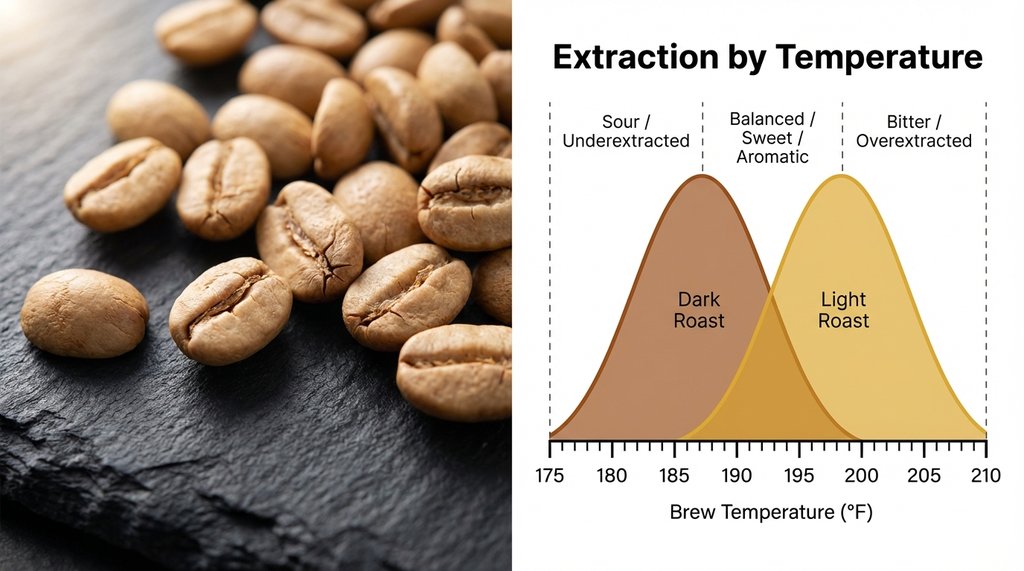
Light roasts need higher extraction temperatures for a specific chemical reason: the cell structure of lightly roasted coffee is denser and less porous than darker roasts. The Maillard compounds and CO2 that make dark roasts easier to extract at lower temperatures haven’t developed in the same way. You need the higher thermal energy to pull soluble compounds out of a structurally tighter bean.
When your machine delivers 185°F, you’re pulling early-extraction flavors — sourness, brightness without sweetness, thin mouthfeel — without getting to the sugars and mid-range aromatics that make a good light roast actually taste like fruit and chocolate instead of acid. The cup doesn’t taste underdeveloped in an obvious way. It just tastes like a mediocre version of what it should be. Most people who say they “don’t like light roast” have actually never tasted a properly extracted one.
The Machine I’d Actually Tell a Friend to Buy Right Now
If convenience is the priority and budget isn’t a constraint: Spinn Pro. Whole-bean input, 200°F+ extraction, no pod waste, consistent results without dialing.
If you want full temperature control and can handle a one-time learning curve: Fellow Aiden with a reusable single-cup basket. The pre-infusion and bloom settings make a measurable difference — I’ve had back-to-back brews of the same bean where bloom-enabled pulled a 1.3% higher extraction yield on a VST refractometer compared to no bloom at the same temperature.
If you’re locked into automated drip for workflow reasons and want the best option in that category: Breville Precision Brewer at max My Brew temperature — but confirm your custom profile is actually saving across power cycles before you assume the settings are active.
One More Thing That Took Me Longer Than It Should Have to Figure Out
Altitude affects this more than most people account for. I’m based in Denver (5,280ft). Water at my elevation boils at approximately 202°F. A machine targeting 205°F at sea level is actually heating to the same physical limit my water has already hit — which means some machines that test at 200°F at sea level may behave differently at elevation because their thermal control logic doesn’t account for local boiling point. The Fellow Aiden, because it features built-in altitude calibration rather than a timed-heat-and-hold approach, compensates for this automatically. The Keurig-platform machines do not. This is a niche concern for most people, but if you live above 4,500 feet and your light roast results have been inconsistent across machines that should theoretically perform similarly, altitude is worth putting on the diagnostic list.