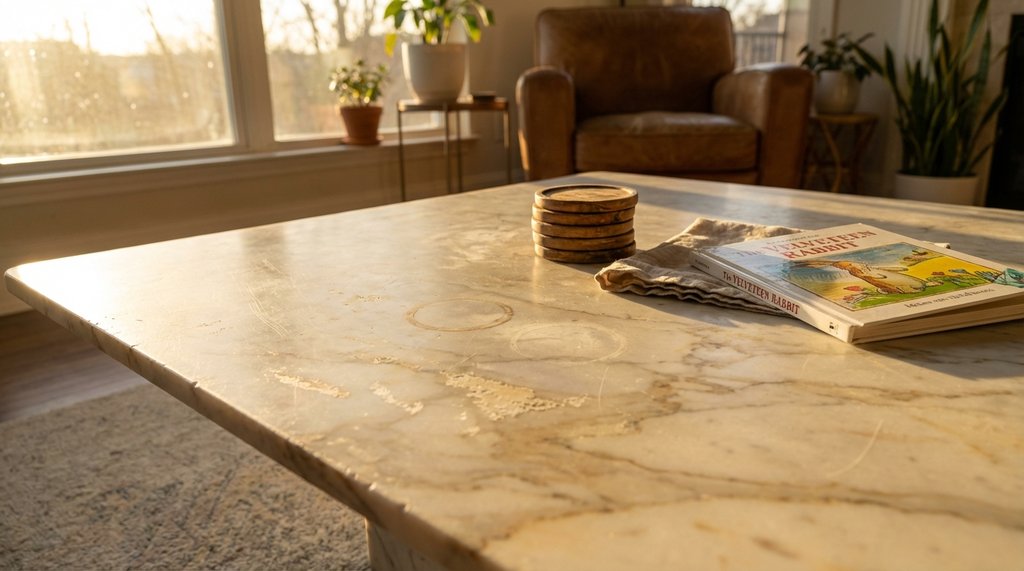
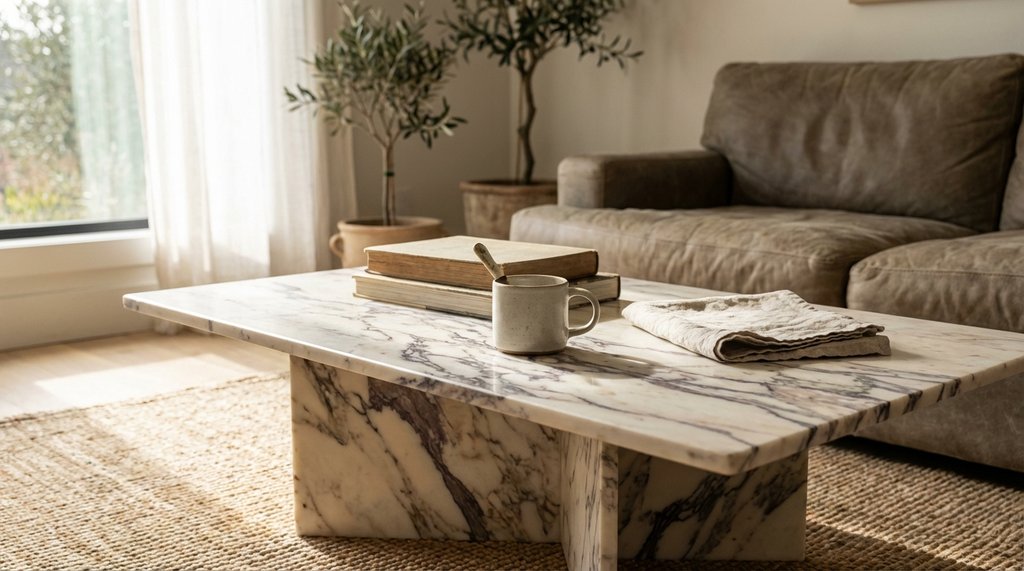
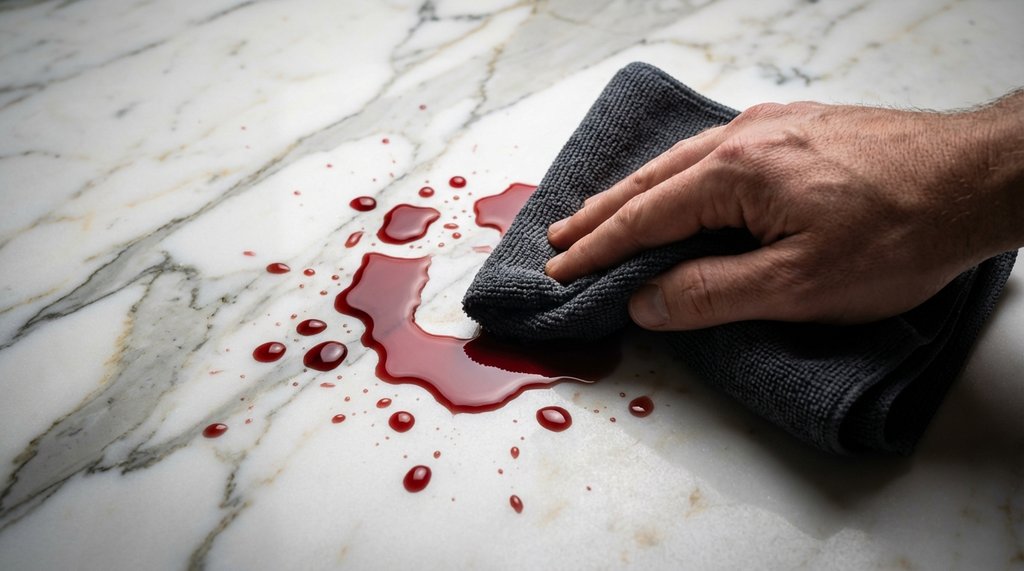
My youngest got a nosebleed directly onto the Calacatta Gold surface on a Tuesday afternoon, and I stood there for about four seconds doing absolutely nothing useful before muscle memory kicked in. That’s the moment I realized our care routine had actually started working — not because the marble came out perfect, but because I knew exactly what to do and in what order, and the stain didn’t set.
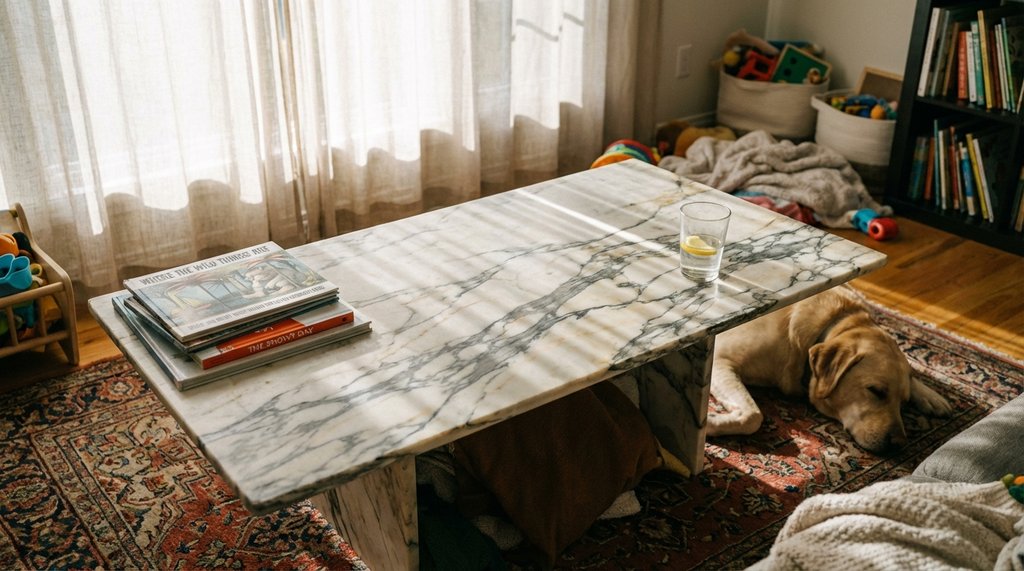
Getting there took about eighteen months of trial, error, and one genuinely ugly etching scar that’s still visible in certain light from the left side of the table. So here’s what the routine actually looks like when you have a five-year-old, a seven-year-old, and a Labrador who thinks the coffee table is a snack station.
The Sealer Situation Is More Complicated Than Anyone Tells You
Almost every article about marble care will tell you to seal it. That’s not wrong, but the advice stops right there, and that’s where most people run into problems.
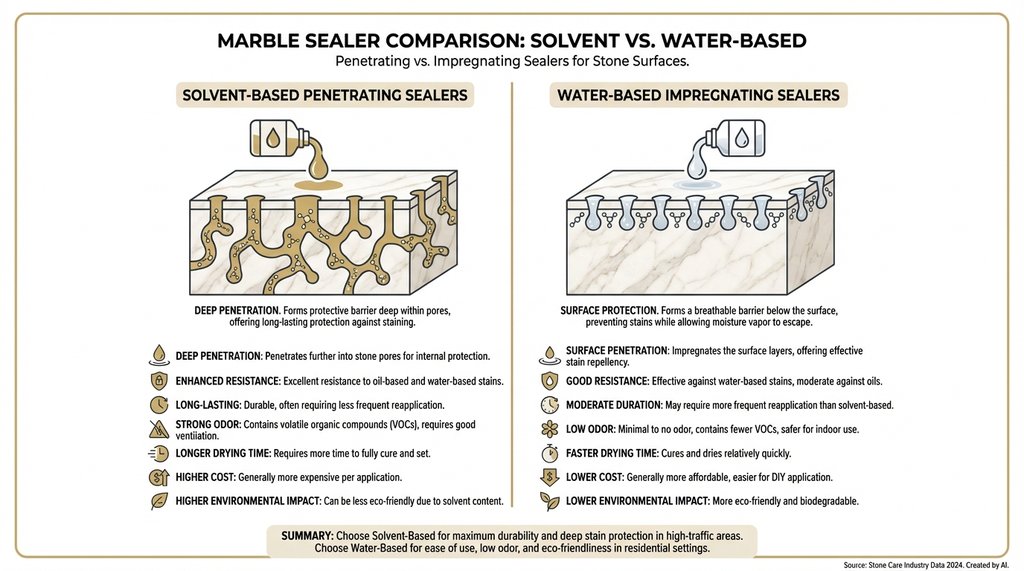
The sealer I used for the first year was a solvent-based penetrating sealer from a well-known stone care brand — I’m not going to name it specifically because the problem I had might be application-specific, but it was a product sold widely at tile supply stores and rated for food-contact surfaces after cure. I applied it quarterly, the way the instructions said. What I didn’t know is that on Calacatta marble, which has relatively tight grain compared to something like Crema Marfil, a solvent-based sealer applied too heavily will leave a slightly waxy residue that actually traps fine particles. You won’t see it immediately. After about six months, I noticed a grayish cast building up in the center of the table — the high-traffic zone — that wouldn’t respond to normal cleaning. A stone restoration professional told me later it was sealer buildup combined with embedded particulate matter, and removing it required a low-concentration poultice of diatomaceous earth and a neutral enzymatic cleaner left on for 48 hours, followed by a light re-honing with a 400-grit diamond pad.
That repair cost me about $280 in professional time, not counting materials.
After that, I switched to a water-based impregnating sealer with a lower solids content — specifically one formulated for dense, low-porosity stones — and dropped application frequency to twice a year with a much thinner coat. The water bead test (drops sitting high and round on the surface for 60+ seconds before absorbing) has held consistently since the switch.
The non-consensus point here is this: if you have a densely veined, tight-grained white marble and you’re sealing it quarterly with a standard penetrating sealer, you’re likely over-sealing it, and over time that creates more maintenance work than it prevents.
What “Immediate Response” Actually Means When You Have Kids
The standard advice is “blot immediately, don’t rub.” Correct, but wildly incomplete for a household where spills happen while you’re in a different room.
Red wine is genuinely the easiest one to manage if you catch it within three minutes. The surface tension on sealed marble means wine beads slightly before it starts to penetrate, and a dry microfiber cloth blotted from the outside edge inward will pull almost all of it before anything etches. I’ve cleaned probably thirty red wine incidents on this table now — the sealer holds as long as the response is under five minutes.
Orange juice is harder than red wine. The citric acid etches the calcium carbonate in marble before the color even has a chance to stain, and it works fast — faster than most people expect. I had a glass of OJ get knocked over while I was in the kitchen roughly eight feet away, got to it in under two minutes, and there was already a faint etch mark. Not a stain — the color was fine — but the surface texture was dulled in about a four-inch diameter circle. That etch filled in partially with a marble polishing powder over several weeks of buffing, but it never fully disappeared.
The lesson I took from that isn’t “clean up OJ faster.” It’s that acidic liquids need to be treated with a neutralizing step immediately, not just blotted. A mist of a diluted baking soda solution (roughly one teaspoon per cup of water) applied after blotting stops the acid reaction before it can progress further. This is the step nobody puts in the standard advice, and it’s the one that made the actual difference in our routine.
For pet incidents — our dog has knocked over his water bowl onto the table edge twice, and once dragged a half-eaten piece of chicken across the surface — the concern isn’t so much immediate staining as the organic matter that gets into micro-pores and starts producing a slight odor over time. The enzyme-based cleaner is the right call here, and it needs to sit for at least five minutes rather than being wiped off immediately. The enzymes need contact time to break down the proteins. Wiping in thirty seconds, which is what you instinctively want to do, significantly reduces their effectiveness.
The Daily Maintenance Routine
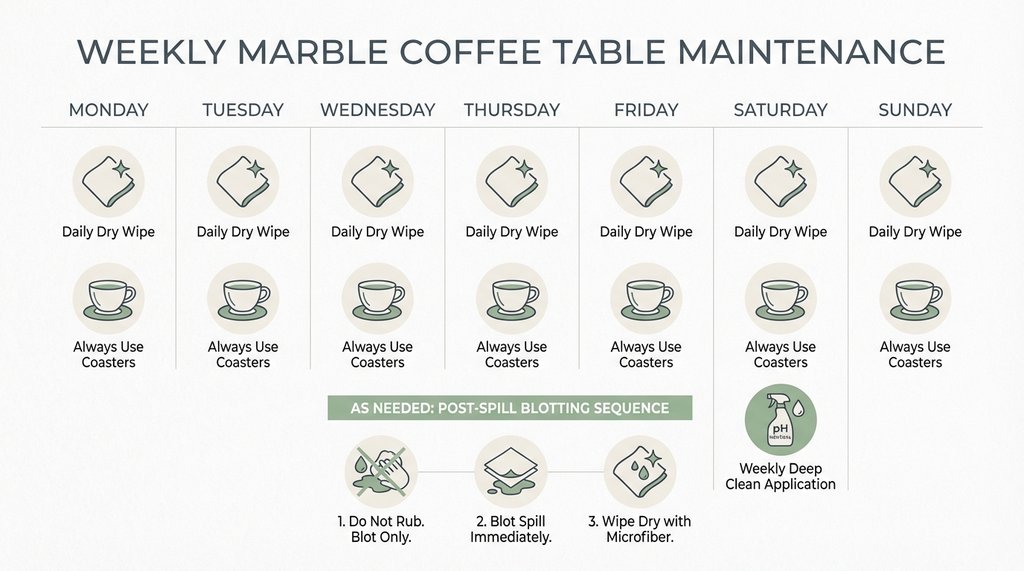
We don’t do anything elaborate on a daily basis, and I think the tendency to over-maintain marble surfaces is real. The routine that’s worked for three years:
Every morning, quick dry wipe with a clean microfiber cloth to pick up any surface dust or pet hair. That’s it. About forty-five seconds.
When the table gets used for snacks, drinks, or crafts — which with two kids is constantly — anything placed on the surface goes on a silicone mat or a coaster. This sounds obvious and I also thought it was obvious before I got the table, and then ignored it about 40% of the time for the first six months because it felt fussy. The etching scar I mentioned at the beginning of this article came from a glass of lemon water sitting directly on the surface for about twenty minutes while homework was being done. Lemon water. Not wine, not juice — just water with a lemon slice that someone had been drinking for an hour.
After any wet spill, the area gets wiped with a microfiber cloth dampened with plain water, then dried immediately with a second dry cloth. No cleaners unless there’s an organic substance involved. Marble does not need to be cleaned with soap on a daily basis, and the film residue from even pH-neutral dish soap builds up visibly over time.
Once a week, a light clean with a stone-specific pH-neutral cleaner, applied sparingly with a barely-damp cloth, buffed dry immediately. The specific product matters less than the pH — anything between 7 and 8.5 is safe. Anything marketed as a “natural cleaner” with citrus or vinegar components will destroy the surface over time regardless of how it’s diluted.
The Craft Supplies Problem
This one took me longer to solve than anything else. Kids at coffee tables means markers, paint, stickers, and Play-Doh. The Play-Doh turned out to be the least problematic — it sits on top of sealed marble without penetrating if you don’t grind it in, and picking it up cleanly with a soft silicone spatula works well.
Markers are the issue. Water-based washable markers, if blotted immediately, are fine. Permanent markers, applied even briefly to sealed marble, are genuinely difficult. Acetone will remove the marker but also strip the sealer completely in that spot, leaving an unprotected zone until the next seal application. I’ve found that rubbing alcohol (70% isopropyl) works better than acetone for permanent marker on sealed marble — it lifts the marker without completely stripping the sealer, though it does lighten the sealant layer somewhat and that area should be spot-resealed once the alcohol has fully evaporated (at least 24 hours).
The actual solution we landed on was a clear, lightweight silicone mat that covers roughly 60% of the table surface during any craft activity. Not a tablecloth — the kids still see the marble, which matters to them because apparently the aesthetic of the table is something they’ve internalized — but a mat sized and positioned to cover the working area. This eliminated the marker incidents entirely because they don’t register the mat as a “surface” the way they did with coasters.

What Happens When the Routine Breaks Down
We had a three-week period in October two years ago when both kids had back-to-back illnesses, the dog had a GI situation, and the table essentially went unattended in any serious way. Multiple unaddressed spills, some dried food, a sticker campaign by my younger one, and general entropy.
When I got back to it, the surface had three new etch marks (two minor, one moderate), a dried berry smoothie ring, and about a dozen sticker residue patches. The total recovery time was roughly four hours spread over two weekends, using a combination of the baking soda paste method for the rings, a plastic razor blade and citrus-free adhesive remover for the sticker residue, and a marble polishing compound for the etch marks.
Everything came back except the moderate etch mark, which is still slightly visible at certain angles. Not from the smoothie — that cleaned up completely. The etch was from something acidic that sat long enough to do real structural damage to the calcite crystals in the surface. My working theory is it was a vitamin C gummy that got stepped on and partially dissolved against the surface, but I have no way to confirm that.
The recovery being mostly successful actually validated the routine in a strange way — even after three weeks of neglect, the underlying sealer had protected the stone enough that the damage was limited and mostly reversible. Before I had a consistent sealing schedule, a single bad spill week would have left permanent damage.
Long-Term Realities
Three years in, the table shows its age in a way that a marble table with no children or pets would not. There are two minor etch marks that never fully polished out. The edges show some wear from toys being put down at angles. Under raking light in the late afternoon, you can see a slightly different patina in the areas that have seen the most cleaning.
I don’t think that’s a failure of the care routine. Marble in active household use develops a patina, and if you’re buying a marble coffee table expecting it to look showroom-perfect after years of real life, you’ve miscalibrated your expectations regardless of what care products you use. The goal of a consistent routine isn’t to prevent all evidence of use — it’s to prevent the deep, irreversible damage (severe etching, permanent organic staining, structural degradation from acid exposure) while letting the surface age in a way that remains beautiful rather than just looking damaged.
The routine I’ve described achieves that. The table looks lived-in, which it is. It does not look wrecked, which it could easily have been by now.