

The first time I watched my cream disappear straight into the coffee — not float, not drift, just sink, in about 0.4 seconds flat — I’d already made three Irish Coffees that night and handed them to guests. Nobody said anything, which was almost worse.
That was during a private dinner service I was doing in late February, maybe a dozen people, and the host had specifically asked for Irish Coffees as the dessert course. I’d made them probably forty times before. I thought I had it. I didn’t.
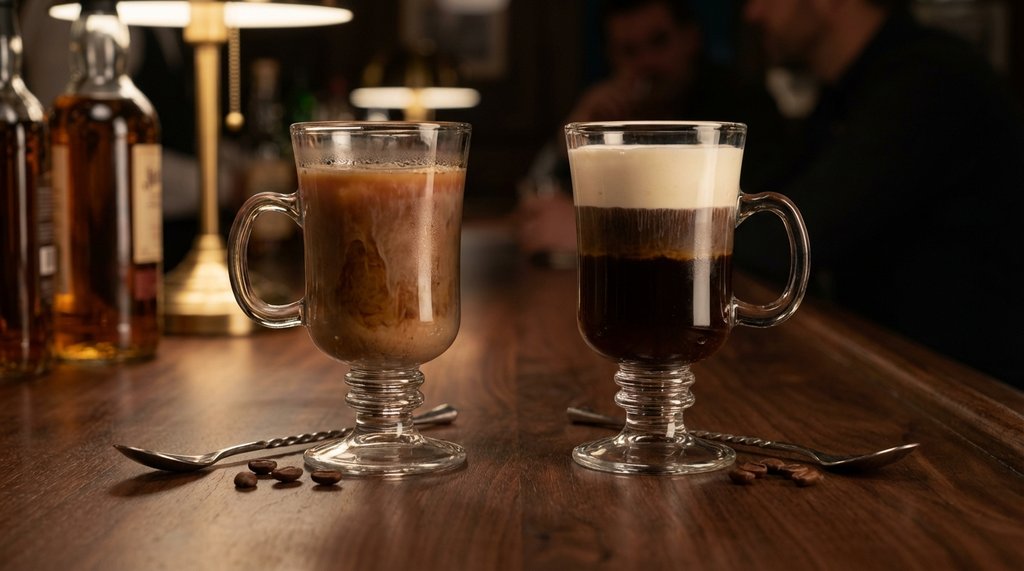
Here’s what’s actually happening when the cream sinks, because most of the explanations floating around online get this partially wrong.
The cream layer works because whipped heavy cream — at the right fat content and aeration level — has a lower density than the sweetened, whiskey-laced coffee underneath it. The spoon technique doesn’t create that float. It just prevents the kinetic energy of pouring from punching the cream through the surface tension of the coffee before density has a chance to do its job. If your cream is already sinking before the physics can catch up, one of three things is wrong:
- Your cream isn’t whipped enough, or it’s whipped too much
- The temperature differential is wrong
- You’re pouring too fast, or from too high, or at the wrong angle — and these three are not the same problem
I spent an embarrassing amount of time fixing #3 when the actual issue was #1.
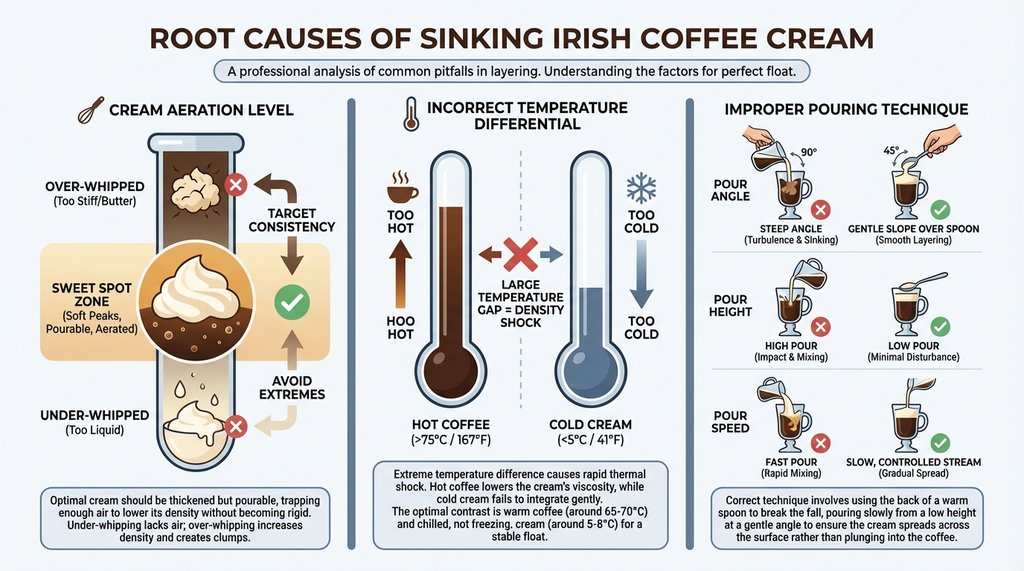
The cream consistency problem nobody talks about precisely enough
Every guide says “softly whipped.” That phrase is doing almost no work. I’ve seen “softly whipped” cream that was basically still liquid and “softly whipped” cream that held firm peaks. Both will sink on you, just for different reasons.
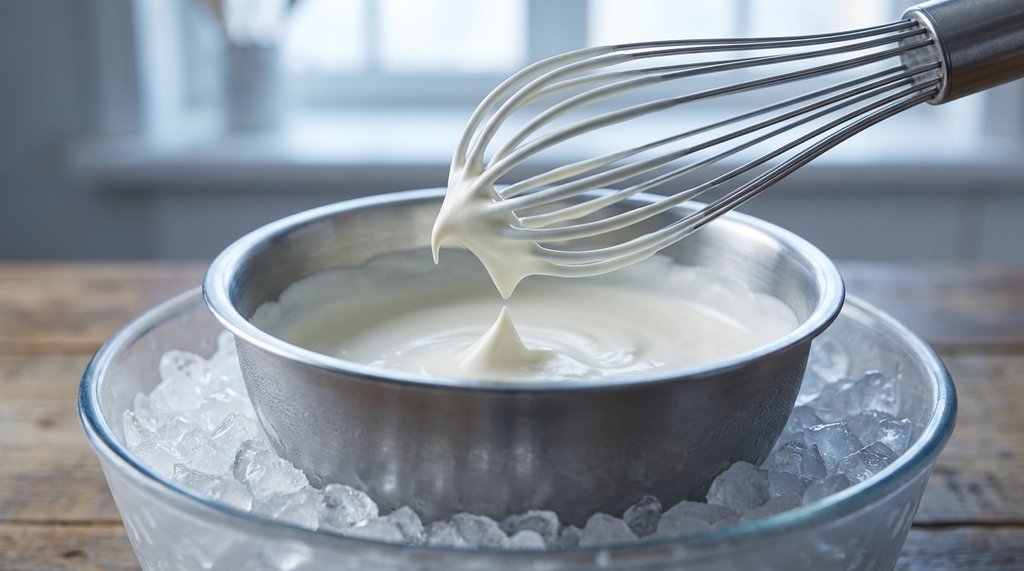
What you’re actually targeting is cream that has increased in volume by about a third, holds its shape for about three seconds when you lift the whisk and then slowly slumps back — not immediately collapses, not holds rigid — and when you tilt the bowl, it moves as a single slow mass rather than flowing like liquid. If I had to give it a number: somewhere between 30% and 40% aeration by visual volume increase, which in practice means stopping the whisk right around the time you see the first soft trails starting to hold shape on the surface.
Over-whipped cream — anything approaching stiff peaks — sits on top of the spoon beautifully, and then hits the hot coffee surface and the heat partially deflates it before it can spread. It goes from a layer to a clump. I tested this specifically one evening by making six glasses in a row with progressively stiffer cream, and the float started deteriorating noticeably at the stage where the cream just barely started to hold a soft peak. The glasses where cream was closer to 35% aeration — still slightly pourable, a little loose — floated cleanly every time.
Use heavy cream with at least 36% milkfat. I’ve tried it with 35% and the margin for error basically disappears. In the US, look for “heavy whipping cream” specifically, not regular whipping cream, and check the label. The 1% difference in fat content sounds irrelevant until you’re mid-service and your fourth float just sank.
Cream temperature: Cold. Straight from the refrigerator. Not room temperature, not “chilled.” The cold temperature slows down the heat transfer that destabilizes the foam. I keep the cream in a metal bowl set over a separate bowl of ice while I’m pouring multiple drinks.
The actual spoon technique, in the specific detail it deserves
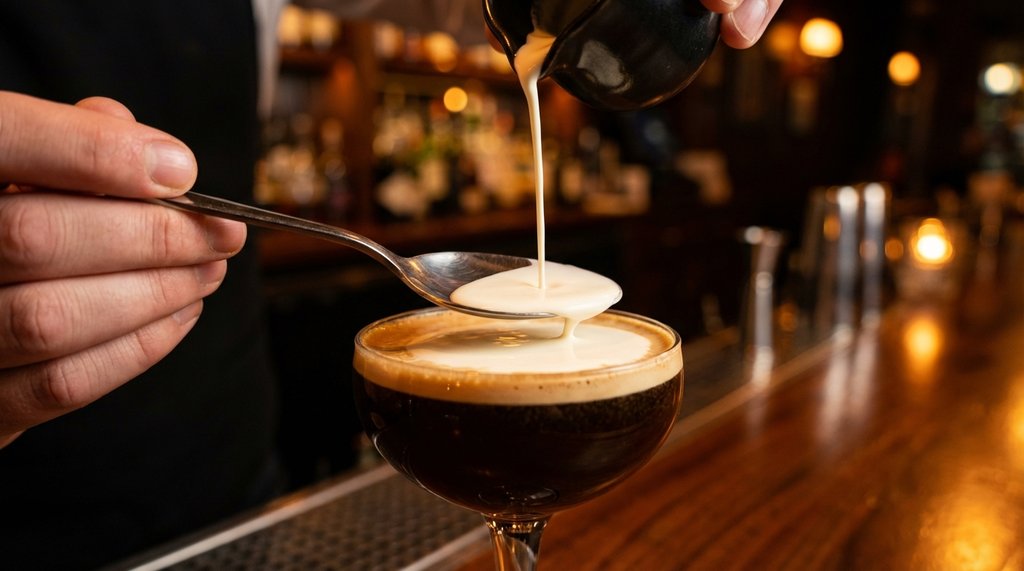
Use a spoon with a wide, shallow bowl — a dessert spoon, not a teaspoon, not a tablespoon. The geometry matters because you want maximum surface area for the cream to spread laterally before it hits the coffee surface.
Hold the spoon so the back faces up, angled at roughly 30 to 40 degrees from horizontal. Not flat, not steep. The leading edge of the spoon — the tip — should be about 3 to 5 millimeters above the surface of the coffee. Not touching. Not an inch above. 3 to 5 millimeters.
What that gap does: the cream lands on the spoon back, spreads across it, and then slides off the trailing edge as a continuous wide thin sheet moving almost horizontally across the coffee surface. The horizontal velocity is minimal. It’s not hitting the coffee from above — it’s joining it from the side, at the same level, which means surface tension can actually catch it.
The pour rate from your cream pitcher into the spoon should be slow and continuous — I aim for roughly 15 to 20 seconds to pour about 45ml of cream over one glass. I know that sounds extremely slow. It is. Speed it up and you’re putting momentum back into the equation that the spoon was supposed to absorb.
The moment I see most people break this technique: they start correctly, but about halfway through the pour they speed up slightly because the float looks like it’s working and they relax. That last bit of cream goes in too fast, punches through, and now there’s a cream island floating on top of a coffee-cream swirl underneath. Close, but not right.
The non-consensus thing about glass temperature
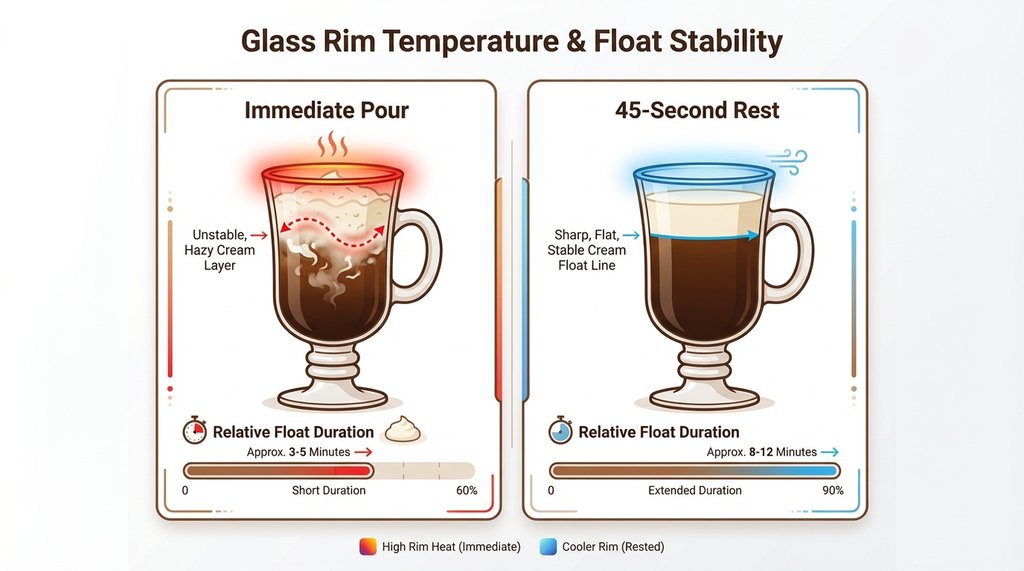
The standard advice is to preheat the glass with hot water before you build the drink. Good advice, no issue there. But I’ve found — and this took me a while to actually verify because the effect is subtle — that the rim temperature specifically matters for the cream float in a way nobody mentions.
If the rim of the glass is very hot when you’re pouring the cream, the cream coming off the spoon near the rim of the glass partially contacts the heated glass wall and starts to warm and thin before it’s settled on the surface. The float is less stable. It doesn’t always sink, but it loses that clean defined layer and goes hazy around the edges faster.
What I do now: I preheat with hot water, but I pour the water out about 45 seconds before I’m ready to pour the cream, and I let the glass sit. The body of the glass retains enough heat to keep the coffee hot. The rim, being thinner glass with more surface area exposed to ambient air, drops to closer to room temperature by the time I’m floating the cream. Tighter float, cleaner edge, stays separated longer.
I tested this side-by-side on the same night — six glasses preheated-then-immediate-pour versus six with the 45-second wait — and the wait glasses consistently held the float layer for at least 40% longer before the cream started migrating downward. That’s not a carefully controlled lab measurement, but the visual difference was clear enough that I haven’t gone back.
What actually happened in February
The cream that sank on me that night was heavy cream I’d whipped too far in advance — probably an hour before service — and kept in the refrigerator. By the time I was pouring, it had over-set in the cold. Still looked good, moved like soft whipped cream, but the structure had tightened past the ideal window. It hit the coffee, the surface heat destabilized the over-set foam structure almost instantly, and down it went.
Now I whip the cream fresh, in small batches, maximum 20 minutes before I’m using it. If I’m doing a large batch for an event, I slightly under-whip it, knowing it’ll continue setting in the cold, and I check the consistency just before service rather than trusting what it looked like when I put it in the refrigerator.
The spoon angle and the pour rate matter. But they’re the last 20% of the problem. If the cream isn’t right, the best spoon technique in the world is just slowing down the inevitable.