
My first attempt at scaling up to a 32 oz French press went sideways because I kept using the “1 tablespoon per 6 oz” rule from drip coffee guides. The brew came out thin enough that I could see the bottom of the mug through it. Not weak — thin. There’s a difference, and it took me a while to figure out why.
The short answer: for a fully loaded 32 oz French press, you need 10 to 11 rounded tablespoons of coarsely ground coffee, using roughly 900 ml of water (not the full 946 ml that 32 oz technically measures out to — more on that gap in a second).
The longer answer involves why the tablespoon method is actually unreliable in a specific way that most guides refuse to admit.
The actual math behind 32 oz
The standard French press ratio is 1:15 by weight — 1 gram of coffee for every 15 grams of water. Water weighs 1g per ml, so 900 ml of water calls for exactly 60 grams of coffee.
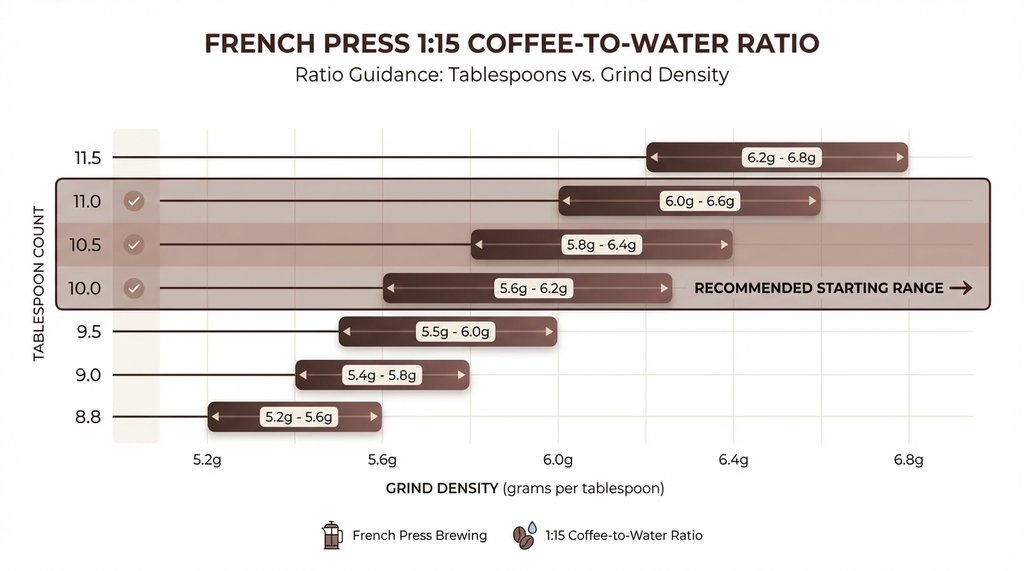
Here’s where the no-scale problem bites: a tablespoon of coarsely ground coffee weighs somewhere between 5 and 7 grams depending on how coarse the grind is and how packed the tablespoon gets. That’s a 40% swing in dose from one extreme to the other. A level tablespoon of a coarse grind from a burr grinder on its coarsest setting might be 5.2g. A tablespoon of medium-coarse from a blade grinder, measured with some natural tamping from the bag, can hit 6.8g.
At 60g target with 5.2g per tablespoon: you need 11.5 tablespoons.
At 60g target with 6.8g per tablespoon: you need 8.8 tablespoons.
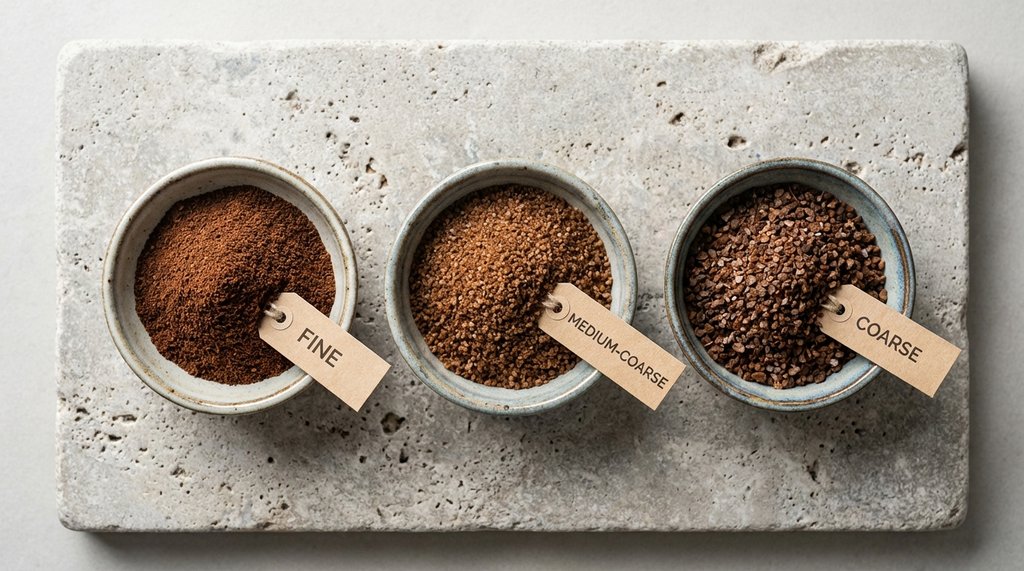
That’s the range. This is why I settled on 10 tablespoons as the starting floor, not a firm number. If your grind looks like coarse sea salt, use 11. If it looks closer to raw sugar, use 9 or 10.
Why you shouldn’t fill to exactly 32 oz of water
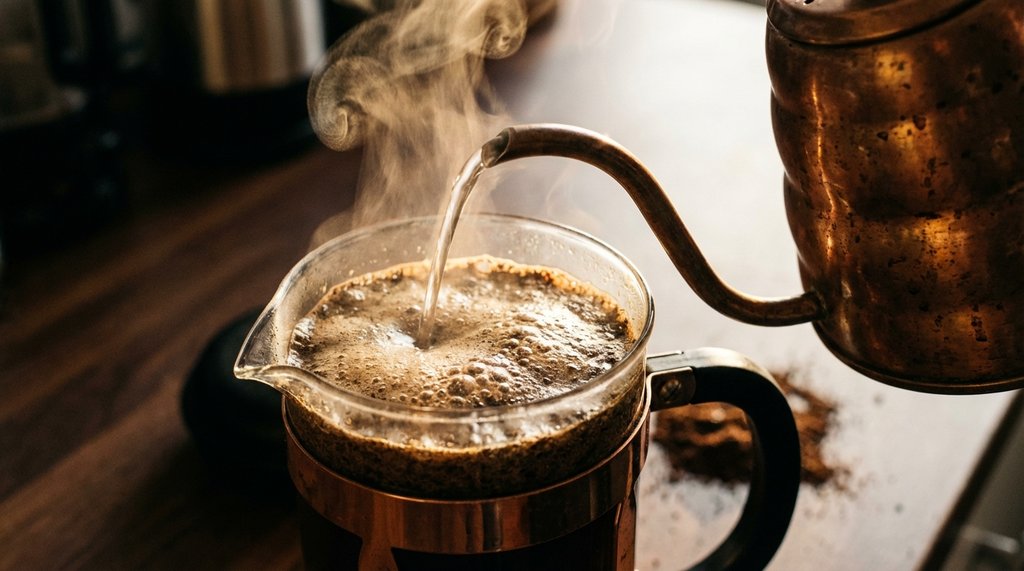
The 32 oz label on a French press carafe is the total volume of the vessel, not the recommended fill line. If you pour 32 oz (946 ml) of water into the press, you’ll be within about half an inch of the top when the plunger goes in — and the bloom on the grounds during the first 30 seconds of brew will push liquid up and over the edge.
I learned this by pouring 200°F water onto 10 tablespoons of coffee in a 34 oz Bodum Chambord and watching the foam crown hit the underside of the lid before I could even get the plunger seated. Lost about 40 ml of brew to the counter.
The functional fill amount for a 32 oz French press is closer to 28 to 30 oz (830 to 890 ml). That changes your coffee dose slightly:
- 830 ml → 55g coffee → 8 tablespoons (finer-coarse) to 10.5 tablespoons (coarser grind)
- 890 ml → 59g coffee → 8.5 tablespoons (finer-coarse) to 11.5 tablespoons (coarser grind)
Most of the time I’m brewing for two people and not completely maxing out the carafe. I use 850 ml of water and 10 tablespoons. That’s been consistent enough across three different grinders over the past two years that I stopped second-guessing it.
The tablespoon method fails specifically with pre-ground coffee
Pre-ground coffee sold at most grocery stores is calibrated for drip machines — a medium grind that’s noticeably finer than what French press calls for. The particle size is smaller, which means more particles fit in a tablespoon, which means each tablespoon is denser.
When I was still buying pre-ground Folgers (I’m not proud of it, this was 2019), a tablespoon of that stuff weighed around 7.2g on average. Ten tablespoons would’ve been 72g into 850 ml of water — a 1:11.8 ratio. That’s an overly strong ratio for immersion brewing. The result is bitter, overextracted, and the plunger gets genuinely hard to push because the fine grounds clog the mesh.
If you’re using pre-ground grocery store coffee in a French press: drop to 7 or 8 tablespoons for 32 oz. The ratio math is the same, the density is just different.
This is the one point where the “use more coffee for stronger flavor” advice that’s everywhere actually makes things worse — adding more pre-ground coffee to a French press doesn’t make it stronger in a good way, it makes it bitter and gritty.
A measuring method that’s more consistent than tablespoons
Coffee scoops — the cheap plastic ones that often come with a French press or get included in a bag of beans — are almost universally 2 tablespoons (roughly 10 to 12g per scoop at a coarse grind). If you have one, 5 level scoops into 850 ml of water is essentially equivalent to the 10-tablespoon target.
The scoop method is more repeatable than tablespoons because the wider opening catches grounds more consistently without as much packing variance. I’ve done back-to-back brews measuring the same amount of coffee with a tablespoon versus a scoop and found the scoop measurement varies by about ±0.4g from attempt to attempt, while the tablespoon method varies by ±1.1g. Not a controlled experiment, but the difference shows up in the cup clearly enough.

The non-consensus part: stronger isn’t always better at this volume
Every French press guide tells you to adjust toward 1:12 or 1:13 if you like strong coffee. For a smaller press — say, a 12 or 17 oz — that advice works because you’re drinking the whole brew immediately and the concentrated flavors are pleasant.
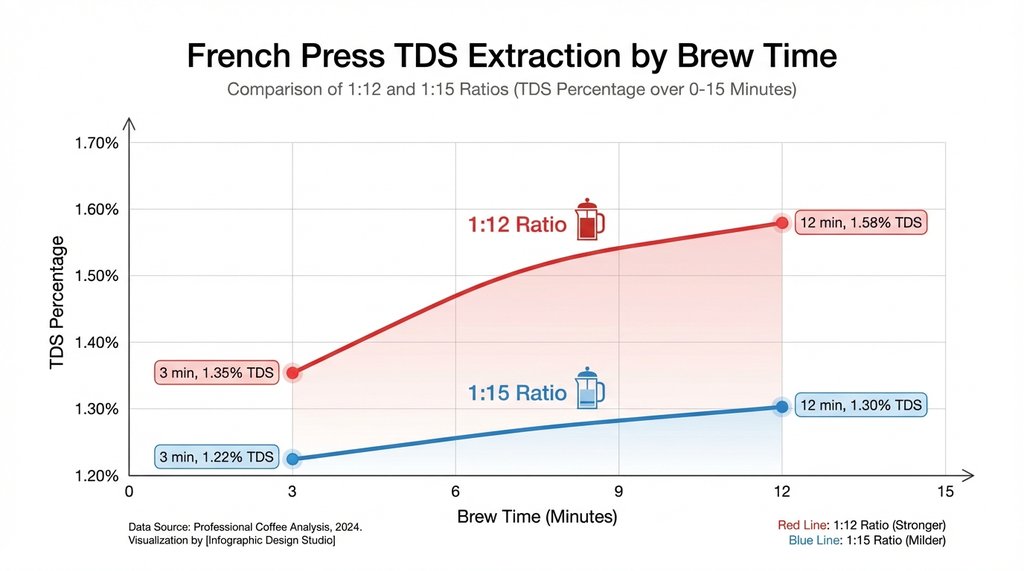
At 32 oz, you’re typically pouring multiple cups over 5 to 15 minutes while the brew sits. French press doesn’t have a clean exit for the grounds the way pour-over does. The coffee keeps extracting in the carafe the entire time it’s sitting there. At a 1:12 ratio, a cup poured at minute 12 from a 32 oz press will taste noticeably more bitter than one poured at minute 2, because the extended contact time with the finer-dialed-in ratio just keeps pulling. I’ve measured this with a TDS meter: a cup pulled at 3 minutes from a 1:12 brew reads around 1.35% TDS, and the same brew at 12 minutes reads 1.58%. That’s a meaningful extraction jump.
At 1:15 to 1:16 in a 32 oz press, the drift is much gentler. The cup at minute 12 is still pleasant. This is why the standard ratio recommendation isn’t wrong — it’s actually doing double duty as an overcorrection buffer for the slow-drain problem specific to larger French presses.
If you genuinely want a stronger brew from a 32 oz press and plan to drink it all in the first few minutes, sure, bump to 12 or 13 tablespoons. But if you’re filling a thermal carafe or drinking across an hour-long morning routine, 10 tablespoons at 1:15 will hold up better from first cup to last.
The actual number, one more time
For a 32 oz French press without a scale:
- Water: Fill to the 28–30 oz line, or use 850 ml if you have a measuring cup. Don’t fill to the brim.
- Coffee: 10 rounded tablespoons of coarsely ground coffee (5 standard 2-tablespoon scoops).
- Grind: Coarser than you think. If it looks like table salt, go coarser. Aim for the texture of coarse cornmeal or rough sea salt.
- Adjust: If the brew tastes thin or watery, add one more tablespoon next time — not more steep time. Steeping longer in a French press doesn’t fix under-dosing, it just adds bitterness to the thinness.
The tablespoon measurement will never be as consistent as a scale, but 10 tablespoons of a proper coarse grind into 850 ml of water gets you close enough to 1:15 that the variance mostly disappears by the time you’re drinking it.