
The first time I asked for “half the syrup, oat milk” at Better Buzz, I got a drink that tasted like sweetened cardboard with espresso poured in as an afterthought. That’s the version most people end up with when they try to cut sugar without knowing which levers actually matter.
After ordering at the Pacific Beach location probably four times a week for the better part of two years — and having more than a few genuinely useful conversations with the baristas there when the morning rush died down — I’ve figured out that low-sugar customization at Better Buzz is much more specific than the usual “ask for less syrup” advice that floats around on TikTok.

The Part Nobody Talks About: Where the Sugar Is Actually Coming From
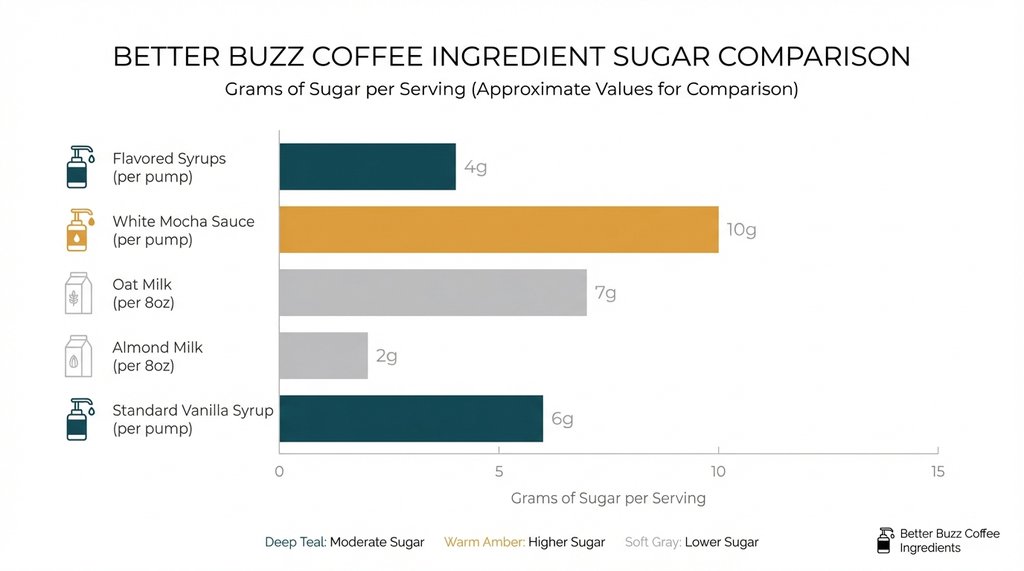
Before you can sub anything intelligently, you need to know that at Better Buzz, the primary sugar load in most menu drinks comes from three places — in order of volume:
- Flavored syrups (usually 1.5 to 2 pumps standard for a 12oz, scaling up to 3–4 for 16oz)
- The milk itself (oat milk, for example, runs around 7g of sugar per 8oz serving from the barista-blend Oatly they use — that’s not nothing)
- Sauces vs. syrups — and this distinction is where people consistently get confused
The sauces (white mocha, dark chocolate) are different from the clear syrups. They’re thicker, more concentrated, and carry more sugar per pump, but they also carry more flavor per pump. That’s actually useful when you’re trying to reduce sugar without nuking the taste profile entirely.
I spent about a month ordering the same drink two ways — once with 2 pumps of vanilla syrup and once with 1 pump of white mocha sauce — because I was curious whether the sweetness difference was real or placebo. The white mocha at 1 pump landed at roughly the same perceived sweetness level as vanilla at 1.5, but the flavor was richer and more present. My improvised conclusion: if you’re cutting sugar, cutting to 1 pump of a sauce often feels less like a sacrifice than cutting to 1 pump of a syrup, because the flavor doesn’t hollow out the same way.
The Swaps That Actually Hold Up
Vanilla Syrup → Sugar-Free Vanilla + Half a Pump of Lavender
Better Buzz does carry a sugar-free vanilla. Most people don’t know to ask for it because it’s not on the menu board. The issue with going pure sugar-free vanilla is that it tends to have a slightly metallic finish — you’ll notice it especially in milk-forward drinks like the Vanilla Bean Latte or anything with heavy oat milk. The fix I landed on: 1.5 pumps sugar-free vanilla plus a half pump of lavender syrup (not sugar-free). That half pump of lavender adds back just enough floral sweetness to mask the aftertaste, and you’re adding maybe 2–3g of sugar instead of the full 8–10g from standard vanilla dosing. I’ve recommended this to at least six people and all of them have stuck with it.
Oat Milk → Half Oat, Half Almond
This one I resisted for a long time because I assumed splitting the milks would just water down the texture. It doesn’t — not at the ratio Better Buzz typically pours. The almond milk they use is lower in sugar (about 3g per 8oz), which cuts the background sugar from the oat milk roughly in half while keeping enough body that it doesn’t taste thin. If you go full almond, cold drinks get watery fast. The 50/50 split holds up through ice melt in a way that full oat does not.
Caramel Sauce → Skip It, Add One Pump of Brown Sugar Syrup Instead
Counterintuitive, because brown sugar sounds less healthy. But the caramel sauce at Better Buzz is high-viscosity and extremely sweet — the standard drizzle on something like the Caramel Macchiato adds more sugar than most people expect from what looks like a small garnish. One pump of brown sugar syrup delivers a similar warm, slightly molasses-y depth at a lower total sugar load, and it incorporates into the drink rather than pooling at the bottom of cold drinks the way the sauce does. This is actually a swap I had a barista suggest to me unprompted when I was complaining about the caramel being too aggressive — so I’m not the only one who’s noticed it.
The One Swap I Thought Would Work and Completely Didn’t
For a while I was convinced that asking for half-sweet and then adding a pinch of cinnamon powder would compensate for the lost flavor complexity. The idea was that cinnamon would add a warm, slightly bitter-sweet note that would make the reduced sweetness less obvious.
In a hot drink, this works. In iced drinks — which is what I’m ordering probably 80% of the time at Better Buzz — cinnamon powder doesn’t dissolve. It floats on top, clumps, and then you get these concentrated bursts of cinnamon that don’t taste like anything other than cinnamon. I tried it across four different iced drinks over the course of a week before accepting it was a texture problem I couldn’t solve without access to a blender mid-order.
Cinnamon syrup is a different story and it’s available at most locations. That does work in cold drinks and adds roughly 4–5g of sugar per pump, which is still well below standard flavoring.
Specific Drink Builds Worth Using
Low-Sugar Version of the Honey Latte
Standard is honey (about 2 pumps) + milk. The honey is one of the higher-sugar options they offer.
My build: 1 pump lavender, 1 pump sugar-free vanilla, half oat/half almond. Ask for no honey drizzle. The lavender does enough work on its own that the honey isn’t carrying as much flavor as you’d expect — it’s mostly adding sweetness without a distinct honey taste once it’s in the drink.
Low-Sugar Cold Brew Customization
Their cold brew base is unsweetened, which is actually a great starting point that most people immediately bury under 3 pumps of syrup. If you’re drinking cold brew because you want the caffeine without the sugar, ask for 1 pump of brown sugar syrup and oat milk on the side (poured lightly, not fully incorporated) rather than blended in. You get the sweetness on the front of the sip without it dominating the entire drink. This is closer to how cold brew is consumed by people who actually drink a lot of cold brew and have developed a preference for it.
The Matcha Situation
This one I’ll be honest about: the Better Buzz matcha latte is not a low-sugar friendly drink regardless of customization, because the matcha powder blend they use is pre-sweetened. How sweetened depends on the location and the batch, but when I asked a barista at the Hillcrest location directly, she estimated the mix comes in pre-sweetened enough that even without added syrup, you’re starting at a meaningful baseline. If you’re doing matcha for health reasons, asking for no added syrup still leaves you with a moderately sweet drink. You can’t fully customize around it with the standard menu.
What “Half Sweet” Actually Means in Practice
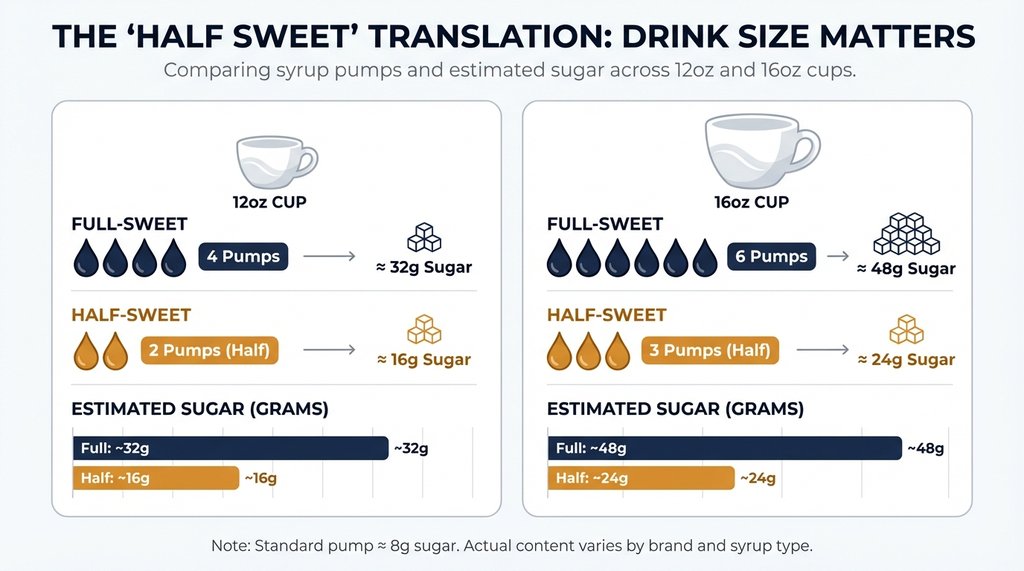
One thing that confused me early on: “half sweet” at most places means half the number of pumps. At Better Buzz, the baristas I’ve talked to apply it the same way — if the standard is 2 pumps, half sweet is 1 pump. But the drinks aren’t uniformly portioned across sizes. A 16oz drink at full sweet is often 3–4 pumps, so half sweet on a 16oz is 1.5–2 pumps, which is actually more sugar than a full-sweet 12oz.
If you’re serious about keeping the sugar count low, ordering a 12oz half-sweet is usually a better outcome than ordering a 16oz half-sweet, even if you’re thirsty. The 12oz at 1 pump of vanilla syrup is coming in around 4–5g of sugar from the syrup alone, which is workable. The 16oz at “half sweet” can still be 8–10g just from syrup, before you account for the milk.
What the Baristas Actually Recommend (When You Ask Directly)
Most of the time, when you ask for a low-sugar version of a drink without specifying how, you’ll get a politely reduced version of the standard build. Asking “what would you actually change if you were making this for someone avoiding sugar” gets a different answer.
Three different baristas across two locations have independently mentioned the same thing when I’ve asked that question: the combination of sugar-free vanilla plus a small amount of a flavored syrup (they usually suggest lavender or brown sugar) outperforms going fully sugar-free, which they describe as tasting “flat” or “one-note.” That’s not marketing — they’d sell you more syrup if they were pushing product. It’s just that full sugar-free builds don’t hold up texturally or flavor-wise in the same way, and they notice it.
The other thing that’s come up more than once: don’t reduce syrup and switch to a lighter milk at the same time if you haven’t tested each change individually. Those two changes compound, and you might end up with something so stripped down that you’re not enjoying the drink at all. Make one change, test it, then adjust from there. It’s slower, but you’re much less likely to write off a customization that was actually working fine before you layered a second modification on top of it.