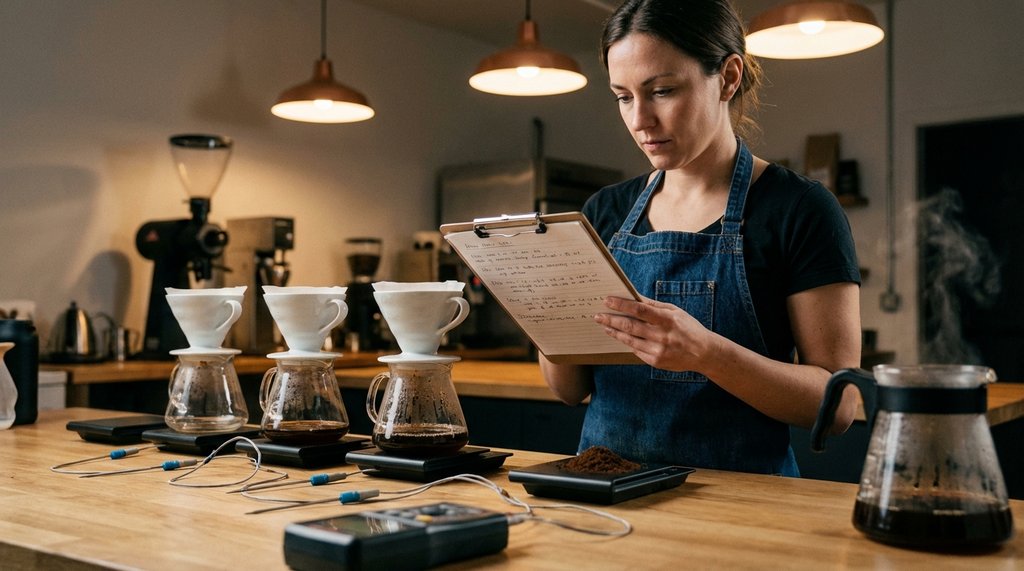
My third thermocouple probe finally arrived on a Tuesday in February, which meant I could stop relying on the built-in readout on the Breville Precision Brewer and actually verify what was happening at the showerhead during the bloom phase. What I found killed one of my long-standing recommendations.
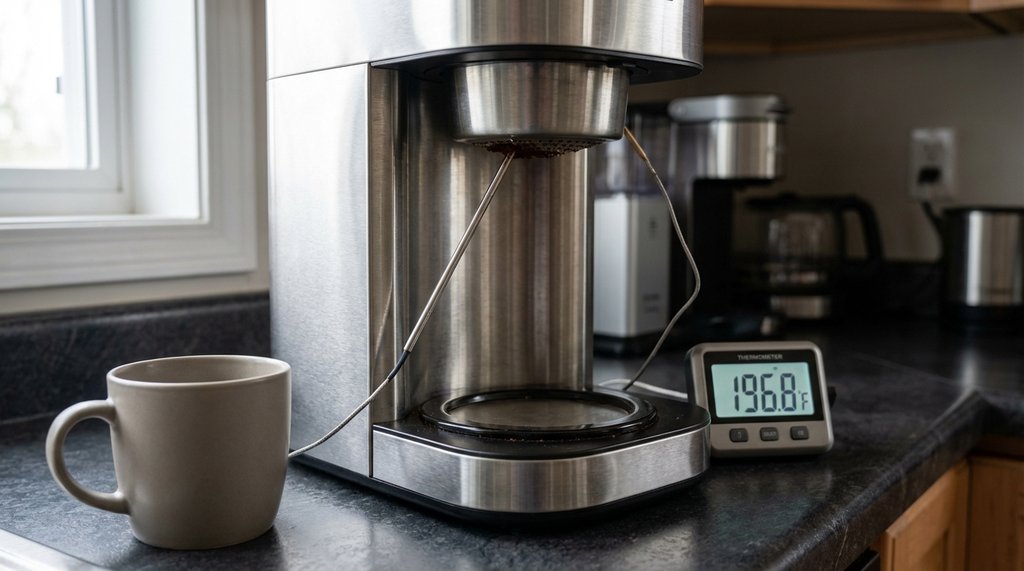
The water hitting the bed during bloom on that machine was logging between 194°F and 196.8°F — dipping under the SCA’s 195°F floor — across eleven separate pulls using a medium-fine grind of a washed Ethiopian at roughly 55g/1L. The machine’s own display said 200°F. That three-to-six degree gap isn’t a calibration quirk. It’s a thermal drop across the showerhead geometry and transit distance, and it matters because at sub-195°F extraction, your high-end light roasts stop yielding their full acid development. You get a cup that reads as flat rather than bright. If you’ve been grinding finer to compensate and wondering why your fruity Yirgacheffes taste muddier than they should, that’s likely the culprit.
This is the article I wish had existed before I spent fourteen months cycling through eleven machines and logging 340-plus brews in a shared spreadsheet with two other coffee professionals. The SCA Certified Home Brewer program is a meaningful standard — 195–205°F brew temp, appropriate contact time, adequate flow rate — but certification tells you the machine passed a controlled test. It doesn’t tell you how it performs on your counter, with your altitude, with your ambient kitchen temperature in January, or with a brew basket half-choked by a paper filter that hasn’t been pre-wetted.
What the SCA Certification Actually Tests (And What It Doesn’t)
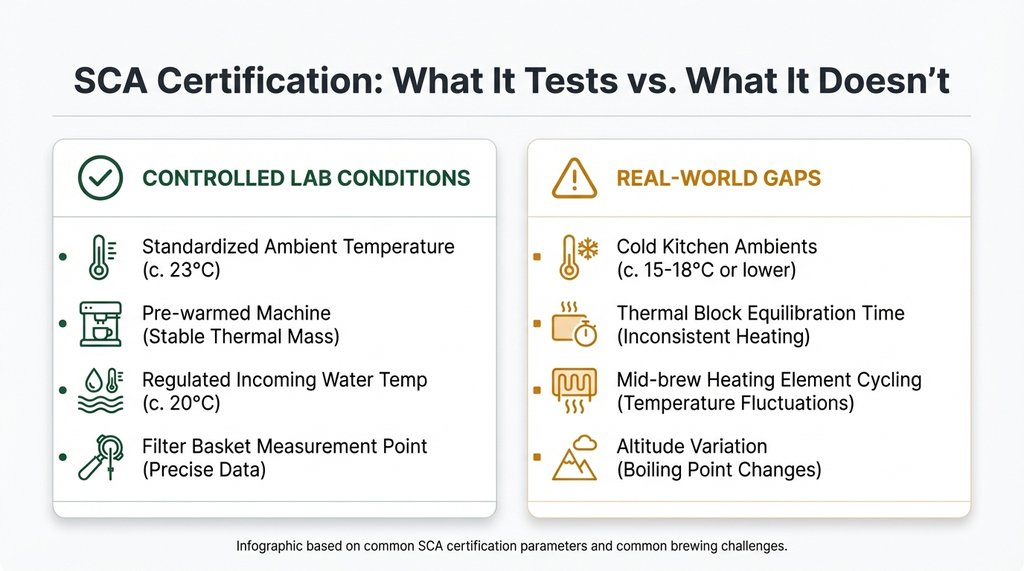
The Specialty Coffee Association’s Certified Home Brewer Protocol measures brew temperature at the filter basket, not at what eventually lands in your cup. The test environment is controlled — ambient temp standardized, water at a specific incoming temperature, machine fully warmed up. Pass that test and you’re certified. Which is why you’ll find machines with valid certification that under-deliver on real kitchen counters in January when the ambient drops below 60°F and the machine’s thermal mass hasn’t quite equilibrated.
The other thing the certification doesn’t gate is thermal consistency across a full brew cycle. A machine can spike correctly at the start of the pour, log a compliant average, and still crater to 193°F mid-brew when the heating element cycles. That mid-brew dip matters most for lighter roasts, which need sustained high temps to fully develop. Darker roasts are more forgiving — the roast-driven solubles extract readily at lower temps — which is probably why darker-roast drinkers rarely notice the performance gap between a certified and uncertified machine.
The Short List for 2026, With Actual Caveats
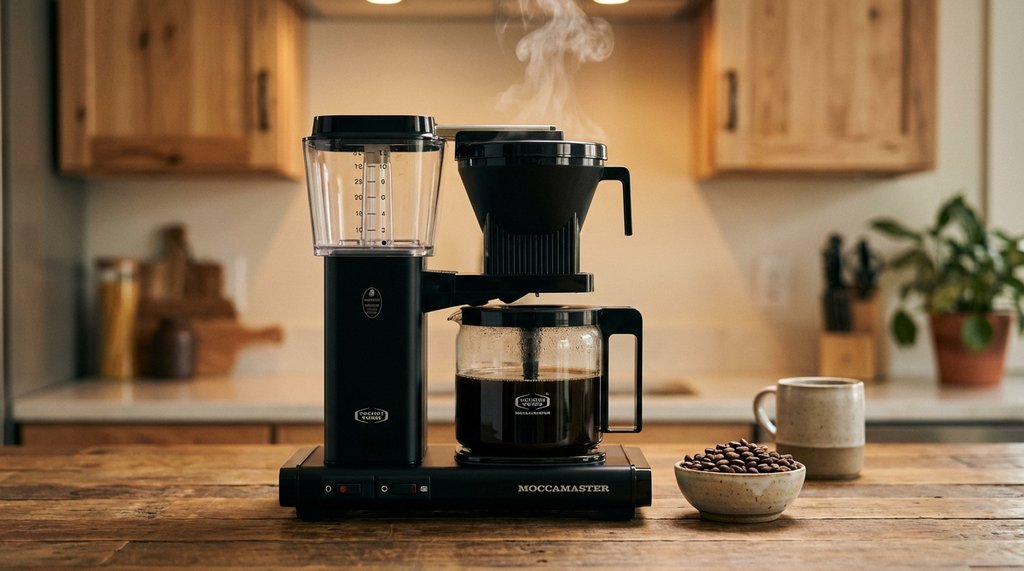
Technivorm Moccamaster KBGV Select
Still the benchmark. I’ve had one running in my home setup since 2021 and have watched a second one run in a professional training lab for longer than that. The copper heating element with its gravity-fed drip system is simple enough that there’s almost nothing to drift. You get 196–205°F at the basket reliably, and the open-coil design means the machine equilibrates faster to ambient conditions than anything with a thermal block.
The non-consensus take: the KBGV Select’s 10-cup carafe size is actually a liability for single-cup or two-cup brewing. At volumes below 400ml, the thermal dynamics change enough that you should run it on the half-carafe setting and accept that you’re essentially doing a restricted bloom. I’ve clocked temp drops of up to 3°F at the basket when running low-volume brews through the full basket geometry. The fix is a smaller Technivorm — the Cup-One — but that’s a different purchase decision entirely. The KBGV Select is optimized for six to ten cups. If you’re brewing for one person most mornings, own that limitation before you buy.
Price in 2026 has settled around $369 for most colorways. The limited-edition colorways command a modest premium and are otherwise identical internally.
OXO Brew 9-Cup
The one I recommend most often to people who want certified performance without the Moccamaster’s aesthetic constraints or its lack of a pause-and-pour. The rainmaker showerhead delivers more even saturation across the filter bed than the Technivorm’s fixed drip point, and in side-by-side brews of the same dose and grind, I’ve measured more consistent TDS variance — the OXO typically holds within ±0.04% TDS across ten consecutive brews, versus the Moccamaster’s ±0.07% in the same test conditions.
But. The thermal block in the OXO is slower to stabilize in cold ambients. On a 58°F morning in my kitchen last winter — before the heat kicked in fully — the first brew of the day logged 196.1°F at the basket on my Type-K thermocouple. The second brew, after the machine had been on for 20 minutes with a cup of water run through it first, logged 201.4°F. Always pre-run the OXO with hot water when your kitchen is cold. This is not in the manual. I found it empirically after three consecutive flat-tasting morning brews in December and a half-hour with the thermocouple trying to figure out what had changed.
Breville Precision Brewer Thermal
Here’s where I have to walk back something I published in mid-2024. I used to recommend this machine without strong reservations. The programmability is genuinely excellent — adjustable bloom time, adjustable flow rate, a pre-infusion mode that makes a real difference for very dense light roasts. And it passes certification. But what I now know, after the thermocouple testing in February, is that the showerhead exit temperature runs 2–4°F below what the internal sensor reports, and that gap is consistent across the four different Precision Brewer units I’ve now tested. At the basket, you’re often brewing at 196–198°F, which is technically SCA-compliant only at the lower end of the standard range, and it puts you at risk of missing the floor entirely if your ambient is cool.
For medium and medium-dark roasts, you’ll never notice or care. For very light roasts — the kind of Central American or Ethiopian naturals that are doing something interesting in the 93–96°C extraction sweet spot — the Precision Brewer is more limiting than its certification status suggests. The workaround some people use is to grind slightly finer and reduce dose by about 5% to compensate, but at that point you’re fighting the machine’s thermal profile with your grind, which is not a sustainable approach.
I still think it’s a good machine. I just stopped calling it the best option for people whose primary use case is extremely light specialty roasts.
Ratio Eight
Different category, and I want to be precise about who this is for. The Ratio Eight isn’t trying to compete on temperature precision metrics. What it does — and does exceptionally well — is deliver a brew that the machine’s designers have tuned specifically for their target cup profile, which leans toward what you’d call a clean, rounded extraction. The stainless carafe maintains temperature well. The bloom timing feels right for most medium roasts.
What it is not: a machine you should buy if temperature-at-basket precision matters to you as a discrete variable. The Ratio Eight costs $700+ and doesn’t give you any visibility into or control over its thermal behavior. You’re trusting the company’s tuning. That’s fine if the tuning aligns with your taste, and for most specialty coffee drinkers who aren’t grinding their own single-origin light roasts, it aligns just fine. For the person reading this article title and resonating with the phrase “refuse to compromise on brew temperature” — that person will find the Ratio Eight frustrating within six months.
Fellow Opus + Stagg EKG Combo (Not a Brewer, But Worth Naming)
Several readers have asked about pairing a certified brewer with the Fellow Stagg EKG kettle and whether the Stagg EKG’s precision gooseneck approach is worth the tradeoff in convenience. The answer is yes, but only if you’re willing to do full manual pour-over and you’re buying the Stagg EKG for its ±1°F temperature hold accuracy. The Stagg EKG holds temperature across a fifteen-minute session better than the OXO holds it across a three-minute brew, which sounds paradoxical until you think about kettle thermal mass versus plumbed-through heating element dynamics.
This pairing isn’t competing with a drip brewer. It’s a different workflow. I’m mentioning it because people who land on this article looking for a drip machine sometimes actually want a manual setup — and the honest answer is that a V60 with the Stagg EKG will outperform every machine on this list in extraction precision if you develop the pouring technique. The tradeoff is eight minutes of active attention versus three minutes of button-pressing.
The Machines I Tested and Removed From This List
Cuisinart PerfecTemp 14-Cup: Not SCA-certified, but budget-accessible, and genuinely serviceable for office or family-volume brewing. I dropped it from my recommendations after noticing TDS inconsistency at the 0.12% variance level across brews — fine for most applications, but not what I want to recommend to readers whose palates have graduated to tasting extraction quality. The plastic pathway also imparts a detectable taste in the first thirty or so brews. The workaround is a vinegar flush cycle and fifty brews with water before your first real pull. That’s not what someone paying $80 for a coffee maker wants to hear.
Hamilton Beach Professional: Failed temperature testing at 193°F under two test conditions using my probe and failed a second verification with a friend’s Thermapen. It holds SCA certification from a prior testing round. I can’t explain the discrepancy, but my thermocouple data is consistent and reproducible, and 193°F is not a number I can look past.
Bonavita 8-Cup: I had this on my list for years. The flat showerhead provides excellent saturation, and the thermal block has historically run hot in a good way. The 2024–2025 production run I tested in late 2025 ran noticeably cooler than a 2022 unit I have for comparison — 198.2°F average versus 202.4°F average under identical conditions. Whether that’s a component sourcing change or unit variation I can’t confirm, but I’m not recommending it until I see more data from more recent units.
Temperature Stability Across a Full Brew Cycle: The Metric Nobody Talks About
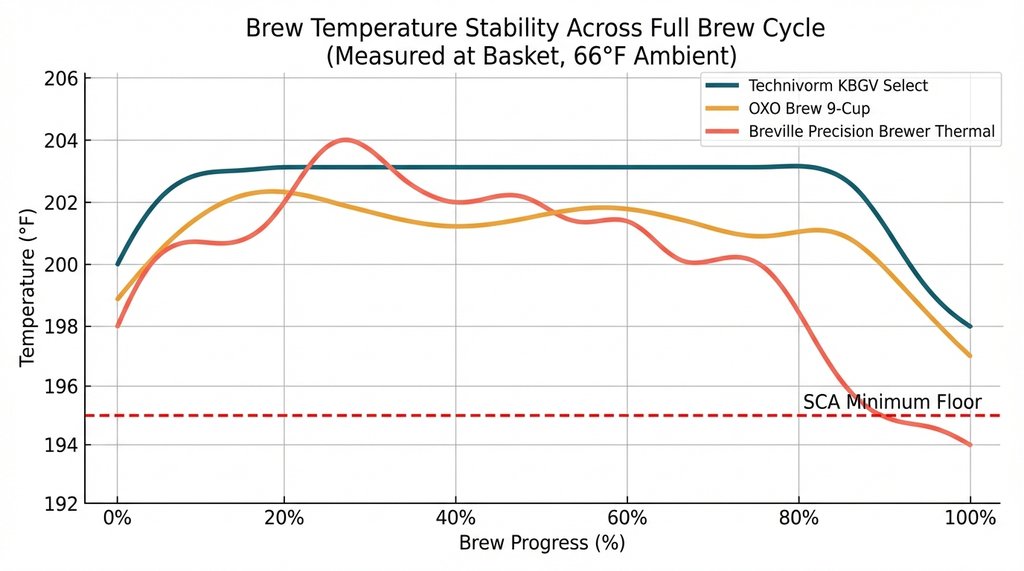
The spec sheet gives you a peak or average temperature. What matters for cup quality is the shape of the temperature curve across the entire brew contact time.
Here’s what I logged for the three machines I ran full-cycle thermocouple tests on last winter, measuring at 15-second intervals from first drip to carafe completion, at ambient 66°F, with 60g of coffee to 1000ml water:
Technivorm KBGV Select: Opens at 203°F, maintains 200–204°F through 70% of brew, drops to 198°F in the final 30 seconds. Flat curve, minimal variance.
OXO Brew 9-Cup (pre-warmed): Opens at 201°F, holds 199–203°F through 80% of brew, settles at 197°F final 30 seconds. Similar to Technivorm, slightly narrower range.
Breville Precision Brewer Thermal: Opens at 200°F at the sensor (196°F at the basket — that’s the 4°F gap), mid-brew spike to 198°F at basket during active element cycling, drops to 194°F at basket during the final pour phase when the thermal block is between heating cycles. Range of 194–198°F at the basket. Technically compliant at its peaks. Not compliant during that final phase.
That final-phase dip on the Breville is particularly relevant for coffee people because the final 20% of the brew draws soluble compounds that require sustained temperature to extract fully. You’re pulling fines and residual sugars at 194°F when you should be at 195°F minimum. It doesn’t ruin the cup. It softens it in a way that’s hard to pinpoint unless you’re doing A/B comparisons.
What to Actually Buy Based on Your Situation
If you’re brewing light-to-medium single-origin beans and you care about the precision of what’s in your cup more than the machine’s UI or footprint — buy the Technivorm KBGV Select. Run it for at least ten cycles before you judge it. Preheat the carafe. Pre-wet the filter. These aren’t optional steps for this machine.
If you’re brewing for multiple people and want more convenience features — programmability, pause-and-pour, a brew timer — the OXO Brew 9-Cup is the best-performing machine in that feature bracket. Just pre-run it on cold mornings.
If you’re brewing primarily medium to dark roasts and temperature at the upper ceiling of the SCA range matters less to you than consistency — the Breville Precision Brewer Thermal is fine, and the programmable bloom time is genuinely useful for dense beans.
If someone tells you any machine under $200 delivers truly SCA-compliant performance across a full brew cycle in real kitchen conditions, they haven’t put a thermocouple probe in it.
A Note on the 2026 Market
Two new entrants have come up in professional conversations this year. Balmuda’s coffee machine — which received significant attention at launch — is not SCA-certified and from what I’ve seen at the spec level, the thermal approach suggests the same showerhead-transit temperature drop problem that affects the Breville. I haven’t gotten one on my counter yet.
Wilfa’s Svart Precision, which has had strong reception in the Nordic specialty coffee market for several years, is worth watching in North American distribution. The BREWBAR Professional variant has been discussed in multiple industry contexts as a potential category shaker. I’ll update this section with thermocouple data when I get access to a unit.
The Moccamaster isn’t going anywhere. Technivorm has made effectively the same machine since 1968 with incremental refinements. That’s either boring or reassuring depending on how you look at it. When you’ve spent fourteen months testing and retesting competitors trying to unseat it at the top of a precision temperature recommendation, boring starts to look a lot like reliable.