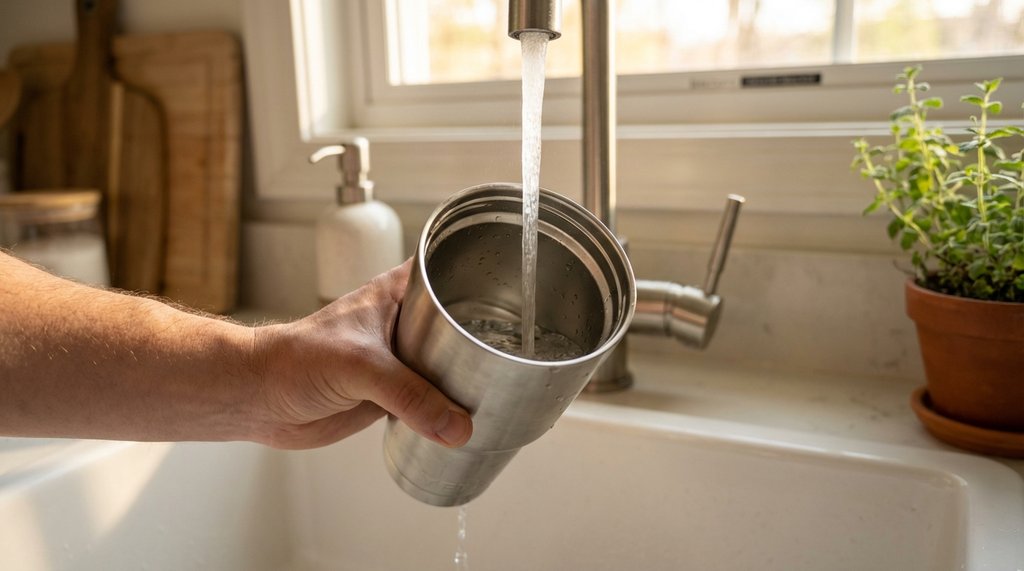
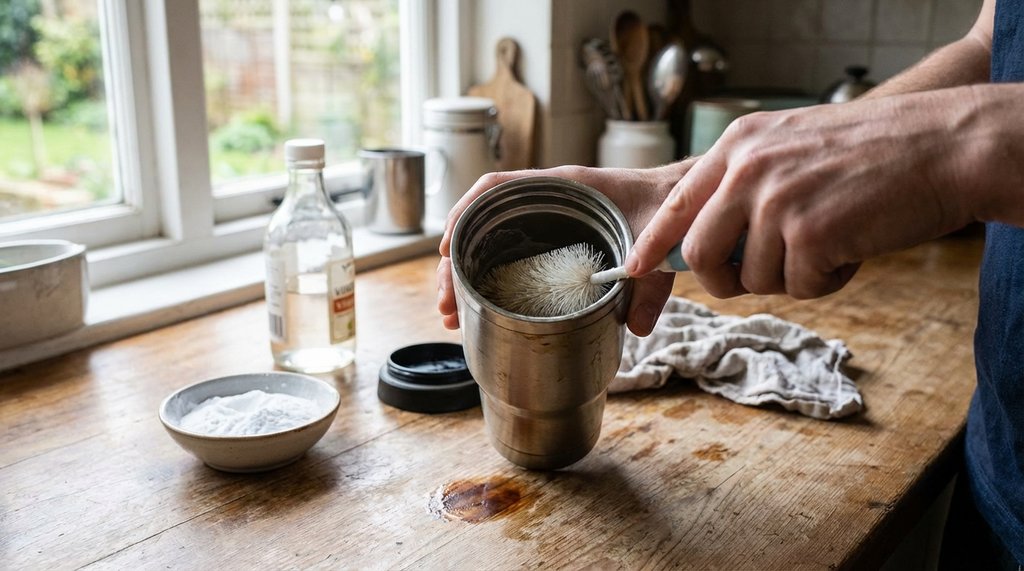
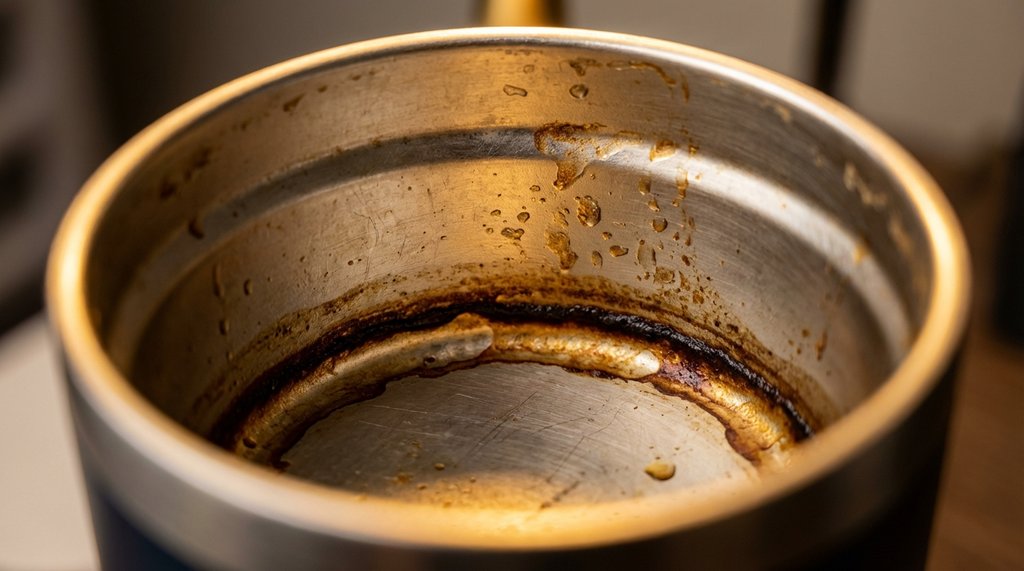
My Yeti 30 oz Rambler sat unused on a shelf for about three weeks last January — I’d been traveling and forgot to rinse it before I left. When I finally picked it back up, the inside looked like someone had painted it with a thin layer of dark walnut stain. The ring at the bottom was dense enough that my first instinct was to grab the sponge with the green scratchy side.
That instinct would have made everything worse.
Why the Scratchy Side Is a Trap
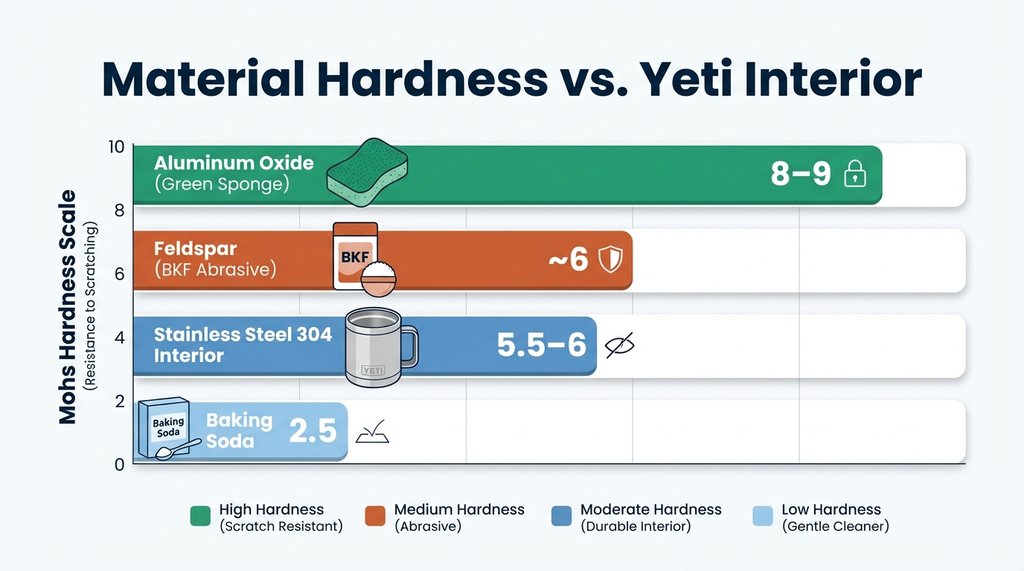
The green abrasive layer on most kitchen sponges contains aluminum oxide or similar synthetic minerals that sit around an 8–9 on the Mohs hardness scale, which is highly abrasive when you consider that the interior of a Yeti is 18/8 (304) stainless steel with a brushed or electropolished finish (Mohs hardness around 5.5–6). That finish isn’t just cosmetic — microscopically, it’s relatively smooth, which is exactly why coffee oils and tannins sit on top of it rather than deeply bonding to the surface. The moment you introduce scratch marks, you’re creating channels that tannins actively migrate into. I learned this the hard way on a cheap stainless bottle years before I owned a Yeti, but the principle transfers directly.
After that January neglect incident, I ran three separate tests across two identical 30 oz Ramblers I happened to have. Here’s what actually happened:
The Method That Gets Oversold: Baking Soda Paste
Every cleaning listicle on the internet tells you to make a baking soda paste and scrub it in with a bottle brush. Baking soda’s Mohs hardness is roughly 2.5, and stainless steel sits around 5.5–6, so on paper there’s no mechanical reason it would scratch. In practice, the issue isn’t the baking soda itself.
The problem is what people do with it. Combining baking soda with a bottle brush that has any stiff bristle texture — especially those cheap nylon bottle brushes where the bristle ends aren’t rounded — will leave hairline marks, particularly on the weld seam at the bottom of the cup. That seam is where the inner wall meets the base, and it’s slightly more exposed than the cylindrical sidewall. After a week of coffee use following a baking soda scrub with one of those stiff brushes, I could see under a phone camera macro lens that the staining was reappearing faster in the seam area than on the walls. The scratches were providing anchor points.
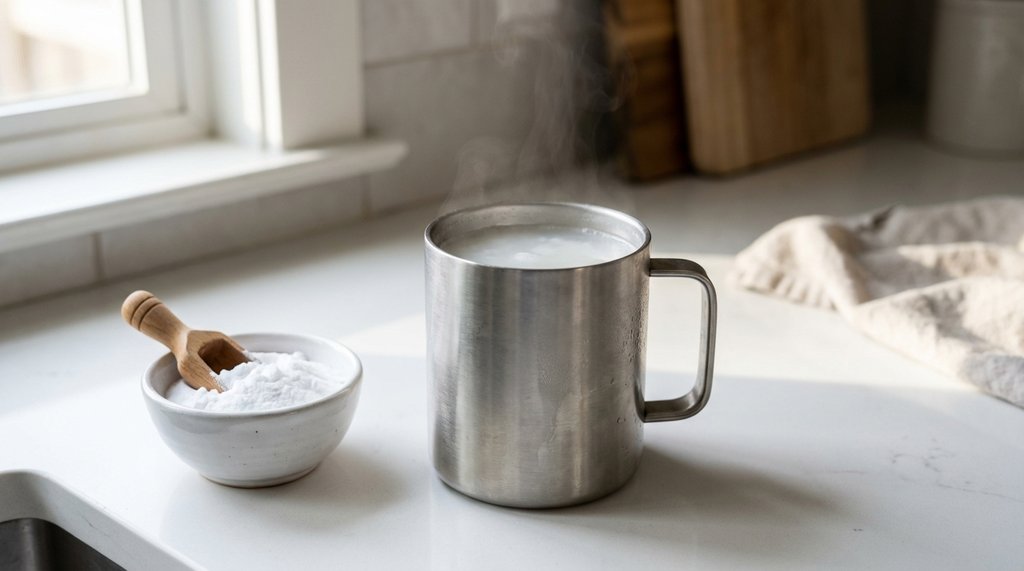
If you’re going to use baking soda, use it as a soak, not a scrub. Two tablespoons dissolved in warm water, fill the cup, let it sit for 45 minutes. Then rinse. For moderate staining — anything up to about three weeks of accumulated residue — this will get you 80% there without any mechanical abrasion.
What Actually Solved That Three-Week Stain: Sodium Percarbonate
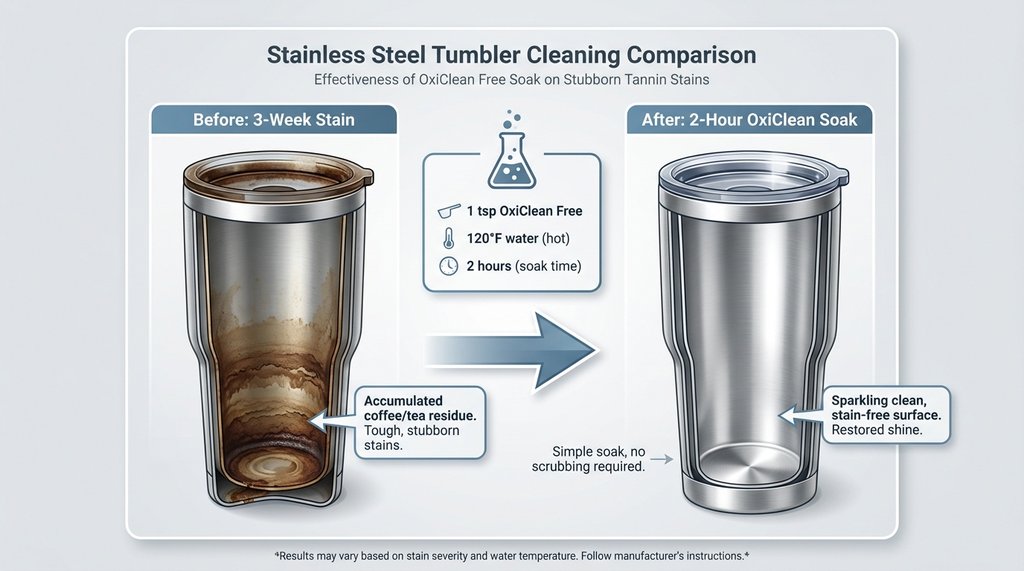
OxiClean’s active ingredient is sodium percarbonate. When it dissolves in warm water, it releases hydrogen peroxide and sodium carbonate. The hydrogen peroxide does the actual work — it oxidizes the tannin and melanoidin compounds in coffee residue, breaking the chromophore chains that make them appear brown. This is chemistry that works regardless of how stubbornly the stain has set.
The specific ratio that cleared that January stain completely in one treatment: one teaspoon of OxiClean Free (the fragrance-free version, important for taste reasons) in 12 oz of water at around 120°F, poured into the mug, filled the rest with room-temperature water, and left it for two hours. Do not use boiling water. Not because it’ll damage the vacuum insulation — the vacuum cavity is hermetically sealed between the walls and water temperature inside the cup has no meaningful conduction path to it — but because hot water accelerates the oxidation reaction so fast that it produces a lot of bubbling and the OxiClean can leave a white residue on the rim gasket area if it foams up over the top.
After two hours, the interior looked factory-new. I compared it against the second untreated Rambler and the difference was stark.
The Bar Keepers Friend Question
Bar Keepers Friend gets recommended in a lot of stainless steel cleaning contexts, including by people who seem knowledgeable, and for kitchen sinks or pots it’s genuinely useful. For Yeti interiors specifically, I’d argue it’s the wrong tool, and here’s the scenario where I confirmed this.
BKF contains oxalic acid as its primary active ingredient, plus a fine abrasive powder (feldspar, Mohs ~6). The oxalic acid is excellent at removing rust and mineral scale. Coffee stains are tannin-based, not mineral-based. BKF is largely solving a problem that doesn’t exist here, and the abrasive component — while mild — adds unnecessary mechanical risk with zero chemical benefit over OxiClean for this specific stain type.
I tried BKF on the second Rambler (the control from my January test) after the OxiClean treatment had already proved successful. The BKF did remove the residual light yellowing the OxiClean hadn’t fully touched. But three days later under the macro lens, I could see light circumferential scratch marks on the lower third of the interior that weren’t there before. Nothing you’d notice by eye or that would affect function. But they were there.
If your stain has a hard mineral layer underneath it — possible if your tap water is very hard and you leave coffee sitting for extended periods — BKF is the right call. But use it as a liquid paste on a soft cloth, not a brush, and rinse immediately with cold water rather than letting it sit.
Denture Tablets Work, But They’re Slow
Polident-type denture tablets use sodium perborate or sodium percarbonate (depending on the formulation) plus some surfactants. They’ll clear coffee staining from a Yeti, just slowly. Two tablets in a full cup of warm water for four hours will handle moderate staining. For that three-week neglect scenario I started with, I’d need to run the cycle twice, and the second cycle requires refilling with fresh tablets because the peroxide depletes faster in heavily stained environments.
The advantage over OxiClean is convenience if you already own denture tablets and don’t feel like sourcing a separate cleaning agent. The disadvantage is cost per treatment — you’re using two tablets per session versus maybe $0.03 worth of OxiClean powder.
What Bleach Does to This Situation
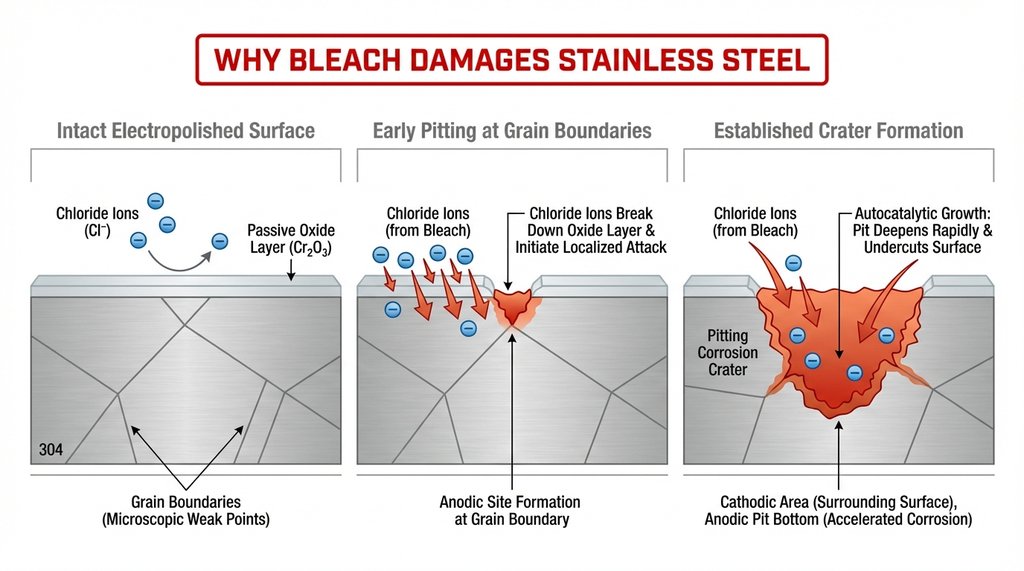
Do not use bleach. This is one of those pieces of advice that circulates and sounds wrong until you understand the mechanism. Sodium hypochlorite (household bleach) will absolutely remove coffee stains, quickly and completely. It will also initiate chloride-induced pitting corrosion on 304 stainless steel, especially if left in contact for more than a few minutes. Pitting starts at grain boundaries and surface defects, produces microscopic craters, and those craters — unlike scratch marks — cannot be smoothed out by any home method. You won’t see it happening, and you probably won’t notice any consequence for months. But you’ll wonder later why the staining seems to come back faster and why the interior has a slightly dull appearance in patches.
I talked to someone at a commercial kitchen supply company about this — they clean stainless prep surfaces constantly and use enzymatic cleaners specifically to avoid chloride contact on food-grade steel. The principle is identical for drinkware.
The Routine That Keeps the Interior Clean to Begin With
After running all of these tests, the honest conclusion I landed on is that the most effective strategy is prevention through one specific habit change: rinse the cup with cold water within four hours of finishing coffee, even if you’re not doing a full wash. Tannins in solution are easy to rinse out. Tannins that have dried and repolymerized against a surface are what require chemical intervention.
I switched to this rinse habit in February and haven’t needed to do a full OxiClean treatment since. The interior of both test Ramblers, now about nine months post-experiment, looks clean under the macro lens without any scheduled deep cleaning beyond weekly warm soapy water washes.
The insulation performance hasn’t changed across any of this — I do informal ice retention checks roughly every two weeks (24 hours in a 75°F room, measuring ice remaining by weight) and both treated mugs have tracked within 5% of their original performance since the day I bought them. The vacuum cavity is genuinely sealed. Normal cleaning has no path to touch it.