
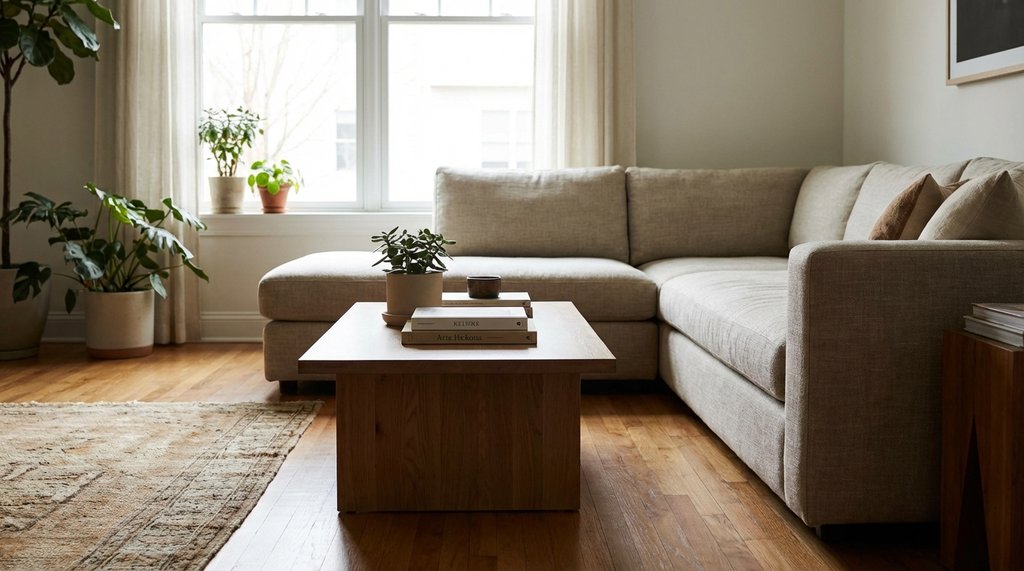
The measurement tape I pulled out last spring told me 3.4 meters by 4.2 meters. My client had already ordered the sectional — a 270cm × 175cm L-shape — before asking me which coffee table to buy. So that math was already locked in, and suddenly the whole proportioning exercise got a lot more constrained than the usual “pick something you like” conversation.
That situation taught me more about small-room coffee table sizing than a decade of reading interior design guides, mostly because every single standard rule I tried to apply either didn’t work or actively made things worse.
The 2/3 Rule Breaks Down Faster Than You’d Expect
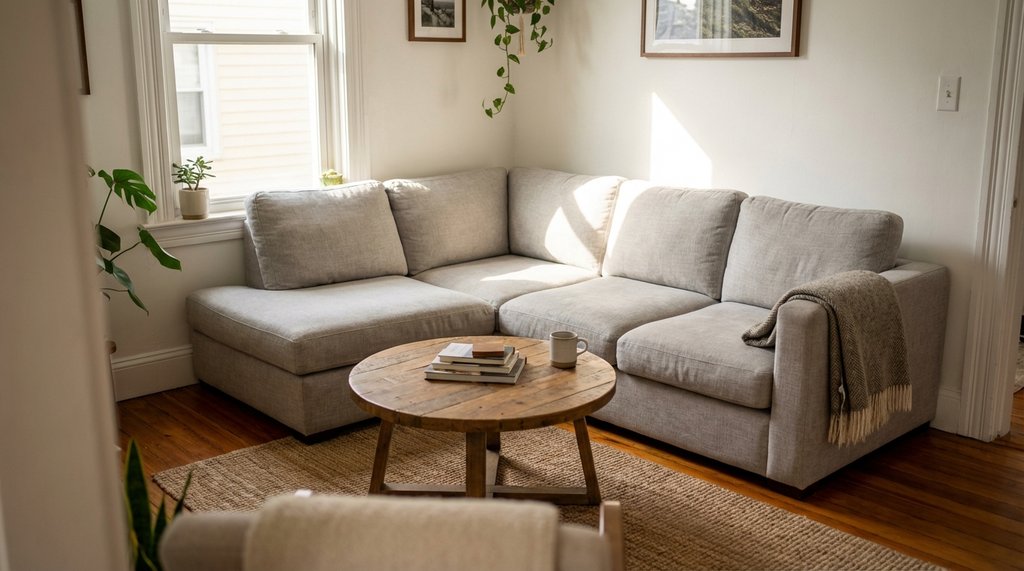
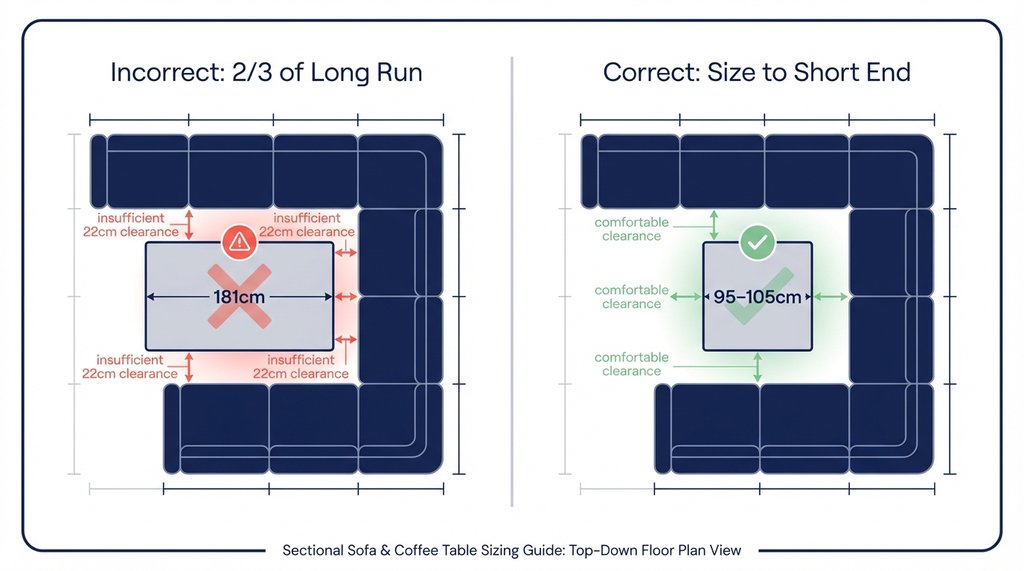
You’ve probably seen the recommendation to size your coffee table at roughly two-thirds the length of your sofa. Sounds sensible until you’re standing in front of an L-shaped sectional in a 14.3 square meter room trying to figure out which length you’re even measuring. The long run of the L? The short chaise end? The combined perimeter? Nobody specifying this rule seems to have actually applied it to an L-configuration in a tight space, because if you take two-thirds of the long side — say, 270cm × 0.67 = 181cm — you end up with a table that physically cannot sit inside the L without butting against the chaise within the first week of daily use.
I’ve watched three clients make this mistake. One bought a 180cm rectangular table for a sectional almost identical in size to what I described above, in a room that was just under 15 sqm. The table looked right in the showroom photo she sent me. In the actual room, the clearance between the table edge and the chaise cushion was 22cm — less than a standard dinner plate is wide. She was climbing over it to reach the far seat within a month.
The rule that actually works for L-sectionals in sub-15 sqm rooms: size to the short end of the L, not the long run. If your chaise section is 155cm, you’re working with a table in the 90–105cm range. That feels counterintuitive — it looks undersized in a product photo — but in the room it reads correctly because the L itself creates visual bulk that a proportionally smaller table balances rather than competes with.
The Interior Corner Is Wasted Space You’re Probably Counting Wrong
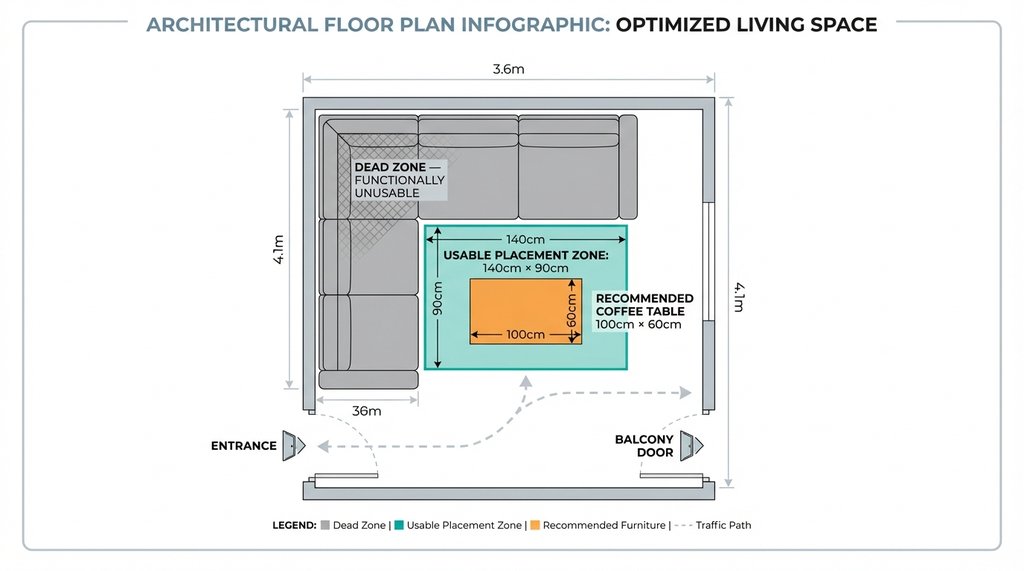
Here’s the geometry problem most people skip over. An L-shaped sectional creates an interior corner — the concave angle between the two sofa runs — and that corner is functionally dead space. You can’t sit there comfortably, you can’t reach a table placed deep into it, and visually it reads as a void. When you’re calculating usable floor area for the coffee table placement zone, that interior corner doesn’t count.
In a room I measured at 3.6m × 4.1m last autumn, the sectional occupied a corner position (which is the only configuration that makes sense for an L-shape in a room this size — don’t try floating it). The actual usable rectangle in front of the sofa, after subtracting the dead interior corner and maintaining functional clearance from the TV unit on the opposite wall, was 140cm × 90cm. Not the 210cm × 150cm that a purely mathematical reading of the room would suggest.
That 140cm × 90cm zone dictated a table no larger than about 100cm × 60cm, with the long axis running parallel to the longer sofa run. Anything bigger either blocked the natural path from the room entrance to the balcony door, or pushed so close to the sofa that standing up from the chaise required a deliberate sideways shuffle.
Clearance: 45cm Is a Lie You Should Stop Believing
The 45cm (18-inch) clearance between sofa edge and coffee table edge is cited everywhere, including in otherwise credible sources. In my experience running through the actual ergonomics of this measurement, 45cm is the number you need if you are routinely getting up from the sofa carrying something — a full tray, a sleeping child, a large dog. For normal seated-to-standing movement, 35cm is genuinely sufficient, and I’ve now used that number across enough projects to feel confident in it.
The difference between 45cm clearance and 35cm clearance is 10cm. In a room under 15 sqm, that 10cm is often the margin between a table that fits your space and one that requires you to size down an entire product category. Going from a 45cm clearance to a 35cm standard let me use a 95cm × 55cm table in a room where the “correct” clearance math would have capped me at 80cm × 50cm. The larger table looked considered. The smaller one would have looked like an afterthought.
Where this gets dangerous: if you have kids under 8 (where a coffee table with hidden toy storage might also be a priority) or elderly household members who use the sofa edge to push themselves up to standing, hold the 45cm line. The ergonomic margin matters differently for different users. But for a standard adult household, 35cm is not a compromise — it’s a recalibration.
Shape: Rounds Aren’t Always the Small-Room Solution
I used to default to round or oval tables for small rooms because the absence of corners reduces the visual sharpness that makes tight spaces feel crowded. I still recommend them sometimes. But for L-shaped sectionals specifically, I’ve moved away from this as a general principle, and here’s why.
A round table in front of an L-sectional creates an asymmetric visual relationship with the sofa. The sofa has a hard directional geometry — it points two directions. A circle is non-directional. In a small room, that mismatch reads as slightly unresolved, like a piece that didn’t quite get chosen intentionally. More practically: a round table’s diameter has to be sized to its narrowest function, which means you lose usable surface area relative to a rectangle of equivalent visual footprint.
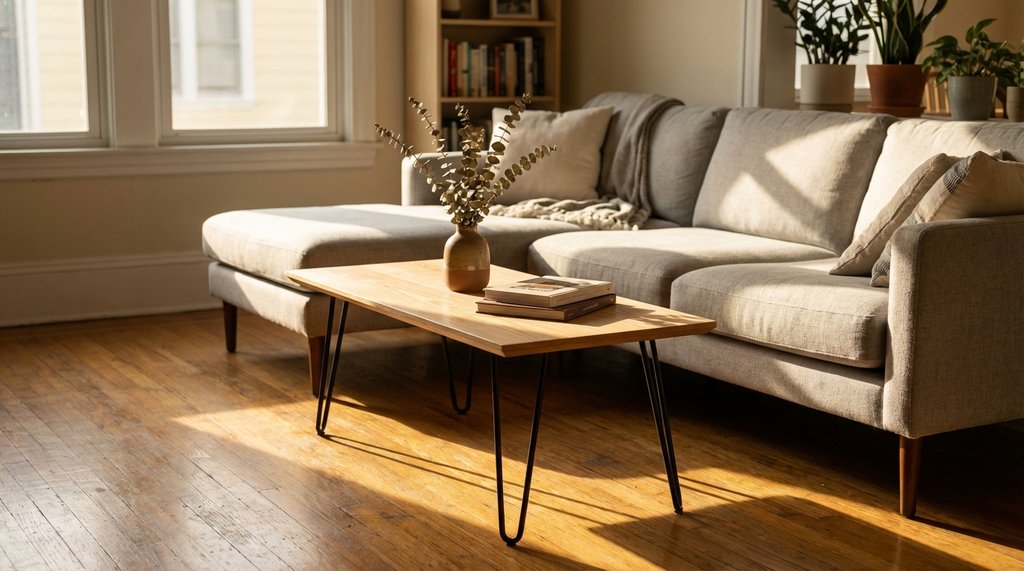
The configuration that’s worked best in the projects I’ve documented: a low rectangular table, roughly 2:1 or 3:2 in its length-to-width ratio, oriented with its long axis parallel to the longer sofa run. Low means seat-height minus 3 to 5cm — so if your sofa seat sits at 44cm, the table should be in the 39–41cm range. Tables marketed as “cocktail height” at 46–50cm are proportionally wrong for most sofas and make a small room feel like a hotel lobby.
Material and Visual Weight Matter More Than You Think, and Differently Than You Think
The standard small-room advice is to go with glass or acrylic to reduce visual weight. I’ve given this advice. I’ve also watched it fail.
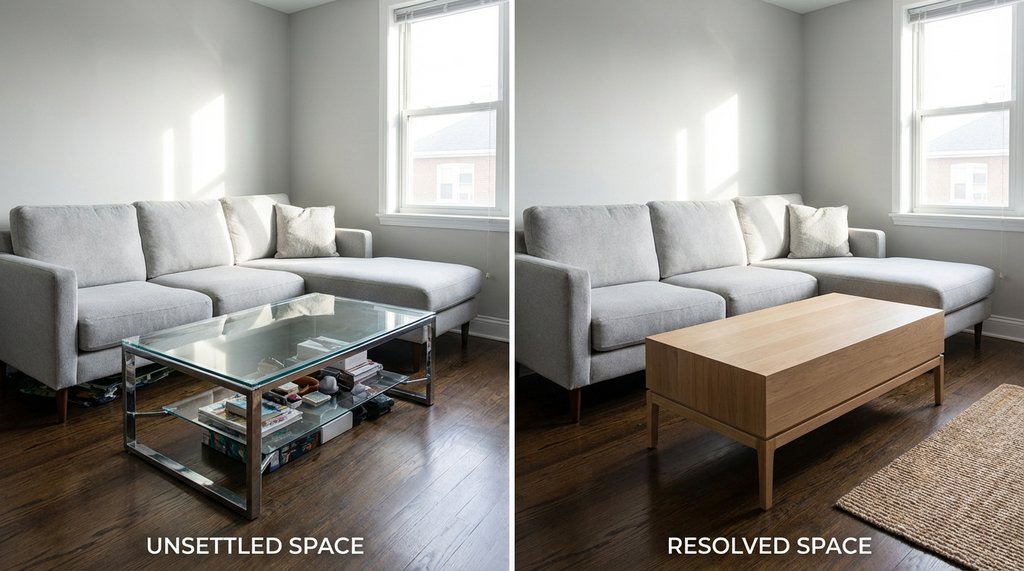
Glass tables in rooms under 15 sqm with L-sectionals create a specific problem: the reflection of the sofa’s base and legs in the glass surface adds visual complexity at floor level. In a room where you’re already managing the visual density of a large sectional, the reflected geometry underneath a glass table makes the lower third of the room feel busier, not lighter. I noticed this first in a 13.5 sqm living room where the client had a light gray linen sectional — beautiful sofa — and a tempered glass-top table with chrome legs. The zone between the sofa skirt and the floor looked chaotic in photographs and felt unsettled in person. We replaced it with a solid white oak table of similar footprint, and the room immediately read as calmer.
The better approach for visual lightness in this specific configuration: keep the legs slender and raised (no solid base panels, no aprons), use a matte or honed surface finish rather than gloss, and choose a color that’s within two tones of either the floor or the sofa — not both, but one anchor point. A table that matches neither the floor nor the sofa floats oddly in a small room and draws more attention to itself than you want.
The Actual Sizing Framework I Use
For any L-sectional in a room under 15 sqm, I run through this sequence before touching a product listing:
Step one: Measure the short end of the L (the chaise or shorter run). This is your maximum table length. Subtract 10cm. That’s your working ceiling.
Step two: Measure from the sofa’s front edge to whatever is directly opposite — wall, media unit, bookcase, whatever. Subtract 70cm (35cm clearance on each side of the table). What’s left is your maximum table width or depth.
Step three: Confirm table height is 3–5cm below your sofa seat height. If the sofa has a particularly deep seat (over 60cm), you can push to 6cm below seat height without it looking awkward.
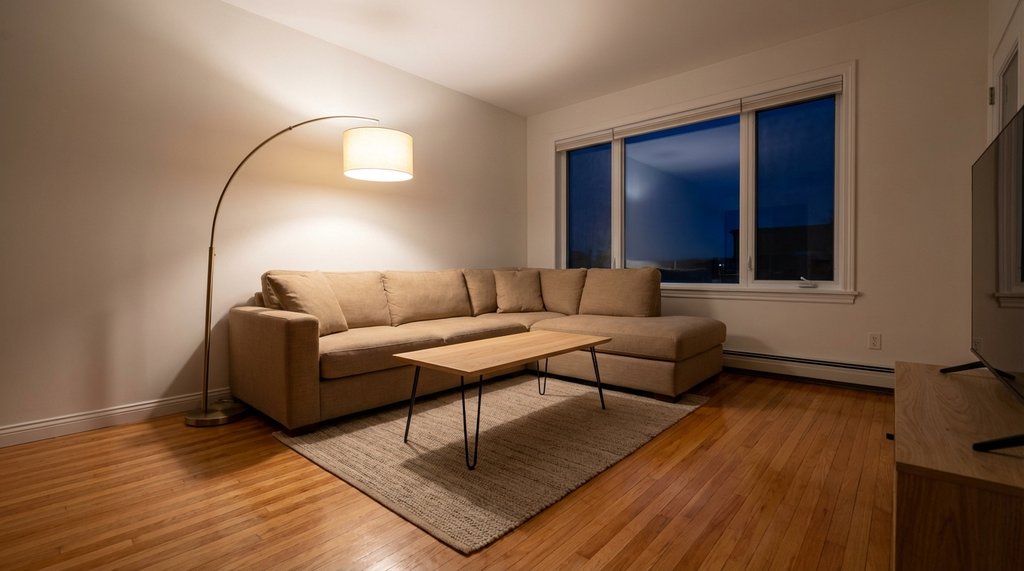
For the room I opened with — 3.4m × 4.2m, sectional at 270cm × 175cm — those calculations yielded a maximum working size of approximately 165cm × 55cm. The table I ultimately recommended was 100cm × 55cm in natural ash with hairpin legs, oriented parallel to the long sofa run with the table centered on the usable seating zone rather than on the room’s geometric center. That last detail — centering on the seating zone, not the room — is something I had to learn from getting it wrong first. Centering on the room in a corner-placed L-sectional arrangement puts the table partially in front of the dead interior corner, which means nobody can comfortably reach the half of the table that’s nominally closest to them.
The client sent me a photo six weeks after installation. The room looked like it had twice the floor area it actually had. That’s not magic — it’s just arithmetic applied to the right measurements.
2 thoughts on “Coffee Table Size for L-Shaped Sectionals in Small Rooms”