
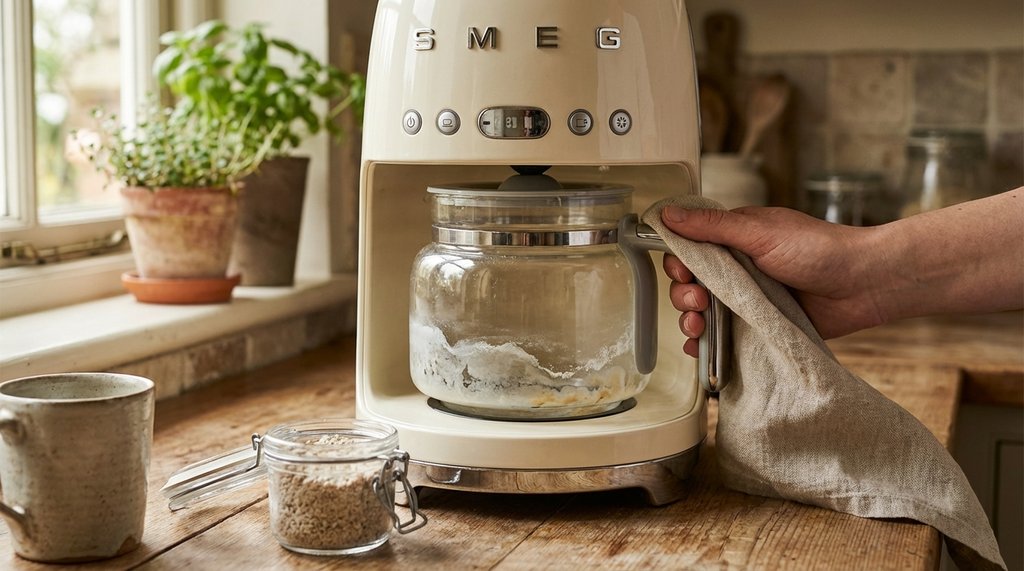
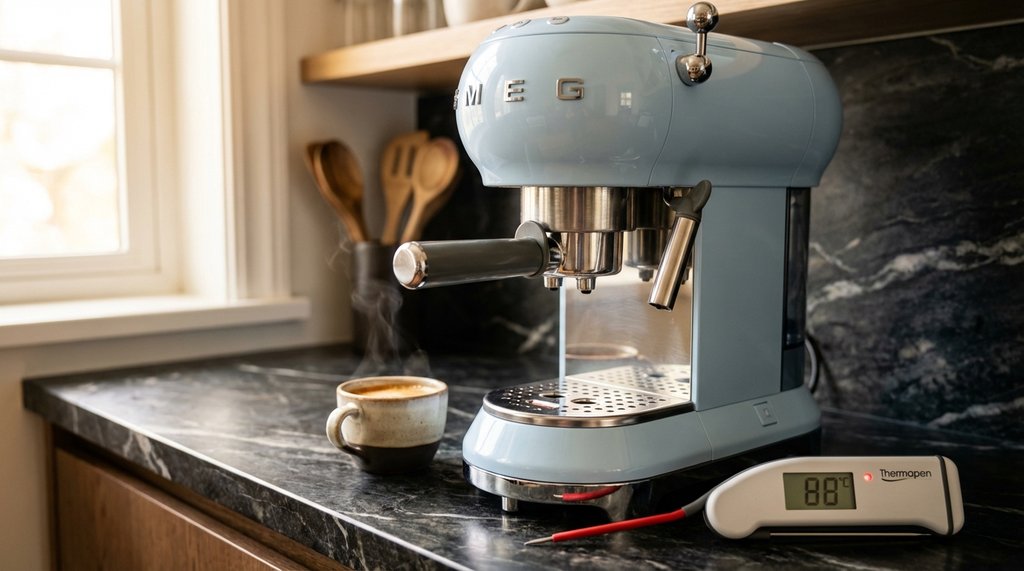
My Smeg ECF01 threw a descale alert eight months after I bought it. I ignored it for three weeks because the coffee still tasted fine. By week four, the brew temp had dropped enough that my espresso was pulling noticeably sour — I measured 88°C at extraction on a Thermapen when the machine should have been hitting 93°C. That’s a 5-degree swing from scale buildup alone, and the machine was barely a year old.
That experience made me stop trusting the onboard alert system entirely and start actually thinking about water chemistry.
The Alert Interval Is Calibrated for Somewhere That Isn’t Your House
Smeg’s default descale reminder on most of their drip and semi-automatic machines (the DCF02, BCC02, and the filter coffee range) triggers around 200 brew cycles. The assumption baked into that default setting is roughly 150–200 mg/L total dissolved solids — which is considered “moderately hard” and corresponds to maybe 8–11 °dH. That’s approximately the median for central Germany, where a lot of European appliance testing gets standardized.
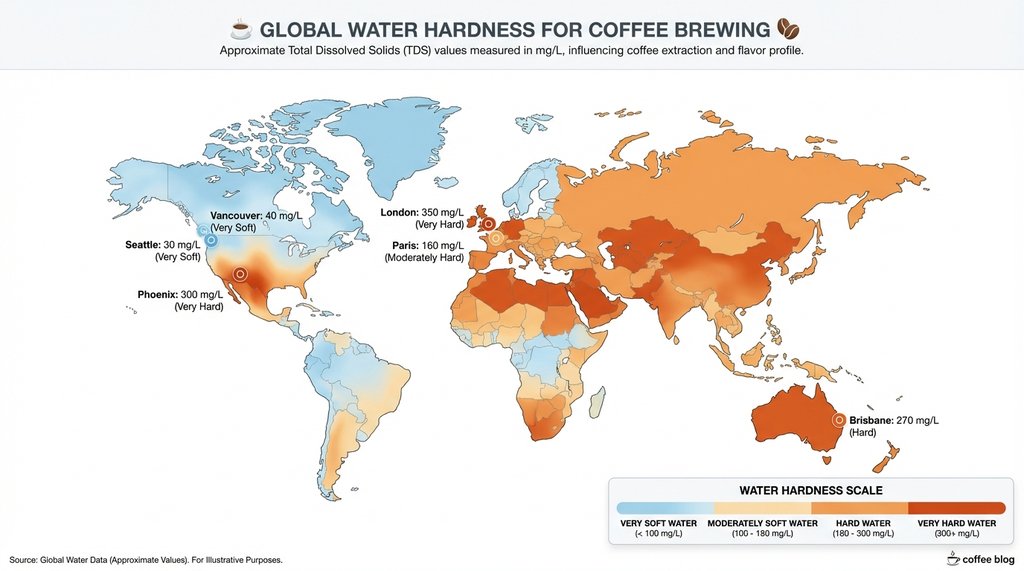
If you’re in Phoenix, Arizona, you’re looking at 250–350 mg/L depending on your district and season. South London tap water routinely measures 320–380 mg/L. Adelaide’s water supply has tested as high as 285 mg/L during dry periods. In all three of these places, following Smeg’s default 200-cycle guidance means you’re descaling at roughly half the frequency you actually need.
Conversely, if you’re pulling water from the Pacific Northwest — Portland, Seattle, Vancouver — you might be sitting at 20–50 mg/L. Descaling every 200 cycles there is almost certainly overkill, and if you’re using a citric acid descaler (which is mildly acidic, pH around 2–3 depending on concentration), unnecessarily frequent descaling starts to wear the internal gaskets and seals faster than scale ever would.
I’ve watched people buy the Smeg BCC02 bean-to-cup machine, follow the manufacturer schedule religiously in Perth’s hard water, and still wind up with a failed NTC thermistor inside 18 months because the scale had insulated the sensor enough to cause the heating element to overheat and cycle off repeatedly under load. The element itself was fine. The sensor died from thermal stress. Replacing the NTC on a BCC02 isn’t a user-serviceable repair — it voids the warranty and involves disassembling the machine.
How to Actually Figure Out Your Descaling Interval
The most honest answer is: test your water once, do the math, then ignore the machine’s counter.
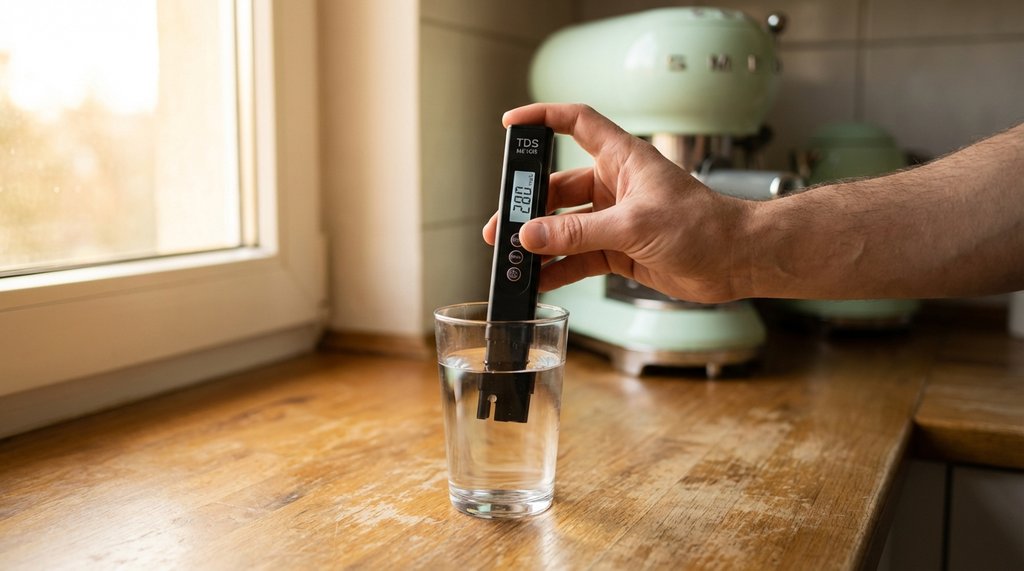
Pick up a TDS meter (the cheap aquarium ones from Amazon work fine for this — I’ve cross-checked a $12 meter against a Hanna Instruments HI98192 and the readings were within 4%) and measure your cold tap water before it hits any filter. Write down the number.
Then use this rough framework:
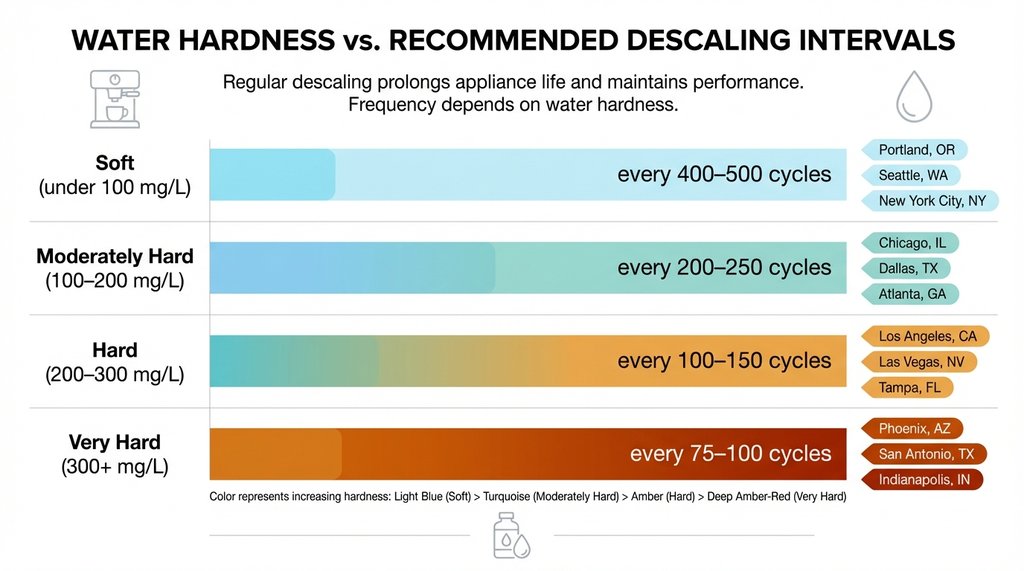
Under 100 mg/L (soft): Descale every 400–500 brew cycles, or roughly every 6–9 months with daily use. At this hardness, you’re not fighting calcium carbonate so much as magnesium bicarbonate, which is softer and deposits more slowly. Some people in very soft water regions skip descaling for a full year and the machine is genuinely fine — though I’d still do it annually just to flush the internal circuit.
100–200 mg/L (moderately hard): This is where the manufacturer interval was designed. Every 200–250 cycles, or every 3–4 months with daily use. Smeg’s built-in counter is actually reasonably accurate here if left on its default setting.
200–300 mg/L (hard): You need to cut that interval roughly in half. Every 100–150 cycles, or every 6–8 weeks if you’re making 2–3 cups a day. The alert will fire first and you should treat it as a minimum, not a suggestion.
Above 300 mg/L (very hard): Every 75–100 cycles. At this level I’d also seriously consider a filtered water pitcher or inline filter upstream of the machine. Descaling this often is expensive and does cause cumulative wear. London, Phoenix, and most of central Australia fall into this category.
The Citric Acid vs. Commercial Descaler Debate Is Mostly Settled, But Not How People Think
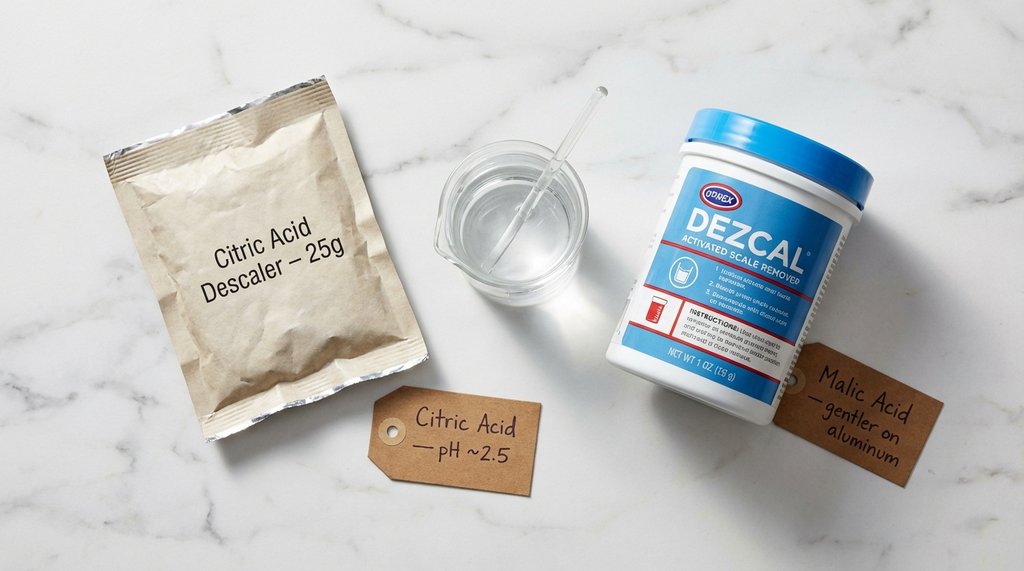
Most specialty coffee forums have landed on citric acid as the “safe and effective” choice, and for most use cases that’s correct. Smeg’s own branded descaler is a citric acid formulation at around 2% concentration. Descaler sachets from third parties claiming to be “machine-safe” are almost always the same thing in a different sachet.
Where this advice quietly falls apart is in machines with aluminum internal components. The ECF01 has an aluminum thermoblock. Citric acid at the concentrations in commercial descalers isn’t corrosive enough to cause visible damage in a single cycle, but at 300+ mg/L water hardness where you’re descaling every 6–8 weeks — that’s 6–8 descaling cycles per year, which is around 40+ cycles over a five-year machine life — you are slowly etching the oxidation layer on the aluminum. It’s not dramatic failure, it’s gradual degradation that shows up as a metallic taste in your brew somewhere around year three or four.
I switched to a lactic acid–based descaler (like DeLonghi EcoDecalk, which uses lactic acid rather than citric) for my ECF01 specifically because lactic acid is substantially gentler on aluminum at equivalent descaling efficacy. There isn’t a lot of manufacturer-level documentation on this distinction because it complicates the “just use our descaler” message, but the chemistry is not controversial.
What Scale Damage Actually Looks Like Before You Notice Extraction Problems
The temperature drop I mentioned at the top is already a fairly late indicator. By the time you’re pulling 5°C low at extraction, there’s meaningful scale insulating your heating element or thermoblock wall.
The earlier signs in Smeg machines specifically:
The fill-to-brew cycle gets longer. On a clean DCF02, water heats and begins flowing in roughly 45–55 seconds from cold. When I tracked mine over three months in hard water without descaling, that number crept up to 70 seconds. The resistance in the heating circuit increases as scale builds, so the element runs longer to hit target temp.
The machine gets louder during heat-up. Scale creates micro-hotspots on the element surface where steam bubbles form and collapse — that’s the cracking and pinging sound that gets more pronounced as buildup increases. A clean Smeg is essentially silent during heat-up.
Brew volume inconsistency appears before taste does. If you’re measuring yield by weight (and you should be if you care about this), you’ll notice 2–3g variance in brew weight before you notice any flavor shift. Scale partially blocking the showerhead or grouphead affects flow rate in a way that’s invisible until you’re watching a scale.
The One Thing That Genuinely Surprised Me When I Started Tracking This
I assumed that using filtered water — specifically water run through a Brita-style pitcher — would push my descaling interval out to the “soft water” range regardless of my actual tap hardness. My tap in the area I’m in runs around 280 mg/L. A standard Brita pitcher reduces that to roughly 130–160 mg/L depending on filter age and flow rate. That’s a meaningful reduction, but it’s still solidly in the “moderately hard” bracket.
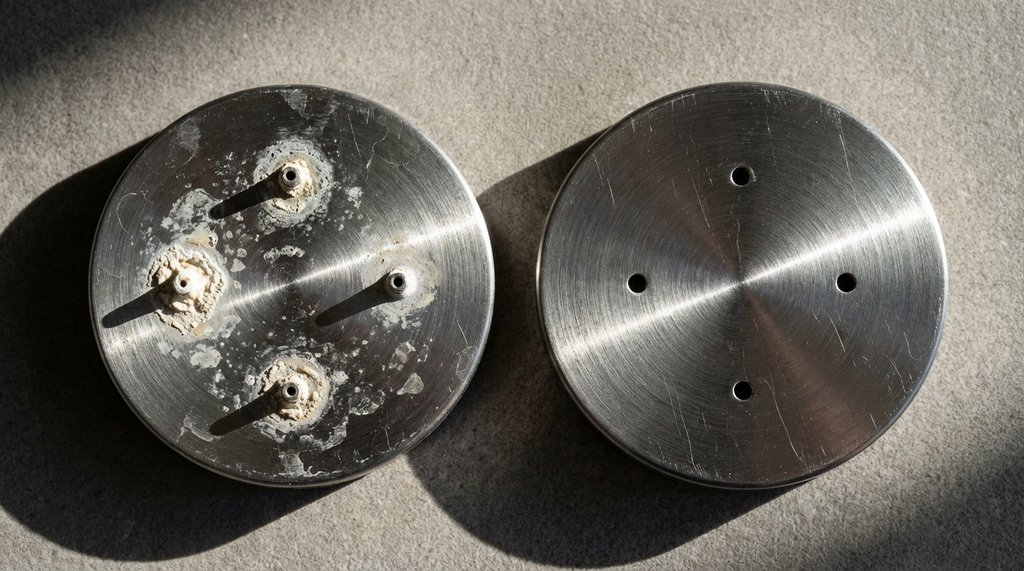
I had convinced myself I was in soft water territory and stretched my descale interval to 6 months. At month 5, I pulled the shower plate on my BCC02 and found visible white deposit around three of the eight spray holes. Not catastrophic, but enough that two holes had roughly 40% reduced flow, which I confirmed by running water through the plate into a measuring cup and timing it against a clean plate I have from a machine I use less often.
Filtered water genuinely helps. It doesn’t give you soft water unless you’re using a zero-water or reverse osmosis filter, and those create their own problem — water that’s too low in mineral content is actually bad for espresso extraction chemistry, tends to corrode metal components, and is explicitly not recommended by Smeg or most machine manufacturers. The target range for espresso brewing water is generally 75–150 mg/L, and most coffee-focused water guides (Scott Rao’s, for instance) land somewhere in that band.
Running RO water through a Smeg to avoid descaling entirely is one of those solutions that creates a worse problem than the one it solves. I’ve seen this kill thermoblocks and boilers.
Regional Quick Reference
If you know roughly where you are and don’t want to test:
Likely soft (under 100 mg/L): Pacific Northwest US, most of Scotland, coastal Norway, upland Wales, much of Ireland, Vancouver, Seattle, Portland, Reykjavik. Descale every 5–6 months with daily use.
Likely moderate (100–200 mg/L): Parts of the US Southeast (varies heavily by city), most of France outside Paris, inland New Zealand, most of coastal Australia (check your specific utility). Follow manufacturer interval.
Likely hard (200–300 mg/L): Most of Southern England outside London, large parts of the US Southwest, most of Germany’s lowland regions, Los Angeles. Cut manufacturer interval by 40%.
Likely very hard (300+ mg/L): London (especially south and east), Phoenix, Las Vegas, Denver during drought periods, much of inland Queensland. Descale every 6–8 weeks. Seriously consider an upstream softening filter.
These are generalizations and city-level water chemistry varies by district and season. The $12 TDS meter takes 30 seconds and is simply more accurate than any geographic shortcut.
The actual cost of ignoring this isn’t the scale itself — it’s what scale does downstream. On the BCC02 specifically, the pump works harder when it’s compensating for restricted flow, and the NTC thermistors cycle more aggressively. None of that shows up as a single dramatic failure. It shows up as a machine that dies at month 20 instead of running fine at month 60. Smeg’s warranty is two years in most markets. The math on whether you’re still covered when the compounding neglect becomes visible is usually not in your favor.