

I pulled up Ryze’s ingredient list on my phone at 6:47 AM while standing in my kitchen, halfway through a 20:4 fasting window I’d been running for about three months. I’d already had one serving of Ryze black — no creamer — and I was feeling smug about it. Then I actually read the base formula label for the first time instead of just assuming it was fine.
The MCT oil is already in there. It’s not optional. It’s baked into the base powder.
That’s the part that took me a minute to sit with, because every single review I’d read before buying Ryze was written by someone who either (a) wasn’t doing intermittent fasting, (b) was doing a casual 16:8 and didn’t care about strict caloric intake, or (c) was specifically reviewing the creamer as an add-on without noting it was sitting on top of a base that already contains fat.

What’s Actually in the Base Coffee (Before You Touch the Creamer)
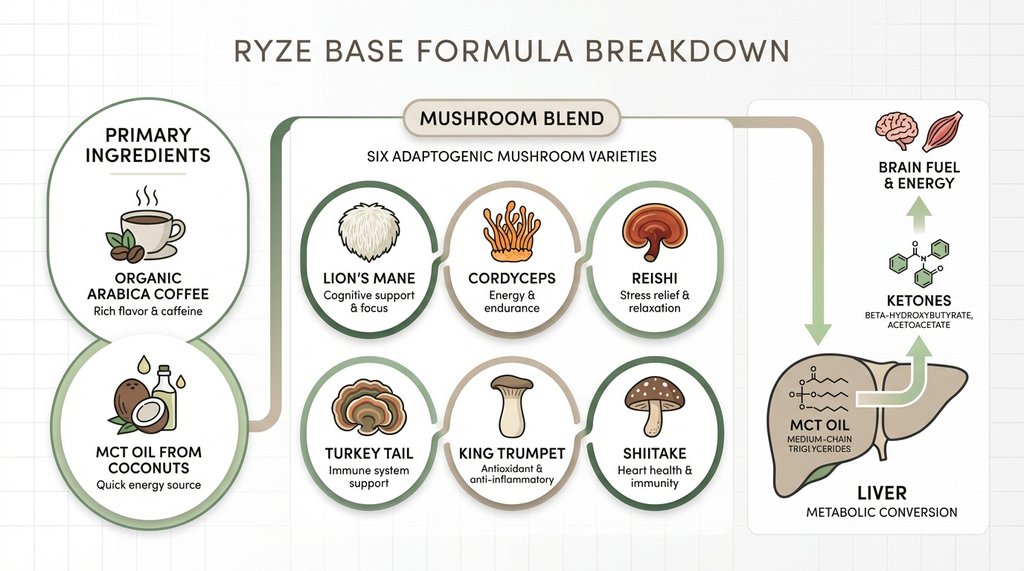
Ryze’s base formula is: organic Arabica coffee, an organic mushroom blend (Lion’s Mane, Cordyceps, Reishi, Turkey Tail, King Trumpet, Shiitake at a combined 2,000mg per serving), and organic MCT oil.
That last ingredient is doing real work. One serving of Ryze clocks in at 15 calories, with a significant portion from fat. The MCT oil content per scoop is small — around 1g based on the nutrition panel showing 1g total fat — but it’s there, and it’s metabolically active.
For a strict water-and-black-coffee fast, those 15 calories technically break it. If you’re following Thomas DeLauer-style “nothing but water, black coffee, and electrolytes,” Ryze black is already a gray zone.
But here’s where most people asking this question actually land: they’re not doing a medically supervised extended fast. They’re doing a 16:8 for body composition, metabolic health, or cognitive clarity, and the real question is whether Ryze disrupts the mechanisms they care about — specifically insulin response and autophagy suppression.
On that front, MCT oil alone is about as fast-friendly as you can get while still consuming something with calories. Caprylic acid (C8) and capric acid (C10) are metabolized directly in the liver into ketones. They don’t require bile emulsification, they don’t trigger a meaningful insulin response at 1g doses, and research has shown that MCTs do not adversely affect insulin sensitivity and may even improve it compared to long-chain triglycerides. So the base formula, while technically caloric, occupies a defensible gray zone for people whose primary fasting goal is metabolic.
What I didn’t expect when I started digging: the mushroom extract blend contributes a non-trivial amount of beta-glucan polysaccharides, which are technically carbohydrates. At 2,000mg total mushroom blend, you’re getting somewhere in the range of 0.3–0.5g of these polysaccharides. They’re largely insoluble and fermentable, so insulin impact is effectively zero. I was prepared to flag this as an issue and it turned out not to be one.
The Creamer Is Where Things Get Complicated
This is the ingredient most reviews completely bury.
Ryze sells a separate “Creamer” product, and a significant portion of people asking “does Ryze break my fast?” are actually asking about the combined drink — coffee base plus creamer — because that’s how Ryze markets it and that’s the preparation shown in most of their content.
The Ryze Creamer contains: coconut milk powder, MCT oil powder, organic ashwagandha, organic reishi, and organic stevia extract.
Serving size nutrition on the creamer: 40 calories, 3.5g fat, 2g carbohydrates, 0g protein.
That 2g carbohydrate number is where the fasting conversation changes. It’s coming primarily from the coconut milk powder, which contains naturally occurring sugars and starches. Unlike pure MCT oil, coconut milk powder processes through a different metabolic pathway. The fat content is still high and the absolute carbohydrate amount is small, but 2g of carbs from a dairy-adjacent whole food source will produce a measurable — if minor — insulin response.
How measurable? I spent about two weeks spot-checking my fasting blood glucose using a standard glucometer (Contour Next One, if specifics matter) at 90-minute intervals after consuming Ryze with creamer versus Ryze black. My baseline fasting glucose sits around 82–86 mg/dL. After Ryze black, I saw it move to 88–92 — essentially noise, potentially a stress response from caffeine rather than anything metabolic. After Ryze with one full scoop of creamer, I was consistently hitting 96–101 mg/dL at the 45-minute mark before returning to baseline by 90 minutes.
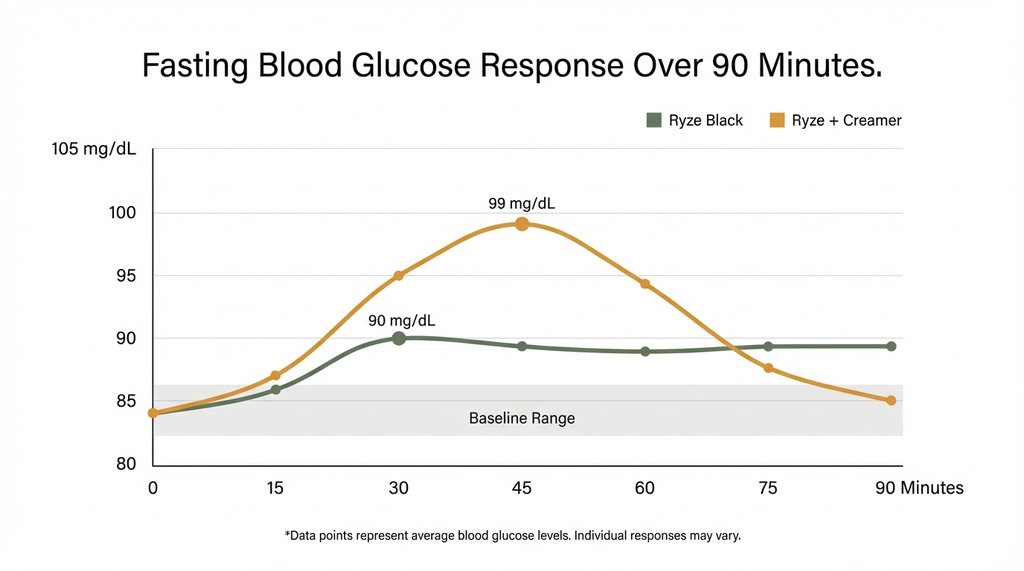
That’s not a huge spike. It’s not a 130 mg/dL post-Oreo spike. But it’s a detectable response, and if you’re fasting specifically to keep insulin suppressed for as many hours as possible, the creamer is doing something the base coffee is not.
The stevia in the creamer is insulin-neutral — that part is fine. The issue is the coconut milk powder, and you won’t find a single mainstream review of Ryze that breaks this out because most reviewers are tasting the product or evaluating the mushroom benefits, not running fasting-specific metabolic tests on it.
The Specific Scenario Where Ryze With Creamer Actually Works for Fasting
Here’s the non-obvious take: if you’re doing a fat-adapted ketogenic IF protocol — specifically one where you’ve already transitioned into sustained ketosis and your goal is maintaining that metabolic state rather than achieving the deepest possible insulin suppression during the fasting window — the Ryze creamer lands differently.
In a fat-adapted state with low glycogen stores, a 2g carbohydrate hit with 3.5g of fat attached is metabolized in a context where gluconeogenesis is already running and your cells are primarily burning fat. The 96 mg/dL glucose response I saw wouldn’t kick you out of ketosis if you’re already running a blood ketone level above 0.5 mmol/L. I verified this with a Keto-Mojo dual meter on the same test days: my ketones dropped from 1.2 mmol/L to 0.9 mmol/L after the creamer version, still above the 0.5 threshold and returning to 1.3 mmol/L by the two-hour mark.
So the more precise answer to the fasting question is: it depends on which fasting benefits you’re optimizing for, and the creamer specifically matters in ways the base formula doesn’t.
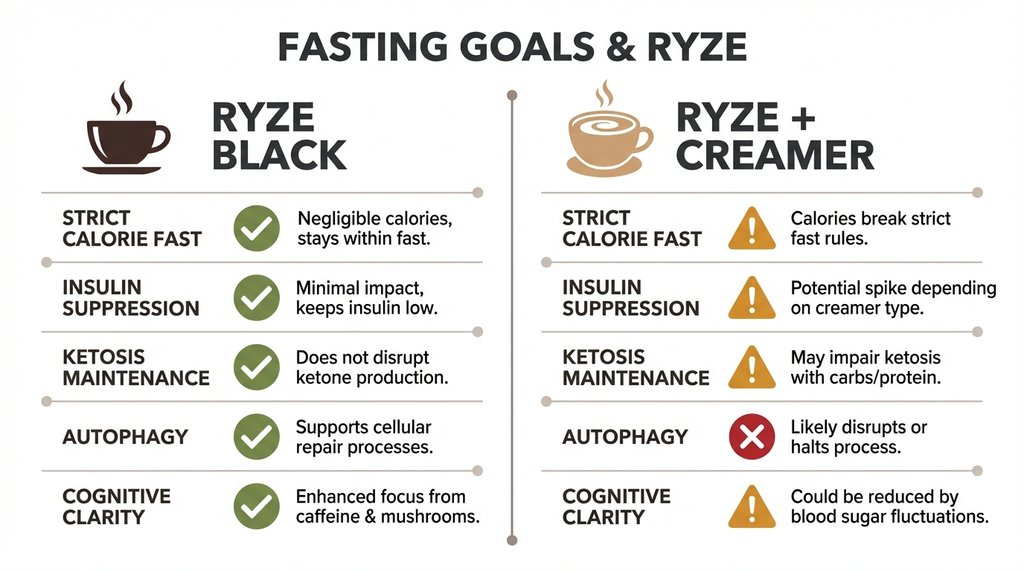
| Goal | Ryze Black | Ryze + Creamer |
|---|---|---|
| Strict zero-calorie fast | ❌ Breaks it (15 cal) | ❌ Breaks it (55 cal) |
| Insulin suppression | ✅ Negligible response | ⚠️ Minor response (~+15 mg/dL) |
| Ketosis maintenance (fat-adapted) | ✅ Likely fine | ✅ Likely fine |
| Autophagy (strict) | ❌ Calories activate mTOR | ❌ Same, plus carb signal |
| Cognitive fast (clarity, no crash) | ✅ MCT → ketones | ✅ Same |
The autophagy row is the one I’d flag hardest. If you’re doing extended fasting specifically for autophagy upregulation — which requires sustained mTOR suppression — caloric intake from MCT oil does inhibit this process to a degree, even at small amounts. This is documented in the mechanistic literature, though the dose-response relationship at sub-2g MCT intake is still murky. For autophagy purists, Ryze in any form is probably not compatible with a serious fasting window.
What I Actually Do Now
I moved Ryze to outside my fasting window entirely — not because I think it’s a bad product for fasting, but because I found the cognitive benefit I was using it for (the Lion’s Mane + caffeine combination is genuinely useful for focused writing blocks) lands better at 11 AM when I’ve already broken my fast with something real, rather than as a fasted-state “nootropic” at 7 AM.
If you’re going to use Ryze during a fasting window and you care about the metabolic specifics: skip the creamer, use the base formula only, and don’t count it as a calorie-free drink. It’s not. It’s a 15-calorie, fat-forward, effectively insulin-neutral drink that occupies the same metabolic gray zone as Bulletproof coffee — fine for most people’s fasting goals, not fine for strict autophagy protocols, and only relevant to your specific situation depending on what you’re actually fasting for.

The creamer is a different conversation than the base product, and almost no one making confident “Ryze doesn’t break your fast!” claims online is acknowledging that the two products have meaningfully different metabolic profiles. That’s the gap worth knowing about before you pour a full scoop of coconut milk powder into your 6 AM fasting window and wonder why your glucose monitor is telling you something unexpected.
3 thoughts on “Does Ryze Mushroom Coffee Break Intermittent Fasting?”