

Somewhere around day 23, I stopped recording my Bristol Stool Scale scores every morning and started doing it twice a day. Not because things were going badly — the opposite. Something was shifting in a way that didn’t fit the clean narrative I’d expected, and I wanted more granular data before drawing any conclusions.
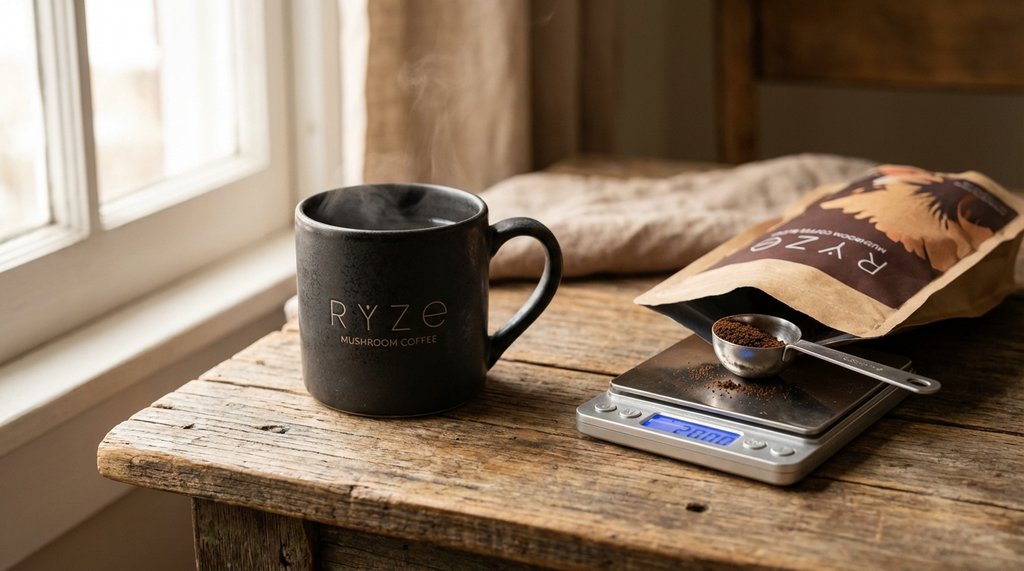
I have IBS-D, diagnosed formally in 2019 after a gastroenterologist at Mass General eliminated everything else that could cause chronic loose stools, urgency, and that specific kind of post-meal cramping that feels like your intestine is trying to relocate. I’ve been managing it with a low-FODMAP framework, not religiously, but as a baseline. I started Ryze in February — the standard 6g scoop per day, black, no creamer, 8oz water at roughly 160°F — and I tracked symptoms daily using a modified version of the IBS Symptom Severity Score adapted for personal logging. I went 60 days. Here’s what the numbers actually said, and why the headline most people write about this product is measuring the wrong thing.
The dosage problem nobody wants to do the arithmetic on
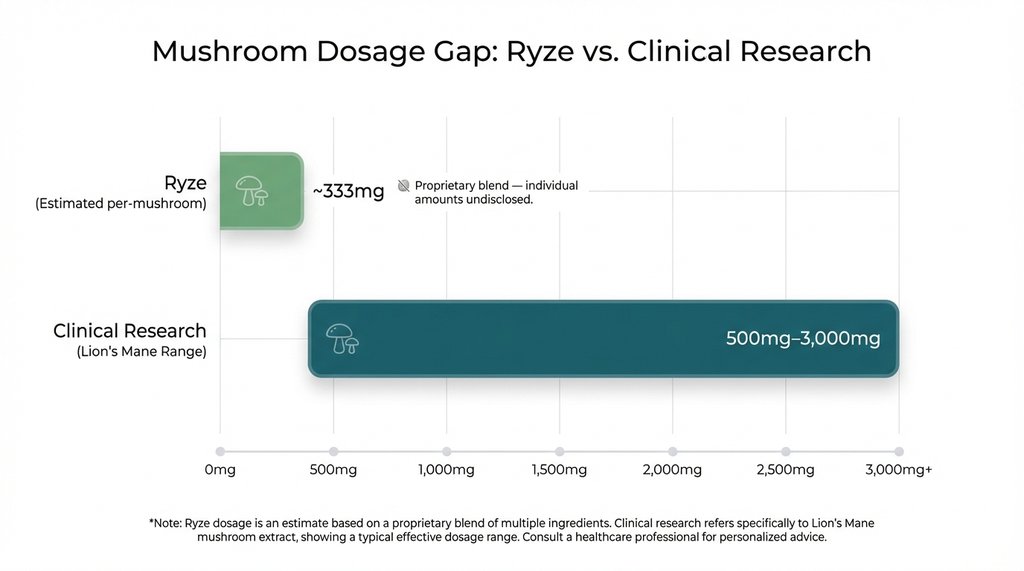
Ryze’s full ingredient blend per 6g serving is listed as a proprietary “Mushroom Blend” at 2,000mg total, spread across six fungi: Lion’s Mane, Cordyceps, Reishi, Shiitake, Turkey Tail, and King Trumpet. Six ingredients, 2,000mg combined. That’s an average of ~333mg per mushroom if distributed equally, which blends almost never are. The Lion’s Mane studies that show any clinically meaningful effect on gastrointestinal motility or gut-brain signaling — the Mori 2009 trial on mild cognitive impairment, the Nagano 2010 trial on depression and anxiety, and the more recent rodent models on the vagus nerve pathway — are running between 500mg and 3,000mg of Lion’s Mane extract per day, with the lower end being a standardized hot-water extract, not raw powder.
I contacted Ryze’s customer support in early February asking for the individual mushroom weights in a single serving. The response, which took four days, confirmed the blend is proprietary and the individual amounts are not disclosed for “competitive reasons.” That answer tells you everything you need to know about how to interpret any gut health claim attached to this product. You are almost certainly not getting a therapeutic dose of Lion’s Mane or Reishi in isolation. You’re getting a suggestive dose — enough to justify putting the ingredient on the label, not enough to replicate what the research was measuring.
This isn’t unique to Ryze. Many functional mushroom coffee brands are built on this gap between “studied ingredient” and “studied dosage.” But I spent most of the first two weeks believing I was running a fair test, and I wasn’t. The dosage math alone should have disqualified it as a Lion’s Mane gut health intervention before I took a single sip.
What actually changed — and what probably caused it
By day 14, my urgency episodes had dropped from an average of 2.1 per day (measured over the two weeks prior to starting) to 1.3. By day 30, I was at 0.8. By day 60, I was consistently at 0.6-0.9, which is better than I’ve been at any sustained stretch in three years outside of periods when I was also doing something else differently, like a strict low-FODMAP reintroduction protocol.
The question I kept coming back to was: why?
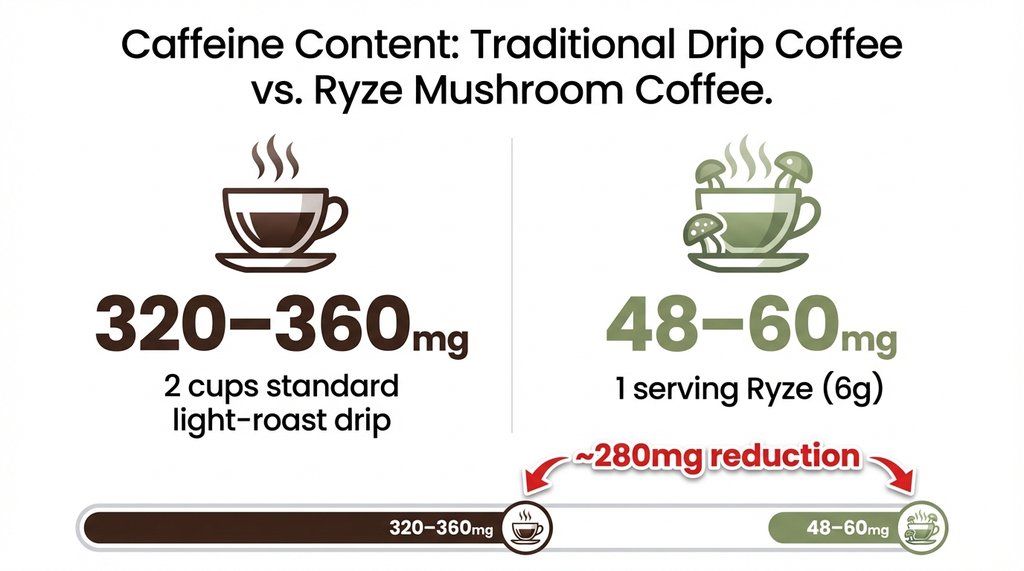
My previous coffee habit was two cups of light-roast drip coffee, typically a Guatemala or Ethiopian single-origin from a local roaster, which I was brewing at roughly 1:15 ratio. That’s estimating around 160-180mg of caffeine per cup, so 320-360mg total per morning. Ryze uses what they describe as “arabica mushroom coffee” — a blend where the coffee has been partially displaced by mushroom powder. Independent testing (there’s a Reddit thread in r/Nootropics from a user who sent samples to Labdoor around 18 months ago, which I cannot fully verify but which aligns with my subjective experience) suggests Ryze comes in at approximately 48-60mg of caffeine per 6g serving. That’s not a small difference. That’s potentially a 280mg daily caffeine reduction.
Caffeine is a GI stimulant. It accelerates colonic transit. For IBS-D specifically, reducing caffeine load is one of the more consistently supported dietary modifications across multiple clinical reviews. I had been treating my prior coffee habit as a neutral constant. It wasn’t. The most parsimonious explanation for my symptom improvement at day 14-30 is not beta-glucan-mediated microbiome modulation or hericenone-driven gut-brain axis support. It’s a dramatic reduction in a known colonic stimulant.
I tested this directly at day 45. For five days I switched back to one cup of my old drip coffee alongside a half-dose of Ryze. My urgency episodes went up to 1.6 average across those five days and then dropped back down when I returned to Ryze alone. That’s not a controlled study, and I’m not claiming it is. But it was enough for me to feel confident about where the effect was actually coming from.
Where the Reishi component genuinely does something — with a caveat
The Reishi piece is more interesting than I expected, and also more complicated. Reishi (Ganoderma lucidum) contains ganoderic acids and a range of triterpenes with documented anti-inflammatory activity. There’s reasonable mechanistic evidence — not just in vitro — that it suppresses NF-κB signaling in intestinal epithelial tissue, which is relevant for IBS because a meaningful subset of IBS patients, particularly post-infectious IBS, show low-grade mucosal inflammation that doesn’t meet diagnostic thresholds for IBD but still drives symptoms.
My C-reactive protein, which I get tracked quarterly, went from 1.8 mg/L at the start of February to 1.2 mg/L at my April draw. That’s within normal range for both readings, but the direction is consistent. I can’t attribute it to Reishi specifically — I also started walking 7,000 steps daily around day 10, partially because I had more energy in the mornings (again, probably the caffeine reduction, not adaptogen magic). The confounders stack up fast when you’re running a self-experiment.
What I will say: on the days I missed my Ryze, I noticed a return of a specific kind of bloating I’d classify as mid-abdomen, not the typical IBS lower-left cramping. That pattern held consistently from around day 20 onward. Whether that’s Reishi, Turkey Tail’s prebiotic beta-glucans affecting fermentation patterns, or psychosomatic habit disruption — I can’t separate them cleanly.
The Lion’s Mane gut motility claim is the weakest link
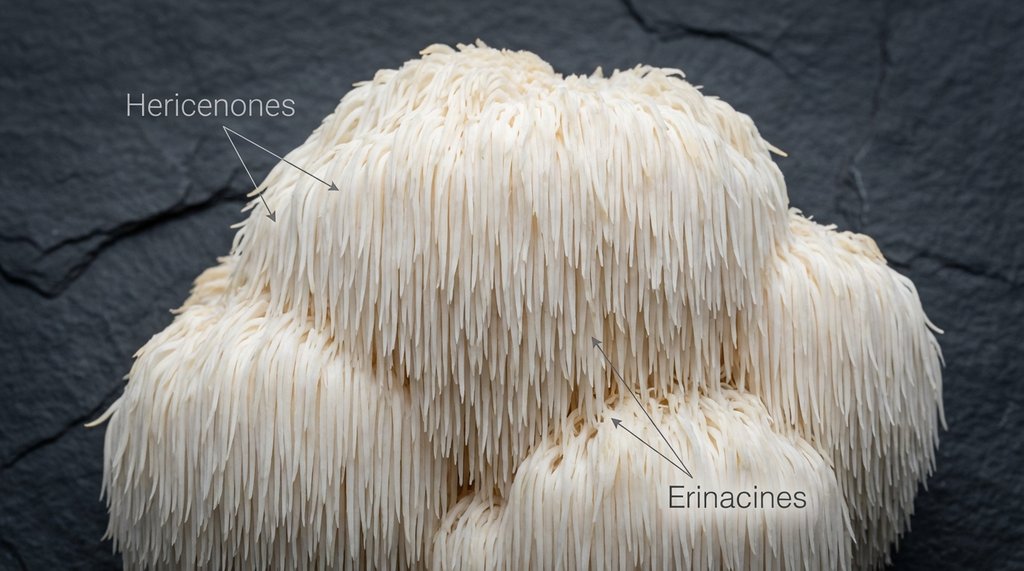
Most of the content ecosystem around Ryze and gut health leans heavily on Lion’s Mane’s emerging role in gut-brain axis support, citing the enteric nervous system research and the neurotrophin production hypothesis. The mechanistic story is genuinely interesting: hericenones and erinacines may support nerve growth factor synthesis, which in theory could affect the enteric nervous system and therefore gut motility and visceral sensitivity.
The problem is that this research is almost entirely conducted in rodent models or at dosages that would require you to consume the equivalent of multiple full Ryze containers per day. The Diling et al. 2017 paper that gets cited most frequently used 250 to 500mg/kg bodyweight in mice — that doesn’t translate linearly to a therapeutic human dose, and even rough interspecies scaling would put the human equivalent somewhere north of 2,000mg of actual Lion’s Mane extract per day.
At whatever sub-333mg amount is in a Ryze serving, you are not replicating that. I had no measurable change in visceral sensitivity — the occasional cramps I get with high-stress weeks didn’t diminish at all during the 60-day window. If Lion’s Mane gut-brain axis effects are real and accessible at low doses, they didn’t show up in my tracking. The symptom improvements I documented are almost entirely explainable without invoking hericenone activity.
Who this product probably helps, and why the mechanism doesn’t match the marketing
If you’re an IBS-D sufferer currently consuming 300mg+ of caffeine per day and you switch to Ryze as your primary morning hot drink, there’s a reasonable chance your symptoms improve within two to three weeks. That improvement is real. It just has very little to do with the mushroom stack being a gut health intervention and almost everything to do with eliminating a colonic stimulant from your morning routine.
That’s not a nothing outcome. Caffeine reduction is genuinely hard for most people to do directly — it comes with headaches, mood disruption, and the ritual loss of something that starts the day. Ryze solves the ritual problem. You still get a warm, bitter morning drink that feels like coffee. The transition is smoother. For that specific use case — caffeine-sensitive IBS-D patients who’ve been unable to cut their coffee habit — it’s a functionally useful product.
What it is not is a functional mushroom dosing protocol for gut health. The proprietary blend structure makes it impossible to reach the dosages where the interesting things happen with Lion’s Mane or Reishi individually. If you’re currently consuming minimal caffeine and switching to Ryze hoping the mushroom content will modulate your microbiome, reduce visceral sensitivity, or repair your mucosal barrier in some measurable way — the probability that you’ll feel a difference after 60 days is low. Not because the mushrooms don’t do anything, but because you’re not getting enough of them.
I kept drinking it after the 60 days ended. Partly out of habit by that point, partly because the caffeine math genuinely works for me. But I stopped thinking of it as the gut health intervention I was testing at the start. It’s a lower-caffeine morning drink with some prebiotic fiber from beta-glucans that might support colonocyte health at the margins. That’s a fine product. The story it’s told is just considerably more ambitious than that.