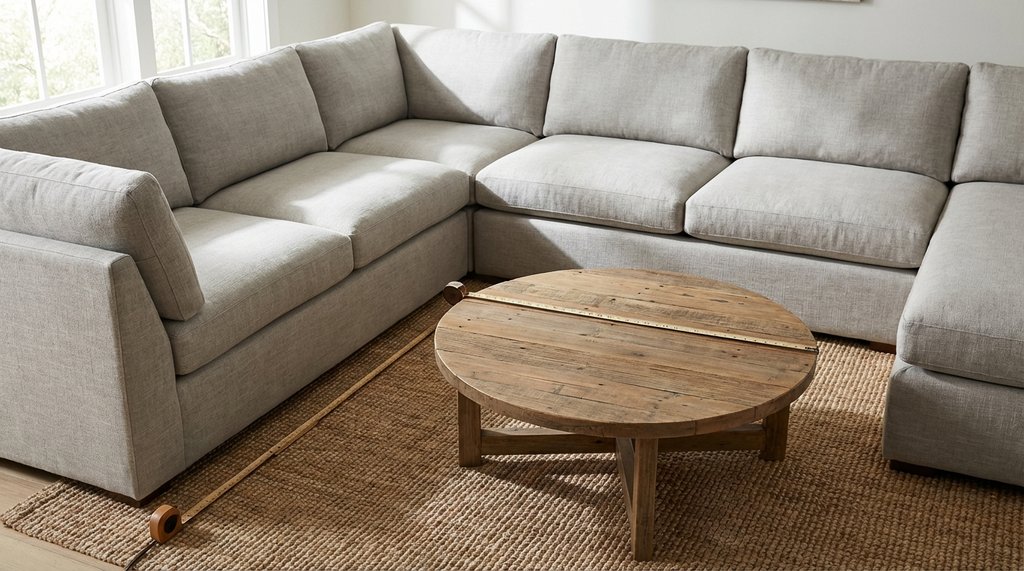
The first time I measured a client’s U-shaped sectional for a round coffee table, I brought out a 48-inch option that every furniture blog on the internet would have called “proportionally correct.” We centered it, stood back, and it looked like a manhole cover dropped into a living room. The sofa swallowed it. More critically, the clearance on the curved ends of the U measured out to just under 11 inches — tight enough that she’d kicked it twice before I’d even finished writing my notes.
That was a 148-inch-wide Restoration Hardware Cloud sectional with a 62-inch interior depth. The math I’d used was wrong, and I’d been using it wrong for about two years before that job forced me to recalibrate.
Why the Standard “18-Inch Rule” Breaks Down Inside a U-Shape
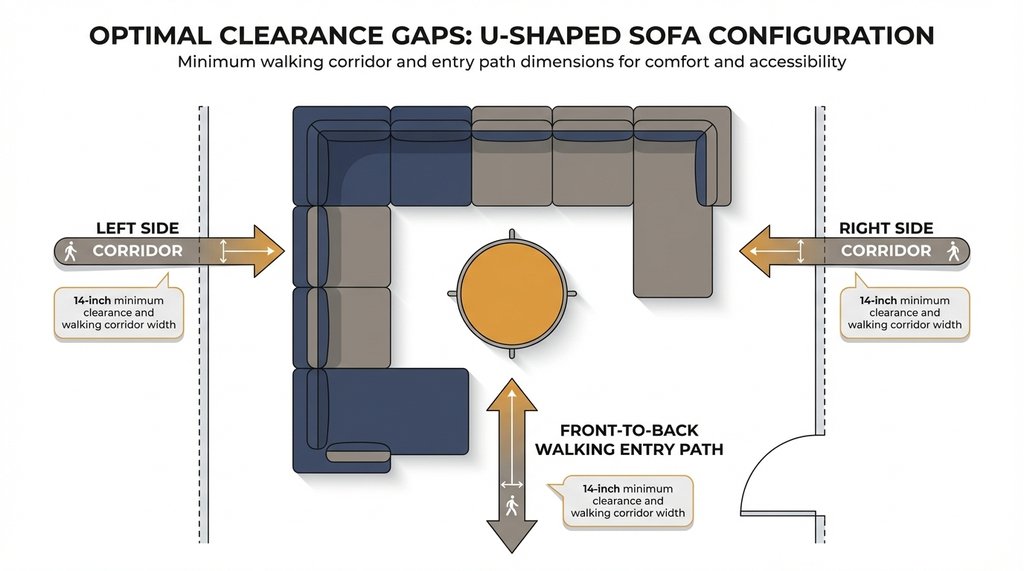
Most clearance advice online treats the sofa as a straight or L-shaped piece and measures one distance: the gap between the sofa face and the table edge. That measurement — 14 to 18 inches — is real and it matters. But in a U-shaped configuration, you’re not dealing with one clearance gap. You’re dealing with three simultaneous clearance constraints and a fourth one that almost nobody talks about: the walking path into the U.
When someone needs to get from the open end of the U to a seat at the back of the sofa, they’re walking beside the table, not just reaching over it. On a round table, the widest point is the diameter itself, and it’s centered in the space. That means the effective walking corridor on each side equals: (interior width of U ÷ 2) minus (table diameter ÷ 2).
If your U-shape interior is 96 inches wide and you drop in a 48-inch round table, each side corridor is 24 inches. That sounds fine until you remember the sofa’s seat cushions extend 3 to 4 inches forward of the frame, and the table legs often splay out another inch or two past the tabletop edge. Real usable corridor: closer to 19 inches. Still passable, but not comfortable when two people are trying to navigate at the same time.
Go up to a 54-inch round table in that same 96-inch interior, and each corridor drops to 21 inches nominal, probably 16 actual. I’ve had people describe that as “fine” until they’re carrying a drink.
The Actual Formula I Now Use
This took embarrassingly long to land on, partly because I was anchored to the 18-inch clearance metric and kept applying it to the wrong measurement.
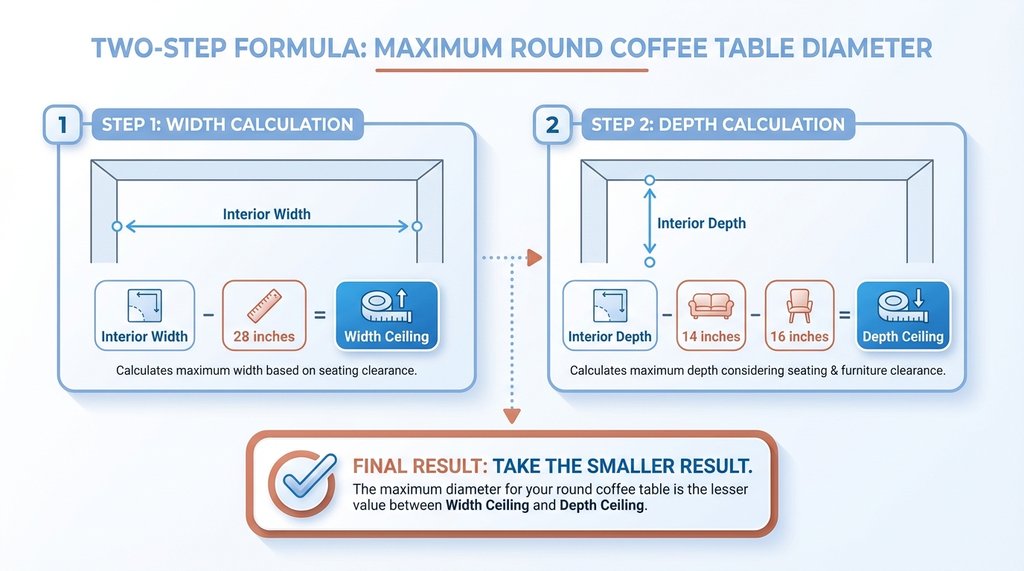
The correct approach for a round table in a U-shaped sectional is to solve for two numbers separately, then take the smaller of the two as your diameter ceiling.
Constraint 1: Side clearance from the curved/end sofa faces
Measure the interior width of your U at its narrowest usable point (usually near the back corners, where the side returns meet the back section). Subtract 28 inches (14 inches of clearance on each side). This gives you your maximum diameter based on width.
Example: 104-inch interior width → 104 − 28 = 76-inch maximum
Constraint 2: Front clearance from the sofa back section
Measure the interior depth of the U — from the front face of your back sofa section to where you consider the “open” end to begin. Subtract 14 inches (clearance from the back sofa face only — you’re not subtracting clearance from the open end because that’s the walking approach). But then subtract an additional 12 to 16 inches to leave room for the person entering the U to actually walk alongside the table without turning sideways.
I use 16 inches for that corridor buffer because that’s the minimum shoulder width for a side-shuffle, and nobody should have to side-shuffle in their own living room.
Example: 68-inch interior depth → 68 − 14 − 16 = 38-inch maximum
Take the smaller result. In this example, 38 inches is your ceiling.
That number will almost certainly be smaller than what feels visually right when you look at the room on paper. That gap is exactly where the wrong-size tables come from.
The Specific Clearance Numbers That Actually Matter
Rather than ranges, here are the hard floors I work with:
- 12 inches: Absolute minimum clearance between sofa face and table edge. Below this, the table functions as a shin obstacle rather than a surface. I won’t go here even in small rooms.
- 14 inches: Minimum comfortable reach-and-set clearance. Functional for leaning forward to place a drink. This is the number to use on your constrained sides.
- 16–18 inches: The target clearance for primary seating positions — wherever the most-used seats are. On a U-shape, that’s usually the back center section and both corners.
- 20–24 inches: What you want on the walking entry path. This is non-negotiable for households with kids (who might also need hidden toy storage in their table), dogs, or anyone who moves quickly through a space.
The reason I stopped quoting ranges and started using specific numbers: clients hear “14 to 18 inches” and they always picture the larger number. They then choose a table that achieves 14-inch clearance on the constrained side and call it within range. Technically correct. Also the reason three different clients ended up with tables they described as “always in the way.”
What “Interior Width” Actually Means on a U-Shaped Sectional
This is the measurement that trips people up at the furniture store.
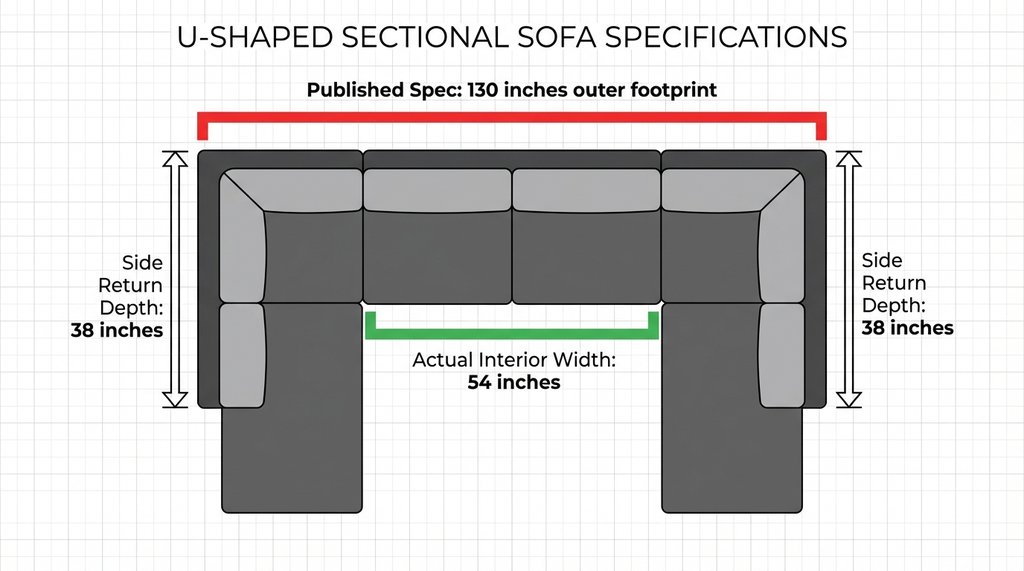
The published dimensions of a U-shaped sectional — say, 130″ × 105″ — refer to the outer footprint. The interior width is the gap between the inside faces of the two side returns. On most production sectionals, the depth of each side return (from its outer edge to its inner face) runs 36 to 42 inches. Do the math for a 130-inch-wide sofa with 38-inch returns on each side: 130 − 76 = 54-inch interior width.
Put a 48-inch round table in a 54-inch interior width and your clearance on each side is 3 inches. I’ve seen this setup in real rooms. People eventually push the table off-center, which looks worse and still catches the corner.
Measure your actual interior width with a tape measure before doing anything else. Don’t use the spec sheet.
When the “Too Small” Table Is Actually the Right Call
Here’s where I’ll push back on the proportionality instinct, because I think it causes more bad purchases than anything else in this specific furniture category.
Interior design convention says your coffee table should be approximately two-thirds the length of your sofa. Applied to a U-shape, people extrapolate this to mean the table should feel substantial relative to the interior opening. The result is that a 60-inch-wide interior frequently gets a 42- or 44-inch round table, which hits right at the visual threshold where it looks “right.”
The problem: a 42-inch round table in a 60-inch interior leaves only 9 inches of clearance per side. That’s below the 12-inch hard floor. I’ve measured this exact configuration in four separate homes over the past three years, and in every case the owners had unconsciously started avoiding the interior seats of the U because it felt cramped to get in and out. One of them didn’t realize this was the reason until I pointed it out. She’d had the sectional for two years.
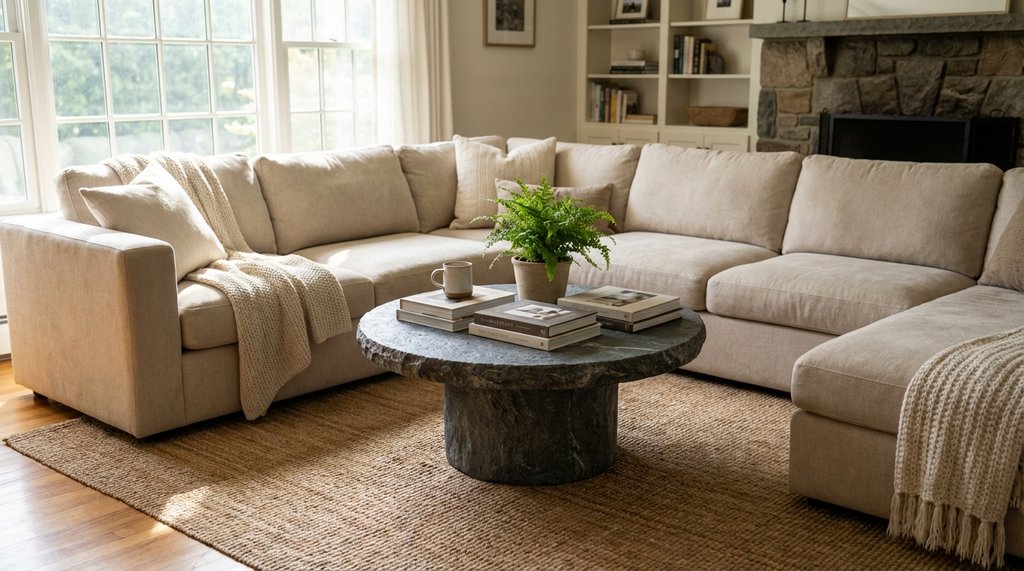
In a 60-inch interior, the honest right answer is a 30-to-34-inch round table. That looks small on paper. It works in person. If the visual lightness bothers you, go with a table that has visual weight in its base — heavy turned wood, solid stone, cast metal — rather than compensating with diameter.
The Floor-to-Tabletop Height Variable That Gets Ignored
One more thing worth drilling into, because it directly affects whether any of the clearance math is meaningful in practice.
The standard guidance is that a coffee table should sit within 1 to 2 inches of your sofa seat height. Most sectionals have seat heights between 17 and 20 inches. Most coffee tables are 16 to 18 inches tall.
But U-shaped sectionals, particularly the deep-seat cloud-style ones that became almost default for living rooms between 2020 and 2024, commonly have seat heights of 15 to 16 inches — and seat depths of 42 to 48 inches. On a 42-inch-deep seat, you’re sitting far enough back that a standard 17-inch tall table effectively disappears below your sightline when you reach forward. A table you can’t see the surface of from your seated position doesn’t serve its function regardless of how perfect the diameter is.
For deep-seat sectionals, I size down on diameter and up on height — a 28- to 30-inch diameter table that is 18 to 20 inches tall (or a tray-style table cluster) serves the space better than a wide flat surface that nobody can comfortably reach.
A Quick Reference by Interior Opening Size
These are the diameter ceilings I use as starting points before measuring actual clearance in the room:
| Interior Width of U | Maximum Round Table Diameter | Notes |
|---|---|---|
| 48–56 inches | 24–28 inches | Small U-shape; consider oval or rectangular instead |
| 57–72 inches | 30–36 inches | Workable range for most round tables |
| 73–90 inches | 38–44 inches | Standard U-shape sweet spot |
| 91–108 inches | 44–52 inches | Verify depth constraint separately |
| 109+ inches | 52–60 inches | Proportion usually allows larger; check walking corridor |
The depth constraint often overrides the width ceiling on longer sectionals. Always run both calculations.
How to Test Before You Buy
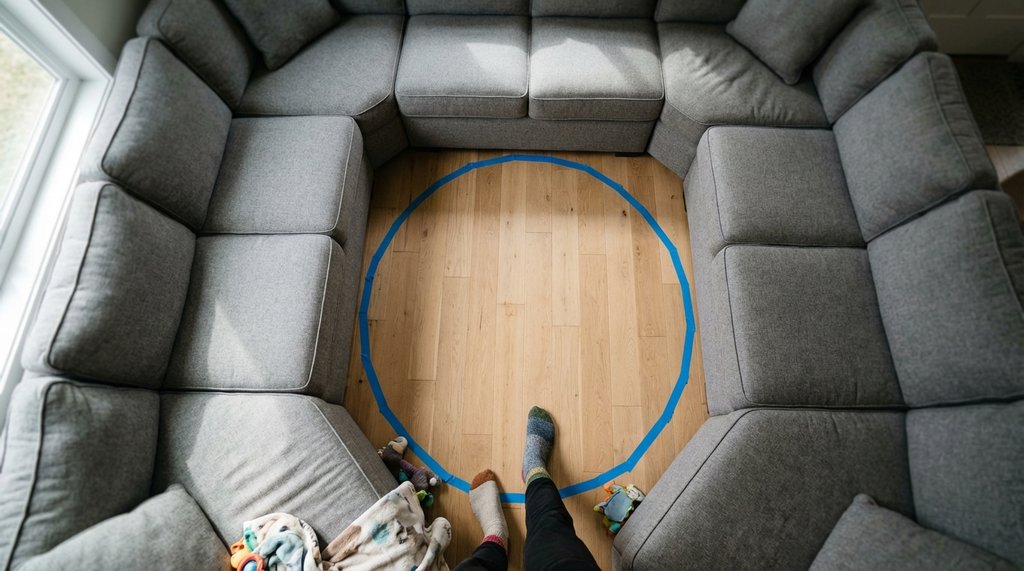
Pull out painter’s tape and mark a circle on your floor in the diameter you’re considering. Live with it for 48 hours — walk through it with a glass of water, have people sit in every section of the sofa, let whoever’s most likely to stub a toe actually stub a toe on the tape edge. The tape test is obvious advice, but the 48-hour part is what makes it useful. You won’t notice whether 14 inches feels tight until you’ve navigated it distracted, carrying something, in the dark.
If the tape circle consistently gets nudged off-center because people are unconsciously pushing it away, the diameter is too large for the clearance constraints. If people keep reaching past the tape edge because the usable surface feels too small, you might be able to go up 4 to 6 inches while still meeting your clearance minimums.
The tape doesn’t lie about clearance the way mental visualization does.