
The first time I made qishr at home, it tasted like weak ginger tea with an identity crisis. I’d followed three separate recipes I found on food blogs, and all three had the same fundamental problem: they were cowardly with the ginger and completely wrong about the husk-to-water ratio. It took me six batches over two weekends to figure out what Qamaria is actually doing differently, and the answer wasn’t what I expected.
The Ratio Problem Nobody Talks About
Every recipe I found online — and I mean every single one, including the ones from people who claim to have “authentic” Yemeni sources — lists qishr as roughly equal parts coffee husk and ginger by volume, sometimes skewing slightly toward the husk. Some go as far as calling for twice as much husk as ginger.
That’s wrong. At least if you’re trying to replicate the specific cup Qamaria serves.
When I finally sat down at their Houston location and paid attention to what I was actually tasting, the ginger wasn’t a background note. It was structural. It was carrying the drink the way espresso carries a latte — not flavoring it, but being it. The husk was providing the color, the slight fruity tartness, and the caffeine, but the ginger was the dominant sensory experience from first sip to the warmth that sits in your chest after.
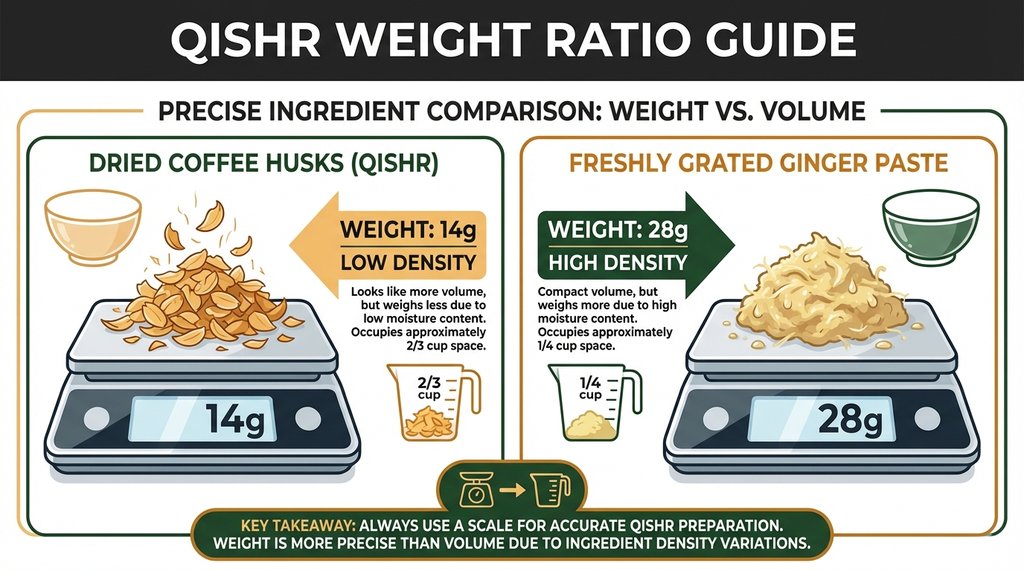
My working ratio after all those test batches: 2 parts fresh ginger (grated, not dried) to 1 part coffee husk by weight. Not volume — weight. This matters because dried coffee husks are light and airy, so volumetrically you end up dramatically under-dosing ginger if you go by the cup.
For a single 8oz serving, that works out to approximately 14g husk and 28g fresh ginger, grated on a microplane until you have almost a paste rather than strips. Some recipes call for sliced ginger. Sliced ginger in this context is basically decorative. You want cell rupture. You want the volatile oils in the water immediately.
Where the Cardamom Question Gets Messy
Half the recipes online include cardamom. Some include cinnamon. A few throw in cloves. I’ve seen one that added black pepper.
Qamaria’s qishr does not taste like cardamom to me. I’ve ordered it there maybe a dozen times now across two visits, and I specifically started paying attention to this after my third failed batch at home. There might be a trace — and I do mean a trace — of something floral in the background, but I’d lean toward it being from the husk itself rather than added spice. The Yemeni coffee husks (especially the ones sourced from the Haraaz or Bani Matar regions) have a naturally hibiscus-adjacent quality that can read as floral without any additional spice.
Adding a full cardamom pod per serving, which is what most recipes suggest, obliterates this. You end up with something that tastes like chai’s less-caffeinated cousin. It’s not bad — it’s just not qishr as Qamaria makes it.
My current approach: no cardamom at all. If you want to experiment, crack open one green cardamom pod and add it to a batch of four servings, not one. Taste it blind against a cardamom-free version. I did this with four people and three of them preferred the cardamom-free version when told nothing about what they were drinking.
The Water Temperature Issue That Destroyed Two Batches
This is the technical mistake I made longest before identifying it.
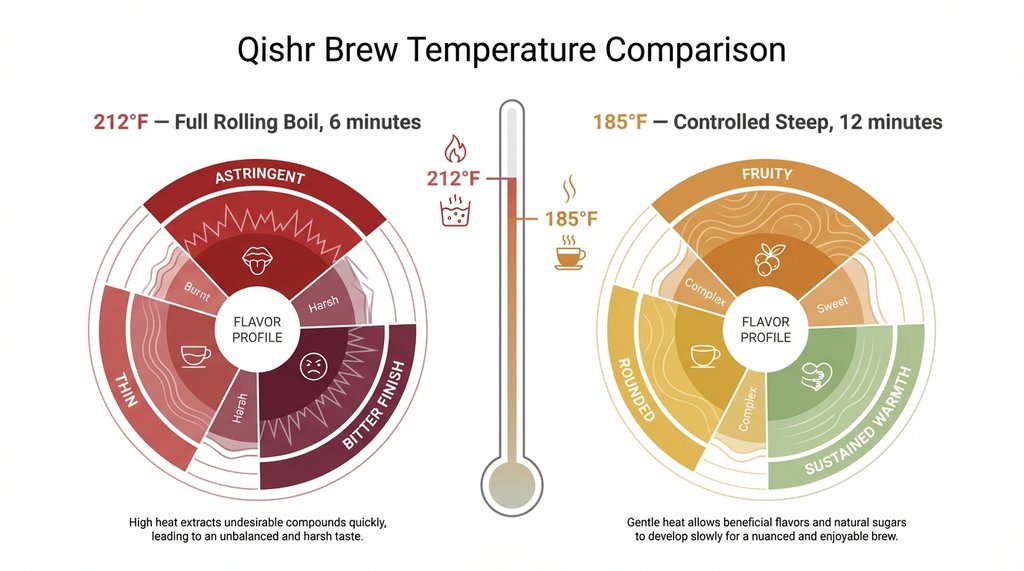
I was brewing qishr the way I’d seen it described — bring water to a boil, add husks and ginger, simmer for five to eight minutes. That’s the standard instruction. What I didn’t realize until batch four was that boiling the husk for anything over about three minutes at a full rolling boil was extracting tannins at a rate that made the drink astringent in a way that didn’t match what I’d tasted at Qamaria.
The fix was dropping the temperature to around 185°F (85°C) — not a simmer, not a boil, that specific below-boiling zone — and extending the steep time to twelve minutes. This is actually closer to how you’d treat a delicate green tea than the aggressive extraction most recipes describe.
At 185°F for twelve minutes, the husk gives you the fruit, the slight sweetness, the body. The ginger paste at this temperature is also less aggressive in a harsh way and more sustained — the heat release sits in the throat rather than hitting the front of the palate immediately.
I confirmed this wasn’t placebo by doing side-by-side comparisons in the same afternoon with the same batch of husks — one at full boil for six minutes, one at 185°F for twelve. The boil version tasted thin and slightly bitter at the finish. The lower-temperature version had a rounder, longer aftertaste. It’s the difference between coffee brewed at 205°F and coffee brewed at 212°F, if you’ve ever done that comparison for espresso troubleshooting.
The Husk Quality Variable Nobody Accounts For
This is where most home recipes fall apart structurally, not just technically: they assume you’re working with a specific quality of husk and don’t account for variation.
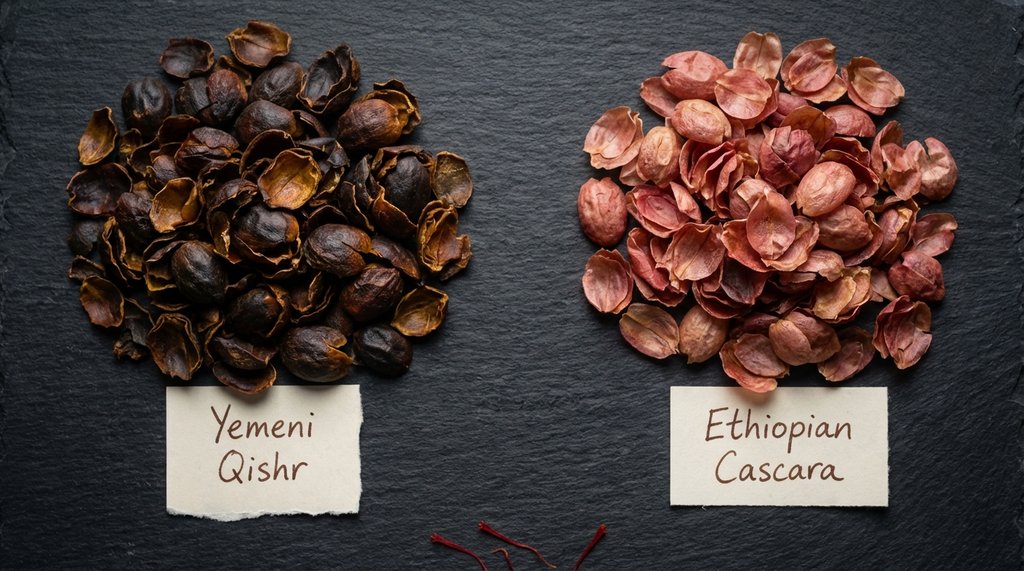
The coffee husks (qishr/cascara) available at most US grocery stores and even many specialty coffee shops are not Yemeni. They’re typically Ethiopian or Bolivian cascara, which is a different product processed differently and with a very different flavor profile — often more tart, more uniform, less complex. Ethiopian cascara tends toward a hibiscus-and-tamarind sweetness. Yemeni qishr husks (which are technically the dried outer skin and pulp, not the same as washed-process cascara) have a darker, more savory, almost tobacco-adjacent note underneath the fruit.
Qamaria sources their own, which is kind of the whole point of what they’ve built. You can’t perfectly replicate their cup without their raw material. What you can do is approximate it, and the approximation requires more ginger to compensate for husk flavor deficit, which is part of why the standard ginger ratios feel so off when you’re working with commodity cascara.
If you’re using non-Yemeni cascara (Verve, Blue Bottle, any mainstream roaster’s cascara), I’d push the ginger ratio even further — closer to 3:1 by weight — and add 2-3 threads of saffron to the steep. Not enough to taste saffron, just enough to round out the flatness. I found this out by accident when I added saffron to a batch I was making alongside a completely different project and realized the qishr that came from that pot was noticeably better.
The Sweetener Is Not a Detail
Every recipe says “sweeten to taste with sugar.” That’s technically true but practically useless.
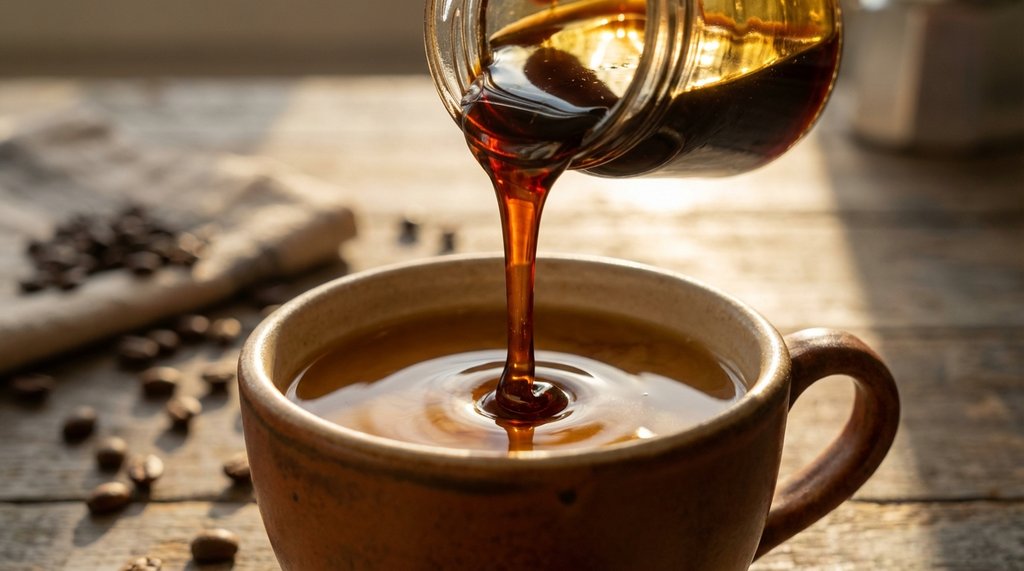
Qamaria’s version, at least in the cup I’ve ordered most consistently, reads as sweetened but not identifiably sugary. There’s a depth to the sweetness that white cane sugar doesn’t deliver. I tested brown sugar, date syrup, and raw palm sugar (jaggery) across multiple batches. The closest match to the flavor memory I had from their shop was date syrup — specifically about 1.5 teaspoons per 8oz serving, added off-heat just before serving, not during the brew.
Date syrup has a slight molasses-like bitterness that counteracts the astringency from the husk and actually amplifies the ginger’s warmth. White sugar just makes it sweet. It’s not a subtle difference once you taste them next to each other.
The Actual Recipe I Use Now
For two 8oz servings:
- 28g coffee husk (Yemeni if you can source it; Bunn Coffee or Yemeni specialty importers occasionally carry it — search for قشر yemeni rather than “cascara” to find the right distributors online)
- 56g fresh ginger, grated on a microplane to paste consistency
- 500ml filtered water
- 1 tablespoon date syrup, added off-heat
Heat water to 185°F. Combine husk and ginger paste in a small saucepan, pour water over, cover, and steep at maintained temperature (use a thermometer; you want it to stay between 180-190°F without boiling — a low gas flame or electric with the dial just below simmer) for twelve minutes. Strain through a fine mesh strainer, pressing the husk firmly to extract the remaining liquid. Add date syrup off heat. Serve immediately.
The pressing step matters more than it seems. A lot of the body and color is sitting in that spent husk. Don’t skip it.
One last thing worth saying: if you make this version and it’s still not quite matching your memory of Qamaria, the answer is probably the husk provenance, not your technique. There’s a ceiling on the home recreation that’s set by the raw material, and that ceiling is lower than most recipe guides are willing to admit. But within that ceiling, the above approach gets you noticeably closer than anything else I’ve tried.