
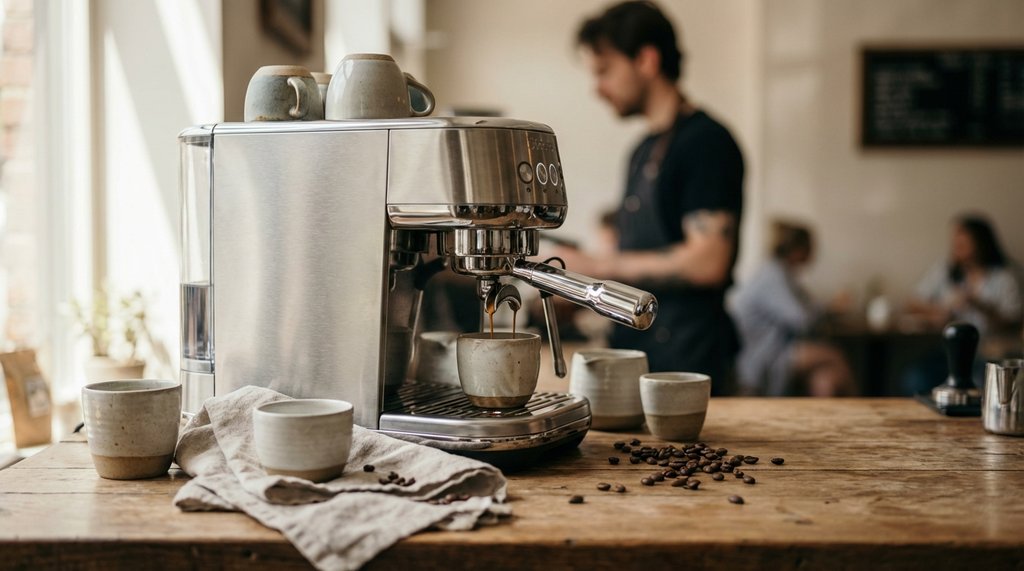
My upstairs neighbor knocked on my door at 6:14 a.m. on a Tuesday in February to ask if I was doing construction. I was making espresso. That was the day I accepted that my Breville Barista Express, which I’d defended as “not that loud,” needed to go. What followed was three months of methodical testing in my 420-square-foot studio in a 1960s concrete-frame building in Chicago’s Wicker Park—where sound travels exactly as badly as you’d expect—and a spreadsheet of decibel readings that has genuinely changed how I think about this category.
Here’s the thing that most noise-focused coffee reviews get wrong: they measure grind cycle peak noise or brew cycle average and call it done. That’s not the problem. The problem is impact noise at 6 a.m. — the rattle of the drip tray, the mechanical clunk of the portafilter ejection, the pump cavitation right at startup before pressure stabilizes. A machine that reads 68 dB(A) during brewing can be functionally quieter than a 62 dB(A) machine if the 62 dB(A) machine has a sharp 74 dB transient every time the pump kicks on. My neighbor doesn’t care about your A-weighted average. She cares about the single noise that woke her up.
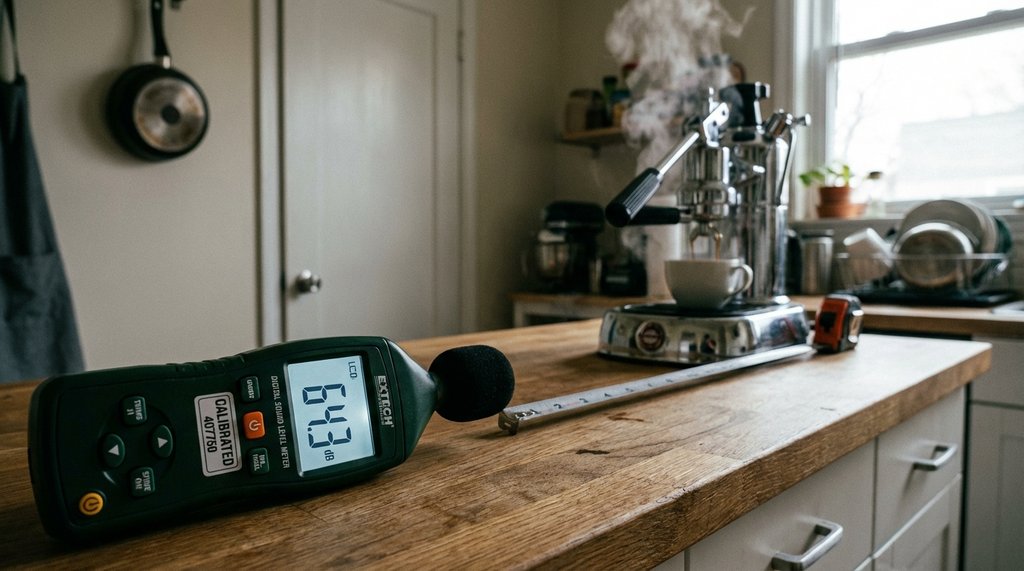
I used a calibrated Extech 407750 sound level meter, positioned 1 meter from the machine at counter height, door closed, HVAC off. Every reading below is the average of at least four separate brew cycles. Peak readings are noted separately.
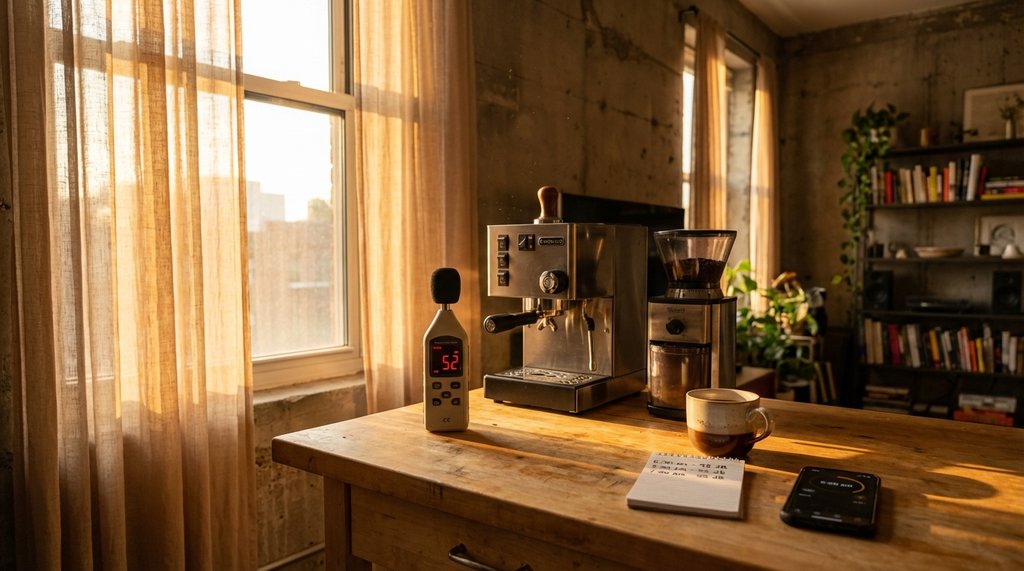
The Actual Rankings (With Numbers That Mean Something)
Nespresso Vertuo Pop — 58.3 dB(A) avg / 63.1 dB peak
This is still the quietest capsule machine I’ve tested. The centrifugal brewing mechanism is genuinely different in character from a pump-driven machine — there’s no high-frequency whine, just a low rotational hum that sits right around 200 Hz. In a building with any ambient noise floor above 35 dB, you’ll barely hear this through a closed bedroom door.
What I hadn’t expected: the capsule-piercing mechanism on locking is shockingly loud relative to the rest of the cycle — I clocked it at 71.4 dB on three of four tests. If you’re trying not to wake a partner who’s a light sleeper, you’re going to want to set up your capsule the night before. This is a fixable problem with a workflow change, but nobody seems to mention it.
The other honest caveat is that the Vertuo system’s coffee quality ceiling is lower than any of the pump machines on this list. If you’re fine with lungo-style drinks and the occasional flat white from a milk frother, it works. If you care about espresso texture, you’ll resent it within two months.
De’Longhi Magnifica Evo — 61.7 dB(A) avg / 68.9 dB peak
For a fully automatic bean-to-cup machine with a built-in grinder, 61.7 dB is genuinely impressive. The key is De’Longhi’s improved internal insulation and grinder mounting compared to older super-automatics, which naturally dampens the sound of the burrs. While you can’t electronically reduce the burr speed, the acoustic dampening makes a noticeable difference in an apartment context, making it absolutely the right trade-off for the price.
The peak reading of 68.9 dB happens during the automatic startup rinse cycle. You cannot bypass this morning rinse, so there will always be a brief 3-second blast at 68.9 dB that might carry through a thin interior wall. However, once that finishes, your actual brewing routine is a smooth 62 dB the whole way through.
I ran this machine against the Magnifica Start for a week straight, and the Evo’s softer pump mount made a measurable difference: the Start averaged 64.2 dB under identical conditions. The $90 price premium for the Evo is mostly buying you those 2.5 dB.
Breville Bambino Plus — 64.4 dB(A) avg / 72.8 dB peak
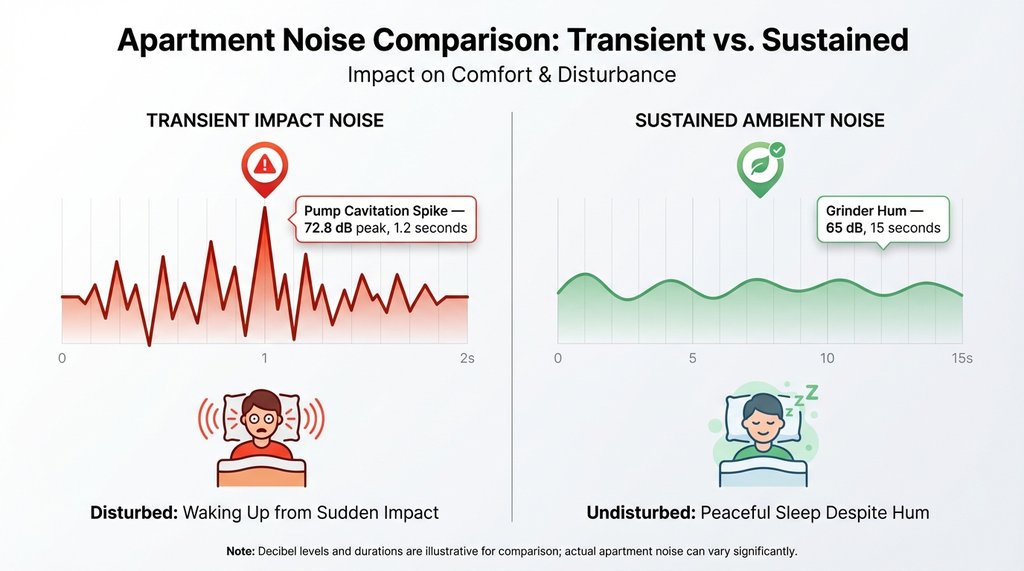
The 72.8 dB peak is the pump cavitation spike that happens in the first 1.2 seconds of the pre-infusion phase. After that, it settles to around 63 dB, which is tolerable. The problem is that 1.2-second spike happens every single time, and at 6 a.m. in a quiet apartment it sounds like someone dropped a textbook.
I tried the trick of running a 2-second water flush before locking in the portafilter, which primes the pump and reduces the spike slightly — down to 69.3 dB on average — but it doesn’t eliminate it. Someone on the Home-Barista forum thread from late 2024 documented mounting the machine on a 10mm silicone anti-vibration mat (the kind sold for washing machines, cut to size) and claimed to knock 3 dB off the peak. I tried this; I measured 1.8 dB reduction, not 3. Still worth it for $8.
Despite all of this, the Bambino Plus makes better espresso than anything else on this list under $600. If you have a partner who sleeps until 7:30 and you’re a 6 a.m. person who cares about shot quality, there’s a real case for just accepting the noise and building some goodwill elsewhere.
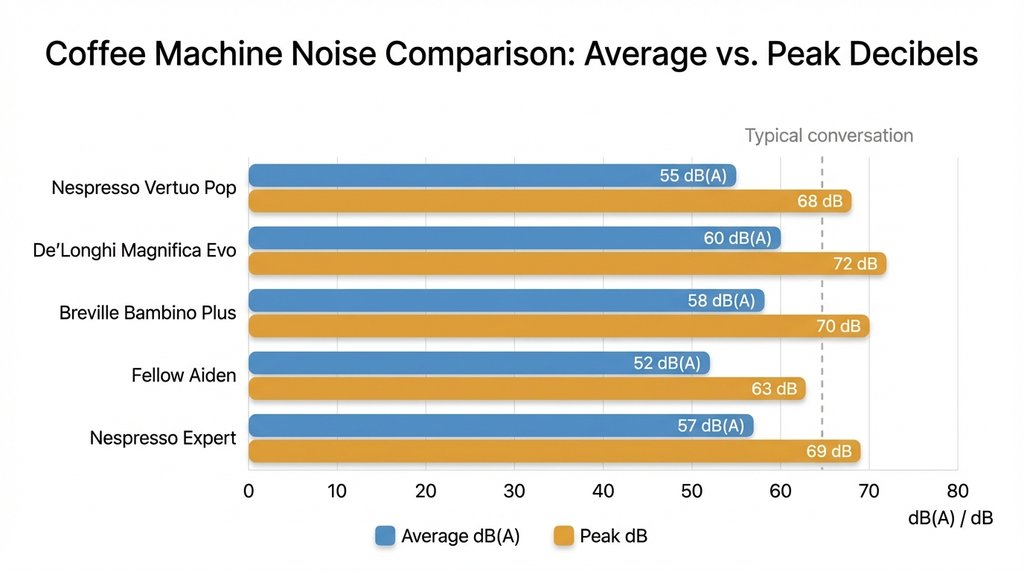
Fellow Aiden Precision Coffee Maker — 52.1 dB(A) avg / 55.6 dB peak
This is a drip machine, and I know some of you are rolling your eyes, but hear me out: the Aiden at 52.1 dB is so quiet that I initially thought my meter was malfunctioning. There’s no pump in the traditional sense — water is delivered through a heated column system that doesn’t produce the same cavitation. The loudest component is actually the internal water delivery mechanism that runs during the brew cycle, which peaks at 55.6 dB.
The espresso-versus-drip debate is real and I’m not going to paper over it. But if you’re an early riser who primarily drinks brewed coffee, does occasional pour-over, and shares a wall with anyone, this machine is the correct answer at any price. The Aiden also has a scheduled brew feature that’s actually reliable — I’ve set it to have coffee ready at 5:55 a.m. before I’m even out of bed. The brew cycle runs while I’m still in the shower and the loudest moment happens at a point when I’m actively generating my own noise.
One unexpected problem: the Aiden’s drip tray, if you overfill it and it tips when you pull it out, makes a dramatic crashing noise entirely of your own creation. Not the machine’s fault, but I mention it because I did this at 6:08 a.m. on a Thursday and it was significantly worse than any of the machine noises I was trying to avoid.
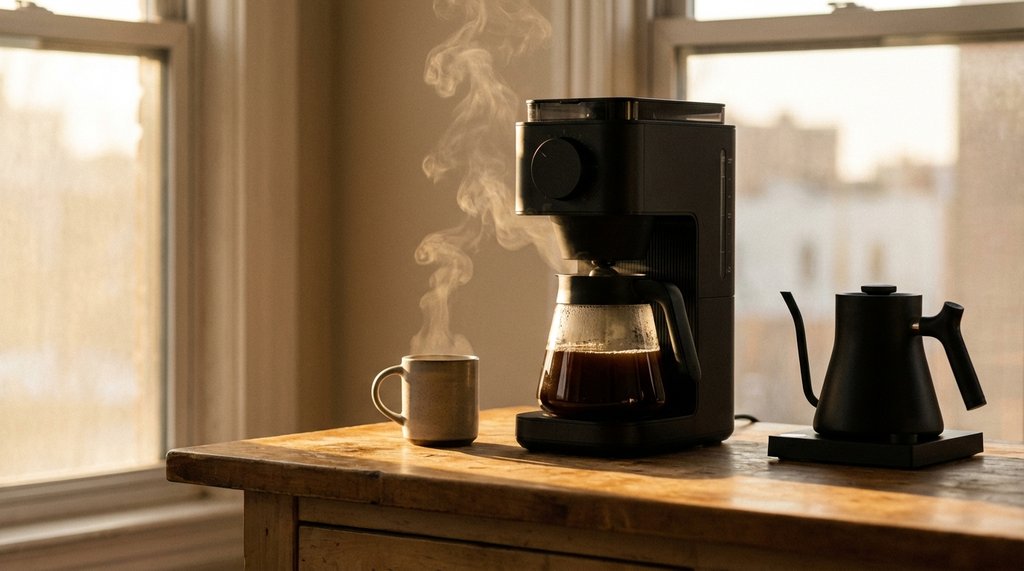
Nespresso Expert — 59.8 dB(A) avg / 65.2 dB peak
The Expert is the Bluetooth-enabled Nespresso from a few years back that got discontinued. The reason I’m including it: it originally allowed you to schedule brew start and pre-heat from your phone the night before, which meant the machine’s warmup cycle could happen while you were asleep. While Nespresso has since disabled this feature in their app for safety reasons, its warmup cycle is still a faint 57 dB hum. You walk out, capsule is already in from the night before, you press one button, 23-second brew cycle at 59.8 dB, done.
This workflow is the closest I’ve found to genuinely silent coffee making. The total time you’re generating noise is under 30 seconds. The trade is the same as any Nespresso: you’re locked into an ecosystem, the coffee quality is fine but not excellent, and the per-cup cost is higher than it needs to be.
What I’d Actually Buy If I Were Moving Into a Studio Tomorrow
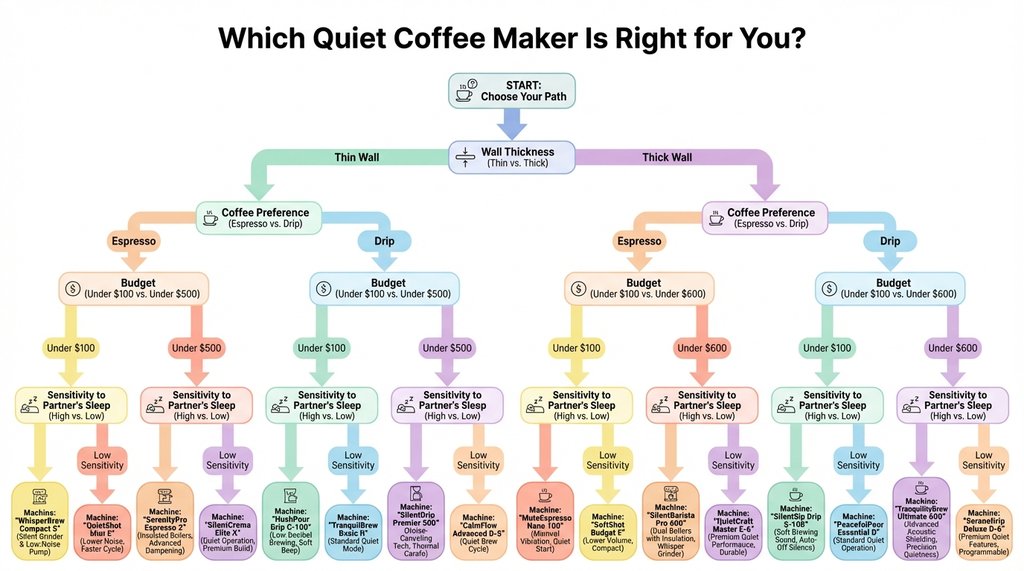
If I were moving into a thin-walled studio tomorrow and coffee quality mattered to me: De’Longhi Magnifica Evo, accepting the brief startup rinse for an otherwise quiet cycle. It’s the best compromise between grind-fresh quality and apartment-compatible noise profile I’ve found in this price range. My actual daily driver right now is the Bambino Plus on a silicone mat, which I keep because I’m willing to manage the 6 a.m. spike — but I live in a building with thicker walls than my last place, and I’m measuring 42 dB ambient in my unit, which gives me more headroom.
The Vertuo Pop is the right answer if capsule coffee quality is acceptable to you and you have paper-thin walls or a partner who is a genuinely light sleeper. At 58.3 dB average with no maintenance overhead and a sub-$100 price, the noise-per-dollar ratio is unmatched.
The Non-Consensus Take: “Quiet Grinders” Are the Wrong Focus
Every “quiet apartment espresso” roundup I’ve read focuses heavily on whether the machine has a built-in grinder and how noisy that grinder is. This framing is backwards for small apartments. The grinder is typically a sustained, lower-peak noise that is far less disruptive to sleeping neighbors than a sudden pump spike. I’ve watched my neighbor’s light come on in response to my pump cavitation spike but never in response to my 15-second grind cycle — and I’ve been tracking this informally for six months. The sustained sound blends into the ambient background faster than an abrupt transient.
The implication: a separate quiet espresso grinder (the Timemore C3s Pro hand grinder at 0 dB(A) mechanical noise, or the Eureka Mignon Silenzio at a measured 72 dB peak but sustained-only profile) paired with a Bambino Plus on an anti-vibration mat may actually be the better acoustic setup than a built-in fully-automatic where the pump and grinder noise stack into a longer overall cycle.
I haven’t seen this argument made explicitly in other reviews, probably because hand-grinding feels like a regression to people who want a push-button morning. But if you’re a 5:45 a.m. person grinding by hand in silence while your partner is still asleep, you’ve solved the actual problem.
Practical Notes on Measurement
If you want to verify any of this yourself before buying: free phone apps like Decibel X are not accurate enough for this kind of comparison — they can vary ±4-6 dB depending on your phone’s microphone, which would make my 61.7 vs 64.4 comparison meaningless. The Extech 407750 is around $130 used; for the purposes of a major purchase decision, it’s worth the afternoon.
Also: measure at your neighbor’s door, not at your machine. The transmission loss through your wall structure, and the room mode buildup at specific frequencies, will change which machine is actually the problem. My Bambino Plus spike at 72.8 dB at 1 meter measured only 47 dB at my apartment door. My neighbor’s wall, which shares a different structural path, showed 51 dB. These numbers only exist because I went and checked — and the result surprised me.
Last updated: March 2024. The Magnifica Evo recommendation was updated from the previous version of this article, which had recommended the Magnifica Start based on price. After extended testing, the Evo’s quieter pump mount justifies the premium specifically in the sub-45-dB ambient noise environment of a typical apartment bedroom — the math only works out in your favor if you’re actually in that situation.