
Light roast cold brew has a reputation problem it doesn’t entirely deserve. Most of the advice floating around—the “just steep it longer” school of thought—comes from people who treated a washed Ethiopian the same way they’d treat a dark-roasted blend and then wondered why it tasted like cold, slightly floral dishwater.
I spent about three months dialing this in after I picked up a 5lb bag of a natural-process Yirgacheffe that was roasted to what the roaster called “city plus”—just finished first crack, still pretty dense. I wanted to preserve those strawberry-jam notes in a cold format, and my usual cold brew method (coarse grind, 1:8 ratio by weight, 18 hours in the fridge) produced something that was technically correct but completely hollow. It hit the right bitterness floor—almost none—but the brightness I was after had collapsed into a flat sweetness with zero structure.
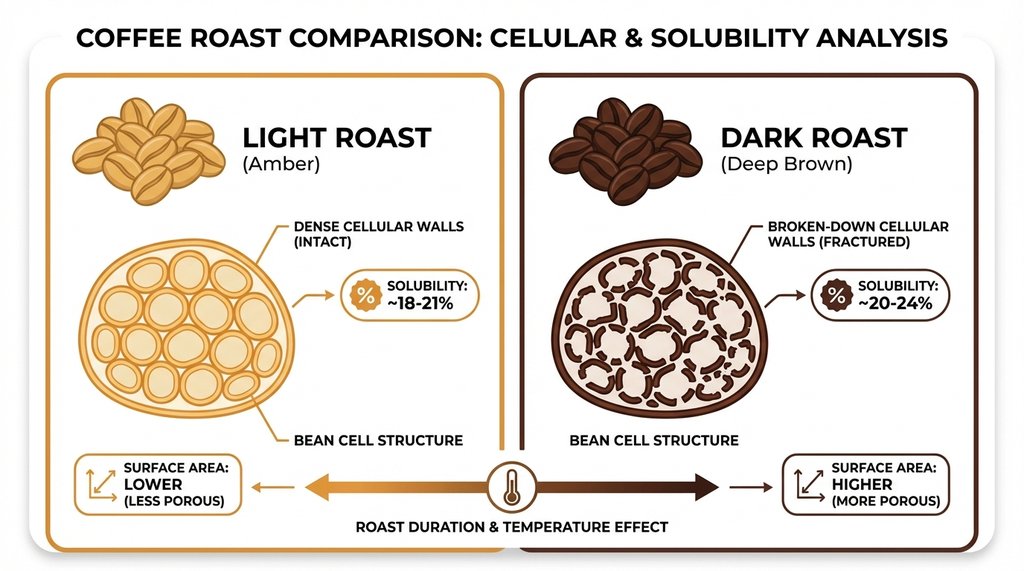
The core problem with light roasts in cold brew isn’t extraction time. It’s solubility.
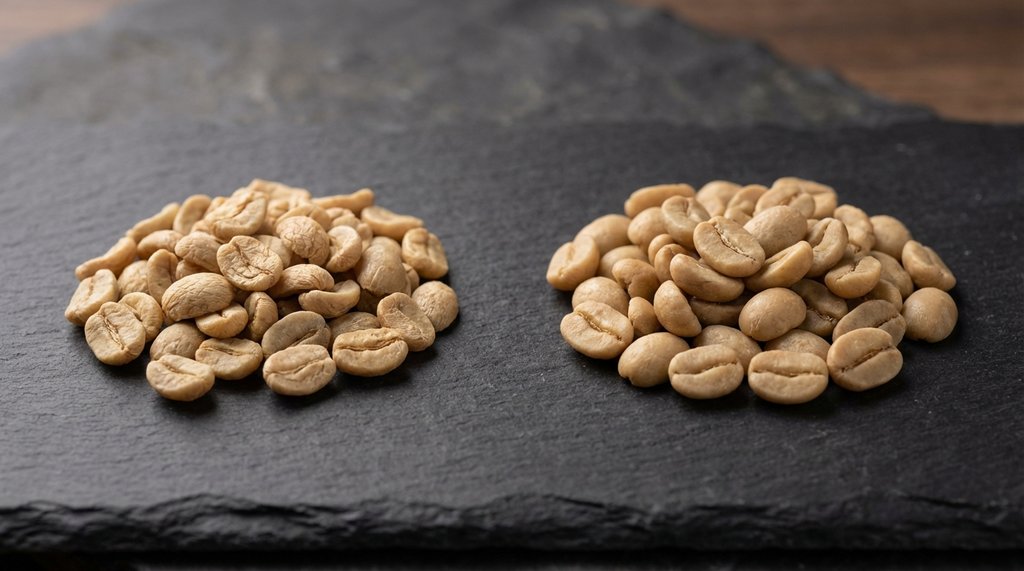
Light roast beans haven’t undergone the cell structure breakdown that happens deeper into the roast. They’re physically denser. Grinding coarse—which is the standard advice for cold brew, and correct for dark roasts—leaves you pulling from a particle surface area that already has lower soluble yields. You’re fighting two deficits at once.
My first fix was going one click finer on my Comandante. Instead of 30 clicks (my usual cold brew setting), I dropped to 22. That alone changed the extraction trajectory noticeably, but it also introduced a new problem: at 18 hours in the fridge with that finer grind, I started pulling astringency. Not bitterness exactly—more of a dry, chalky finish that came in around the 30-second mark after swallowing. That’s over-extraction of certain phenolic compounds, and once you’ve tasted it, you can’t un-taste it.
Here’s the adjustment that actually worked, after several failed batches:
Ratio: 1:6 by weight (not 1:8, not 1:4). For a 750ml batch, that’s 125g of ground coffee to 750g of filtered water.
Grind: Medium-coarse. On a standard Comandante, 24-25 clicks. On a Fellow Ode Gen 2, around 4.5. Finer than your usual cold brew, coarser than pour-over.
Water temperature: Room temperature (68–72°F / 20–22°C) for the first 2 hours. This is the part most guides skip entirely, and it makes a real difference. Starting at room temp accelerates early extraction of the soluble aromatic compounds—the stuff that gives light roasts their brightness—before you park the whole thing in the fridge.
Total steep: 14–16 hours. Not 20, not 24. The 2-hour room-temp window + 14 hours in the fridge at around 38°F (3°C) hits the extraction target without tipping into that astringency window.
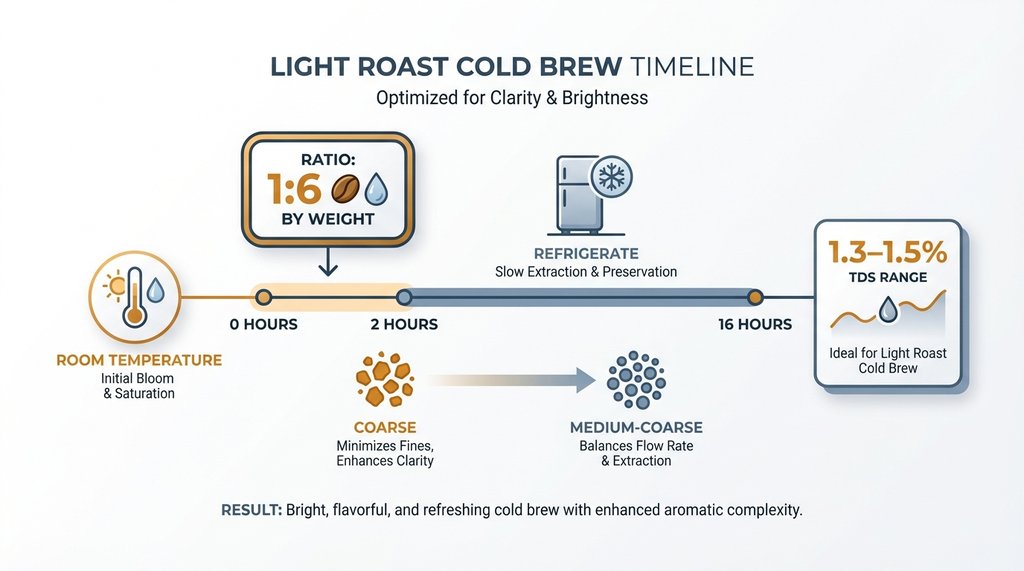
I’ve run this with TDS measurements using a cheap refractometer, and this method consistently lands between 2.5–3.5% TDS on the concentrate before dilution, which gives you enough body to still feel like cold brew rather than cold-steeped tea, while keeping the clarity of flavor that makes a good light roast worth the extra effort.
The non-consensus thing I’ll push back on: a lot of cold brew enthusiasts say light roasts are simply “not suited” for cold brew and that you should use an iced pour-over or Japanese-style flash brew instead. In isolation, that advice is fine. But it ignores a specific use case where cold brew light roast is genuinely the better choice: batch serving over 3–4 days.
Flash brew degrades fast. The volatile aromatics that make it taste bright on day one are mostly gone by day two in the fridge. Cold brew, by contrast, is already extracted under low-heat conditions, and those compounds are more stable in the final concentrate. A properly made light roast cold brew at day three, stored correctly in a sealed bottle at 38°F, tastes almost identical to day one. I’ve done side-by-side comparisons. The flash brew day three tastes dull, while the cold brew day three still has that fruit-forward acidity intact.
So if you’re making coffee for a week of mornings, or prepping for an event, cold brew from a light roast wins on longevity. Flash brew wins on peak flavor on the day of brewing. That tradeoff is worth knowing before you default to one method.
A few specific pitfalls I hit that didn’t appear in anything I read beforehand:
Agitation matters more with light roasts. With a dark roast, you can just combine water and grounds, give it a stir, cover it, and walk away. With a light roast’s lower initial solubility, I found that a 30-second stir at the 1-hour mark (while it’s still at room temp) meaningfully improved extraction evenness. Without it, I was getting a pronounced top-to-bottom extraction gradient—the grounds at the bottom were pulling differently than the ones floating near the surface.
Don’t use your prettiest beans. I know that sounds counterintuitive, but the most complex, most expensive single-origin light roasts I’ve tested—particularly anything with heavy natural processing—tend to produce a cold brew that’s muddy in ways that are hard to predict. The wild-fermented fruitiness that works so well in a 6-minute pour-over can become an almost wine-like sour funk in cold brew. My best results have been with washed or honey-processed light roasts, particularly from East Africa. A clean washed Kenyan or Ethiopian will outperform a natural process from the same region in cold brew, almost every time.
The concentrate dilution math is different. Standard dark roast cold brew concentrate is usually diluted 1:1 with water or milk. Because you’re already brewing at a higher water-to-coffee ratio (1:6 instead of 1:4), your concentrate is less concentrated. I dilute mine closer to 2:1 (concentrate to water), or just drink it closer to straight if I want something more like an iced americano. Running it at the same dilution as a standard cold brew concentrate makes it taste thin.
The setup I’ve landed on for a weekly batch:
- 125g light roast, ground at 24 clicks on a Comandante
- 750g filtered water at room temperature
- Combine in a 1-liter mason jar, stir thoroughly
- Leave on the counter for 2 hours, stir once at the 1-hour mark
- Transfer to fridge at 38°F
- Steep 14 more hours (total 16 hours from initial contact)
- Filter through a Chemex filter inside a fine-mesh strainer to capture fines
- Store in a sealed glass bottle, good for about 5 days
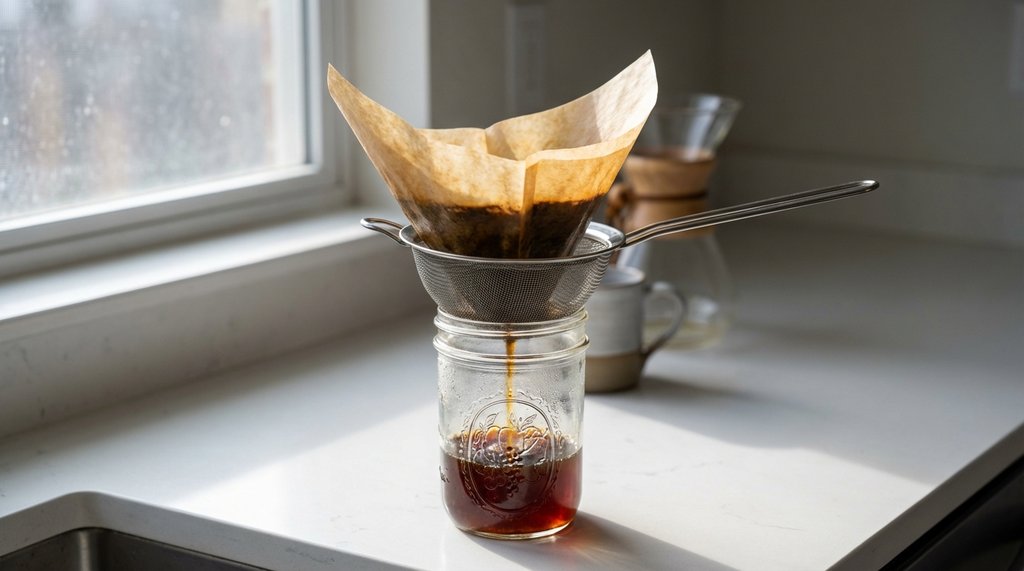
That Chemex filter step is slower than just using the mesh alone, but it eliminates the sediment that otherwise accumulates and starts contributing extraction even in the fridge. I lost two batches to progressive over-extraction before I figured that out—the sediment was continuing to steep even after I thought I was done.
One ratio worth bookmarking if you’re dialing in a new bean: start at 1:7 for the first batch, taste the concentrate before diluting, and adjust from there. If it tastes hollow and flat, go to 1:6 next time. If it tastes astringent or overly tannic, go to 1:7.5 and cut the steep time by 2 hours. The bean-to-bean variation in light roasts—especially between roasters who are hitting different internal bean temperatures—means there’s no single ratio that works universally. But 1:6 at 16 hours with the room-temp start is a reliable baseline that gets you within adjustable range on the first try for most light roasts I’ve worked with.