
The first batch I made that actually lasted two weeks without going sour sat in the back of my fridge for 14 days and tasted cleaner on day 13 than a lot of café cold brews do on day one. That wasn’t luck — it came from changing exactly three things about how I was doing it, and none of them were the ones I’d been obsessing over.
The Ratio Problem Nobody Talks About Honestly
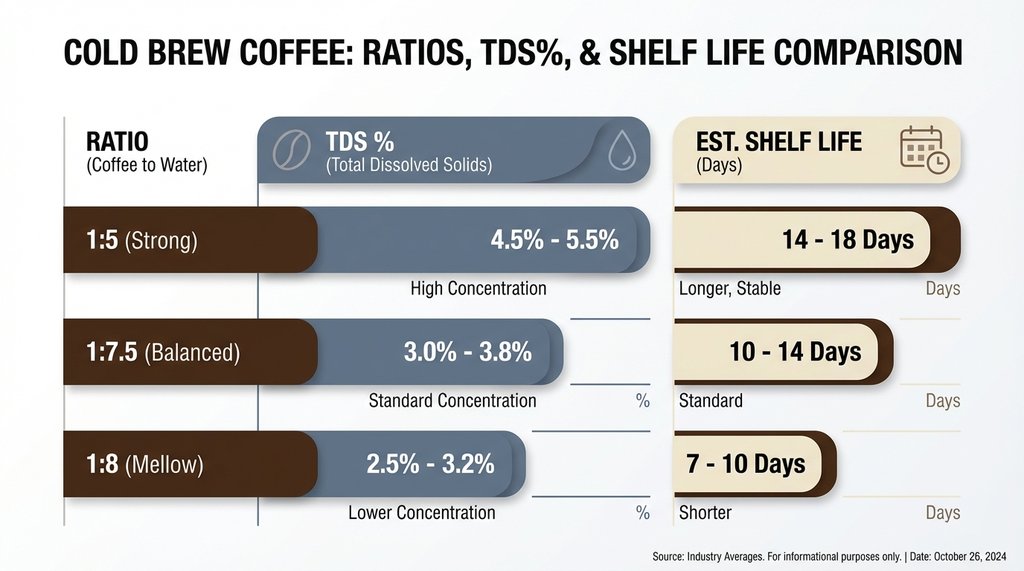
Most cold brew guides throw “1:4 for concentrate, 1:8 for ready-to-drink” at you and move on. I used 1:8 for two years. My batches consistently went funky around day 7 or 8 — a dull, almost metallic flatness that showed up even when stored properly in a sealed glass jar.
The issue wasn’t the ratio itself. It was that a 1:8 ready-to-drink batch requires storing a larger volume of liquid, which leads to more oxygen exposure every time you open the container. I didn’t figure this out until I started measuring TDS on my batches with a refractometer I borrowed from a friend who does hydroponics. Ready-to-drink cold brew at 1:8 was consistently hitting 1.2–1.4% TDS. My 14-day batches run at 1:5 concentrate — around 4.8–5.2% TDS — diluted at serving. That higher concentration means I can store the brew in smaller-volume jars that are emptied more quickly, which matters more than people think.
If you’re making cold brew to drink straight, that’s fine, but store it in the smallest containers you can find. A 500ml jar you drain in two days will always outperform a 2-liter pitcher you’re reaching into for a week.
Steep Time: The 24-Hour Rule Is Wrong for Most People’s Fridges
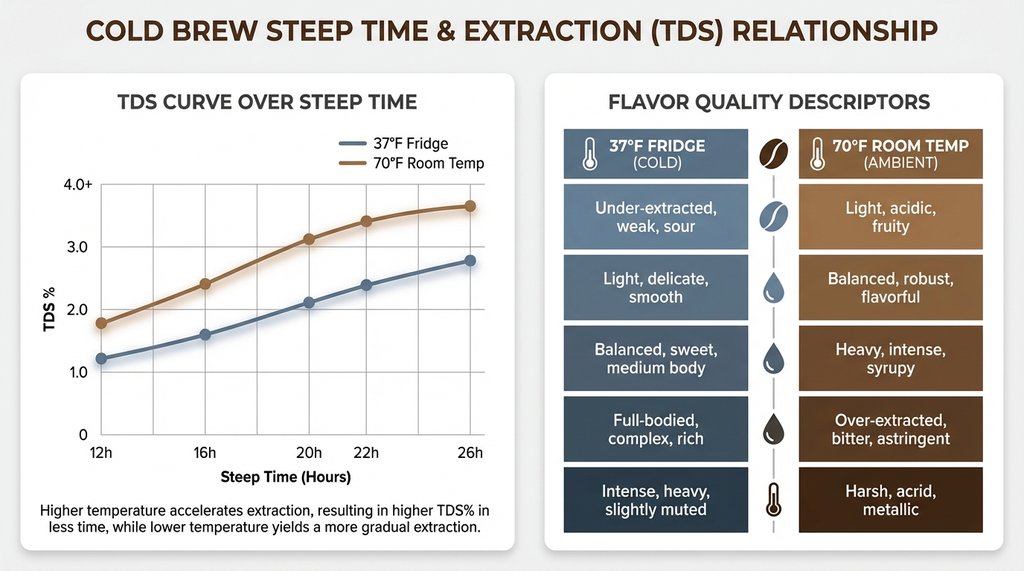
Here’s what I kept getting burned by: recipe after recipe says 12–24 hours in the fridge. My fridge runs at 37°F (2.8°C). Most domestic fridges run between 35–40°F. At 37°F, 12 hours produces an underextracted, thin brew that’ll taste like watered-down iced coffee. You need a full 20–22 hours at that temperature to hit extraction numbers that actually give you the body and sweetness that makes cold brew worth making.
I’ve tested this at three different steep durations with the same Guatemala Huehuetenango beans, same grind size (Baratza Encore at 28, which is medium-coarse), same 1:5 ratio:
- 16 hours at 37°F: TDS 3.8%, noticeably thin, high acidity, short shelf life because there’s not enough dissolved buffer material
- 20 hours at 37°F: TDS 4.9%, balanced, good body — this is my standard
- 26 hours at 37°F: TDS 5.4%, full-bodied but starting to get bitter tannin notes, and shelf life actually decreased slightly — by day 10 there was a tannic dryness that wasn’t there with the 20-hour batch
Room temperature steep (around 70°F/21°C) is a different equation entirely. At 70°F, you want 12–14 hours, maximum. I pushed a room temp batch to 18 hours once and it tasted fine on day 1, genuinely undrinkable by day 5. The faster extraction at room temp pulls more volatile compounds that go stale fast.
If you’re doing room temperature: strain and refrigerate no later than 14 hours. This isn’t optional for shelf life.
The 14-Day Freshness Protocol
This is the part people usually skip, then wonder why their brew goes bad. It’s not mysterious — it’s microbiology and oxidation, and you can control both.
Equipment you actually need:
- Glass mason jars (wide-mouth quart size, or smaller)
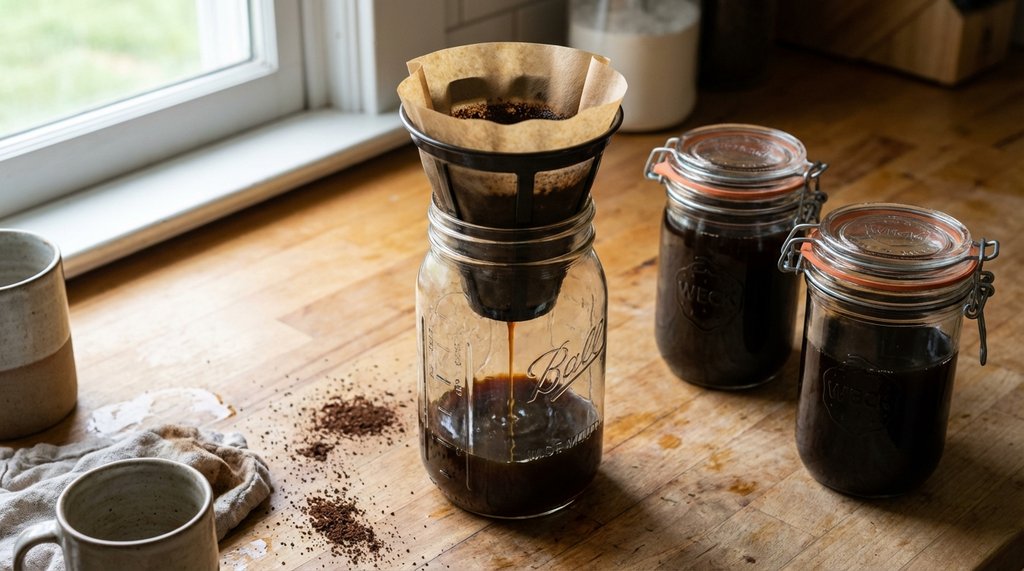
- A fine mesh strainer plus unbleached paper coffee filter
- Airtight lids (not the standard mason jar two-piece — get plastic snap lids or Weck clamps)
The double-strain through mesh then paper is non-negotiable if you want 14 days. Coffee fines — the powder-sized particles that slip through a mesh filter — don’t just make it cloudy. They continue extracting and decomposing in solution. I ran a side-by-side: mesh-only straining lasted 8 days before off-notes appeared; mesh-plus-paper consistently gets me to 14 days with no noticeable flavor degradation.
The oxygen exposure problem is the one people underestimate most.
Standard mason jar two-piece lids create a minor vacuum when cold, but every time you open them at room temp, you’re introducing a full headspace exchange. For a 2-liter batch, that’s significant. My current approach: 500ml jars, filled to within 1cm of the lid, sealed with Weck rubber-gasket clamps. Headspace is maybe 15ml. The difference in how the brew tastes on day 12 versus the same batch stored in a half-full quart jar is immediately noticeable — the quart jar version has this papery staleness that I initially blamed on my beans for way too long.
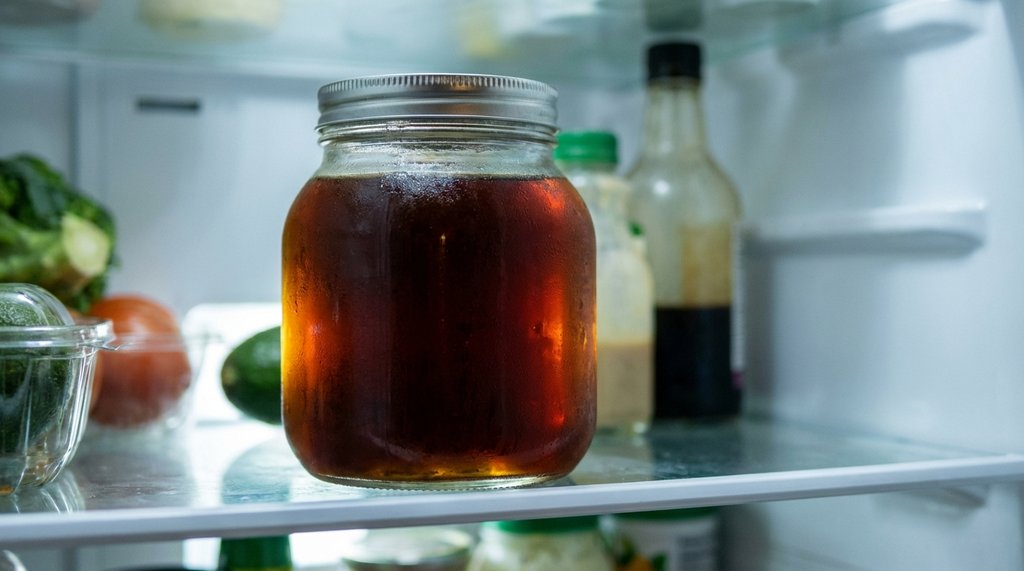
Refrigerator placement matters. Don’t store cold brew in the door. Door temperature fluctuates 8–12°F every time you open the fridge. Back of the middle shelf, where temperature is most stable. This is one of those things that sounds overly fussy until you notice your door-stored batches consistently dying at day 9.
The Grind Size Nobody Recommends (But Should)
The consensus is medium-coarse. I disagree, conditionally.
For 20+ hour fridge steeps, I run slightly coarser than medium-coarse — Encore setting 30 instead of 28. The reasoning: at lower temperatures over longer steep times, a slightly coarser grind helps balance the overall extraction rate. At medium-coarse, I was getting over-extraction from smaller particles and under-extraction from larger ones in the same batch. Inconsistent extraction means you’re getting both sharp acids and over-extracted bitterness simultaneously, and that combination degrades faster in storage.
Setting 30 at 20 hours hits my target TDS reliably. Setting 28 at the same time was inconsistent batch to batch — sometimes 4.7%, sometimes 5.3%, with no obvious reason. Once I went coarser, my batch-to-batch variance dropped to ±0.2% TDS, which also means more predictable shelf life.
The Coffee That Actually Stays Fresh
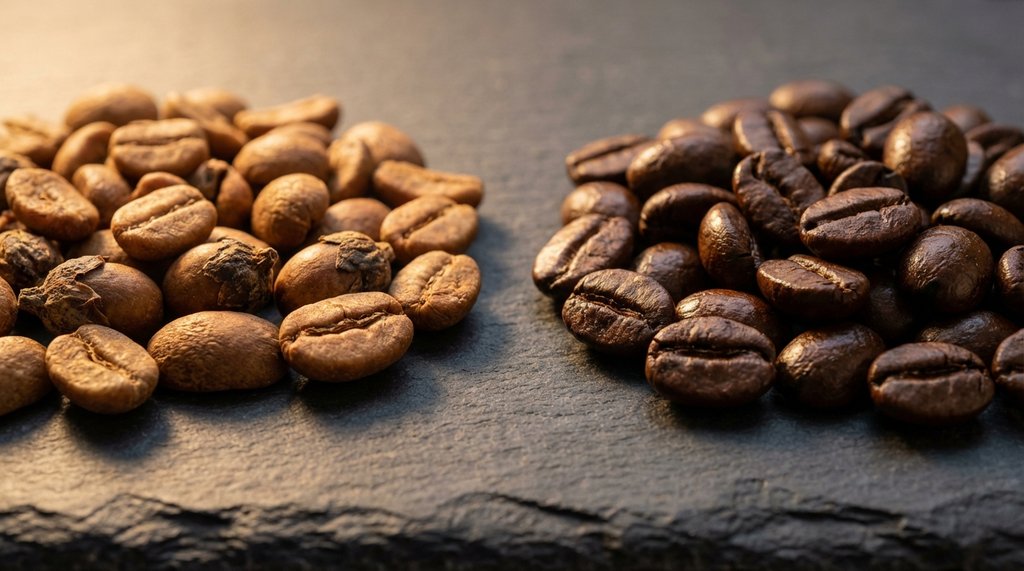
Roast level affects shelf life in a way that almost no recipe mentions. I’ve run this comparison directly: same method, same everything, Ethiopian natural process (light roast) versus Brazilian Cerrado (medium-dark).
Light roast batches last longer. My best 14-day batches are almost always light-to-medium Ethiopian or Colombian coffees. The reason is probably that light roasts have more intact cell structure, which releases compounds more slowly and consistently. My medium-dark batches rarely make it to day 12 with the same flavor quality — there’s a rancidity that starts creeping in around day 9 that I can’t engineer around regardless of storage method.
Fresh beans also matter more than most guides admit. I made a batch with beans that were 4 months past roast date. It was drinkable on day 1 and aggressively stale by day 5. Same method with beans within 6 weeks of roast: clean through day 14. Stale beans have already undergone lipid oxidation before they hit the water — you’re accelerating a process that started without you.
The Ratio That Works, Stated Simply
For concentrate (dilute 1:1 or 1:2 with water or milk at serving):
Coffee to water: 1:5 by weight. 100g coffee, 500g filtered water. Steep 20–22 hours at fridge temperature. Double-strain. Store in small sealed glass containers with minimal headspace.
For ready-to-drink (no dilution needed):
1:7.5 by weight. 80g coffee, 600g water. Same steep time and storage protocol. This is the version where storage container size matters most — keep it in 500ml or smaller jars.
Both versions, made with beans within 6 weeks of roast and stored properly, consistently hold through 14 days in my kitchen. The 14-day claim isn’t from a food science study — it’s from running the same protocol for about 18 months and tasting every batch at day 1, day 7, and day 14, which is tedious but the only way I trust any of this.
5 thoughts on “How to Make Cold Brew Coffee Last 14 Days in the Fridge”