
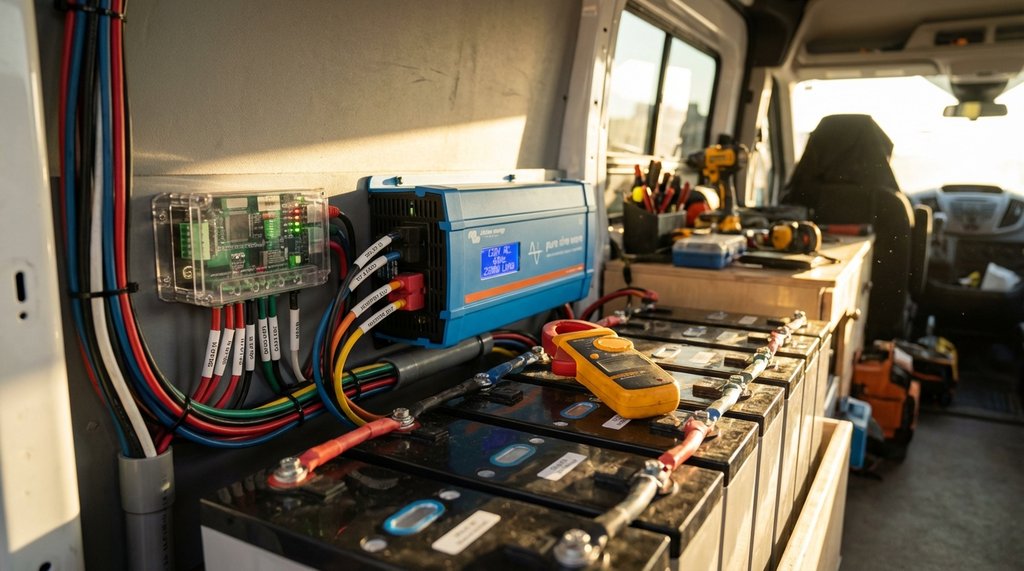
My Nespresso Vertuo pulled 1,630 watts at startup. The inverter in my Transit build was rated 2,000W continuous, so I figured I had headroom. What I didn’t account for was that the Vertuo’s heating element cycles on and off during brewing — which sounds fine until you’re running it at 7 AM with the diesel heater also pulling from the same 200Ah lithium bank and you watch the BMS cut everything at once because the combined surge hit somewhere past 2,400W. I’ve rebuilt that electrical system twice now, and most of my opinions on van life coffee come from that kind of hard lesson rather than from spec sheets.
Here’s where I actually am in 2026 after about four years of full-timing: the “low-wattage coffee brewer” category is still full of bad marketing math, and the options that genuinely work are fewer than the YouTube van build tours suggest.
The Wattage Problem Nobody Talks About Honestly
The number on the box is almost never the number that matters. Every 12V brewer I’ve tested — and I mean physically tested with a clamp meter, not just read the manual — draws more than rated during the first 60 to 90 seconds when the element is trying to climb to target temperature.
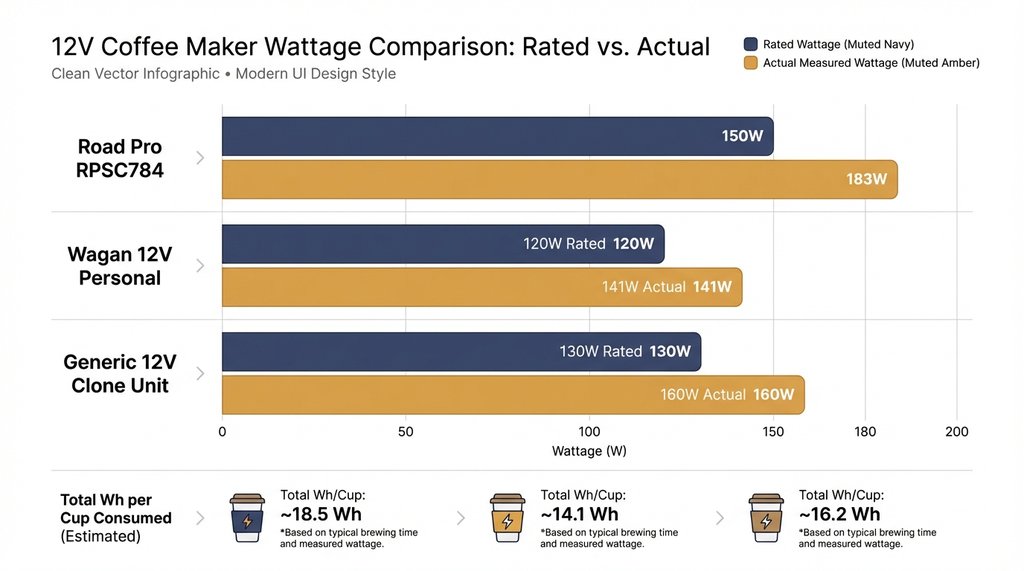
The Road Pro RPSC784 12V coffee maker lists 150W. Actual measured draw at startup on a cold unit: 178–183W sustained for the first two minutes. That’s a difference of about 2.3 amps at 12V, which seems trivial until you’re doing load calculations for a 100Ah Battle Born and trying to stay above 20% SOC through a two-day cloudy stretch in the Oregon coast.
The Wagan 12V Personal Coffee Maker — which has been rebranded and relabeled probably six times since 2019 — lists 120W. I measured 141W cold start on a 58°F morning in November camped outside Moab. Fine, whatever, close enough. But the brew time for a single 12oz cup runs 18–22 minutes on 12V, which means you’re drawing that wattage for nearly 20 minutes per cup. Total energy cost per cup: roughly 47–50Wh. That’s not nothing when your house bank is 200Ah.
What Actually Works on True 12V (No Inverter)
The Road Pro RPSC784 and Its Clones
There are probably eight manufacturers making what is functionally the same drip-style 12V coffee maker, differentiated only by the color of the plastic housing and whether they include a matching travel mug. They all use a resistive heating coil, most source from the same OEM factory in Guangdong, and they all brew slowly and produce coffee that tastes like a gas station in 2009.
I kept one in the van for two years as a backup. It’s reliable in the sense that cheap resistive elements rarely fail. It’s not reliable in the sense that if you forget to keep the water reservoir topped off, it’ll run dry and the plastic near the heating element will start smelling like regret. The carafe seal on every version I’ve used also degrades within about six months of daily use and starts leaking from the bottom. Replacements aren’t available; you just buy another one for $25.
If you need a pure 12V brewer with zero inverter dependency, this is the floor of the category, not the ceiling.
Handpresso Auto
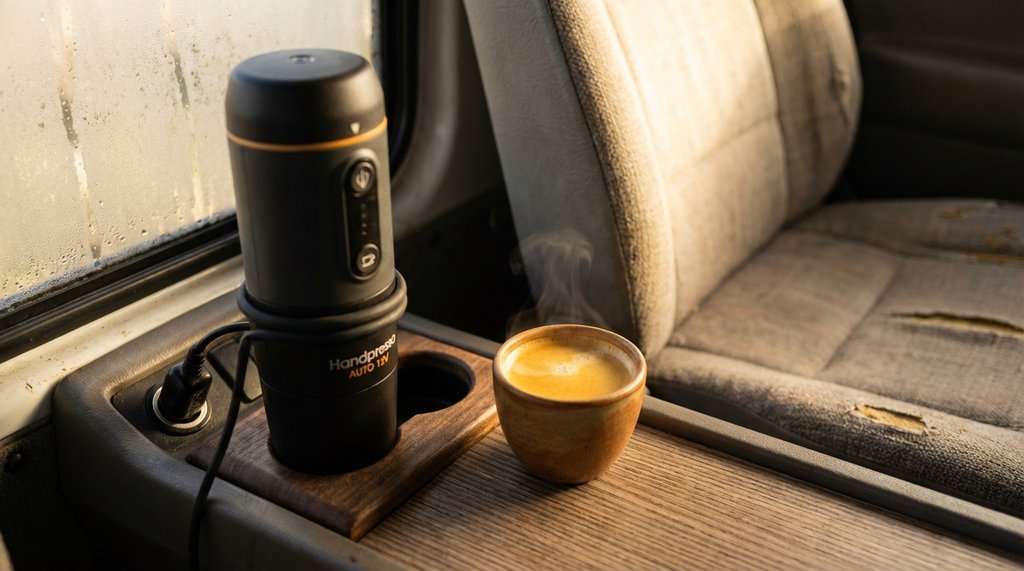
This one genuinely surprised me. The Handpresso Auto is a 12V espresso machine designed specifically for the car/RV market — it uses ESE pods or ground coffee, draws about 150W from the 12V socket, and produces actual espresso-pressure extraction (it claims 16 bar, I’ve never validated that with a pressure gauge, but the puck compression and extraction ratio look right). Brew time is around 3–4 minutes for a double shot.
The catch: it’s loud. On the highway with windows up it’s manageable. Parked in a quiet campsite at 6 AM next to someone in a tent, you will make an enemy.
Also, ESE pod availability is genuinely spotty in rural areas of the US. I’ve had better luck in Europe, where the format is more common. If you’re doing extended desert Southwest or mountain west travel, you’re ordering pods and planning around resupply.
Inverter-Based Options: The Pure Sine Wave Tax You Have To Pay
Most of the coffee brewers worth drinking from need an inverter. Here’s the thing that burned me early: I bought a modified sine wave inverter because it was $80 cheaper than the equivalent pure sine wave unit. Ran my Baratza Encore grinder off it fine. Ran my AeroPress kettle off it — fine, the heating element didn’t care. Then I connected a portable electric espresso maker that has a small pump motor, and the motor ran hot and buzzy, and it died inside of three weeks. Modified sine wave is genuinely hard on brushed motors and anything with a transformer. Budget the extra money for pure sine wave; don’t compromise on this.
Wacaco Nanopresso and Minipresso (Manual — Zero Watts, Actually)
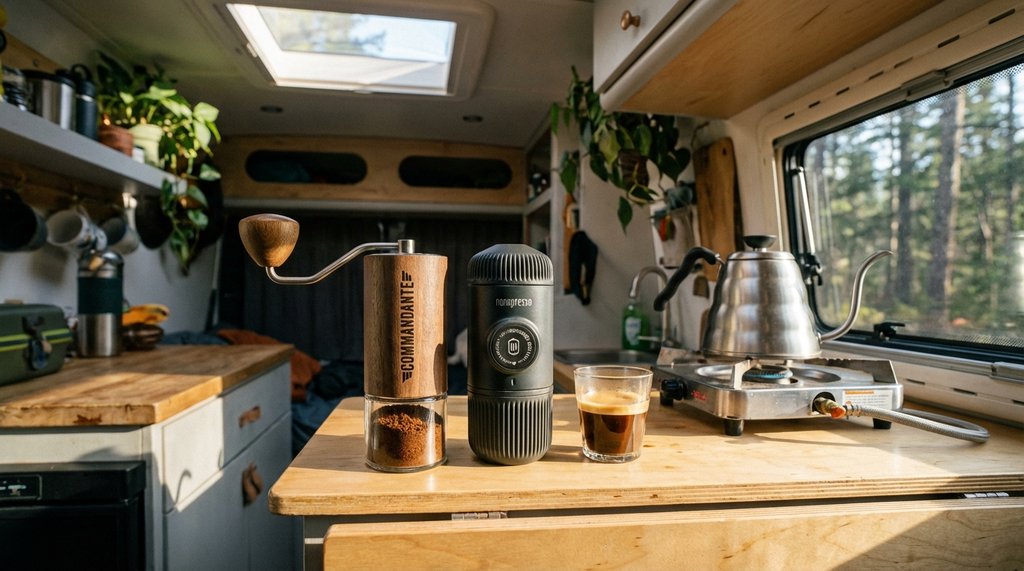
Worth saying plainly: the best espresso I’ve made in the van has come from the Wacaco Nanopresso paired with an Aeropress kettle heated on the propane stove. Zero electrical draw for the actual brewing process. The Nanopresso’s pump mechanism generates enough pressure (up to 18 bar, though in practice you’re working at 8–10 bar with good technique) for genuine espresso extraction. Puck prep matters — you need consistent grind size and correct dose, and the basket is small (8g), so you’re making a ristretto-style shot.
The Wacaco Barista Kit attachment increases the basket capacity and water tank size, which sounds gimmicky until you realize that pulling a proper double shot requires that extra volume.
This isn’t really a “brewer” in the powered sense, but I’m including it because I’ve watched too many people spend real money on inverters and 200W coffee makers when a $75 Nanopresso and an existing propane setup would have solved the problem completely.
AeroPress on Any Heat Source
The counterintuitive thing about AeroPress for van life isn’t the brewing method — everyone recommends it — it’s the grind protocol. Most van lifers I’ve met use pre-ground coffee because they don’t want to deal with a grinder taking up electrical headroom. The right move is a quality hand grinder. I switched to a Commandante C40 in late 2024 and the improvement in cup quality was significant enough that I questioned everything I’d been drinking for the previous two years. The C40 costs more than some of the 12V brewers in this article. It is worth it.
The Nespresso Problem (And When It’s Actually Fine)
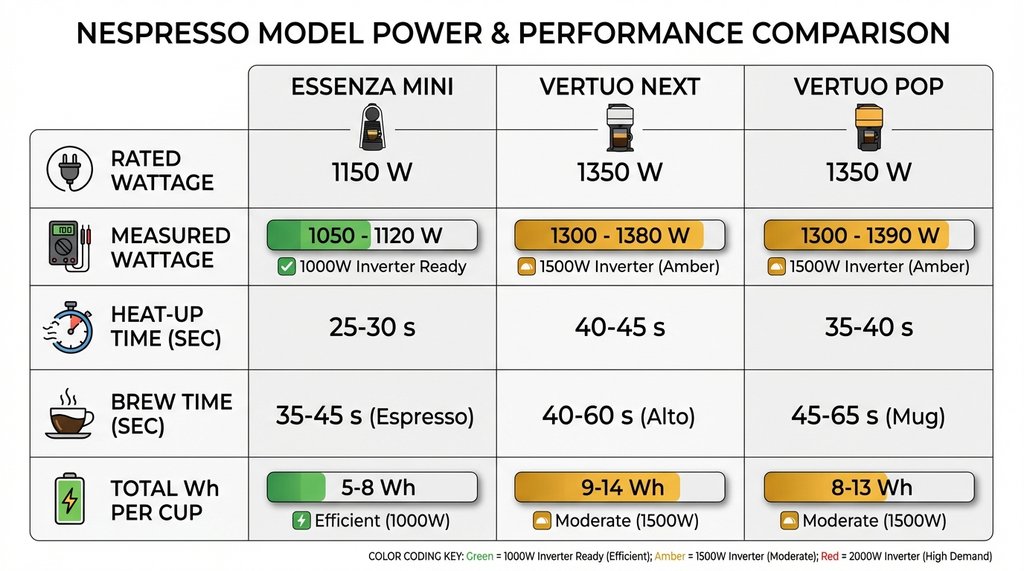
Nespresso machines come up constantly in van life discussions because they’re fast, consistent, and the capsule waste management is the only real logistical headache. Here’s the actual wattage reality:
- Nespresso Essenza Mini: 1,150W rated, measured 1,180–1,240W in my testing
- Nespresso Vertuo Next: 1,500W rated, measured 1,480W during the centrifusion spin-up phase
- Nespresso Vertuo Pop: marketed as “lower energy,” but still rated at 1,500W and measures 1,290W in practice
The Vertuo line’s spinning mechanism adds a variable load that’s hard to predict and harder to spec around. The Original line brewers (Essenza Mini, Pixie) are more predictable because they’re just a pump and a heating element.
If your inverter is 2,000W pure sine wave and your battery bank is 200Ah or more of lithium (lithium tolerates high discharge rates that AGM cannot), a Nespresso Essenza Mini for one or two cups in the morning is a workable solution. The total energy cost per cup — from heat-up to brew — is about 20–25Wh. The machine heats up in 25 seconds, brews in another 30–45 seconds. So you’re looking at roughly a minute of high-draw operation per cup.
Where this goes wrong: people try to run Nespresso on a 1,000W inverter “just to see.” The machine will either fail to heat adequately and brew weak coffee, or the inverter’s overload protection will trip, or — worst case with a cheap modified sine wave inverter — the pump motor runs outside its design parameters. I’ve seen the third scenario damage a machine.
The non-consensus take: if your electrical system is undersized (under 150Ah lithium, inverter under 1,500W), don’t buy a Nespresso. You’ll spend more headspace managing it than it’s worth. Get a Nanopresso and call it done.
The French Press Myth for Van Life
Everyone recommends French press for van life. It requires no power. It’s cheap. The grind tolerance is forgiving.
Here’s the thing: French press in a moving vehicle is a disaster waiting to happen. You’re steeping at temperature for 4 minutes and then the brewer needs to sit undisturbed during the press. That’s fine at a campsite. On a ferry or at a spot where you might need to move quickly, you’re either drinking under-extracted coffee or you’re cleaning French press grounds out of your floor mats. I’ve done both.
The bigger issue is the insulated French press units that everyone buys for van life — the Stanley, the Fellow Clara, the various stainless double-wall options — they retain heat so well that if you forget to plunge and come back 20 minutes later, you have dramatically over-extracted bitter coffee. The regular glass beaker French press at least cools down and stops extracting after a while. The insulated versions don’t give you that safety margin.
I use a Fellow Atmos canister for storage and a stainless single-wall Bodum for actual brewing. The thermal loss is a feature, not a bug.
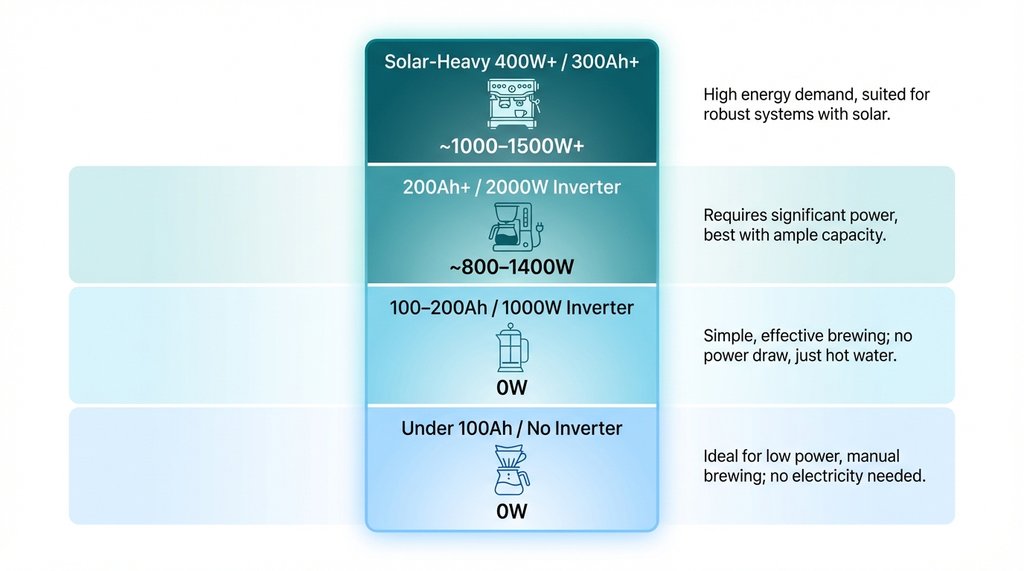
Current Recommendations by Electrical System Size (2026)
Under 100Ah lithium / no inverter:
Wacaco Nanopresso + propane for heat. No other recommendation survives actual use-case scrutiny at this battery capacity.
100–200Ah lithium / 1,000W pure sine inverter:
AeroPress with an 800W electric kettle (the Fellow Stagg EKG draws 1,200W, which is too close to the limit — use a basic 800W unit instead). Total system draw peaks at 800W, leaves headroom, heats to temperature in 4–5 minutes. Alternatively, the Handpresso Auto on direct 12V is workable here.
200Ah+ lithium / 2,000W pure sine inverter:
Nespresso Essenza Mini is legitimate at this level. So is the Bellman CX-25P stovetop steamer/espresso maker on a 1,500W induction burner — though the Bellman takes more hands-on time than most people want at 6 AM.
Solar-heavy build (400W+ panels, 300Ah+ lithium):
The Breville Bambino Plus at 1,600W becomes viable if you’re willing to run it mid-morning when the panels are contributing. I tested this setup in New Mexico in April — 480W of panels, 280Ah Epoch lithium — and a single Bambino session (heat-up plus two shots) drew about 65Wh, which the panels recovered in under 12 minutes at peak production. Not a good plan for cloudy days or winter at northern latitudes.
What I’m Actually Using Now
As of early 2026 my daily driver is the Cafelat Robot for espresso — fully manual, no electricity, produces better espresso than anything I’ve run on an inverter — and a simple 800W kettle on the inverter for Americano or pour-over when I want volume. The Robot requires good grind size consistency, which means the Commandante C40 is non-negotiable in this setup.
Total electrical consumption for my morning coffee: 800W for about 3 minutes (kettle), equals roughly 40Wh. Down from the 60–75Wh I was using when I was running the Nespresso Vertuo that caused the BMS incident.
The setup isn’t sexy enough for a YouTube build tour. It doesn’t have WiFi or a digital display. It makes excellent coffee every single morning, and when something goes wrong, it’s always the user’s fault rather than a firmware issue or a pump seal.
That’s the actual goal.