My first bag of Big Trouble sat on the counter for four days before I touched it. Roast date was March 3rd, I got it March 5th, and I’d already read enough to know Counter Culture’s blends tend to benefit from a bit of rest. By day four I was being patient, responsible, doing everything right.
Then I pulled nine consecutive shots that ranged from 19 seconds to 41 seconds on the same dose, same grinder setting, same machine. Not nine shots across three days while dialing in. Nine shots in one sitting, back to back, changing nothing.
That was my introduction to what Big Trouble actually does in a home setup, and it took me about three weeks of genuinely miserable troubleshooting to understand why.
The Problem Isn’t What the Dial-In Guides Tell You It Is
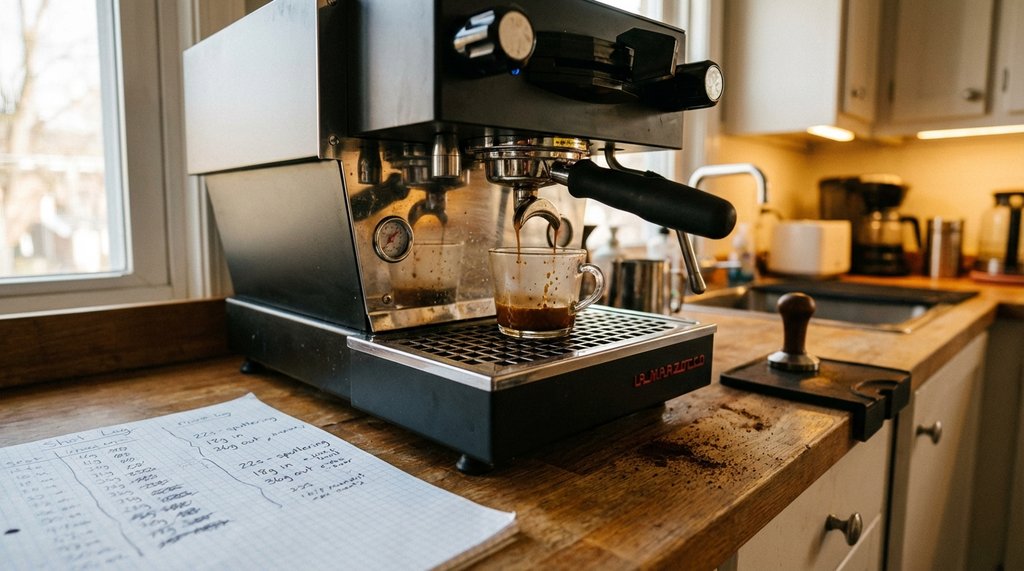
Every resource I found — the Counter Culture brew guides, the Home-Barista threads, the YouTube dial-in videos — framed Big Trouble’s inconsistency as a grind size problem. Go finer if you’re running fast, coarser if you’re choking. Standard espresso logic. I spent the first week treating it exactly that way, micro-adjusting my Niche Zero by single-digit increments in both directions, logging every shot in a spreadsheet.
By shot 34, I had data confirming that my grind setting had almost no predictive relationship with shot time. I could pull back-to-back shots at the identical setting and get a 24-second and a 38-second extraction on consecutive attempts. The variance wasn’t random noise — it had a pattern, I just wasn’t seeing it yet because I was looking at the wrong variable.
What I eventually realized, and what I have not seen written anywhere clearly, is that Big Trouble’s inconsistency at home is primarily a roast level and degassing interaction problem, not a grind calibration problem. The grind adjustment matters, but it’s the last step, not the first. If you start with the grind before you’ve addressed the CO2 situation, you’re tuning a radio that isn’t plugged in.
Why Big Trouble Behaves This Way Specifically
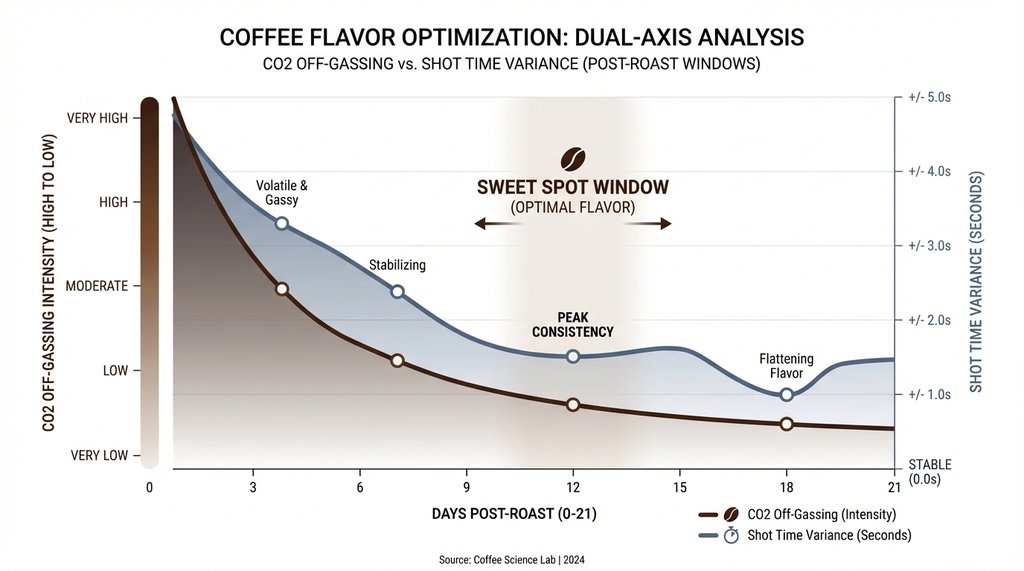
Big Trouble sits at what Counter Culture calls a “service blend” profile — it’s roasted to work in commercial environments where throughput is high, the portafilter is hot, the group head is running at sustained temperature, and the beans are cycling through a grinder that’s warm from constant use. The roast level (medium-dark for Counter Culture’s standards, which tracks somewhere around 14–16% weight loss during roast) produces a bean that off-gasses CO2 aggressively in the first 5–7 days post-roast and then transitions into a more stable window between roughly day 7 and day 18.
In a commercial setting, this matters less. The volume of shots being pulled creates a natural averaging effect, and the beans are typically used within that 7–18 day window almost by default. At home, pulling maybe one or two doubles per morning, you’re working with the same bag across 10–14 days. You’re catching the bean at different points in its degassing curve every single time, and the CO2 content directly affects how the puck resists water flow.
Early in the bag — days 4 through 7 — the beans are still releasing enough gas that pre-infusion behavior gets erratic. The puck expands unevenly as CO2 escapes under low pressure, which creates micro-channels before full pressure is even applied. Late in the bag — past day 16 or so — the opposite problem: you’ve got stale-side density, fines behave differently, and the blend (which consists of various Latin American component beans that grind into a wider particle distribution than a single origin) starts producing a grind that packs too tightly and chokes inconsistently based on exactly where in the hopper the beans settled.
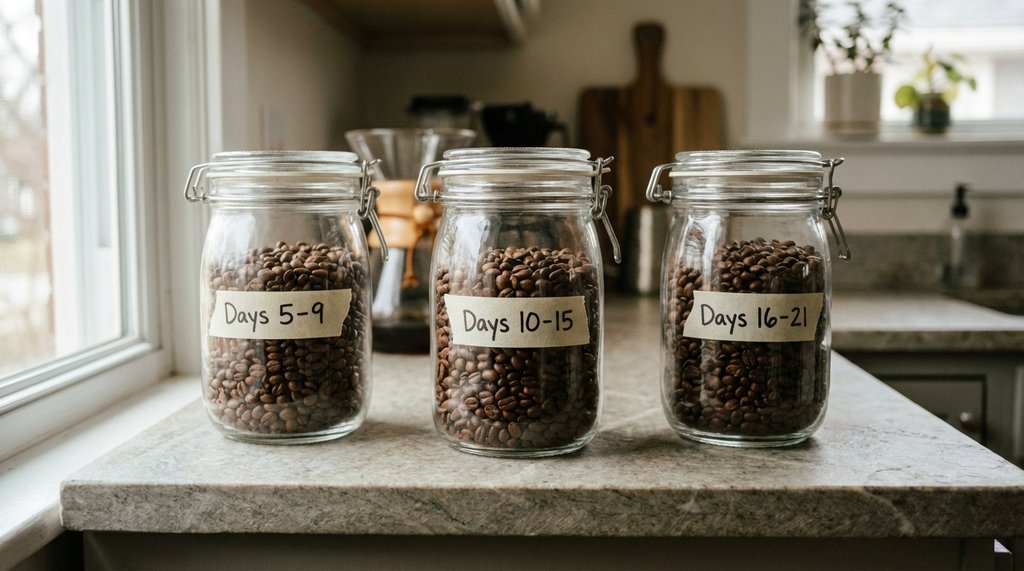
I confirmed this by splitting one bag into three sealed containers at the start: one I used days 5–9, one days 10–15, one days 16–21. The middle container pulled consistently at a single grind setting 7 out of 8 attempts. The early container needed a coarser setting on average but still swung ±6 seconds. The late container was just genuinely difficult regardless of what I did with the grind.
The Actual Fix, in the Order It Needs to Happen
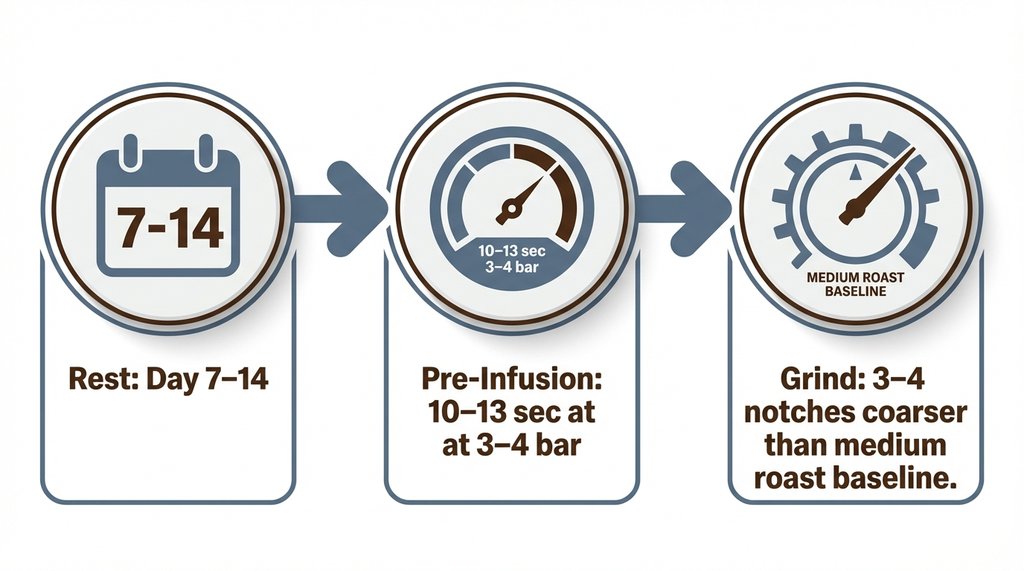
Step one is the rest period. Don’t touch Big Trouble before day 7. I know Counter Culture’s packaging says 7–21 days and technically you’re within window, but for home use on a non-preheated-commercial-group-head, day 7 is the floor. Days 10–14 are the sweet spot I’ve reproducibly dialed into.
Step two is pre-infusion duration, not grind. This is the actual leverage point that almost nobody talks about in the context of this specific blend. I’m running a Breville Barista Express (upgraded baskets, stock pump) and I extended pre-infusion from the stock 8-second soak to 12 seconds. That single change dropped my shot time variance from roughly ±9 seconds to roughly ±3 seconds before I touched the grind at all. The mechanism is straightforward: longer pre-infusion lets the CO2 off-gas through the puck before full pressure hits, which means channeling from gas escape happens during the pre-infusion phase where it’s lower-stakes, not during the actual extraction where it ruins the shot.
If you’re on a machine with adjustable pre-infusion (Decent, La Marzocco Linea Mini, even the Gaggia Classic Pro with a pressure mod), 10–13 seconds at 3–4 bar before ramping to 9 bar is the range. The exact number depends on dose — I’m running 18g in and it wants 12 seconds. If you’re at 17g, 10–11 is probably right. At 19g I’d try 13 and back off if shots are running long.
Step three is the grind adjustment, which is smaller than you expect. Once you’ve got the rest period right and the pre-infusion sorted, Big Trouble wants to run at a coarser setting than comparable medium roasts. I’m two full dial increments coarser on the Niche than where I’d run a similar medium roast single origin. This is expected — darker roasts are more brittle and produce more fines at the same setting, so you’d expect them to need a coarser setting, but most guides don’t actually account for the fact that a well-rested medium-dark with extended pre-infusion has already done part of the flow-resistance work via puck saturation. If you grind fine and extend pre-infusion, you’re doubling up on resistance and shots will run 35+ seconds and taste bitter-astringent. Coarser grind plus longer pre-infusion is the combination, not finer grind as compensation for inconsistency.
Specific numbers for anyone running a Niche Zero: I settled at 18 (down from my usual 14–15 for medium roasts) during the day 10–14 window. Your baseline will differ, but the relative adjustment — going coarser by 3–4 notches from wherever your medium-roast dialed-in position is — should hold.
What Didn’t Work (And Wasted About Two Weeks)
Redistributing tools. I tried the OCD, then a WDT tool I made from an acupuncture needle and a wine cork. Both helped with channeling in general but didn’t address the variance, because the variance wasn’t coming from distribution inconsistency. The puck prep on my worst shots was actually pretty good — the CO2 was still causing channeling beneath the surface no matter how well the grounds were sitting.
Adjusting dose. I went from 17g to 19g in half-gram increments over the course of about 15 shots. Heavier doses with Big Trouble in the early part of the bag actually made variance worse because there’s more mass for the CO2 to churn through unevenly. 18g is where I landed and where it stayed.
Dropping water temperature. A few Reddit posts suggested Big Trouble wants 91–92°C rather than 93°C because of the darker roast component. I ran two sessions at 91°C. Shots ran faster and tasted flatter without fixing the inconsistency. Went back to 93°C, stopped chasing that thread.
The basket upgrade actually did matter, but only marginally. I switched from the pressurized dual-wall basket that came with my machine to an IMS 18g basket about six months before any of this testing. If you’re still running a pressurized basket, upgrade it first — but that’s not Big Trouble-specific advice, that’s just the cost of admission for pulling anything interesting at home.
One More Thing About the Blend Itself
Big Trouble is genuinely not designed for the use case most home baristas are putting it through. It’s a commercial service blend — it’s built for consistency under commercial conditions, which means high-volume use, warm equipment, rapid cycling. At home, you’re running it through equipment that takes 20–30 minutes to fully thermally stabilize, at a pace that gives each shot draft conditions the recipe never accounted for.
That’s not a knock on the blend. The flavor profile — that cocoa-forward base with the caramel and nutty notes happening in the mid-palate — is worth the trouble of figuring out. But the people who tell you Big Trouble dials in easily are either working with genuinely great commercial equipment at home, or they got lucky with their rest window and don’t know it.
Once I got the pre-infusion dialed to 12 seconds and stopped touching the grind during the first week of the bag, my last three bags produced consecutive shots where only one fell outside my 28–32 second target (that one choked at 38 seconds — I traced it back to a grounds clump from a static buildup incident, not the technique). Before that fix, I was throwing out maybe 40% of my shots.
Three weeks of frustration for what turned out to be a 4-second change in pre-infusion time. That’s espresso at home.