
The first time I pulled a shot from a washed Ethiopian Guji at 1,950m elevation, I thought my grinder had suddenly developed a mechanical problem. The puck looked fine. Pressure trace looked normal. Twenty-seven seconds, 36 grams out from 18 in. Completely undrinkable — thin, sharp, and hollow in a way that had nothing to do with acidity and everything to do with a fundamental mismatch between the bean and every assumption I’d brought to the portafilter.
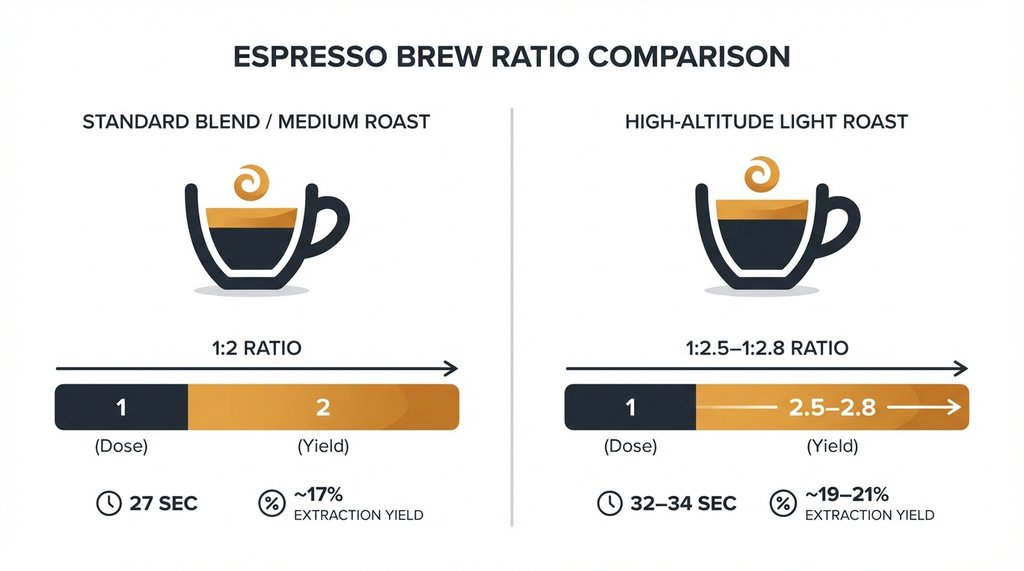
That was about three years ago, and I’ve since dialed in probably forty or fifty different single-origin lots across a Comandante C40, a Niche Zero, and eventually a DF64 Gen 2. High-altitude light roasts from Ethiopia, Kenya, and Colombia above 1,800m are in a completely different category from blends or anything roasted past a first crack pop. The variables that normally function as reliable anchors — your standard 9-bar extraction, water at 93°C, a 1:2 ratio in roughly 27 seconds — become actively misleading reference points. They’re not just insufficient; they’ll push you in the wrong direction.
Here are the three specific places where I’ve watched this go wrong, including my own failures.
Mistake #1: Treating Brew Ratio as a Fixed Target Instead of a Diagnostic Tool
Most home barista resources — even the good ones — present 1:2 as the espresso ratio. For high-altitude light roasts, I’ve found that treating 1:2 as anything other than a starting hypothesis is the fastest route to a week of bad shots.
The structural issue is density. A washed Kenyan AA from Nyeri at 1,900m has a significantly higher bean density than, say, a Brazilian natural at 900m that was taken to a medium roast. High-altitude beans have tighter cell structure. The same grind setting that produces a 28-second shot on a darker, lower-grown bean will choke or dramatically under-extract the same dose of a Kenyan light roast — not because the grind is wrong, but because the bean is resisting water penetration in a fundamentally different way.
When I first started working with a lot from Karogoto in Nyeri — a washed SL-28/SL-34 blend, roasted maybe five days off the date I received it — I was targeting 18g in, 36g out, somewhere around 27 seconds. I was getting shots that read around 7.8% TDS on my VST refractometer, which corresponds to roughly 15-16% extraction yield at that ratio. Technically in range. Completely flat and sour in the cup.
The non-consensus move I eventually landed on: I extended the ratio to 1:2.5 to 1:2.8 and let contact time climb to 32-34 seconds. For a lot of home baristas, those numbers feel wrong — they’ve internalized “lungo = bad” and anything past 30 seconds as a sign of under-extraction pressure issues. But with a washed light roast at this altitude profile, that extended ratio was what finally got the cup above 19% extraction yield (reading at 7.0-7.8% TDS) and opened up the florals that were clearly in the bean based on the cupping notes.
The mistake isn’t pulling a longer ratio. The mistake is thinking the ratio is a rule rather than a number you move to find the extraction yield you want.
Mistake #2: Adjusting Grind Size Without Accounting for Rest Time — and Getting It Exactly Backwards
I had a bag of a Colombian Huila lot, grown around 1,750m, processed as a natural — unusual for Huila but this was a specific producer doing some experimental stuff. I received it and immediately started dialing it in at about seven days off roast. I was grinding finer and finer, because the shots kept coming out thin and fast, and my instinct was “grind finer to slow it down and improve extraction.”
By the end of that session I was at a grind setting where the same beans would have produced a 6-minute pour in a Chemex. Still getting a hollow, sour shot. The puck was soupy, channeling was visible on the bottom when I knocked it out, and I had no idea why grinding finer kept making it worse.
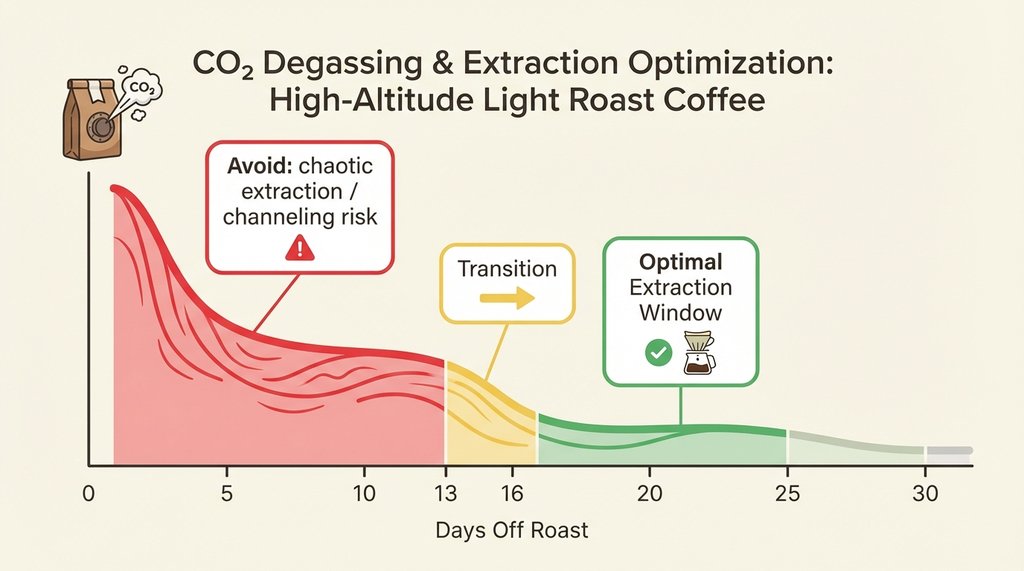
What I’d done was confuse a CO₂ degassing problem with an extraction problem. Light roasts at altitude — especially naturals — retain a substantial amount of dissolved CO₂ in the first 7-14 days off roast. When you pull a shot on a bean this fresh, the degassing during extraction creates turbulence in the puck. CO₂ is actively disrupting water flow, creating micro-channels that aren’t visible until you look at the bottom of the puck or, if you’re using a naked portafilter, see the chaotic spray pattern underneath. Grinding finer doesn’t fix this — it makes the CO₂ eruption more violent and concentrated.
The actual solution was to wait. I pulled that same bag at 18 days off roast, at the exact grind setting I’d started with on day seven, and the shot was a different beverage. 26 seconds, 8.6% TDS, clean through the whole cup. Same grind. Twelve days difference.
For washed Ethiopian and Kenyan light roasts at high altitude, I’ve found the extraction sweet spot is typically days 14-25 off roast, with washed processed beans being slightly more forgiving on the fresh end than naturals or honeys. The conventional wisdom in a lot of specialty circles is “espresso needs more rest than filter” — true — but there’s a secondary piece that gets ignored: high-altitude light roasts need more rest than the rest of your espresso lineup, not less. The roast level and the origin’s density compound the degassing issue.
If you’re dialing in before day 14 and things feel wrong, try the opposite of what your instincts say. Grind coarser, not finer. Go faster, not slower. See if you’re fighting the bean’s off-gassing.
Mistake #3: Pulling at 93°C Because That’s What the Recipe Says
This one took me longer to unlearn because the 93°C recommendation comes from sources I respect and it’s grounded in real chemistry around dissolved solids and solubility curves. For most espresso, it’s a reasonable anchor. For high-altitude light roasts, I’ve found it consistently produces shots that are technically “in extraction range” by the numbers but taste thin and overly acidic in a way that doesn’t resolve regardless of ratio or grind adjustments.
The relevant physical fact is that the flavor compounds you’re trying to extract from a high-altitude washed Ethiopian or Kenyan bean — the florals, the stone fruit, the complex sugars from the higher-grown cherry — are compounds that were developed at a low roast temperature and need higher brew water temperature to solubilize properly, compared to the caramelized, Maillard-heavy compounds in a darker roast. At 93°C, you’re efficiently extracting the acids, which are readily soluble at lower temps, while leaving the more temperature-sensitive aromatics behind.
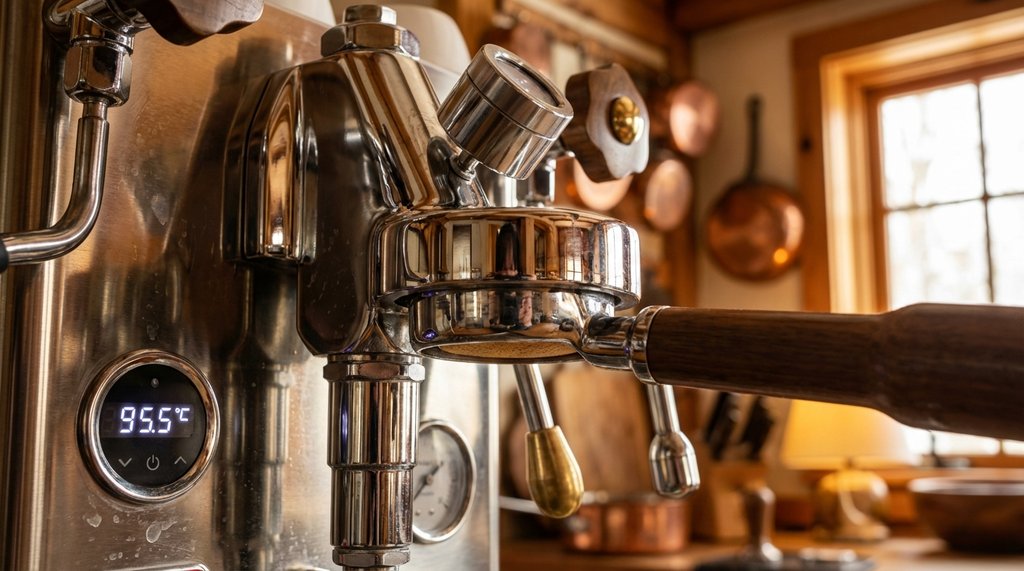
My machine is a Lelit Bianca V3, which lets me adjust group temperature with reasonable precision. When I started pushing to 94.5-96°C on high-altitude light roasts specifically, I was skeptical it would matter — we’re talking 1.5 to 3 degrees Celsius. The difference in the cup was not subtle. The same Guji lot that had been sour and thin at 93°C became something I’d actually want to serve at 95.5°C. Same grind, same ratio, same timing, 2.5 degrees up on the group. The shot read 8.9% TDS versus 7.6% TDS at the lower temperature — almost a full percentage point difference in dissolved solids from a temperature adjustment that most people dismiss as within margin of error.
The counter-argument I hear from people is that higher temperature increases bitterness risk. That’s true for medium and dark roasts — but for a light roast at this altitude, there’s very little of the bitter-tasting compounds present in the first place. You’re not adding bitterness by pulling at 96°C; you’re completing an extraction that 93°C was leaving half-finished. I’ve now defaulted to 94.5°C as my baseline for anything I’d describe as a light roast from above 1,700m, and I only adjust down if the specific lot is showing signs of being more developed than the label suggests.
The Underlying Pattern
These three mistakes share a structural root: they’re all cases where a calibration developed for medium-roast, lower-grown, blended espresso was applied to a context it wasn’t designed for, and the feedback signals — puck resistance, shot timing, visual yield — looked normal while the cup was failing.
High-altitude light roasts are diagnostic edge cases. The usual sensory and visual cues that help baristas troubleshoot become unreliable because the behavior of the bean deviates from what those cues were developed to interpret. The puck can look perfect and feel perfect and the shot will still taste wrong.
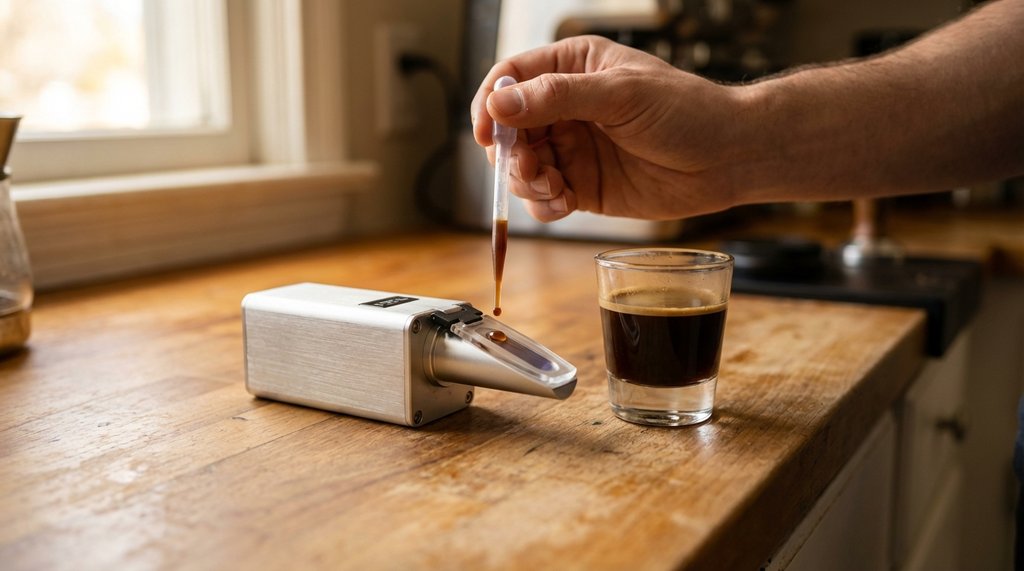
The most consistent piece of advice I can give: taste at every variable change, and buy a refractometer before buying any other accessory. Pulling shots without TDS measurement while dialing in a single-origin light roast is genuinely flying blind — the cup will lie to you in ways that grind adjustments and timing won’t reveal.
The VST lab refractometer runs around $400 to $600 used. I resisted buying one for about 18 months. When I finally did, I immediately identified that three espresso recipes I’d considered “dialed in” were actually sitting at 15-16% extraction yield, which explained why I kept finding them “good but not great.” Not a single forum post or YouTube breakdown would have surfaced that specific number. The refractometer did it in about 90 seconds.
One thing I’d adjust in retrospect: I spent the first six months of single-origin work trying to find universal parameters rather than accepting that each lot needs to be treated as its own calibration problem. A Kenyan AA from Kiambu at 1,800m will not dial in with the same variables as a Sidama natural at 2,100m. The altitude, process, and variety interact in enough ways that a 3-4 shot exploratory sequence for each new lot is not optional overhead — it’s the actual work.