
How Long Can Brewed Coffee Safely Sit in a Coffee Pot?
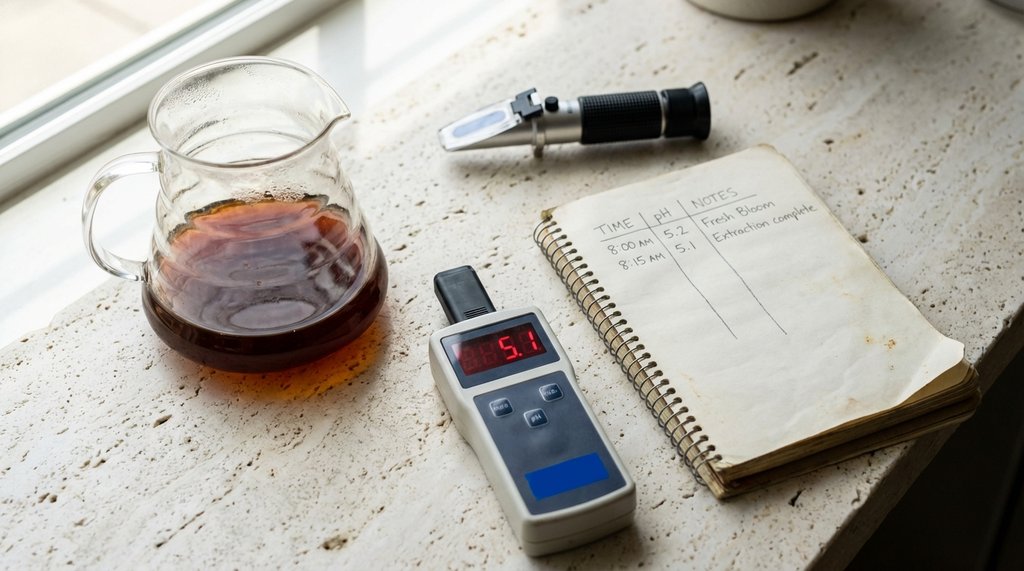
Thirty minutes. That’s roughly when the carafe on a standard drip machine—sitting on a hot plate set to 185°F—crosses from “still pretty good” into “actively getting worse.” I know this because I’ve spent an embarrassing amount of time with a refractometer and a pH meter checking what actually happens to coffee across a two-hour window, not because I had a grant, but because I kept arguing with coworkers about whether the office pot was “fine” or “disgusting” and got tired of guessing.
Here’s what the numbers actually looked like in that informal test: fresh-brewed at 7:00 a.m. showed a pH of about 5.1, which is typical for medium-roast drip coffee. By 8:00 a.m. on the hot plate, pH had dropped to 4.7. By 9:30 a.m., we were at 4.4—a significant drop, though still less acidic than orange juice. Flavor-wise, the bitterness compounds (specifically chlorogenic acid lactones breaking down into quinic acid and caffeic acid) had stacked up noticeably. This isn’t me being precious about coffee. There’s a measurable chemical process happening, and “it’s just coffee” doesn’t make it stop.
The Hot Plate Is The Real Problem—Not Time
Most people frame this question as a time issue. It’s not. It’s a temperature issue wearing a time costume.
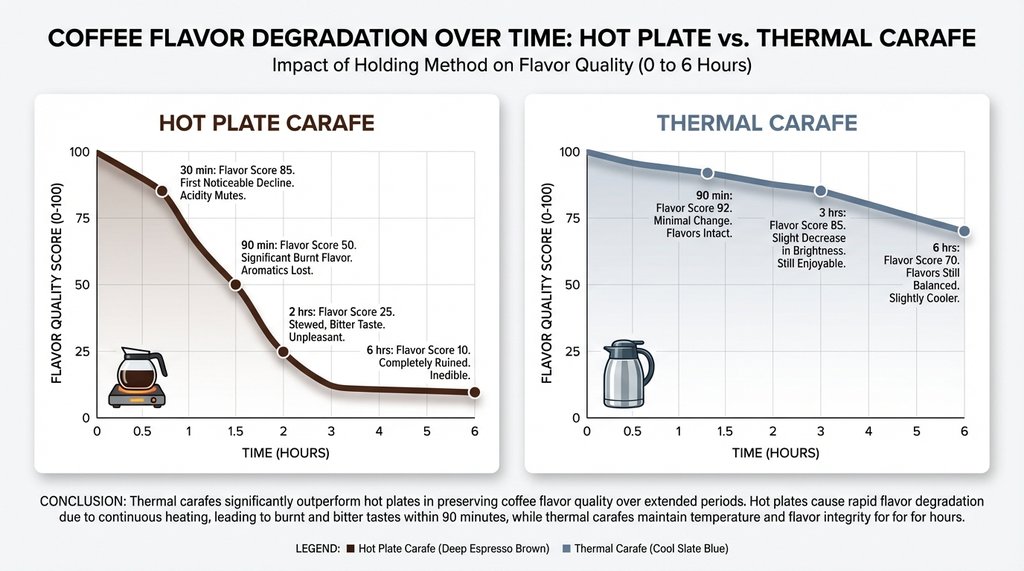
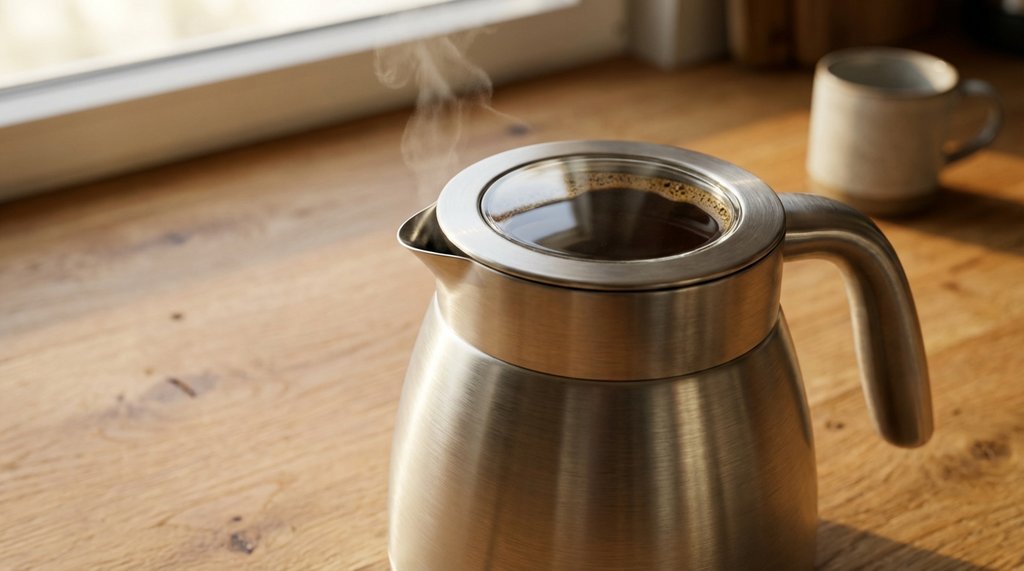
A thermal carafe—the kind with no heating element underneath—will keep brewed coffee genuinely drinkable for four to six hours. I’ve had coffee from a quality stainless carafe at hour five that, blind, I would have called one to two hours old. There’s some oxidation and minor flavor drift, but without continuous heat applying energy to the degradation reactions, the process is slow.
Now put that same batch on a hot plate and the timeline compresses to under an hour for noticeable bitterness, and under two hours for something most people would describe as tasting “burnt” even if no burning technically occurred. The oxidation and degradation reactions don’t care about your coffee budget. They just need heat and time.
The specific failure mode I kept hitting before I understood this: I’d brew a fresh pot, get pulled into a meeting, come back 90 minutes later, and genuinely couldn’t tell if the bitterness was from the coffee being old or from using a darker roast than usual. Turns out the answer was both, and the hot plate was accelerating what the roast level started. Dark roasts degrade noticeably on a hot plate because they already start with higher concentrations of bitter compounds like quinic acid from the roasting process—this is not something most coffee guides mention, but it matters if your office buys whatever’s on sale.
What “Harmful” Actually Means (And When It Actually Applies)
This is where I want to be precise, because a lot of internet content conflates “it tastes bad” with “it will hurt you,” and they’re not the same threshold.
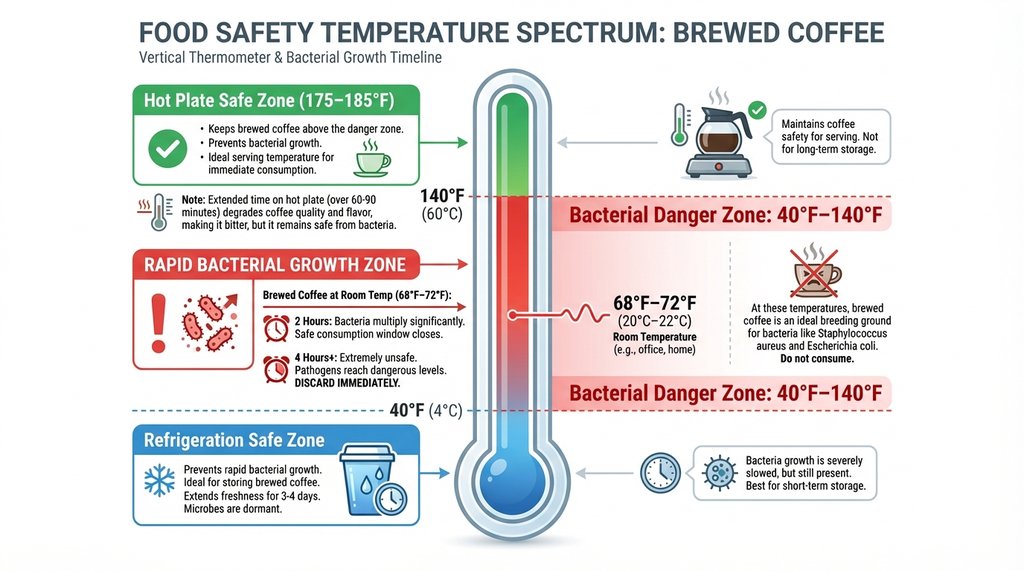
For healthy adults, brewed coffee left at room temperature—not on a hot plate, just sitting on a counter in a glass carafe or pot—becomes a legitimate bacterial concern at around 12 hours. Brewed coffee is mildly acidic and contains antimicrobial compounds from caffeine and polyphenols, which gives it some natural resistance. But those defenses aren’t infinite. At the 12-hour mark at typical indoor temperatures (68–72°F), bacterial counts start to climb in ways that matter. At 24 hours, coffee left at room temperature can harbor enough microbial activity to cause GI distress in people with sensitive systems. I’ve seen this framed as “coffee is fine for 24 hours” on wellness blogs, which is technically defensible for most people under most conditions but leaves out the part where the acidity has also climbed, the off-flavors are significant, and the antioxidants have largely oxidized out.
Hot plate scenario: bacteria aren’t your concern. At 175–185°F, the pot is well above the 140°F threshold for keeping food safe. The problem is purely sensory and chemical. You won’t get sick from two-hour hot plate coffee, but the quinic acid concentration will be high enough to irritate an already-sensitive stomach. I’ve had clients mention that afternoon coffee “sits differently” than morning coffee, and when we dug into their routine, they were drinking from a pot that had been on the warmer since 8:00 a.m.—three, four, sometimes five hours old.
Cold brew and iced coffee are a completely different story and don’t belong in this conversation—those are designed to sit, and their pH/bacterial behavior under refrigeration is governed by different chemistry.
The Reheating Question Nobody Asks Correctly
“Can I reheat old coffee?” is usually answered with some version of “technically yes, but the flavor gets worse.” Both parts of that are true but miss the more interesting point.
Reheating coffee that’s been sitting at room temperature for two to three hours is not a food safety issue if you bring it back above 165°F. But reheating it doesn’t reverse the chemical degradation. Quinic acid is quinic acid. The bitterness you’re tasting isn’t volatile—it won’t cook off or neutralize with heat. What microwave reheating does do is add another round of thermal degradation and oxidation on top of what’s already there.
My actual practice: if coffee has been sitting for more than 45 minutes on a hot plate or 90 minutes at room temperature and I want something hot, I make a fresh pot. If I just need caffeine and don’t care about flavor, two-hour hot-plate coffee reheated in the microwave for 45 seconds is not going to send me to the hospital. But I’m not going to pretend it tastes good.
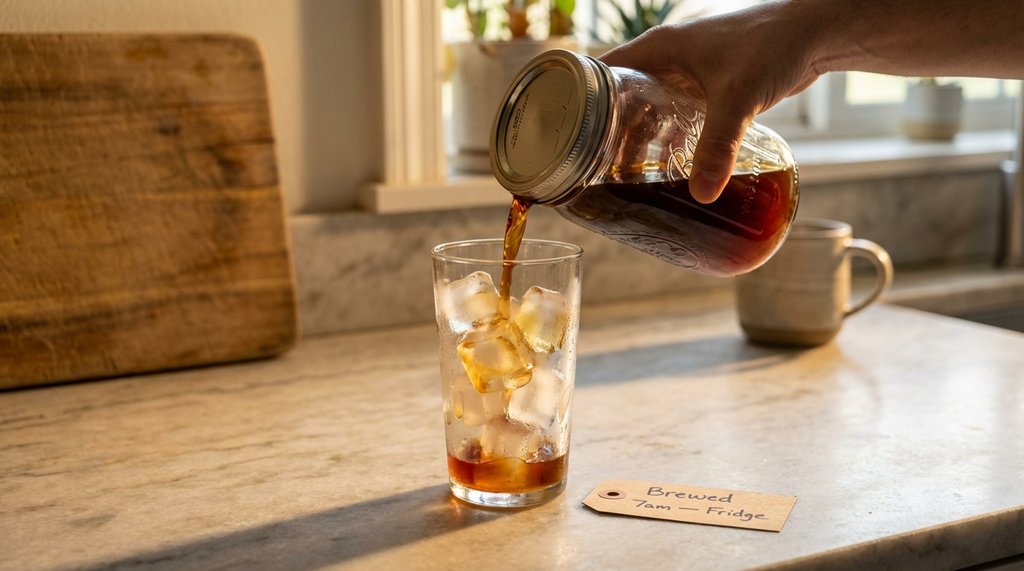
The one non-obvious use case: day-old coffee (stored in the fridge, covered, within two to three hours of brewing) makes genuinely good iced coffee when poured over ice. The overnight chill doesn’t arrest the flavor degradation completely, but it slows it enough that by hour 18–20 in a sealed container at 38°F, the coffee is still more interesting than a lot of cold brew concentrates I’ve tasted. The pH remains relatively stable or drops slightly in cold storage, staying closer to its original 5.0–5.1 for most medium roasts, which is actually gentler on the stomach than hot coffee that has been left on a warmer.
Why the “Two-Hour Rule” Most Sites Quote Is Both Right and Wrong
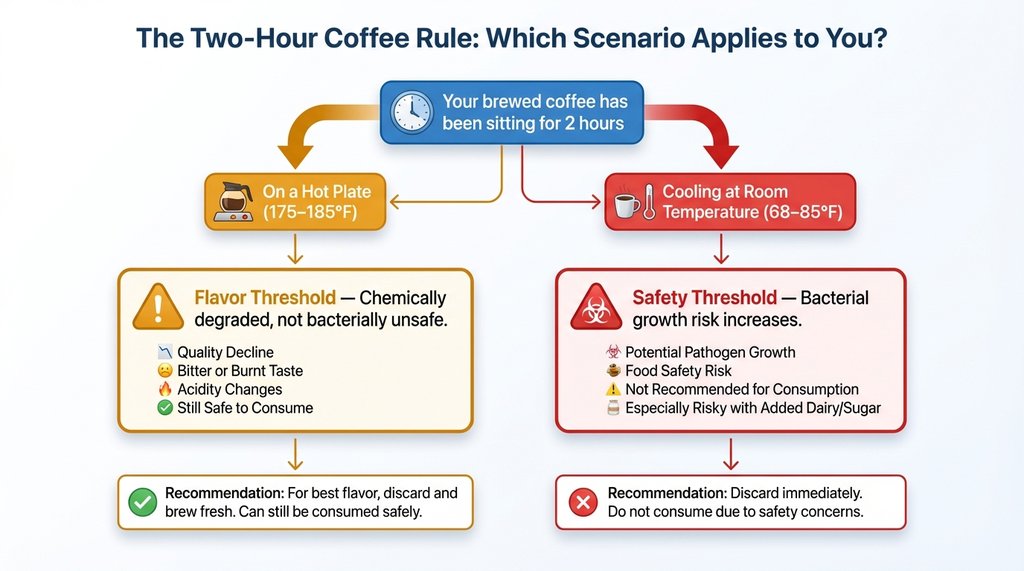
You’ll see “discard after two hours” repeated across most food-safety-adjacent coffee content. The USDA’s broader guidance on hot-held beverages supports something in this range. I don’t think this is wrong, but I think it’s applied to the wrong variable most of the time.
The two-hour guideline is most relevant for coffee that’s been cooling from brewing temperature down through the bacterial danger zone (40–140°F). That’s a scenario where you brewed coffee, left it out, and it slowly cooled. In that case, two hours is a reasonable conservative threshold before bacterial growth becomes a real factor, particularly in humid environments or if the pot wasn’t fully clean to begin with.
It is less relevant for coffee that’s been continuously held on a hot plate at 180°F, where bacteria aren’t growing. In that scenario, “two hours” is a flavor threshold, not a safety threshold. Conflating them leads to either throwing away coffee that’s safe but bad-tasting, or misapplying the rule to the room-temperature scenario where it actually matters.
The scenario where I’ve seen real problems: coffee brewed into a thermal carafe, left in a warm kitchen (80–85°F in summer), opened and closed several times throughout the morning, and then treated as safe because “it’s a thermal carafe.” The carafe insulates against heat loss but doesn’t sterilize the environment. If that pot is sitting at 110–120°F after three hours—warm enough to feel like it’s holding temperature, but cool enough to have dropped out of the safe zone—you’ve been in the bacterial danger zone for a meaningful stretch. The off-flavor develops slower than on a hot plate, so there’s less sensory warning.
What Actually Extends Coffee’s Useful Life
Nitrogen flushing, which some specialty cafes do for bottled or canned coffee, dramatically extends shelf life by eliminating the oxygen that drives oxidation. For home use, this isn’t practical.
What is practical: brew into a pre-heated thermal carafe, fill it as close to the top as possible (less headspace = less oxygen contact), and don’t open it repeatedly. Coffee stored this way at the four-hour mark will be noticeably better than coffee that’s been in an open carafe for 90 minutes. I’ve done side-by-sides. The difference is not subtle.
If you’re managing coffee for a group—office, catering, event—the better operational model is brewing smaller, more frequent batches rather than a large batch held for a long time. Two 6-cup brews spaced 45 minutes apart will produce consistently better coffee than one 12-cup pot sitting for two hours. The math on this seems obvious when you say it out loud, but it requires someone deciding that coffee quality is worth the extra attention.
The Specific Thing I Got Wrong For Years
For a long time, I assumed the bitterness from old coffee was primarily from over-extraction—that the hot water kept pulling compounds out of whatever residual grounds were in the filter basket. Turns out that’s a minor contributor. The more significant mechanism is thermal degradation of already-dissolved compounds in the brewed liquid itself.
This matters because my attempted fix—removing the carafe from the hot plate and using a separate warmer set to a lower temperature (around 155–160°F)—helped with the rate of degradation but didn’t solve the fundamental problem the way I expected. At 155°F, the coffee degraded more slowly, and at the 90-minute mark it tasted noticeably better than 185°F coffee. But by two and a half hours, they had converged to roughly the same place. Lower heat buys time; it doesn’t stop the clock.
The fix that actually worked was switching to a thermal carafe entirely and accepting that coffee older than four hours, regardless of storage method, needs to be made fresh. A small operational change that had a large quality impact—extending the acceptable flavor limit by about 2.5x compared to the hot plate setup.