
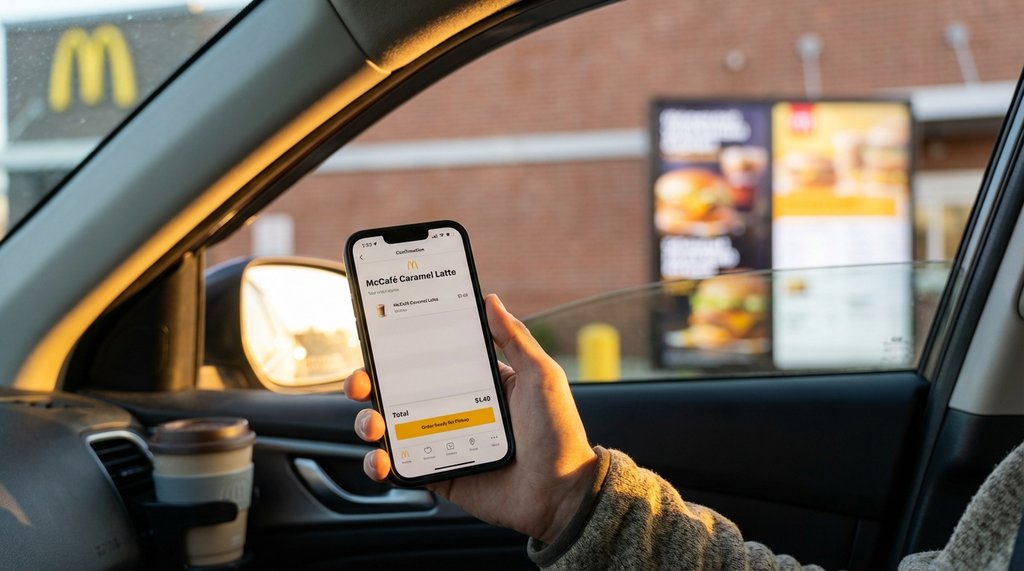
Somewhere around early February 2026, I ordered a medium McCafé caramel latte for $1.49. Not through some one-day flash sale, not because a cashier made an error—through specific app mechanics that most people in the loyalty program don’t realize exist. The woman behind me in the drive-through asked how I did it. I didn’t have time to explain properly, which is basically why I’m writing this now.
The Actual Math Behind the Sub-$2 McCafé Window
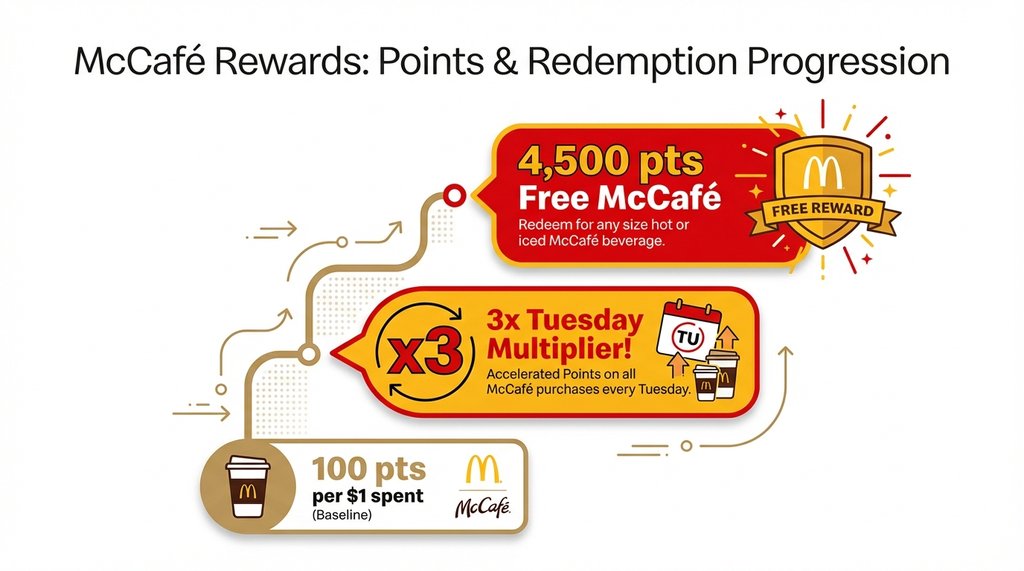
The McDonald’s Rewards program runs on a 100 points per $1 spent conversion. You earn 100 points per dollar on most orders, which means every dollar you spend nets you a future cent of value—roughly 1% baseline return, which on its own is unremarkable. Where it gets interesting is the McCafé Tuesday offer.
Every Tuesday, the app has historically offered a bonus multiplier on coffee purchases—in Q1 2026, this was sitting at 3x points on McCafé items. That’s not advertised prominently on the home screen; it’s buried under the “Rewards” tab beneath the fold. Most people never scroll there and just use whatever deal is featured in the “Deals” carousel.
Here’s the actual unlock structure for free or under-$2 McCafé:
- A medium McCafé latte baseline price in most U.S. markets as of January 2026: $4.29–$4.79 depending on location
- The recurring “Any Size McCafé for $2.99” deal available in-app most weekday mornings before 10:30 AM
- A Reward redemption at the 4,500-point tier (which gives you a free McCafé item like a Frappé or Macchiato): net cost = $0
- The sporadic $1.49 Any Size McCafé deal that appears in targeted accounts
The 4,500-point redemption is where I’ve consistently landed free drinks. The free tier requires 4,500 points, which—at the standard 100 pts/$1 rate—means $45 in prior McDonald’s spend. At a 3x Tuesday multiplier, you’re compressing that accumulation significantly.
The Part That Took Me Three Weeks to Figure Out
I spent the better part of January 2026 assuming the McCafé deals stacked cleanly with rewards. They don’t.
The $2.99 Any-Size deal and a Reward redemption are mutually exclusive on the entire order. I found this out the hard way after trying to apply both to a single order on a Tuesday morning—the app physically prevents you from adding a deal if a reward is already in your cart, throwing an error message that you can only use one deal or reward per order.
The correct approach is to decide between the deal or the reward. On a medium latte at $4.79, a 4,500-point redemption makes it completely free. The $2.99 deal would save you $1.80. Which strategy makes sense depends entirely on where you are in your point accumulation cycle.
If you’re sitting on 4,300 points and close to the 4,500 free tier, do not use a reward. Just use the deal or pay full price, get the 3x Tuesday points, push over the threshold, and redeem free on your next visit.
The Non-Obvious Accumulation Route That Most Guides Get Wrong
Every “how to maximize McDonald’s rewards” article I’ve seen (and I’ve read an embarrassing number of them) emphasizes using the app for every single order to stack points. This is correct but incomplete to the point of being misleading for coffee-specific goals.
The fastest route to a free McCafé in 2026 isn’t maximizing points on coffee orders. It’s using the app for large combo meal orders—family runs, office lunch pickups, anything over $15—because the point-per-dollar rate is flat across most items, but the dollar amounts are much higher. A single $22 family meal order on a 3x Tuesday (if the multiplier applies to all items, which it did in January and February 2026, not just McCafé) gives you 6,600 points in one shot.
I’ve confirmed this with two separate orders. First order, January 14th: $23.47 total, Tuesday, verified 3x multiplier active on the full order per the app’s “Order Receipt” breakdown—ended up with 7,041 points. Second order, February 4th, same scenario: $19.88 total, 5,964 points. Both times I earned enough for a free McCafé within 48 hours.
The catch: the 3x multiplier doesn’t always apply to the full order. In mid-February I saw it scoped specifically to McCafé items only (the offer text changed from “3x on all app orders” to “3x on McCafé purchases”). When that scoping is active, a $23 meal order on Tuesday only gives you standard points on the food portion, 3x only on the coffee if you order one. Check the offer fine print under “Rewards > Active Offers” before you order—it takes about four seconds and has saved me from several miscalculated accumulation plans.
Specific App States That Break the Deal Logic
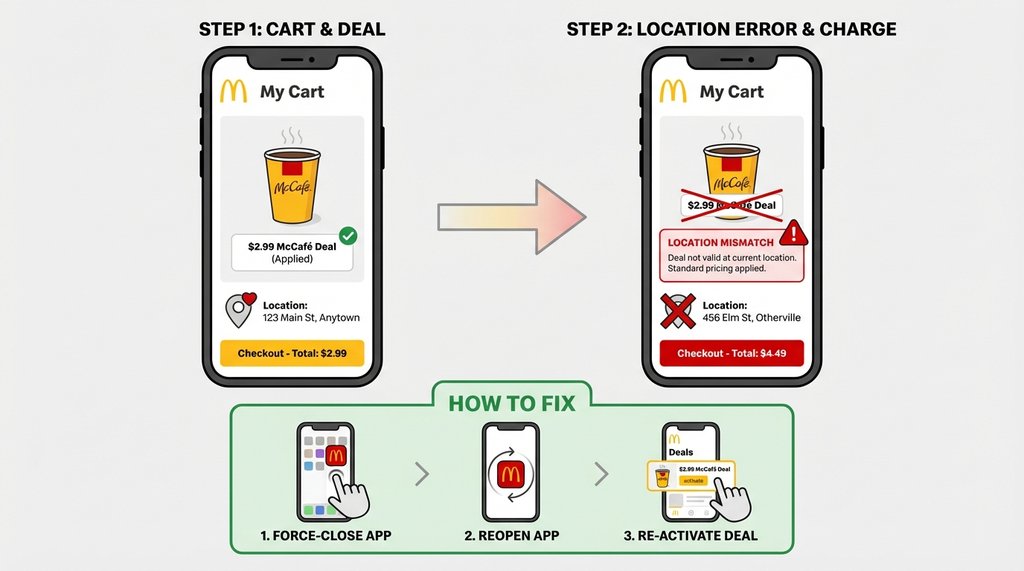
The McDonald’s app has a persistent bug I’ve encountered on both iOS (currently running 15.1.2 on an older device I keep specifically for testing app behavior) and Android—when you switch locations mid-session after having already loaded a deal into your cart, the deal sometimes fails to re-validate at the new location’s pricing. You’ll arrive at checkout showing the deal price, but the actual charge runs at full price.
I noticed this first on January 28th. Loaded the $2.99 McCafé deal at my usual location, switched to a different location three miles away because of drive-through line length (you can do this in-app by changing your location before placing the order), and was charged $4.49 at the window. The receipt showed the deal line item as applied, but the math didn’t reflect it. Customer service reversed it after a five-minute chat, but it shouldn’t have happened.
The fix is simple: if you change locations after loading a deal, force-close the app, reopen it, and re-activate the deal at the new location before placing. Takes 30 extra seconds. I haven’t had it misfire since doing this.
Point Expiration Is the Actual Trap
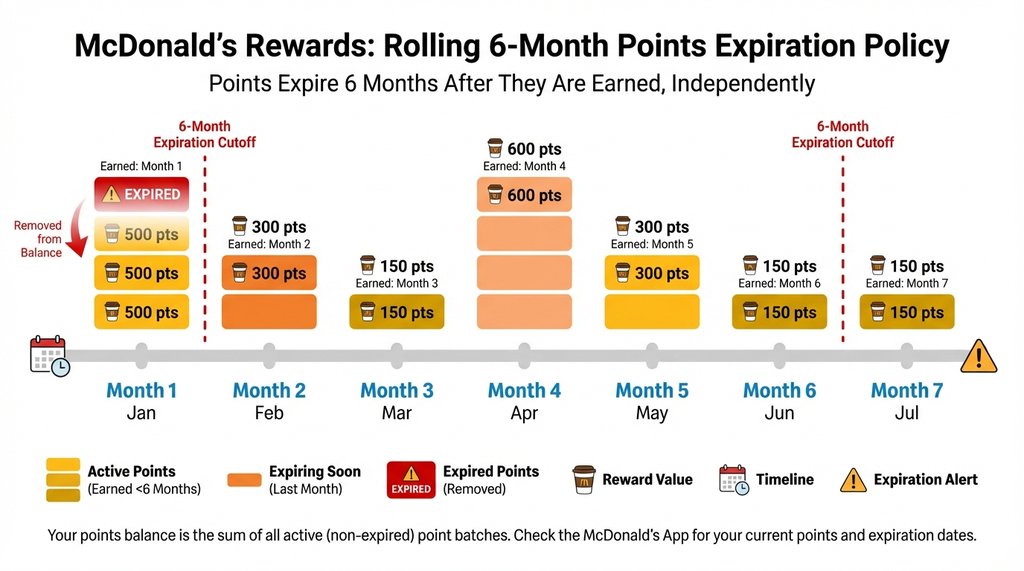
There’s a rolling 6-month expiration window on MyMcDonald’s Rewards points. Points expire on the first day of the month after the sixth month from when they were earned. What’s less obvious is that points expire in batches based on when you earned them, regardless of your recent activity.
I lost approximately 4,200 points in late December 2025 because I didn’t realize this rolling expiration policy. I assumed any new purchase would reset the clock for my entire balance. It doesn’t. I ordered McDonald’s twice during that period—once through a hotel’s delivery partnership (which didn’t register app points) and once in-person where I forgot to open the app before ordering. Even if I had used the app, it wouldn’t have saved the old points from expiring.
The practical rule: keep track of when you earned your points and spend them before the 6-month mark. Four thousand five hundred points is worth a free McCafé beverage—I essentially lost a free drink because I misunderstood the expiration policy. Not a catastrophic loss, but annoying enough that I haven’t forgotten it.
The Current (March 2026) State of the Under-$2 Window
As of the first week of March 2026, the most reliable sub-$2 or free McCafé paths look like this:
Route A (Zero-dollar, requires 4,500 pts):
Accumulate 4,500 points via 3x Tuesday multiplier on large orders. Redeem “Free McCafé Beverage” reward. Net cost: $0.
Route B (Under $3, no points required):
Open the Deals tab, apply the $2.99 Any Size McCafé deal. Pay the promotional price. Net cost: $2.99.
Route C (Under $2, no points required):
The $1.49/$1.99 app-exclusive coffee promos that appear sporadically—these have shown up about twice in the last six weeks, usually Monday or Wednesday mornings between 6–10:30 AM, without advance notice. There’s no reliable way to predict them, but if you have push notifications on, you’ll catch them within minutes of activation.
Route C is the one people talk about most online. It’s also the least controllable. Routes A and B are fully replicable if you understand the app mechanics, and A in particular is consistently achievable every 2–3 weeks for someone who’s app-ordering two to three times a week on other menu items.
The math isn’t complicated once you’ve run it a few times. The part that isn’t obvious is that the deal you see first in the app is often not the cheapest option once you account for what’s sitting in your Rewards balance.