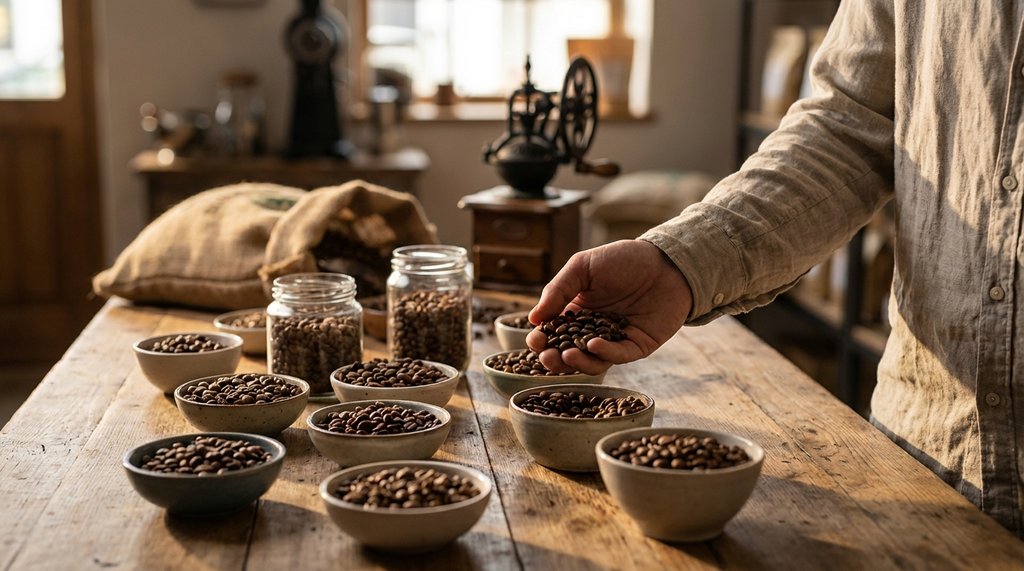
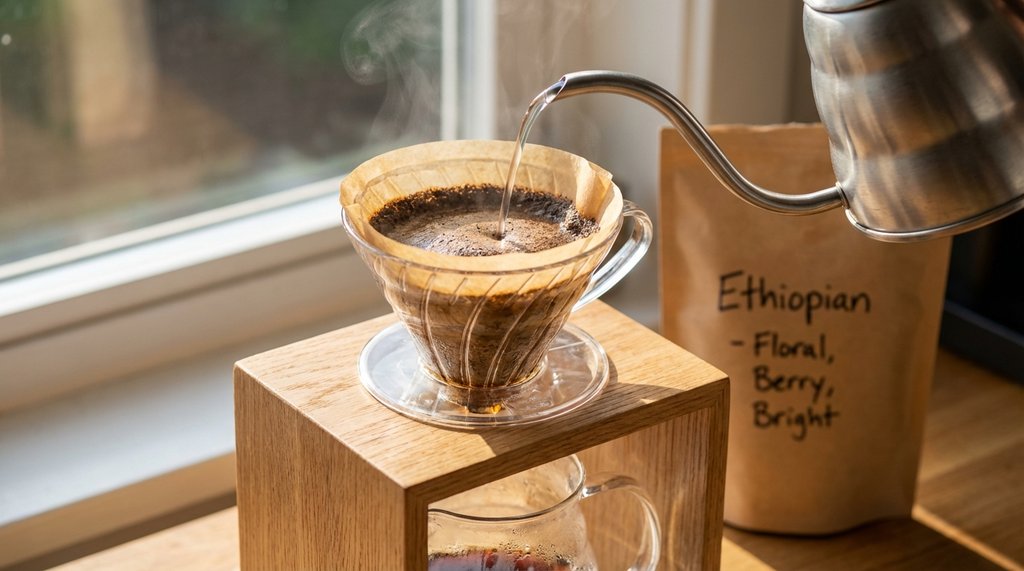
The first time I bought a bag of natural-processed Ethiopian Yirgacheffe specifically for my Hario V60 was the first time I genuinely resented a roaster’s tasting notes. “Blueberry, dark chocolate, heavy syrupy body” — every word on that label was technically accurate. Every word was also a trap. I brewed it at my usual 93°C with a medium-fine grind, ran a 2:45 total drawdown, and ended up with something that tasted like a blueberry jam left in a hot car. Sweet, yes. Muddy, absolutely. The kind of cup that makes you question whether you even know what you’re doing.
The problem wasn’t the coffee. The problem was that I’d been reading tasting notes as descriptions of what I’d taste, when they’re actually descriptions of what’s in the coffee — and those are two completely different things depending on how you extract it.
What tasting notes are actually telling you
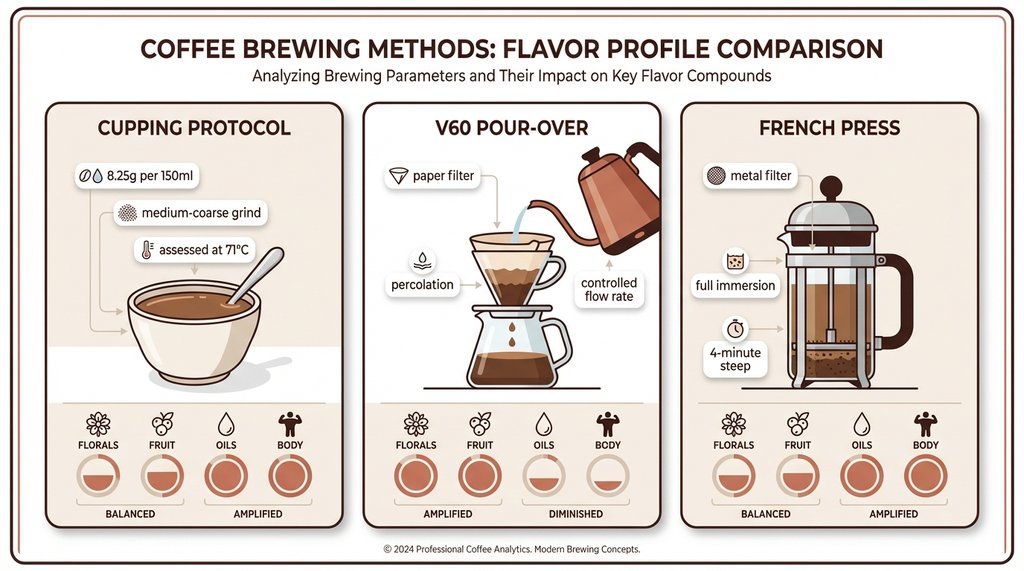
Roasters cup their coffees on a calibrated cupping table using a standardized protocol: 8.25g per 150ml of water, ground at a medium-coarse setting, no agitation after the first stir, assessed at around 71°C. That’s the context in which those blueberry and dark chocolate notes were detected. Your French press is not a cupping bowl. Your V60 is not a cupping bowl. The extraction environment is different enough that some notes will amplify, some will disappear entirely, and some will curdle into something unpleasant.
There’s a specific shorthand I’ve started using: think of tasting notes as ingredients listed before cooking. A chef describing a dish that includes red wine, dark chocolate, and black pepper is telling you something different from what ends up on the plate. The proportions, the heat, the technique — these transform the raw inputs. Your brew method is the cooking technique. And if you’re picking a red wine reduction recipe expecting the wine to taste like wine, you’ve misread the instructions.
The variable that matters most: solubility profile of the flavor compounds
Pour-over and French press don’t just differ in immersion vs. percolation. They differ in which flavor compounds they preferentially extract and at what concentrations.
The lighter, more volatile aromatic compounds — the ones that register as floral, citrus, and bright fruit — are extracted early in the brew and are highly sensitive to bypass dilution and flow rate. In a pour-over, if your grind is dialed correctly and your pours are controlled, these compounds get locked in before the heavier, oilier compounds fully saturate the brew. The result is clarity and definition. Each note sits in its own lane.
French press keeps the grounds in full contact with the water for the entire brew time (I run 4 minutes on most single origins, 4:30 on denser lighter roasts). The metal filter passes the fines and oils that a paper filter strips. This means you’re getting the full lipid content of the bean — which carries body, roundness, and what most people describe as “weight” — but it also means that delicate aromatics get buried under that fat content. A coffee with tasting notes of “jasmine and Meyer lemon” will likely lose most of its jasmine in a French press. You’ll taste lemon, probably, but it’ll sit under a layer of creaminess rather than floating above it.
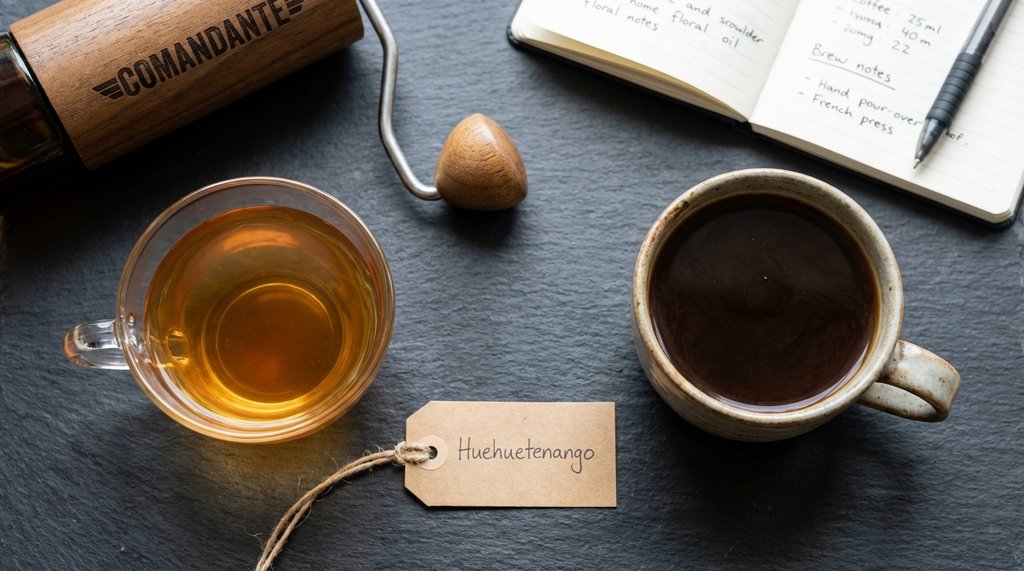
I tested this back-to-back with a washed Guatemalan Huehuetenango from Onyx Coffee Lab (the Buena Vista lot, purchased March 2024). Tasting notes on the bag: brown sugar, green apple, black tea, light body. On the V60 at 92°C, 15g:250ml, I hit brown sugar clearly and the green apple was present as a dry, almost tart finish. Body was exactly as described — clean and light. The same coffee in my Bodum Brazil French press at the same temperature, 4-minute brew, coarser grind: brown sugar became the dominant note to an almost cloying degree, the green apple was mostly gone, and the body was noticeably heavier than the bag suggested. It wasn’t bad. It was a different coffee.
Reading the menu: which descriptors signal pour-over territory
When I scan a coffee menu looking for pour-over candidates, I’m looking for specific language patterns, not just individual words.
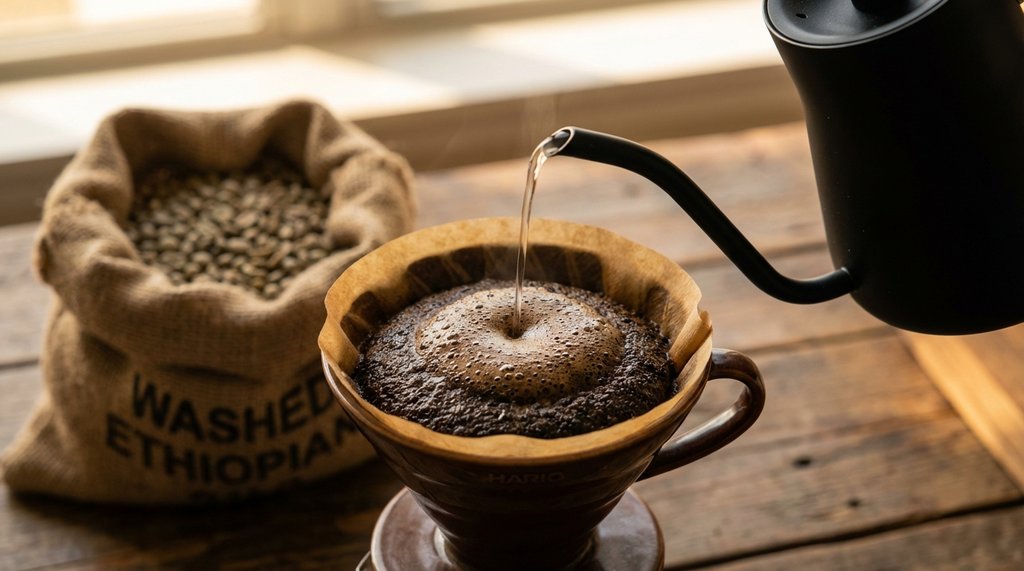
High-clarity descriptors — florals (jasmine, rose, hibiscus), citrus (bergamot, lemon zest, kumquat), stone fruit (nectarine, apricot, peach), and anything described as “delicate” or “tea-like” — are pour-over signals. These are compounds that benefit from the paper filter’s oil-stripping effect and from the defined extraction window that a controlled pour provides. A coffee described as “delicate jasmine and white peach with a juicy, tea-like finish” was almost certainly cupped with exactly that profile in mind, and a well-dialed V60 will get you close to it.
Process matters here more than origin. Washed coffees from East Africa (Ethiopia, Kenya, Rwanda) and Central America (Guatemala, Honduras) in this flavor profile are reliably pour-over friendly. The fermentation and mucilage-removal process in washed coffees produces cleaner, more acidic flavor compounds that shine under precise extraction.
Where I’ve gone wrong repeatedly: assuming that “bright” means “delicate.” A Kenya AA described as “bright blackcurrant and grapefruit with wine-like acidity” is not delicate. Kenyan beans often have a dense, high-density cell structure that requires more extraction to fully develop. I used to under-extract these thinking I needed to preserve the brightness, and ended up with sharp, unpleasantly sour cups that tasted like lemon pith. The fix was counterintuitive — finer grind, slightly higher temperature (95°C), longer total contact time of around 3:00-3:15. The brightness didn’t disappear; it just got balanced.
Reading the menu: which descriptors signal French press territory
French press rewards coffees that are described in terms of weight, density, and layered complexity — not transparency and clarity.
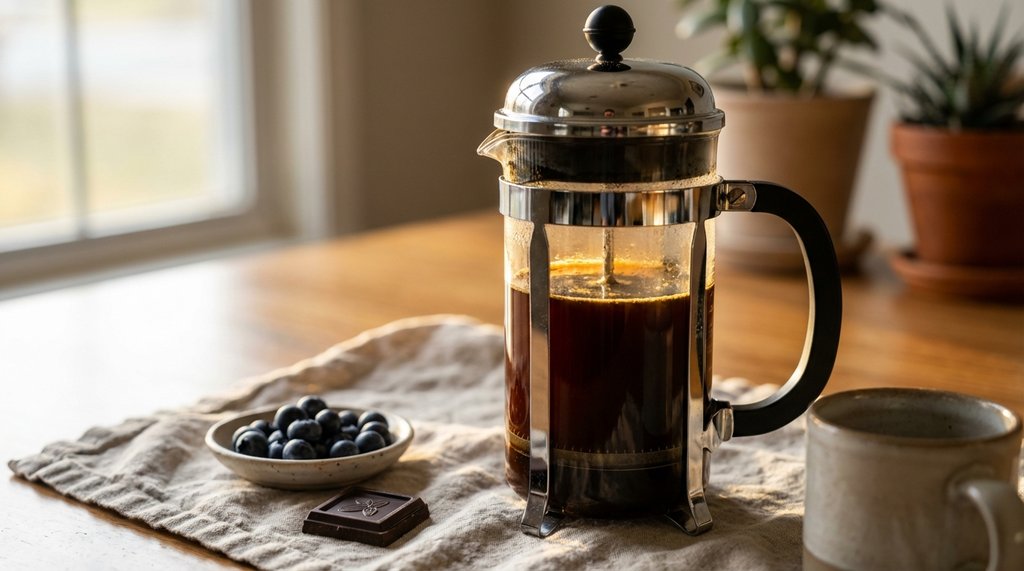
When I see “dark fruit, baking chocolate, brown sugar, full body” or “tobacco, dried fig, molasses, stone fruit,” I’m looking at a French press coffee. Natural and honey-processed coffees from Ethiopia, Brazil, or Yemen, where the cherry ferments around the bean during drying, tend to have higher concentrations of the lipid-soluble flavor compounds that the French press’s metal filter allows through. These are exactly the notes that get muddied in a pour-over if you don’t nail your technique — they’re heavy, they’re complex, and they need that oil content to carry them properly.
The blueberry Yirgacheffe problem I described at the start was this exact mismatch. That natural-processed bean was a French press coffee pretending to be a pour-over coffee on my shelf. I brewed it in the French press the following weekend — same 93°C, 1:15 bloom, total 4 minutes, coarse grind around 800 microns on my Comandante — and the cup was genuinely remarkable. The blueberry was still there but it was round and jam-like in a way that worked. The chocolate had depth. The body carried everything.
One genuinely counterintuitive point: medium-roast single-origin Brazilians are almost always better in a French press than a pour-over, despite the fact that most specialty coffee shops brew them on pour-over because Brazil is an “accessible” origin. The nutty, chocolatey, low-acid profile of most Brazilian beans doesn’t have enough acidity or aromatic lift to stand out clearly in a paper-filtered brew — you end up with something pleasant but flat. The French press’s oil retention adds the dimension that Brazilian coffee needs. I’ve recommended this to probably a dozen people who described their Brazilian coffee as “boring,” and without exception they reported a meaningful improvement.
Acidity descriptors are the most commonly misread
“High acidity” on a coffee label does not mean the same thing to a pour-over brewer as it does to a French press brewer, and I’ve watched people make expensive purchasing mistakes because of this.
In pour-over, acidity is an asset when it’s well-extracted. The bright malic and citric acids in a well-developed washed coffee produce that clean, fruit-forward complexity that makes a good V60 cup distinctive. But acidity needs to be extracted in balance — under-extracted, it’s sharp and unpleasant; over-extracted, it gets buried under bitterness.
In French press, high-acidity coffees are harder to manage. Because immersion brewing has a lower extraction efficiency than percolation, it can struggle to extract enough sweet compounds to balance bright acids, and without the paper filter’s oil-stripping effect, you get a cup where the acidity clashes with the heavy body, tasting almost sour-savory in a way that most people find off-putting. I specifically avoid coffees rated with high acidity for French press unless I’m brewing them at a lower temperature — dropping to 89-90°C reduces the extraction of sharper acidic compounds significantly. The tradeoff is that you also pull less of the aromatic top notes, but for a French press coffee that’s usually acceptable.
The practical shorthand: if a coffee menu uses acidity descriptors like “bright,” “lively,” “sparkling,” or “juicy” prominently — especially if those descriptors are listed first — treat it as a pour-over coffee. If acidity appears as a secondary or tertiary note after body and sweetness descriptors, French press is the safer call.
The roast level modifier
Everything I’ve described above gets modulated by roast level in ways that menus don’t always make explicit.
Lighter roasts retain more of the volatile aromatic compounds and more of the bean’s natural acidity. They also have denser cell structure, which means they need more energy to extract properly — higher temperature, finer grind, or longer contact time. For pour-over, light roasts require precise technique: I typically brew these at 94-95°C, a coarse grind, and I use a Tetsu Kasuya-style 40:60 split pour to control extraction in two phases. For French press, light roasts need the full 4:30 steep, sometimes a brief stir at 3:00 to break the crust and re-introduce the grounds to the liquid layer.
Medium roasts are the most versatile across methods, which is exactly why most specialty roasters default to them for their house offerings.
Dark roasts are almost exclusively French press territory in my workflow. The roasting process has already done the flavor development work — the volatiles are largely cooked off, and what’s left is highly soluble, meaning it extracts very easily and is prone to over-extraction. Trying to coax complexity out of a dark roast on a V60 usually just produces a thin, bitter cup that accentuates the char rather than any underlying character. In a French press, those roasted, caramelized compounds sit comfortably in a heavy body and produce the kind of cup that dark roast drinkers actually want.
A working decision tree
When I’m standing in a coffee shop looking at a menu of single origins with no brewer recommendations, I run through this sequence:
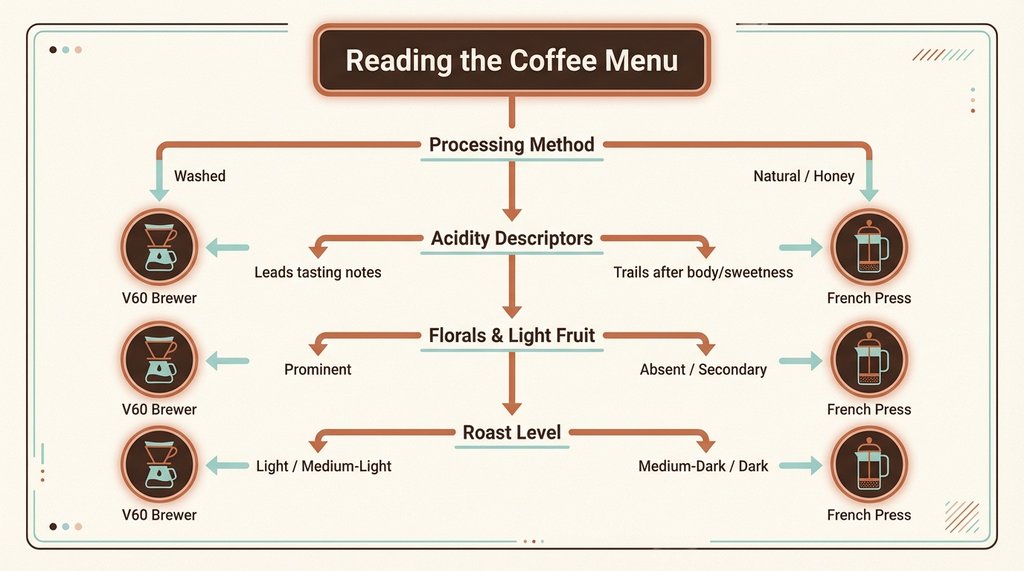
First, I look for the processing method. Washed → lean toward pour-over. Natural or honey → lean toward French press.
Second, I look for acidity descriptors. If they lead the tasting notes → pour-over. If they trail after body and sweetness → French press.
Third, I look at where the florals and light fruit descriptors are. If prominent → pour-over. If absent or secondary → French press.
Fourth, I consider roast level. Light and medium-light → pour-over. Medium-dark and dark → French press.
If all four signals point the same direction, the decision is easy. If they conflict — say, a natural-processed coffee with prominent floral notes, which happens with natural Ethiopians — I default to pour-over but adjust my technique: coarser grind than I’d use for a washed coffee, slightly lower temperature (91-92°C), and a faster pour to reduce the contact time in the bed. The goal is to catch the aromatics before the heavy fruit notes overwhelm them.
That adjustment alone took me about six months of frustrating natural Ethiopian brews to figure out. The conventional wisdom is that naturals are “easier” and more forgiving — they’re not, at least not on pour-over. They’re forgiving in the sense that they’re hard to make taste bad, but they’re difficult to make taste precise, and precision is what pour-over is for.