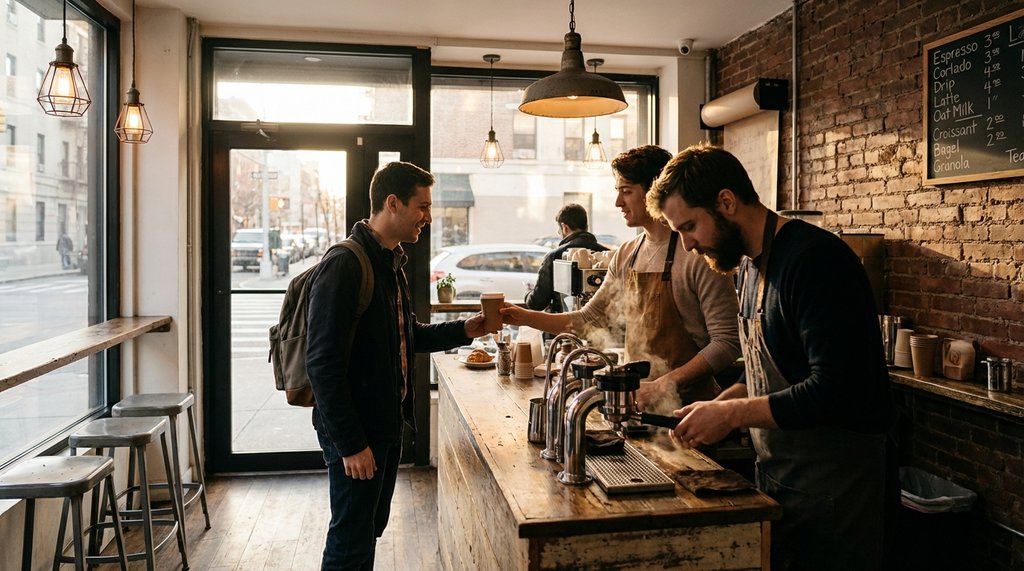
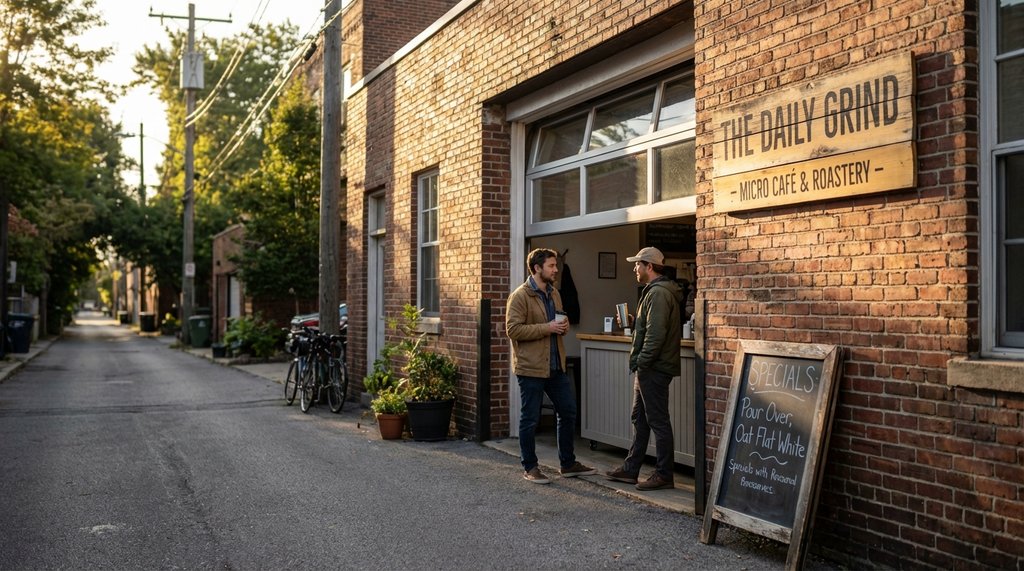
The lease was 380 square feet in a converted garage unit on a secondary commercial strip. I watched three people try to talk the landlord down from $2,800/month while I was still running numbers on a napkin, and all three walked away convinced it wasn’t viable. We opened four months later and pulled $22,000 in revenue our third full month. The space is the least interesting part of that story. What actually determined whether we survived the first year was a set of cost decisions that almost nobody writing about coffee shop startups in 2026 gets right.
So let me just run through what this actually costs, what I’d change, and where first-timers consistently blow their budget before they’ve pulled a single shot.
The Honest All-In Number First
Before the itemized breakdown: if someone tells you a sub-500 sq ft coffee concept can launch for under $40,000, they’re either describing a cart operation, excluding the security deposit, or they’ve never actually done it. The realistic floor for a permanent micro-café with espresso service in a U.S. metro or mid-size city in 2026 is $68,000 to $115,000, depending on your build condition, equipment tier, and local permit complexity.
That range narrows fast once you fix a few variables. Here’s where it actually goes.
Equipment: Where Most Budgets Break First
The single biggest variable in your startup cost is your espresso machine decision, and almost every first-time owner gets pushed in the wrong direction by equipment reps and other café owners who have different operational profiles than a sub-500-foot concept.
A commercial La Marzocco Linea PB (2-group) costs around $16,500 to $18,200 new in 2026 depending on your distributor relationship. I’ve seen first-timers go that route because they toured someone else’s café and fell in love with the aesthetic. For a micro shop with one or two bar staff and a throughput ceiling of maybe 90–110 drinks during a hard two-hour rush, you are paying for a machine that’s engineered for volume you cannot physically generate in your footprint.
What I actually run: a Sanremo You (1-group configuration) paired with a Mazzer Major V grinder. The total package including a second grinder for batch brew and a Marco Beverage Systems SP9 fetched me about $11,400. The Sanremo You gets dismissed a lot because it looks “boutique,” but its thermal stability at low-volume throughput is genuinely better-suited to a 300-cup-per-day maximum than a 3-group machine running at 20% capacity.
The specific cost breakdown for equipment in a realistic micro setup:
| Item | Low Estimate | High Estimate |
|---|---|---|
| Espresso machine (1–2 group) | $6,800 | $17,500 |
| Primary espresso grinder | $2,200 | $4,800 |
| Secondary/batch brew grinder | $800 | $1,400 |
| Batch brewer (Fetco or equiv.) | $1,100 | $2,600 |
| Under-counter refrigeration | $1,400 | $3,200 |
| Blender (if doing cold drinks) | $450 | $900 |
| Water filtration system | $600 | $1,800 |
| POS terminal + hardware | $800 | $2,200 |
| Espresso accessories (tampers, scales, pitchers) | $400 | $900 |
That’s $14,550 to $35,300 in equipment before you touch the space.
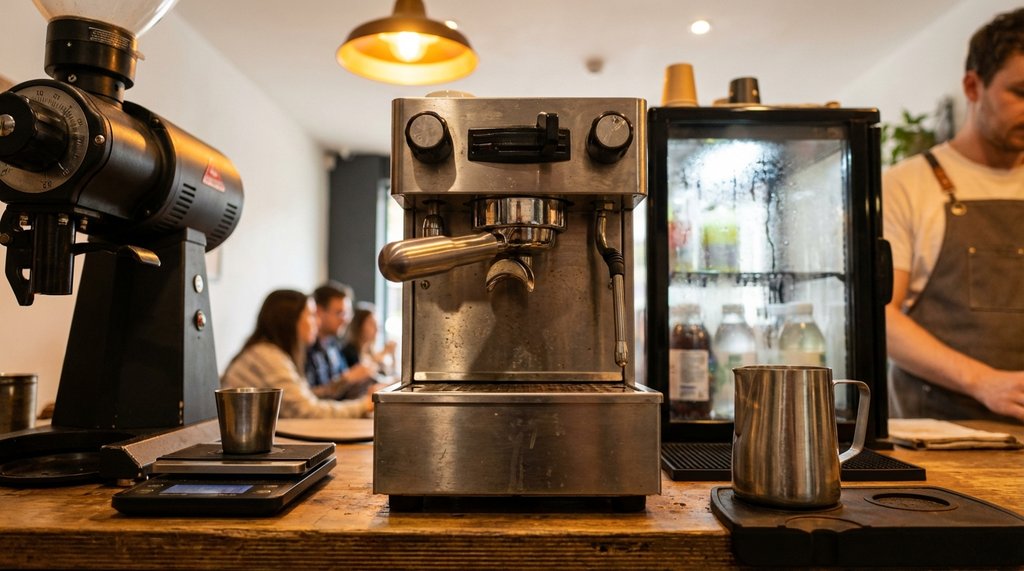
The water filtration line is where I see the most shortsighted budgeting. I skipped a proper 3M HF45 system early on to save $700 and within four months had $1,100 in descaling service calls on a machine still under warranty. The technician told me it was the third time that month he’d seen the same exact situation. Don’t skip filtration to save money. You’re not saving money.
Lease and Buildout: The 500 Sq Ft Paradox
Here’s the thing about small commercial spaces that most startup guides don’t say plainly: landlords don’t discount proportionally for size. A 400-square-foot retail unit in a walkable urban neighborhood frequently gets priced at 60–70% of what a 1,200-square-foot unit on the same block costs in absolute monthly rent. The per-square-foot rate on micro spaces is often higher because they attract boutique tenants who’ll absorb it.
In 2026, across the metro markets I’ve tracked (Austin, Denver, Nashville, secondary Northeast cities), a viable micro-café footprint is running $2,200 to $4,800/month before NNN charges. Add NNN (taxes, insurance, maintenance pass-throughs) and you’re often at $2,800 to $5,600 actual monthly cash out the door.
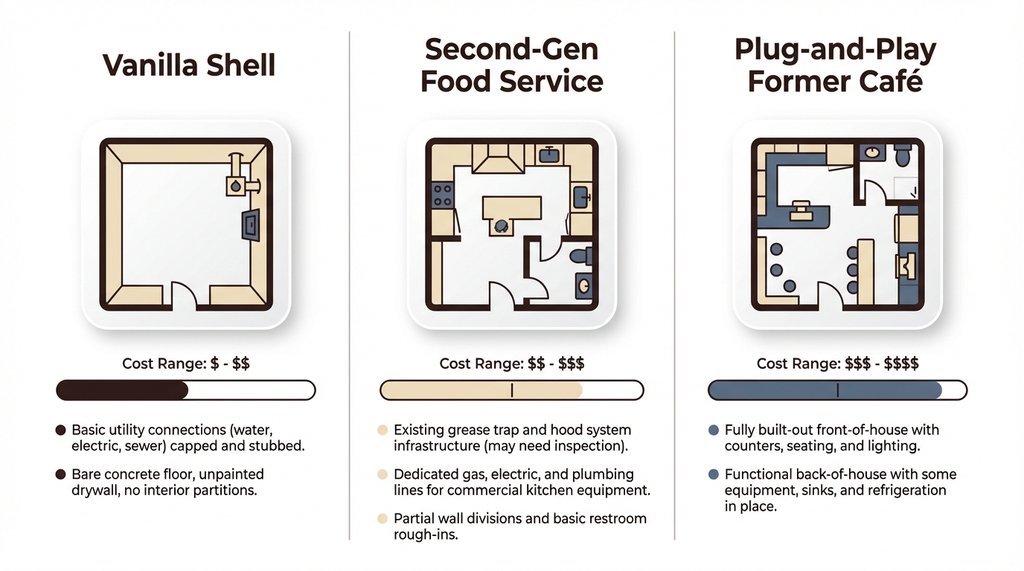
Your buildout cost is entirely determined by what condition the space is in when you take possession. The three scenarios:
Vanilla shell (bare walls, concrete or subfloor, HVAC rough-in only): Expect $35,000 to $65,000 for a sub-500-foot café buildout in 2026. This is where people get wrecked. Plumbing rough-in for a three-compartment sink plus handwash sink plus espresso machine drain line plus floor drain is not cheap in a space that wasn’t designed for food service.
Second-generation food service space: If a previous restaurant or café tenant left behind a grease trap, hood system, and plumbing rough-in, your buildout cost collapses to $15,000 to $28,000 because you’re not paying for the infrastructure from scratch. This is the play. I spent four months looking specifically for second-gen spaces before signing anything.
Plug-and-play (former café): Sometimes you can negotiate to acquire the outgoing tenant’s equipment or take over a space with a hood, plumbing, and even some equipment. I’ve seen these come in under $12,000 in buildout. These opportunities exist but you need to be actively looking for them, not just responding to whatever a commercial broker sends you.
Don’t forget the security deposit, which is typically two to three months’ rent paid before you’ve generated dollar one. On a $3,200/month lease that’s $6,400 to $9,600 sitting in escrow.
Permits, Licensing, and the Hidden Time Tax
I’m going to give you an actual number that almost never appears in these articles: plan for $2,800 to $7,500 in permit-related costs for a micro café in a standard U.S. municipality, and plan for it to take 6 to 14 weeks from application to certificate of occupancy.
The cost breakdown isn’t always the problem—it’s the sequence. Your health department permit requires a completed kitchen inspection. Your kitchen inspection requires finished construction. Your construction requires a building permit. Your building permit requires stamped architectural drawings. If you skipped the architect and tried to DIY your permit package, you’ll find out when the plan checker kicks it back. That’s four to six weeks lost.
Specific costs by category (these are real numbers from a 2025 opening I helped advise in a mid-size Texas city):
- Building permit: $840
- Health department plan review: $375
- Health department operating permit: $275/year
- Business license: $125
- Food handler certification (you + any staff): $15–$25 per person
- Seller’s permit (sales tax): free in most states, but getting it wrong has consequences
- Fire inspection: $0–$200 depending on jurisdiction
- ADA compliance review (sometimes triggered by buildout): $0–$2,400
That Texas opening hit $2,100 in permits plus $3,200 in architectural drawings, for $5,300 total. Not included in the architectural cost: two revision rounds because the original plan didn’t account for the required clear aisle width between the bar and the customer-facing counter.
State registration and business structure (LLC formation, registered agent) adds another $400–$800 if you’re doing it properly.
Initial Inventory and Opening Stock
First-timers systematically over-order coffee and under-order everything else.
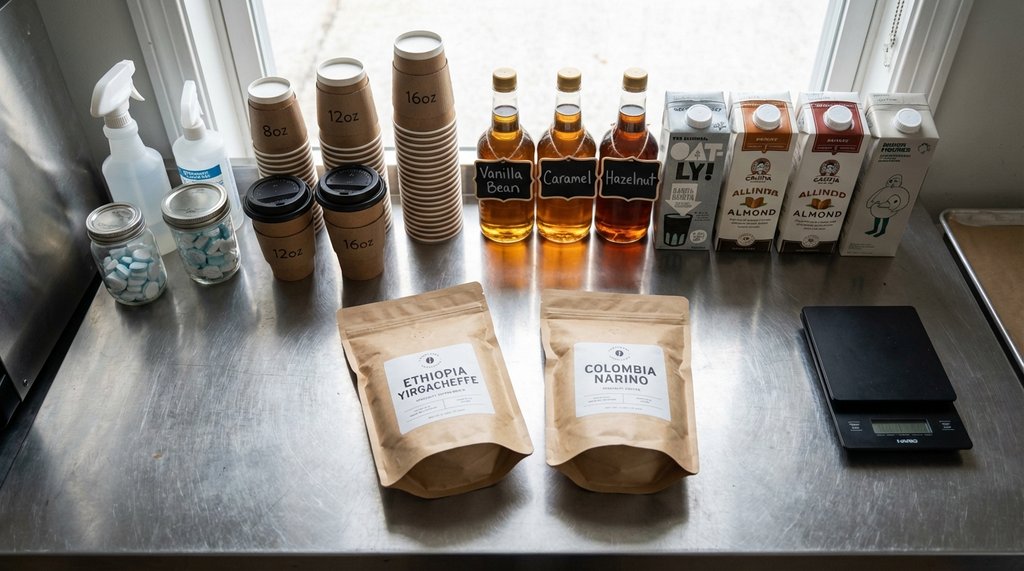
Your opening coffee inventory for a micro café: 30 to 50 lbs of your primary espresso blend, 10 to 20 lbs of a rotating single origin if you’re doing pour-over. At specialty wholesale pricing that’s $450 to $900. You do not need more than this to open. Coffee goes stale. A 15-lb bag that sits behind your bar for three weeks while you figure out your workflow is not serving your guests well.
What you actually need more of: cups (budget $600–$1,100 for a mixed-size opening inventory of 8oz, 12oz, and 16oz paper cups plus a sleeve of ceramic or glass for in-house), lids, sleeves, napkins, straws, syrup ingredients, milk (go deeper on this than you think—figure on $180–$260/week in dairy and dairy-alternative costs at opening volume).
Cleaning supplies, sanitizers, and food safety equipment: $300–$500 to open, recurring weekly after that.
Full opening inventory, realistic figure: $2,800 to $5,200.
POS and Technology Stack
Square Terminal with the $60/month Plus subscription is what most micro operators run, and it’s fine. But the thing nobody mentions: your POS system decision also determines your inventory management, your tipping prompt design (which has a statistically significant effect on average tip rate), and your loyalty program architecture.
I tested Toast against Square for about 14 months across two locations. Toast’s restaurant-grade features are genuinely better for food-forward operations, but for a drink-focused micro café doing 80% of transactions in under 45 seconds, the added complexity costs you in speed. My average transaction time with Square (including card tap and tip prompt) was 22 seconds. With Toast it was 31 seconds. Over 150 transactions during a morning rush, that’s 22 minutes of compounded wait time.
The relevant hardware for a micro café: one terminal, one receipt printer (Epson TM-T88VII runs clean at about $340), a cash drawer if you want one ($90), and potentially a customer-facing display. Budget $900–$2,200 depending on configuration.
The Cash Reserve Line Everyone Undersizes
This is the number I see most consistently low-balled in startup projections: operating cash reserve. Three months of operating expenses held in reserve before you open. For a micro café with $3,500/month in occupancy, $6,000/month in labor (lean two-person coverage), and $4,500/month in COGS and overhead, that’s roughly $14,000/month in operating costs. Three months is $42,000.
Most first-timers allocate $8,000 to $15,000 for “reserves” and then are underwater by month two when revenue hasn’t hit projections and the espresso machine needs a $700 group head rebuild.
The hard reality is that even a well-located micro café with a strong concept typically doesn’t hit break-even revenue until month three to five. The operators who make it through that period are the ones who budgeted for it. The ones who don’t are the ones who show up on Craigslist six months later selling lightly used espresso equipment.
What the Total Actually Looks Like
Running the realistic midpoints:
| Category | Realistic Mid-Range |
|---|---|
| Equipment | $22,000 |
| Lease deposit (2.5 months) | $8,500 |
| Buildout (second-gen space) | $21,000 |
| Permits and licensing | $4,500 |
| Opening inventory | $3,800 |
| POS and technology | $1,400 |
| Signage and branding | $2,200 |
| Furniture and fixtures | $3,500 |
| Pre-opening marketing | $1,200 |
| Operating reserve (3 months) | $28,000 |
| Total | $96,100 |
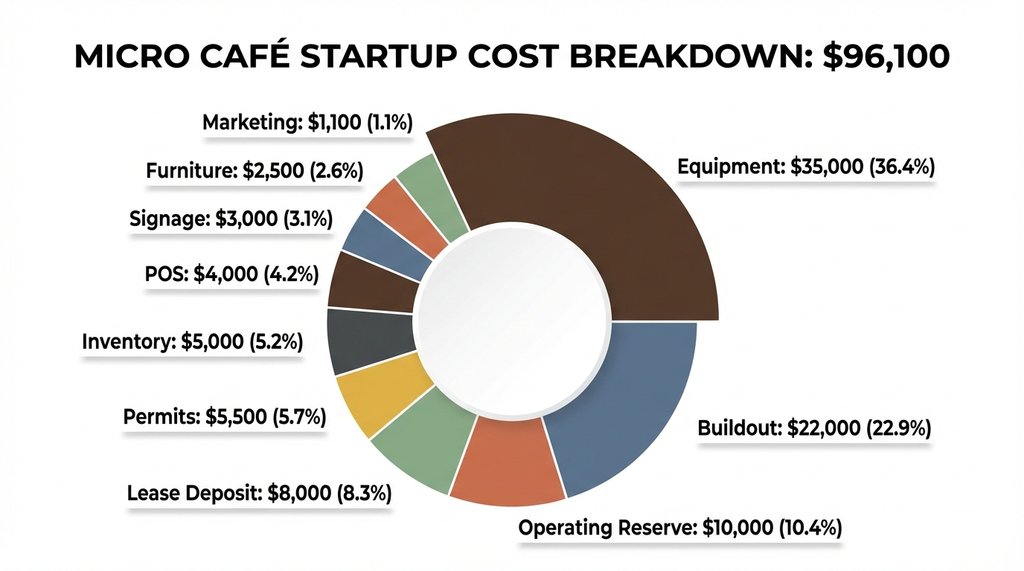
That’s a second-gen space scenario—meaning you got lucky finding a space with existing plumbing infrastructure—with a mid-tier equipment selection and a three-month reserve. A vanilla shell buildout pushes this past $120,000. An equipment upgrade to a new La Marzocco or Synesso adds $8,000 to $12,000.
The $40,000 launches you see on Reddit are cart operations, kiosk buildouts in mall or airport environments where the landlord is providing the infrastructure, or—honestly—people who didn’t actually account for all their costs correctly and are going to find out what they missed in month four.
One Thing I’d Do Differently
The single decision I’d reconsider: I signed a three-year lease because the landlord wouldn’t negotiate a rent abatement on anything shorter. In hindsight, I should have pushed harder for a 12-month initial term with two one-year options, even if it cost $150/month more. A micro café is a proof-of-concept operation. Three years locks you into a location before you know whether the foot traffic patterns you underwrote actually hold.
The rent abatement negotiation is also more possible than brokers make it sound. We got one month free; I’ve since seen operators negotiate two to three months’ free rent on second-gen spaces where the landlord was eager to fill a long-vacant unit. Every month of abatement you can negotiate is a month of operating reserve you get to keep.
On the 500 Sq Ft Footprint Specifically
The constraint creates real operational advantages that don’t show up in pro formas but matter enormously in practice. A 380-to-480-square-foot café has, at maximum, one person making drinks and one person taking orders and handling cold side. That simplicity has a direct effect on training overhead, quality consistency, and labor cost structure. You are not managing a 12-person team. You are managing a craft operation with two or three people who each need to be genuinely skilled.
The trade-off is that you have almost no margin for menu complexity. Every item on your menu that requires more than 90 seconds to execute and every item that requires dedicated cold storage space is a decision that carries real operational cost in a constrained footprint. The most successful micro cafés I’ve seen run a menu of 10 to 14 SKUs and execute all of them at a level that larger shops genuinely can’t match. That’s the actual competitive advantage of the format—not low rent, but operational focus.
Whether $96,000 is a reasonable bet on that advantage is a question only you can answer. But at least now you’re doing the math on the real number.