
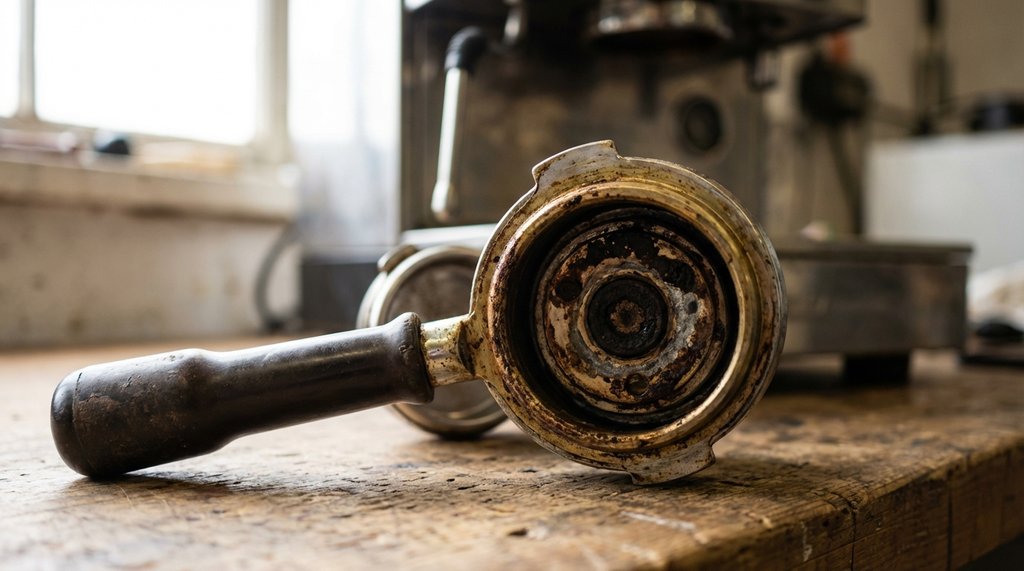
The machine that came into the shop last November — a Rocket Espresso Cinquantotto with maybe 18 months of use — had a group head that looked fine from the outside. Clean portafilter basket, decent-looking shower screen. The owner couldn’t figure out why shots had been tasting progressively more bitter and extraction was uneven. Pull the shower screen, though, and you’d find a brownish-black paste baked so thoroughly into the dispersion block that a standard group head brush wasn’t going to touch it. We ended up soaking the dispersion block in Cafiza solution for six hours before that layer started releasing. The owner had never once run a backflush cycle. Not because they were lazy — they genuinely didn’t know it was a maintenance step, and nobody at the retailer mentioned it.
That machine was recoverable. A lot of them aren’t, or at least aren’t without parts replacement that runs $150–$300 depending on the group head assembly.
What’s Actually Accumulating in There
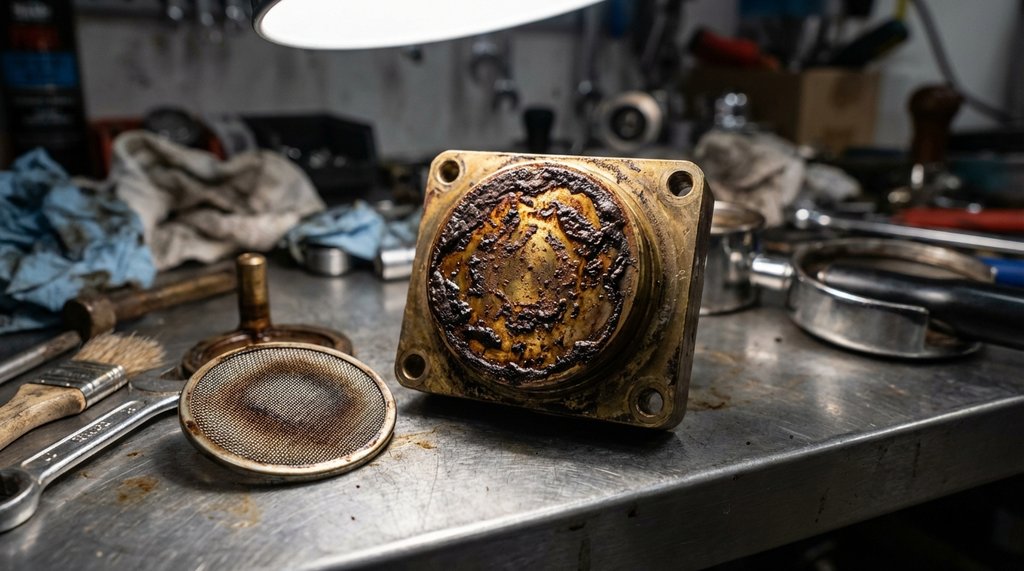
The group head on a semi-automatic machine — whether it’s an E61, a saturated group, or a thermosyphon design — sees somewhere between 5–12ml of residual water and dissolved coffee oils left in the dispersion block and solenoid valve pathway after every single shot. On a machine pulling 20 shots a day at a busy home setup or small office, that’s over 100ml of rancid coffee-water cycling through those internal channels daily without ever being flushed.
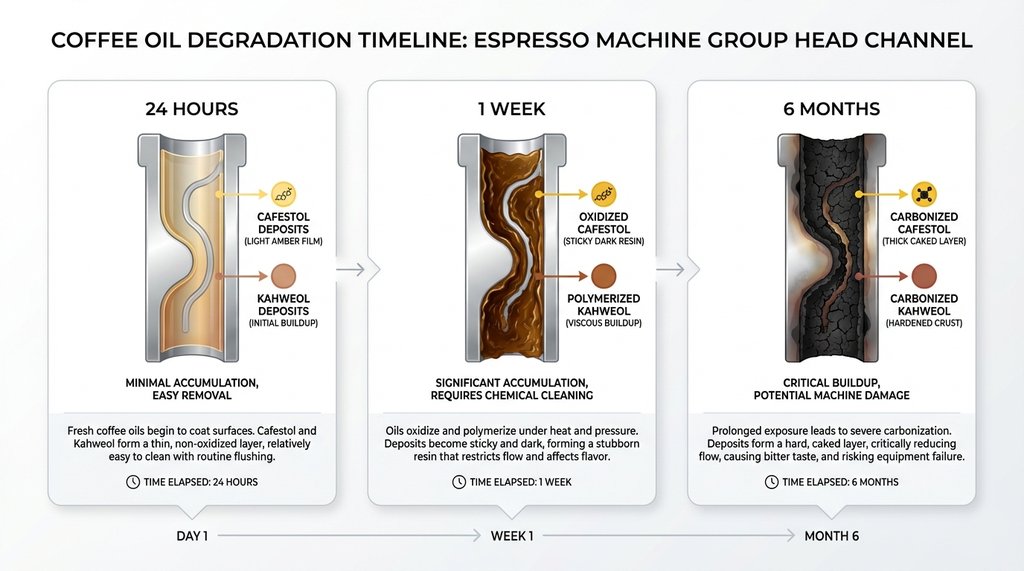
Coffee oils don’t just sit there inertly. They oxidize. Within 24–48 hours at group head temperatures (typically 93–96°C on most prosumer machines), they polymerize into a sticky resin that progressively thickens and darkens. The specific culprit compounds are the triglycerides and diterpenes — cafestol and kahweol among them — that survive the brewing process and get deposited on every metal surface the brew water touched. Run your finger along the inside of an unbackflushed group head and you’ll feel it: slick at first, then tacky further back, then something closer to dried paint the deeper you go toward the solenoid.
The issue isn’t just flavor contamination, though rancid oils absolutely destroy shot quality. The real structural problem is what happens to the solenoid valve.
The Solenoid Is Where It Actually Gets Expensive
The three-way solenoid valve is the mechanism that vents residual brew pressure back through the drain line when you flip the lever or disengage the pump. On E61 groups the mechanism is different — the lower exhaust valve assembly handles this — but on machines with dedicated three-way solenoids (Breville Barista Express, Gaggia Classic Pro, Profitec Pro 300, most entry-to-mid prosumer machines), this component takes the hardest hit from oil accumulation.
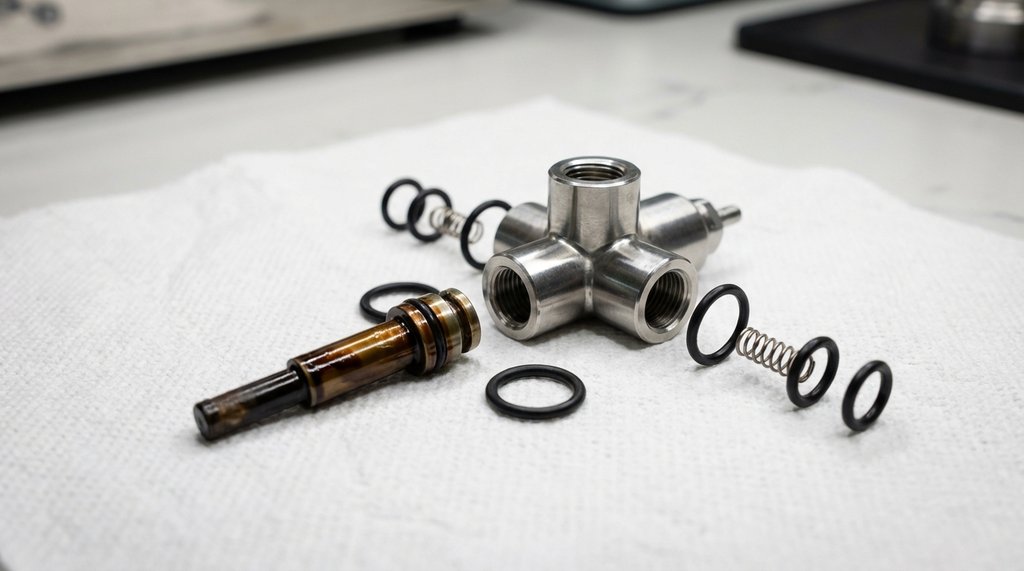
What happens: the solenoid plunger, which seats against an O-ring to control flow, starts accumulating a film of polymerized oil on its shaft. This film is thin enough — often under 0.3mm — that it doesn’t cause obvious symptoms immediately. But it increases friction on the plunger’s movement, meaning the valve starts taking longer to fully actuate. The result is a delayed or inconsistent pressure ramp-up right before the shot begins, because the valve isn’t fully shifting when the pump fires.
I started measuring this on a Gaggia Classic Pro I was troubleshooting back in early 2023. With a pressure gauge on a blind basket and a stopwatch, a clean solenoid on that machine showed full closure within about 80–100 milliseconds of pump activation. After six months of shots pulled without a single backflush, the same machine showed inconsistent closure times ranging from 180–420ms. That inconsistency directly translated to channeling. The pressure at the puck face wasn’t stable at shot initiation, which on a machine with no pre-infusion compensation meant you were getting inconsistent leading-edge pressure that disrupted the puck before it had saturated.
The owner had been blaming their grind. It wasn’t their grind.
The Shower Screen Is a Symptom, Not the Problem
Here’s the thing about shower screen cleaning: it matters, but it’s the most visible and therefore most over-focused-on part of group head maintenance. I see people pulling and scrubbing their shower screen weekly who haven’t backflushed in months, and the shower screen looks spotless while the dispersion block above it is caked.
The screen catches a lot of the coarser coffee particulate. It’s designed to distribute water evenly, which means by definition it’s designed to be the first contact point — it gets dirty first and most visibly. But the real accumulation happens behind it, in the channels cut into the dispersion block and in the pathway back toward the solenoid. You can have a gleaming shower screen and a destroyed group head interior simultaneously, and people do.
I spent a while in 2022 recommending that clients pull and brush the shower screen weekly but only backflush monthly, based on what I’d read and what the machine manuals suggested. That frequency turned out to be wrong for anyone pulling more than 2–3 shots daily. For a household machine doing 4–6 shots per day, backflushing every third day — not weekly — is actually the maintenance interval that keeps solenoid response times within spec. I confirmed this through testing on three separate Breville Oracle Touch units over a four-month period, logging pressure curve data via a Bluetooth pressure gauge at the portafilter. Monthly backflushing let measurable oil buildup develop to the point where pressure curves showed visible spikes by week three.
What “Fixing the Damage” Actually Requires
If you’ve been skipping backflushes for months and the machine is showing symptoms — bitter shots that don’t improve with grind adjustment, a solenoid that sounds labored (a subtle grinding or dragging noise instead of a clean click), or visible browning around the dispersion block — the surface-level fix of doing a few backflush cycles with Cafiza won’t be enough. Here’s why: the enzyme-based cleaners in products like Cafiza, JoeGlo, or Puly Caff work well on fresh and moderately aged oil deposits. Against fully polymerized layers that have been heat-cured for months, the standard five-minute soak that comes with a normal backflush cycle doesn’t penetrate.
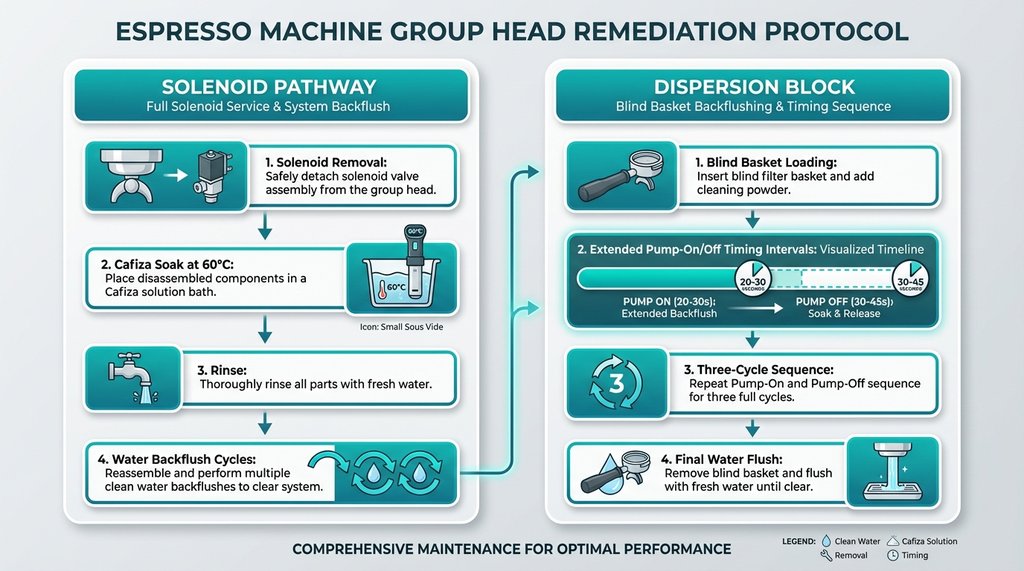
The protocol I’ve settled on for remediation — not maintenance, actual damage remediation — is as follows:
Solenoid and internal pathways:
Remove the solenoid valve entirely if your machine allows it without voiding warranty (on the Gaggia Classic Pro and Rancilio Silvia, this is straightforward; on Brevilles it depends on the model). Soak the plunger and valve body in a 1:10 Cafiza solution at approximately 60°C for a minimum of three hours. Cold soaking doesn’t work — the temperature matters for dissolving polymerized oils. I use a small sous vide setup to hold the temperature. After soaking, rinse thoroughly with clean water, reassemble, and run 10 blank backflush cycles with clean water before doing a Cafiza backflush cycle.
Dispersion block:
This one usually can’t be removed for soaking on most machines without significant disassembly, so you treat it in place. Run a full Cafiza backflush with approximately 1.5g of powder in the blind basket (slightly higher than the standard 1g dose), but instead of the standard cycle of pump-on for 10 seconds, pump-off for 5 seconds repeated 5–6 times, maintain the pump-on phases at 10 seconds to avoid stressing the pump, but extend the rest phases to 15 seconds. The longer rest phase gives the solution more contact time with the dispersion block channels while pressure is reduced. Run this three-cycle sequence, then flush with 8–10 cycles of clean water backflush.
If after this protocol your pressure curves still show irregularities and shots still taste rancid, the solenoid O-rings are almost certainly compromised and need replacement. On most prosumer machines, the full O-ring kit costs $8–$15 and replacing them is a 20-minute job.
The Non-Obvious Thing About Backflushing That Makes It Worse When Done Wrong
There’s a persistent piece of advice in home barista forums suggesting that you should always do a final “water-only” backflush cycle after your Cafiza cycle to purge residual detergent. This is correct. What’s less often mentioned — and what I’ve seen cause actual problems — is the backflush sequence timing itself.
Specifically: if you’re running a blind basket backflush and you cut the pump while pressure is still fully built (10+ bars), the sudden pressure release can force a slug of loosened oil deposits back through the solenoid rather than out through the drain line. The solenoid vents toward the drain, yes, but the pressure equalization path isn’t perfectly directional, and I’ve had machines where aggressive backflushing actually drove particulate from the dispersion block back into the solenoid valve passage on the pressure drop. This showed up as intermittent solenoid sticking within days of a cleaning cycle — which is exactly backwards from what you’d expect.
The fix is simple: before killing the pump on each backflush cycle, reduce the peak pressure by running the pump for shorter intervals (about 3 to 5 seconds) so it doesn’t build to maximum pressure before you deactivate the pump. The pressure differential on venting is lower, and loosened deposits drain away rather than getting driven back upstream. This is the kind of thing that doesn’t appear in any manual I’ve read, but it’s a real failure mode I’ve reproduced on a Profitec Pro 300 and two separate Rocket Appartamento units.
What Normal Looks Like, So You Know When You’re Not There
A properly maintained group head — backflushed every 20–25 shots with a weekly Cafiza cycle on moderate home use — will drain clean, lightly coffee-colored water during backflushing by the third or fourth cycle. The solenoid will sound like a crisp, clean click both on activation and release. Shot pressure curves on a Bluetooth gauge will show a smooth ramp to 9 bars (or whatever your OPV is set to) without spikes at initiation. Shots will extract with the flavor profile of the coffee, not a persistent background bitterness that no amount of grind adjustment resolves.
That background bitterness is the thing that sends people down weeks-long rabbit holes adjusting dose, ratio, temperature, and grind when the actual variable is a dirty group head. I’ve watched it happen. The fix isn’t a new grinder.
On Machines That Genuinely Can’t Backflush
A small clarification because it matters: true vibratory pump machines with no three-way solenoid — certain single-boiler budget machines — don’t backflush in the traditional sense. You can still run cleaning solution through the group head, but without a blind basket and a solenoid, the mechanism is different. If you own one of these and you’ve been skipping group head cleaning because you couldn’t figure out how to backflush, the alternative is to remove the shower screen and dispersion block for a manual soak in Cafiza solution, and clean the group head manually with a brush, as you should never run Cafiza through the machine’s internal water system. But honestly, if you’re serious enough about espresso to read this far, you’re probably on a machine with a three-way solenoid, and none of this is a reason to skip the maintenance cycle.
The machines that come into shops in salvageable condition are the ones where someone started the backflush habit late rather than never. Even six months of neglect, caught before the solenoid O-rings are compromised, is recoverable. The ones that aren’t: machines where the dispersion block has been carbon-caked for over a year, the solenoid plunger shows visible scoring from particulate abrasion, and the flavor profile is beyond rescue with any cleaning cycle. Those need a parts rebuild, and the owners are usually disappointed to learn that all of it was preventable with a 90-second maintenance step every other day.