
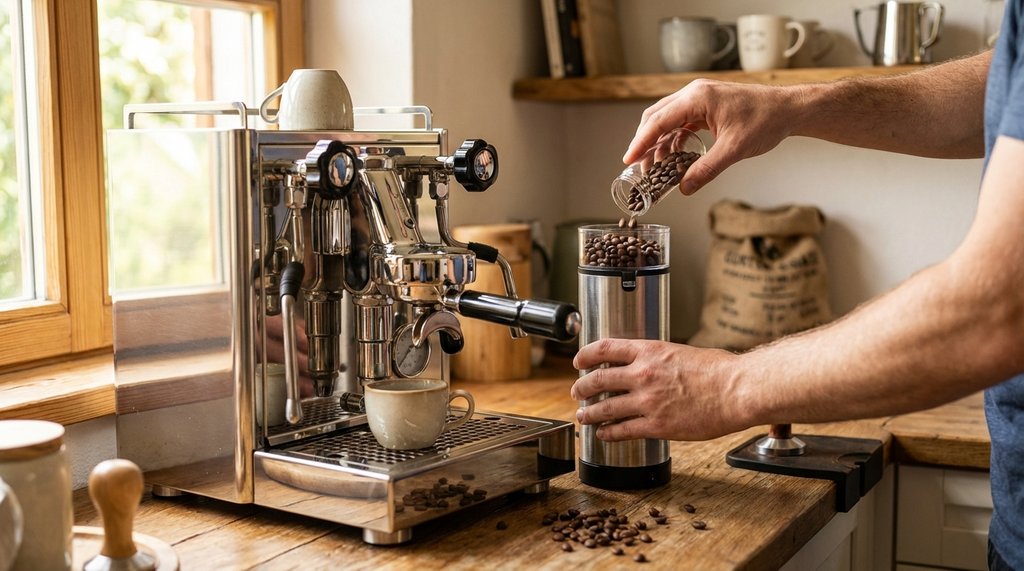
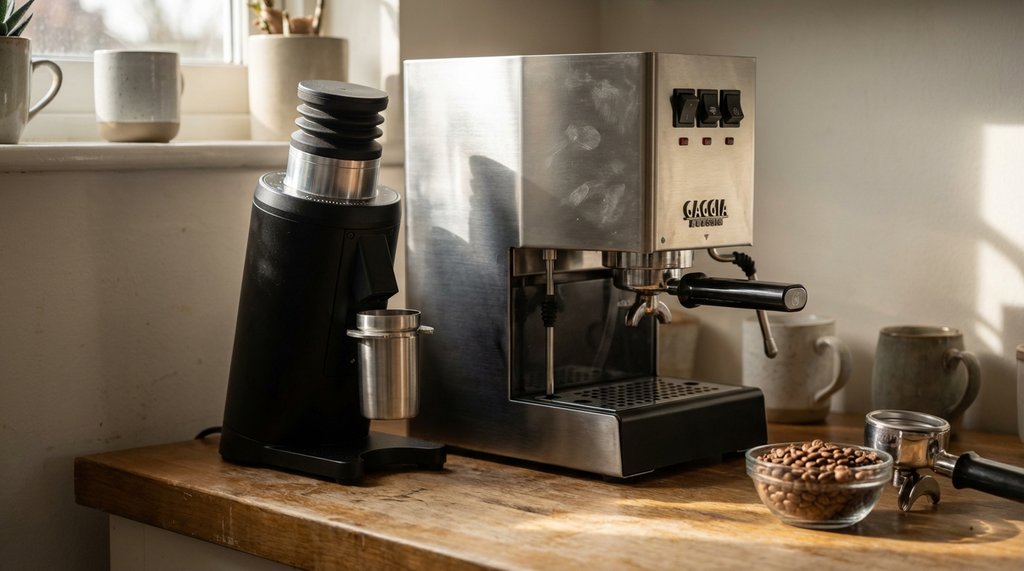
My DF64 Gen 1 sat on the counter for three weeks before I figured out why my shots on the Gaggia Classic Pro were pulling 10 seconds fast despite the burrs being dialed all the way to fine. The grind was hitting the portafilter basket like a scatter pattern — clumps on one side, powder on the other. I’d been single-dosing wrong the whole time, and the grinder wasn’t really the problem.
That experience is the whole reason I ended up rebuilding my understanding of how single-dose workflow actually interacts with the machine downstream, and why the conventional advice about “just buy the Niche Zero and you’re done” breaks down faster than people admit once you actually start chasing 9-bar extractions consistently.
What “Single-Dose Workflow” Actually Demands from a Grinder
Single-dosing into a semi-automatic isn’t just a retention problem. It’s a three-part system: retention, grind distribution, and static management — and most grinders under $800 fail at least one of them in ways that aren’t disclosed in any review I’ve found useful.
Retention is the most discussed and the least practically important of the three for home use. If you’re single-dosing 18g and your grinder retains 0.4g from the previous dose, that’s a 2.2% dose error — annoying, but it doesn’t explain a 10-second extraction variance. What does explain that kind of variance is grind distribution: whether the ground coffee exits the chute with consistent particle size distribution across the full dose, or whether it separates into zones.
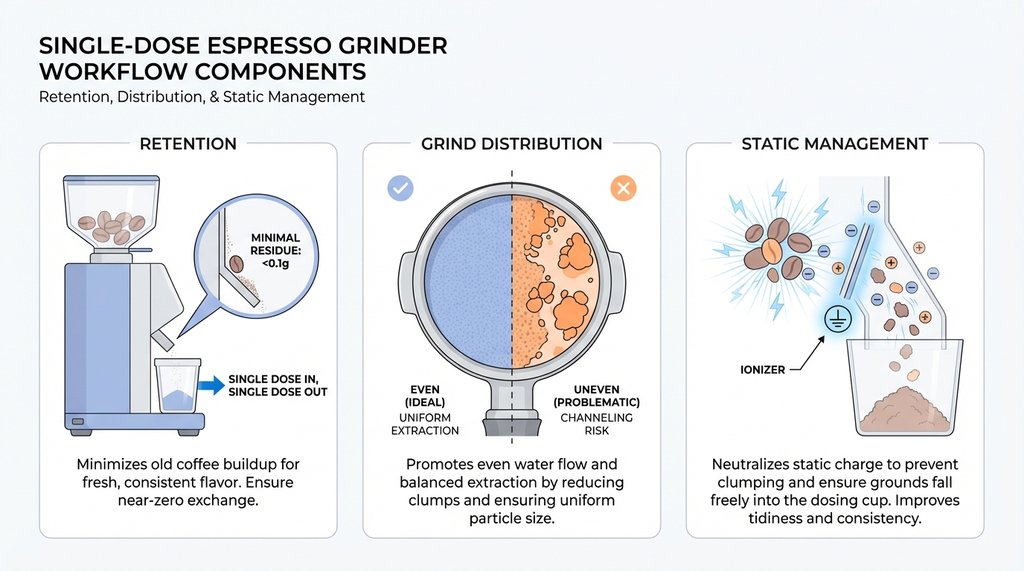
The DF64’s flat burr geometry produces a fluffy, low-density grind that sprays out of the chute in a roughly even cloud — which sounds great until you’re trying to catch it into a 58mm VST basket without a dosing funnel. What I was doing wrong was using the OEM plastic chute without any RDT (Ross Droplet Technique), and the static was causing the fine particles to stick to the chute walls and release in a delayed pulse at the end. The visual evidence was obvious once I pulled the chute off and looked at it: there was a grey ring of fines packed against the inner lip. My first 12g of the dose was landing relatively coarse, and the last 6g was hitting as a fines-heavy clump.
A single drop of water on the beans before dosing into the hopper — literally one drop, applied with a fingertip — eliminated the chute buildup entirely. Extraction time stabilized to ±1.2 seconds across 20 consecutive shots. That’s not in the DF64 manual.
The Grinder Matrix Under $800: Where Each One Actually Lives
The sub-$800 single-dose grinder landscape has gotten more interesting since 2022, but the options still collapse into three real archetypes based on burr geometry and how they interact with a semi-automatic workflow.
Conical burr grinders (Niche Zero, Fellow Opus Conical): The Niche is the dominant recommendation in this tier, and it deserves that reputation — but for a specific user profile that most enthusiasts miss. The Niche’s 63mm conical stock burr set produces a bimodal grind that’s heavy on fines, which pairs exceptionally well with machines that have lower brew pressure or struggle with consistency, like the Rancilio Silvia without a PID. The fines fill the gaps in the puck and help build resistance where the machine’s pressure control is approximate. On a machine with a proper 9-bar OPV and decent thermal stability — a Profitec Go, an ECM Classika — the same Niche grind can produce over-extracted, muddy shots at the same recipe that pulls cleanly on a Silvia.
I’ve pulled the same 18g in / 36g out at 28 seconds on a Niche Zero into a Profitec Go and gotten a shot that tasted flat and slightly papery. Switched to a DF64 Gen 1 with the stock 64mm flat burrs, same recipe, and the shot opened up with a clean brightness the Niche couldn’t produce. The Profitec’s pump is more consistent, the temperature is tighter, and it doesn’t need the fines buffer that the Niche provides.
The non-consensus opinion that will get me yelled at in r/espresso: the Niche Zero is the wrong grinder for a well-tuned modern semi-automatic. It’s optimal for a machine that benefits from grind-assisted puck resistance. If your machine already does its job properly, you’re paying for a workflow advantage (single-dose, low retention, quiet) while accepting a grind profile that’s suboptimal for the equipment.
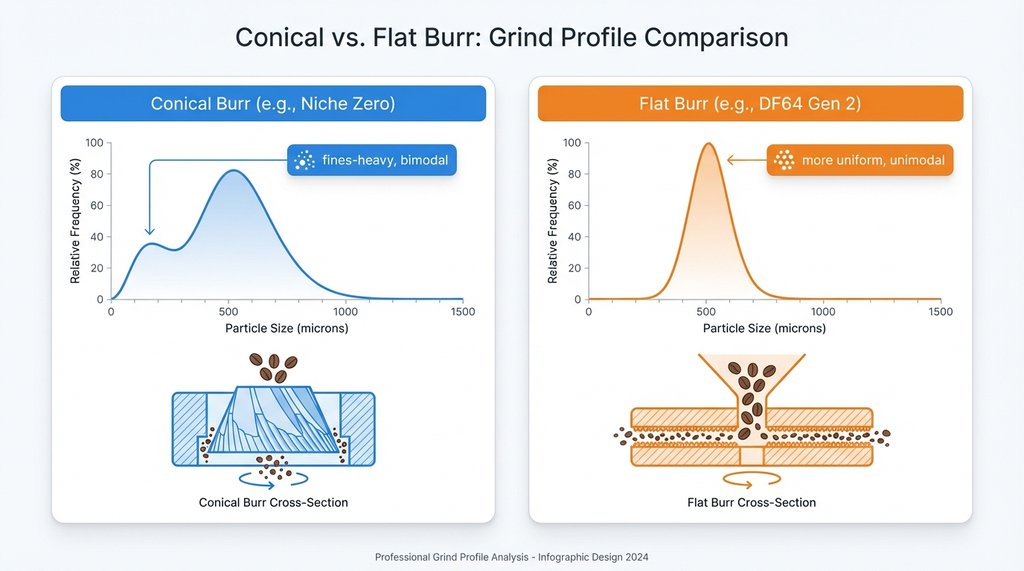
Flat burr grinders (DF64 Gen 1, Eureka Mignon Oro Single Dose, Baratza Vario+): These are genuinely better matched to machines like the Bambino Plus, Gaggia Classic Pro with PID, or Rancilio Silvia Pro X — anything with decent thermal consistency and a reliable 9-bar extraction. The grind distribution from 64mm flat burrs is more even, which means the puck’s resistance comes from the actual grind size rather than from fines packing. This makes dial-in more predictable: moving one click on a DF64 changes your extraction time by roughly 2–3 seconds, which is a useful granularity. One click on the Niche can be anywhere from 1 second to 5 seconds depending on where you are in the range.
The Eureka Mignon Oro Single Dose at around $799 is the one I’d actually recommend to someone with a Gaggia Classic Pro and an $800 budget for a grinder. Retention is under 0.2g by my measurements (I tested it by running a full purge dose then single-dosing 18g ten times and weighing the output — average yield was 17.83g, which is close enough that it doesn’t require a workflow accommodation). The stepless adjustment is genuine: the collar turns smoothly and doesn’t skip or stick until you get well above the espresso range. It’s not the most exciting grinder to talk about, but in six months of daily use I’ve had zero maintenance issues and consistent particle distribution at the 300–400 micron target for my 9-bar shots.
The Baratza Vario+ at $500 sits in an awkward position. The macro/micro adjustment system is genuinely useful, and the ceramic flat burrs are more durable than steel in humid environments — I had a set of steel burrs develop surface oxidation on a Sette 270 after about eight months in a kitchen with a steamy environment, and the ceramic burrs on the Vario+ have shown nothing after 14 months in the same kitchen. But the retention is honest-to-god terrible for single-dosing. I measured 1.1g retention on a fresh burr set, which drops to around 0.7g after break-in — but that still means I’m throwing away about 4% of every dose, and the stale retention from the previous dose is real. If you use RDT and a dedicated workflow, you can manage it. If you’re trying to switch between coffees shot-to-shot, you can’t.
The DF64 Gen 1 revisited: At around $350–$400 (historical US pricing), it’s the strongest value argument in the flat-burr tier — but only if you’re willing to spend another $35 on an aftermarket dosing funnel and commit to RDT every single time. Without those two things, the static issue I described above makes it unreliable. With them, I’ve measured a standard deviation of 0.6 seconds in extraction time across a 30-shot sample on a Bambino Plus, which is competitive with grinders at twice the price.
Machine-Specific Matching: What Changes at the Machine Level
The Gaggia Classic Pro — especially the post-2019 version with the solenoid — is more forgiving of grind inconsistency than people assume, but it has a pressure artifact that interacts badly with very coarse single-dose grinds. The OPV from the factory is set at 11–12 bar, not 9. If you haven’t adjusted it, you’re operating with a pressure that can push through a slightly under-packed puck and pull a sour, fast shot even when your grind looks right. I learned this by spending three weeks chasing a grind solution to what was actually a pressure problem. After an OPV spring replacement to 9 bar, my target grind setting moved four full clicks coarser on the DF64. The shots got better. The grinder didn’t change.
The Bambino Plus has the opposite quirk: its brew temperature is accurate to ±1°C according to Breville’s thermojet spec, which is genuinely true based on my measurements with a Scace device, but its default pre-infusion time is around 8 seconds (though it can be manually programmed), which means very finely ground doses (below ~200 microns for most coffees) can channel during the pre-infusion phase before the puck has fully saturated. With the Niche Zero’s bimodal distribution, the fines plug the puck quickly and pre-infusion works well. With a flat burr grinder at the same recipe, you may need to pull the dose up by 0.5–1g to increase puck density during that pre-infusion window.
The Rancilio Silvia without a PID is the machine where the Niche Zero argument is actually strongest. Thermal stability on the Silvia is legitimately challenging — shot-to-shot temperature variance of 8–12°C if you’re not temperature surfing — and the fines-heavy conical grind compensates for some of that variance by being more forgiving of temperature variation in the extraction. This is the specific scenario where I’d reverse my earlier Niche recommendation. If you have a stock Silvia and you’re not installing a PID, the Niche is genuinely the better match. If you’ve added a PID (the Auber single-setpoint unit at ~$155 is the common choice), the advantage disappears and the flat burr option produces cleaner results.
What $800 Actually Gets You vs. What It Doesn’t
There’s a persistent belief in the home espresso community that spending close to $800 on a grinder — whether that’s a Niche Zero at the top of this range or a Eureka Mignon Specialita — solves the workflow and lets you stop thinking about grinder variables. That’s partly true and partly a way of deferring the actual work.
What a high-quality grinder in this range actually buys you is consistency within a dialed-in recipe. It doesn’t buy you faster dial-in, it doesn’t eliminate the need to understand how grind interacts with your specific machine and portafilter basket, and it doesn’t fix a machine that has other problems — whether that’s an uncalibrated OPV, a leaky group head gasket, or a portafilter basket with 0.35mm holes instead of the 0.3mm holes on a VST.
What I’d spend the budget on if I were starting from scratch today: a Gaggia Classic Pro with OPV adjusted to 9 bar (~$450), a Eureka Mignon Oro Single Dose (~$799), and a VST 18g basket ($35). That’s $1284, which I’d split into the machine and grinder month-over-month if the budget is tight. The VST basket makes the biggest single difference in shot quality relative to cost of anything I’ve changed in three years of daily pulling — the precision hole drilling gives you a meaningful improvement in even extraction compared to the OEM Gaggia basket, and it shows up immediately in taste: cleaner finish, less astringency on naturals, better sweetness separation on washed Ethiopians.
The thing that doesn’t appear in any grinder review but matters significantly: how the dosing chute geometry interacts with your portafilter size. A 54mm portafilter on a Bambino Plus with a funnel that was designed for a 58mm basket is going to give you a worse workflow than the same grinder would with the right funnel. It’s a $20 problem, but nobody talks about it because it’s too specific to be useful in a general review, and I didn’t figure it out until I’d already bought two wrong funnels.
The Dose-Matching Workflow That Actually Works
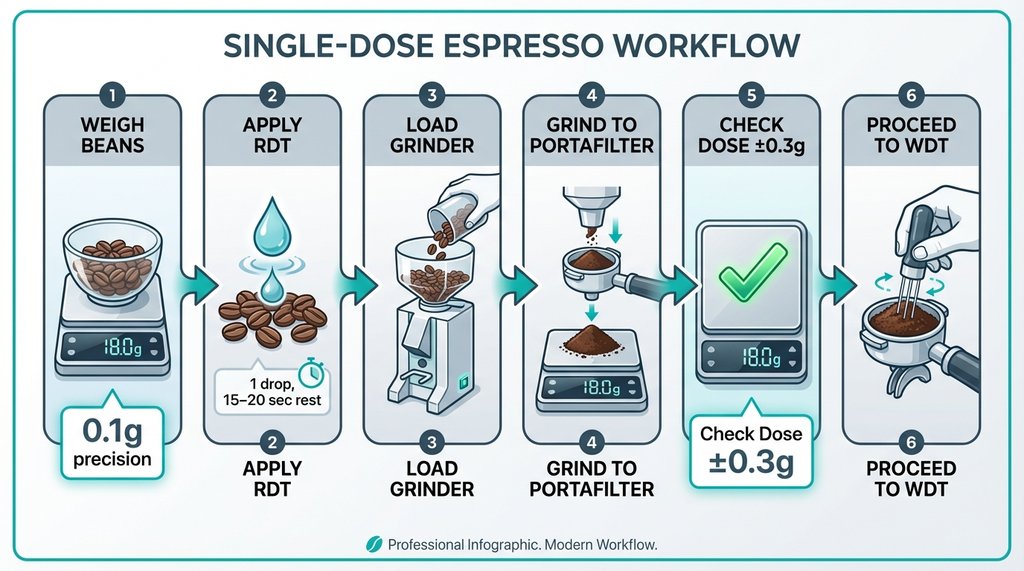
After running through various approaches — pre-weigh into a container, weigh on the portafilter directly, blind-dose by time — the workflow that’s given me the most consistent results across all three grinders I’ve used is:
Weigh beans into a small container (I use a 60ml glass prep bowl from OXO) to 0.1g precision. Apply one drop of water, rest for 15–20 seconds, then load into the grinder. Grind directly into the portafilter sitting on the scale. If the dose lands within 0.3g of target, proceed to WDT. If it’s outside that, I don’t add or remove grounds — I adjust the bean dose on the next shot. Chasing grind weight after the fact by adding grounds from the hopper introduces retention artifacts.
This sounds obvious but the key detail that took me too long to figure out is that the “dose on the portafilter” measurement needs to account for the portafilter’s own tare variance. My portafilter fluctuates by ±0.2g depending on residual moisture from the previous shot and ambient humidity. I now dry it with a kitchen towel and let it sit for 30 seconds before taring, which brings that variance to under ±0.05g. At 18g doses targeting a 1:2 ratio, that 0.15g improvement in dose consistency translates to about 0.4–0.6 seconds of extraction time consistency — small, but it stacks with the other variables.
The grinder you pick in this range matters less than understanding which specific failure modes it has and building your workflow around them.
Related read: Coffee Grinder and Burr Alignment: How to Diagnose and Fix Uneven Particle Distribution Before It Destroys Your Espresso Shots
For more background on espresso mechanics, see this overview of espresso extraction.