
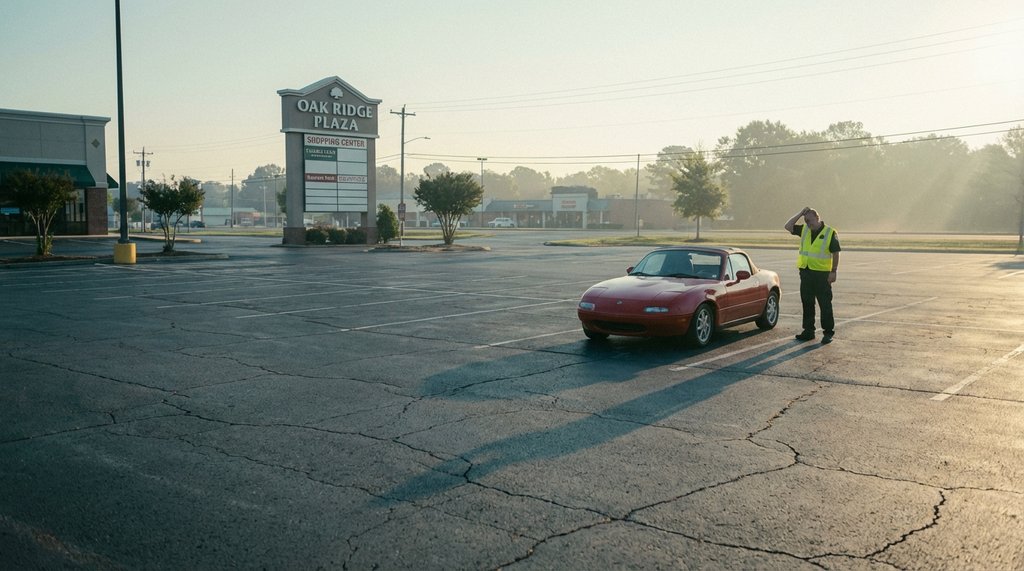
Showed up to a Cars and Coffee last August. Forty-five minutes of driving, found a mostly-empty parking lot at a shopping center, one confused security guard, and a single Miata owner who had also not gotten the memo. The organizer had moved it three days prior — announced exclusively in a Discord server neither of us had joined — and left the Facebook Event page completely untouched with “See you Saturday!” still pinned at the top.
That was the moment I actually sat down and figured out a system for this.
Why C&C Events Specifically Are a Verification Nightmare
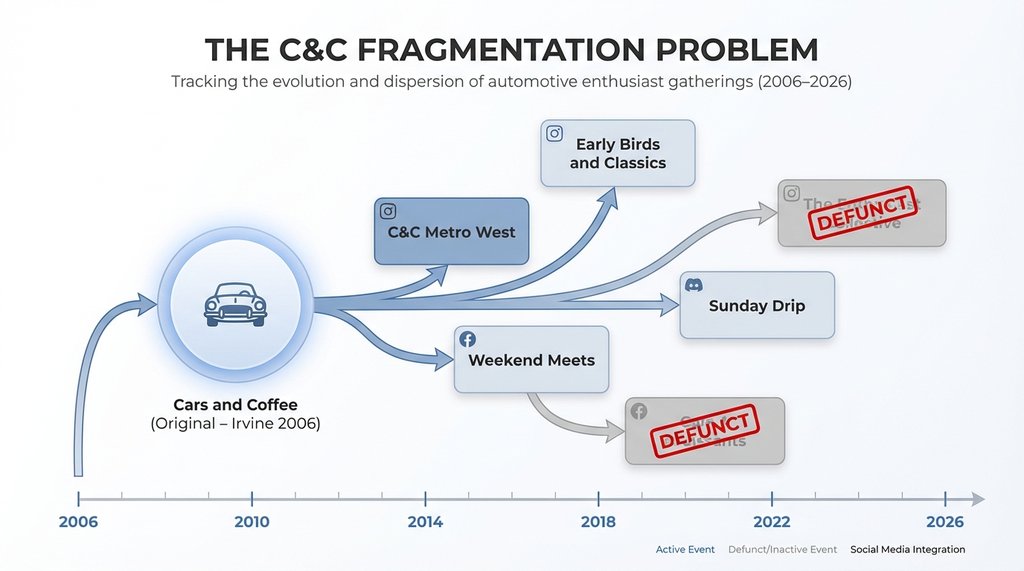
Most hobby meetups have a single organizing body with a real website and an email list. Cars and Coffee doesn’t work that way. The name itself has been passed around, copied, and repurposed so many times that you’ll find anywhere from two to six completely separate “Cars and Coffee” events operating in the same metro area, run by entirely different groups, with no coordination between them. Some of these groups have been running since 2006. Others were created three weeks ago by someone who bought a Subaru WRX and has seventeen Instagram followers.
The original Cars and Coffee Irvine — the one that spawned the whole format — stopped operating at the Mazda North American headquarters location back in 2014. What replaced it fragmented into at least four separate successor events. I’ve watched people cite “Cars and Coffee Irvine” as their source for an event that hasn’t existed in that form for ten years. The social media pages for defunct versions of these events still show up in Google search results because nobody deletes them.
This creates a specific problem: high-authority outdated pages outrank the actual current organizer’s Instagram, which is where the real schedule lives. Google’s local events feature pulls from structured data that event pages submitted months ago and never updated.
The Platform Stack That Actually Works in 2024
I’ve been tracking this across four different metros over the past eighteen months, partly because I travel for work and partly because I got burned enough times to make it personal. Here’s what I’ve found actually works versus what people reflexively check first:
Facebook Events is where you verify, not where you discover. The event page itself is almost never where time-sensitive updates live. You want the group, not the event. Organizers will post a day-of update in the group that never propagates to the standalone event page. If the group has fewer than 400 members and hasn’t had a post in the last 10 days, I treat that event as provisional until I find a second source.
Instagram is where most active organizers actually communicate, but you need to be following the right account. The trick here is searching the location tag rather than the hashtag. Search “#carsandcoffee[yourcity]” and you’ll get a wall of posts from people who attended past events. The organizer’s account is usually the one that appears repeatedly in that tag, posting day-before reminders with parking information. I found the correct Instagram for a Dallas-area event this way after the Facebook page for it had gone dormant for four months.
Meetup.com has had a quiet resurgence for C&C specifically. The platform’s RSVP system creates enough friction that organizers who actually care about attendance use it, and the “is this still happening” ambiguity mostly disappears because you can see live RSVP counts. If an event has 47 people RSVPed as of Thursday and the organizer logged in two days ago, it’s almost certainly happening. If there are 8 RSVPs and the organizer’s last login was six weeks ago, I don’t care what the listing says.
Discord is where you’ll miss critical updates if you’re not already in. This is the one that bit me in August. More car communities have migrated their real-time communication to Discord over the past three years, and unlike Facebook groups, there’s no mechanism that notifies non-members of updates. The server invite is usually in the Instagram bio or the Meetup group description. If you find a Discord, join the #announcements or #events channel and check it 24 hours out. That’s where “we’re moving to the south lot because of the farmers market” gets posted at 11pm the night before.
The Verification Protocol I Actually Use
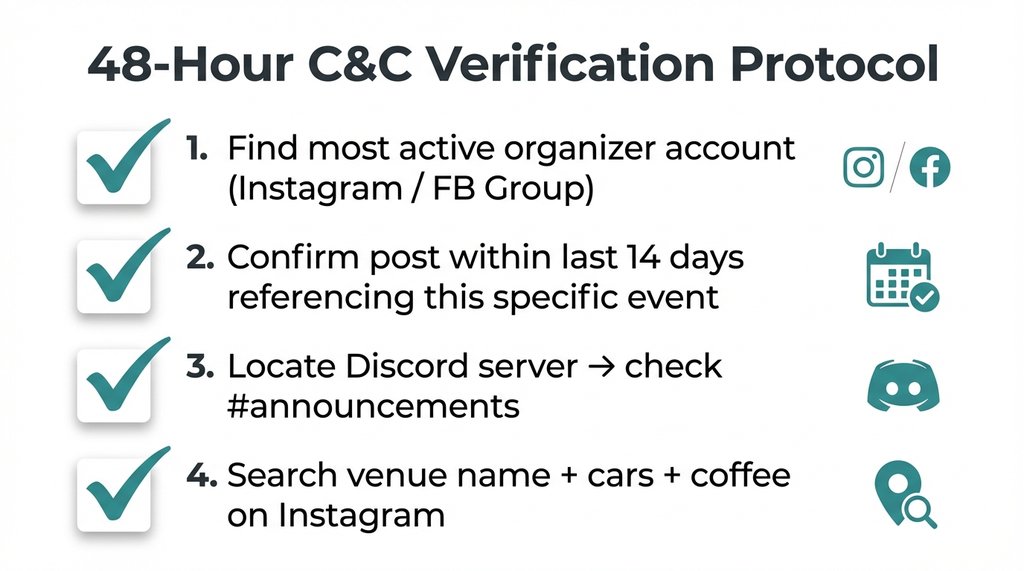
Forty-eight hours before any event I’m driving more than twenty minutes to attend:
- Find the most recently active social media account associated with the organizer (usually Instagram or Facebook group, rarely Twitter/X anymore)
- Confirm there’s been a post within the last two weeks that references this specific upcoming event, not just general content
- Check if there’s a Discord — if yes, verify in #announcements
- If the event is at a venue that requires host coordination (shopping center, dealership, parking structure), search “[venue name] + cars + coffee” on Instagram to confirm the venue relationship is still active
That last step sounds paranoid until you realize how many C&C events lost their host venues post-2020 and either found new spots or quietly folded. A major C&C in the Atlanta metro lost its original host lot in early 2023, the organizer kept posting for about four months using old venue photos before going dark entirely, and the event listing on three aggregator sites still shows the old address.
Aggregator Sites and Why I Treat Them as Starting Points Only
There are maybe a dozen sites that aggregate car meetup listings — I won’t name them all, but you know the type. They pull event data from various sources, sometimes include user-submitted listings, and present everything on a map. The SEO on these sites is genuinely excellent. They will absolutely show up first when you search “cars and coffee near me.”
The data quality problem is structural, not careless. These sites can’t verify whether an event is still active. They index an event when it’s submitted and have no mechanism for detecting when it quietly stops. I’ve found listings on two of these aggregators that reference events confirmed defunct by their own organizers’ social media. One listing I clicked on in February 2024 had a last-verified date of “2022” in tiny text at the bottom. The event had officially ended in mid-2023.
Use these sites to identify candidates. Do not use them as confirmation.
The Regional Variation Nobody Warns You About
How C&C events are organized varies more by region than most people expect, and the right platform to check depends heavily on where you are.
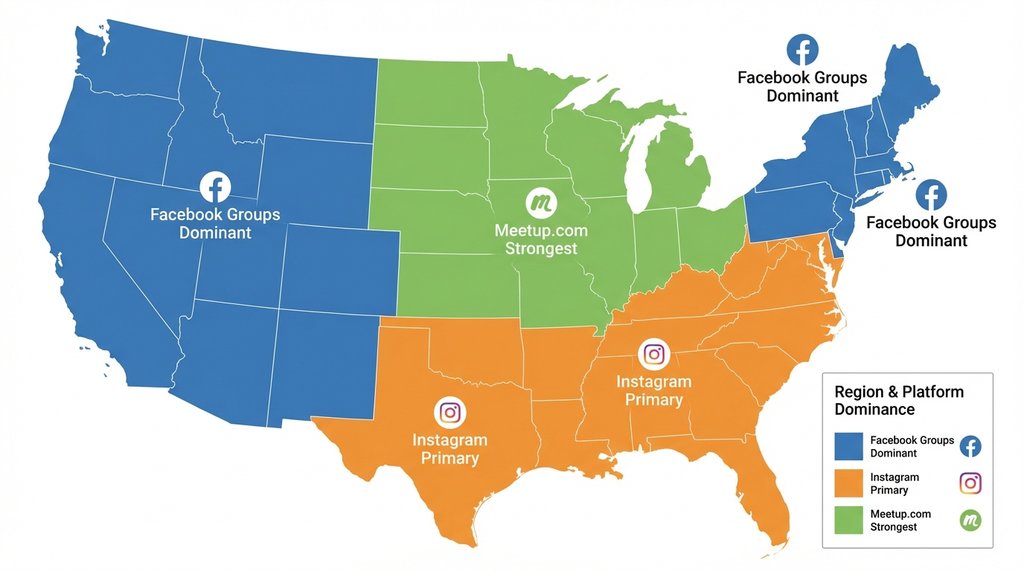
In the Pacific Northwest and parts of the Northeast, Facebook groups remain the dominant coordination platform — these communities are often older, more established, and resistant to migrating to newer platforms. In the Southeast and Texas, Instagram has eaten almost everything; I’ve tracked events in Houston and Charlotte where the organizer has zero Facebook presence and never has. In the Midwest, Meetup.com is disproportionately strong relative to other regions — I have no great explanation for this, it’s just what the data shows across the events I’ve tracked.
If you’ve just moved to a new city and are starting from scratch, the fastest path is: find one person on Instagram who clearly attends local meets (they’ll have photos at events, will tag locations), look at who they follow, and check those accounts. One person embedded in the local car scene knows about five events you’d never find on your own through search.
What Actually Gets Events Cancelled or Moved
Understanding the pattern helps with the verification. The most common reasons, roughly in order:
Weather is obvious but gets mishandled constantly. Most C&C events in northern states have a rain threshold policy that organizers apply inconsistently. I’ve been to events in light drizzle and I’ve seen events cancelled for a 20% precipitation forecast. If the weekend forecast is anything other than clear, check Instagram the morning of, not Friday night.
Venue conflicts kill more events than weather. Farmers markets, outdoor malls running weekend promotions, holiday parking restrictions — these are almost always known in advance by the organizer but communicated poorly to attendees who signed up for a Facebook event six weeks earlier. This is the category that got me in August.
Police/HOA pressure on established routes. Several large C&C events have lost venues not because the venue itself had a problem, but because complaints from adjacent businesses or residents triggered parking restrictions. When this happens, organizers usually move fast and communicate in whatever their most active channel is — which brings you back to the Discord/Instagram problem.
One More Thing on Timing
The sweet spot for most active C&C events is the first and third Saturday of the month, typically running 7am-10am or 8am-11am. That’s not universal but it’s common enough that if you find an event listing with no specific date, that schedule is a reasonable starting hypothesis.
The 2024 shift I’ve noticed: more organizers are adding a low-friction confirmation step — a Google Form or a link-in-bio RSVP — not because they’re gatekeeping but because they want a rough headcount to negotiate parking with venues. If you see this, filling it out takes thirty seconds and usually gets you on whatever last-minute notification list they’re using. That notification has saved me two wasted drives in the last year.