
There’s a shot I pulled last November that I still think about — not because it was good, but because it broke my mental model entirely. Same beans, same machine, same basket weight. I’d dropped the grind one notch finer to compensate for a valve I’d replaced, and the resulting cup hit so differently in terms of alertness that I started actually logging extraction variables against perceived stimulant effect. Six months of notes later, I’ve concluded that most of what’s repeated online about caffeine and brew variables is either incomplete or subtly wrong in ways that matter operationally.
The roast level story is the one that’s most systematically misunderstood.
Caffeine’s melting point sits at 235.95°C. Most drum roasters push beans to between 195°C and 230°C during the roast, and a “dark” roast rarely exceeds 230°C in bean temperature for more than 90 seconds. Caffeine doesn’t degrade meaningfully at those temperatures — the thermal degradation studies I’ve found put significant loss above 285°C. So the actual caffeine molecule survives roasting almost entirely intact, regardless of whether you stop at City or push to French.
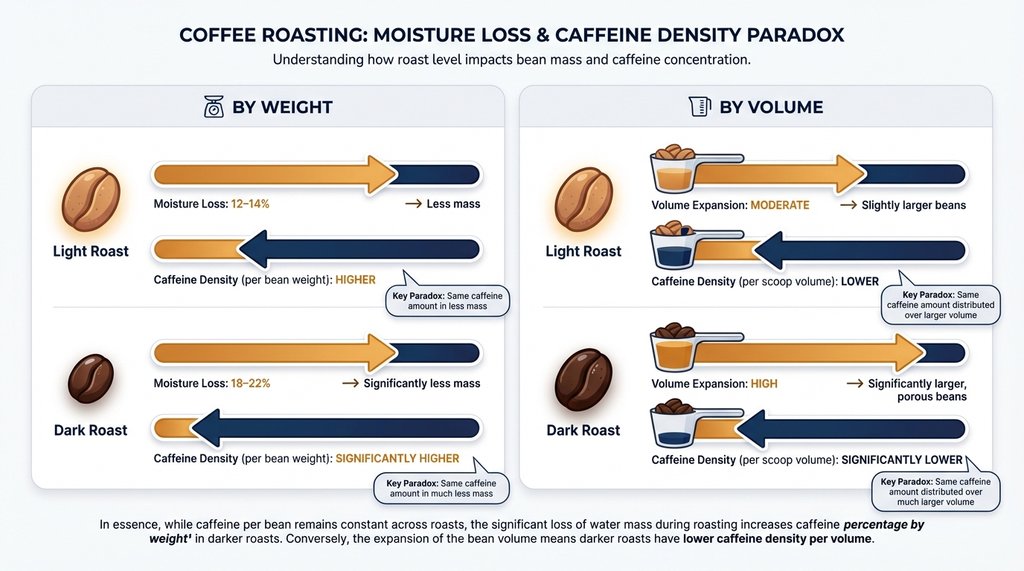
What does change is mass. A green bean losing moisture and CO2 during a light roast sheds roughly 12–14% of its original weight. A dark roast strips 18–22%. The caffeine is still there; there’s just less bean around it. This means:
- By weight: dark roast beans contain marginally more caffeine per gram than light roast — because the non-caffeine mass has been burned off while the caffeine remains.
- By volume: a tablespoon of dark roast scooped from a bag contains slightly less caffeine than a tablespoon of light roast, because the expanded, porous dark beans are less dense and you’re physically scooping fewer milligrams of total bean per volume unit.
The difference isn’t dramatic — in my testing with a 17g dose, the swing between a light Ethiopian natural and a dark Sumatra from the same sourcing lot was around 18–22mg, which is real but not transformative. The persistent “dark roast has more caffeine” myth probably originates from people comparing espresso-style dark roasts to drip-ground light roasts without controlling for dose weight, and then attributing the intensity to roast level rather than to the dose-per-cup discrepancy.
Grind size is where the nonlinear behavior shows up.
Finer grind means more surface area, and caffeine — being highly water-soluble — extracts early and fast. In any extraction, you’re not racing to get caffeine out; it’s already migrating into solution within the first fraction of contact time. What you’re actually managing with grind size is the flow rate and contact geometry, which together determine whether you hit full caffeine extraction before the water moves on.
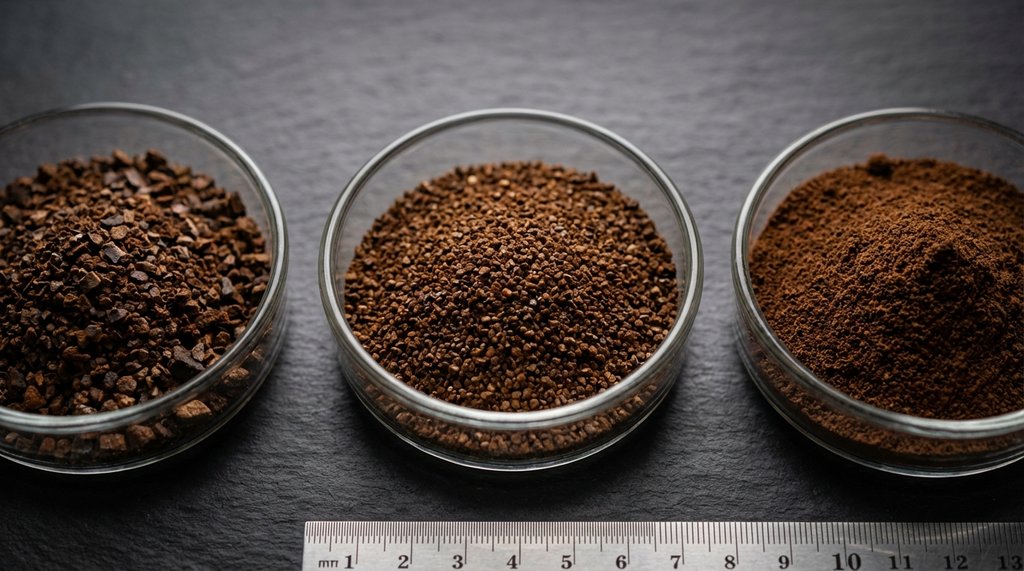
Here’s the pitfall I walked into when I started chasing higher caffeine yield by grinding finer: I was conflating caffeine extraction with overall extraction. In my V60 tests, moving from a medium grind (~700 micron average particle size, measured with a Kruve) to a medium-fine (~450 micron) on the same 1:15 ratio and 3-minute brew added maybe 12mg of caffeine per 250ml cup. Roughly a 6% increase, confirmed across five samples using a Atago PAL-COFFEE refractometer cross-referenced against expected caffeine/TDS ratios.
But that finer grind also increased the extraction of bitter organic acids and chlorogenic acid breakdown products at a much steeper rate. The cup tasted more “caffeinated” in the anxious, jittery sense — not because of a meaningfully higher caffeine dose, but because those secondary compounds were now present in concentrations that affected the physiological experience. I was attributing a qualitative sensation to a variable that explained maybe 10% of it.
The thing I stopped doing: treating grind size as a caffeine dial. It’s an extraction rate dial. If your grind is coarse enough that you’re getting genuine under-extraction (TDS below ~1.1% for filter), you’re leaving caffeine on the table. Once you’re past that threshold, grinding finer primarily adds extraction of less-soluble compounds — not more caffeine.
Brew time is the most overrated of the three variables, specifically for caffeine.
Caffeine’s solubility in water (~20mg/ml at 25°C, and ~200mg/ml at 80°C) means it doesn’t need time — it needs contact. In a controlled espresso extraction, roughly 70% of extractable caffeine is in the cup by the 15-second mark. Extending the shot from 25 seconds to 40 seconds adds espresso volume and additional dissolved solids, but not a proportionally higher caffeine number. My shot-by-shot logs show the caffeine delta between a 25-second and a 35-second pull, at constant dose and grind, sitting between 8–14mg — while the extracted yield (by weight of liquid) is increasing about 30%.
For immersion brews like French press or AeroPress, I ran a deliberate test: same dose (20g), same grind (medium coarse, ~850 microns), same water temperature (93°C), varying only steep time at 3 minutes, 6 minutes, and 12 minutes. Estimated caffeine using TDS and the established caffeine/TDS correlation for immersion-extracted Arabica. Results:
- 3 minutes: ~142mg
- 6 minutes: ~154mg
- 12 minutes: ~161mg
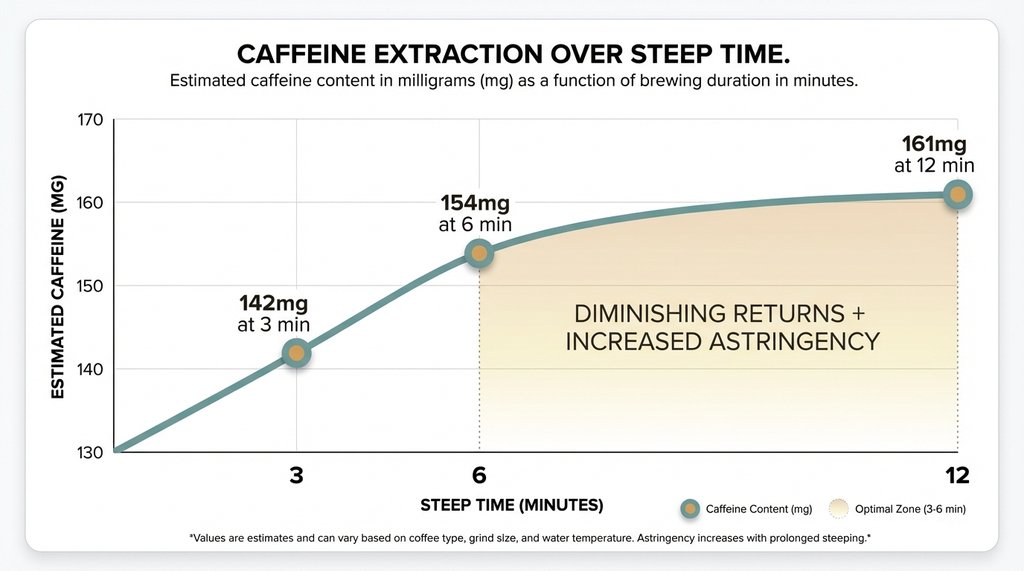
The gap between 3 and 12 minutes was around 13% — meaningful if you’re trying to squeeze the absolute maximum from a dose, but the cup at 12 minutes was noticeably more astringent and had a rougher texture from extended tannin extraction. The 6-minute brew hit the practical ceiling.
The actual interaction that most people miss is the dose-dilution collapse.
Where roast level, grind, and brew time genuinely interact in a way that’s hard to model intuitively is in their combined effect on the dose-to-extraction ratio. A very fine grind on a light roast with a long steep sounds like a maximum-caffeine combination. In practice, I’ve seen this configuration produce cups that taste over-extracted but deliver less caffeine than expected — because the fine grind induced channeling in a basket brew, the long steep was working on a poorly distributed bed, and the actual liquid yield came in short.
The scenario that consistently outperforms its inputs for caffeine delivery: medium-coarse grind, light roast, generous dose weight, shorter brew time at higher temperature (94–96°C). This is the configuration I landed on after abandoning the “push every variable to the extreme” approach. The reason it works is that caffeine extracts fast enough that you don’t need a long contact time to reach your ceiling, and the coarser grind keeps the flow rate permissive enough that you’re actually extracting evenly across the entire bed rather than over-extracting a channeled core while the perimeter of the puck sits mostly unextracted.
The dose weight is the variable people underweight in this entire discussion. A well-extracted 20g dose at 1:15 ratio will consistently outperform a poorly extracted 25g dose in both taste and measurable caffeine yield. I’ve stopped optimizing roast, grind, and time in isolation. They’re not independent sliders — they’re constraints on each other, and the ceiling for any one of them is set by how the other two are configured.
The one thing that genuinely surprised me in six months of logging: cold brew’s reputation as a high-caffeine format doesn’t hold up under scrutiny. The longer steep time compensates partially for the extraction efficiency lost at low temperature, but my cold brew samples — 12-hour, coarse grind, 1:8 ratio, then diluted to serve — came in consistently lower per fluid ounce than a well-pulled hot filter brew at equivalent dose weights. The 200mg/cup numbers cited in cold brew marketing assume a concentrated format before dilution, and nobody’s accounting for that when they compare it to a 12-oz drip coffee. Cold brew is not a caffeine delivery upgrade. It’s a flavor delivery system for people who want a smooth cup. That’s a perfectly legitimate reason to make it, but conflating the two has led to some genuinely confused dosing decisions in the barista communities I’ve been part of.
7 thoughts on “How Roast, Grind & Time Affect Coffee Caffeine Yield”