
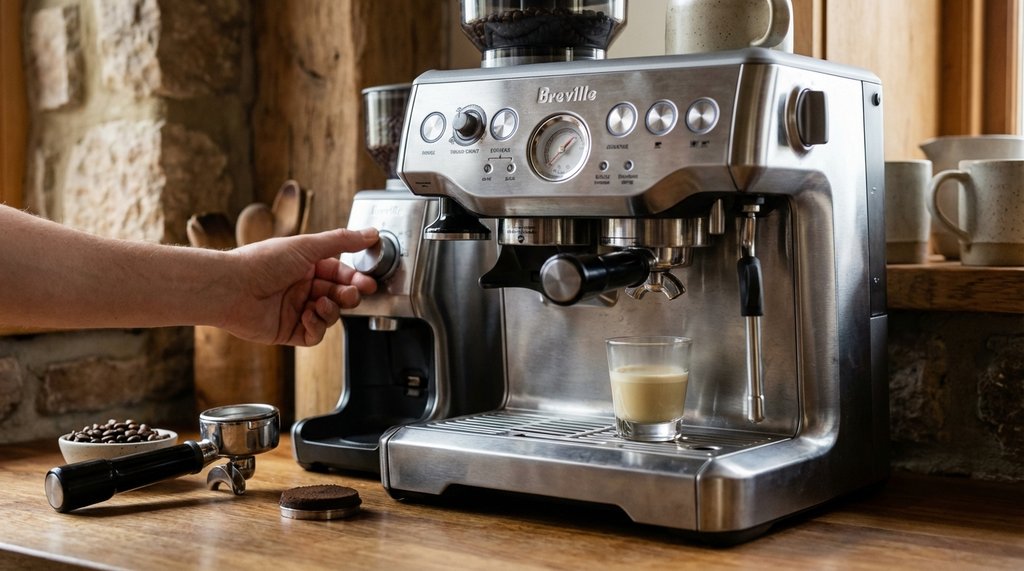
My BES870XL started pulling sour shots the Tuesday after I ran a full descale cycle with the Breville-branded solution, and it took me an embarrassingly long time to figure out why — mostly because I kept chasing the wrong variables.
The pH strip I tested on the final rinse water came back clean. Portafilter was dry, basket was spotless, I’d even replaced the shower screen gasket two weeks prior. But every shot was pulling in 18–20 seconds with that thin, pale crema and a flavor profile that tasted like lemon peel soaked in regret. Classic under-extraction, except nothing in my setup had visibly changed.
I did what everyone does: I went to the forums. Every thread I found said the same three things — check your tamping pressure, make sure you ran the full rinse cycle, maybe bump your water temperature up one setting. I tried all of it. I tamped to 30 lbs. I ran three extra hot water flushes. I moved from the middle temperature setting to the highest. Shots went from 20 seconds to 22 seconds. Still sour.
Here’s what was actually happening, and why it took me three days to find it.
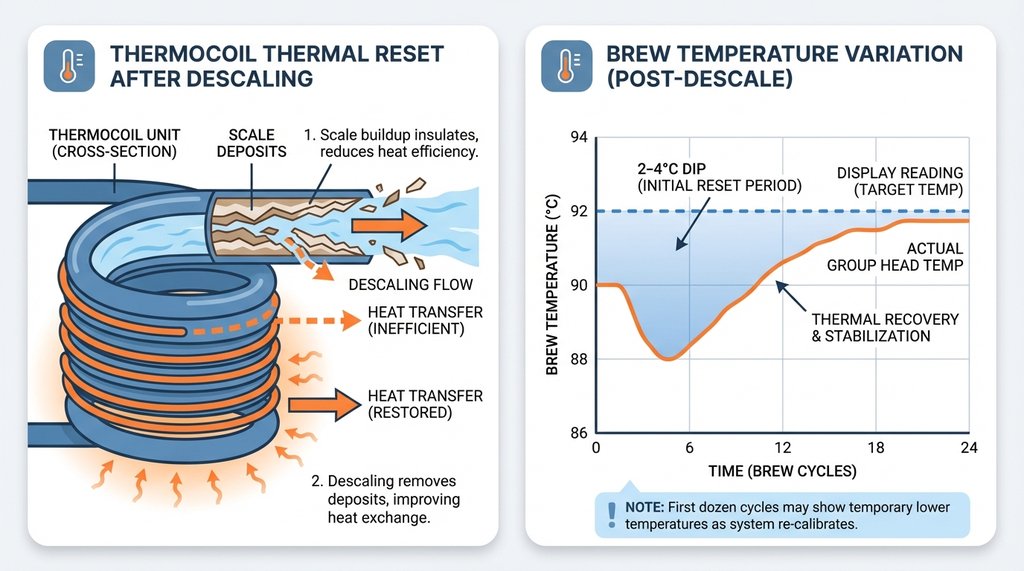
The Breville Barista Express uses a thermocoil heating system, and after a full descale cycle, that coil is running through a complete thermal reset. The descaling agent strips the scale deposits that have been acting — functionally — as part of the thermal mass of the system. Your machine has been compensating for those deposits for however long since your last descale, and now suddenly the coil is transferring heat differently. The machine’s PID is adjusting to the new thermal dynamics over the first dozen or so brew cycles, and during that window, actual brew temperature at the group head can read 2–4°C lower than the programmed setting suggests.
That part is documented, sort of. What isn’t documented — at least nowhere I could find in the first five pages of Google results for every variation of “Barista Express sour after descale” — is what happens to the grinder.
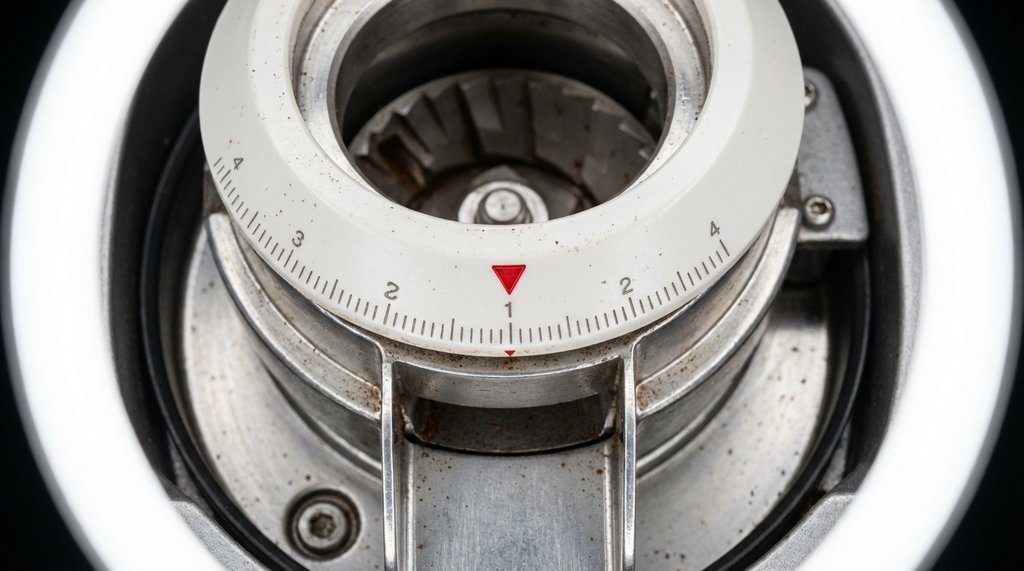
The BES870’s grinder has two adjustment points: the external grind size dial (the numbered ring you turn between shots) and the internal burr collar, which is accessed by removing the hopper and is calibrated with a reference marker against a set of numbers. That internal collar sets the baseline position — it’s what “1” on your external dial actually corresponds to in terms of burr gap distance.
The descale cycle involves a lot of machine vibration. Not intense vibration, but sustained, repetitive pump cycling across 20–30 minutes. In my unit, that was enough to shift the internal burr collar by approximately one position. I confirmed this by removing the hopper after the fact and checking the reference marker against the numbers — it had crept one notch clockwise from where I’d set it during the initial setup, which meant my external dial setting of 7 (where I’d been running consistently for three months) was now functionally equivalent to about an 8.5 in actual burr gap.
That’s your sour shots. The grind was coarser than I thought it was, producing a fast flow rate and under-extraction, and no amount of temperature adjustment or tamp pressure was going to fix it because I was fighting the wrong variable.
Related: How to Descale a Drip Coffee Maker Without Voiding the Warranty
The fix took about four minutes once I understood the actual problem.
Remove the bean hopper. Look for the internal collar adjustment — it’s a black plastic ring with numbers around the circumference and a fixed reference arrow. On my unit, Breville’s factory calibration puts the reference at the “6” mark, which corresponds to a medium grind setting. After the descale-induced drift, mine was sitting between the “6” and “7” marks.
I reset it back to the “6” reference position, reinstalled the hopper, and ran three sacrifice shots into the knock box to clear the grind path and let the machine’s thermal state stabilize. On the fourth shot, pulling at my standard 18g dose into a 36g yield, I was back to 27 seconds. The crema was dense and tiger-striped. The shot tasted like an espresso again.
There’s a secondary issue worth knowing about, because I made this mistake too: don’t pull your calibration shots immediately after the descale rinse cycle finishes.
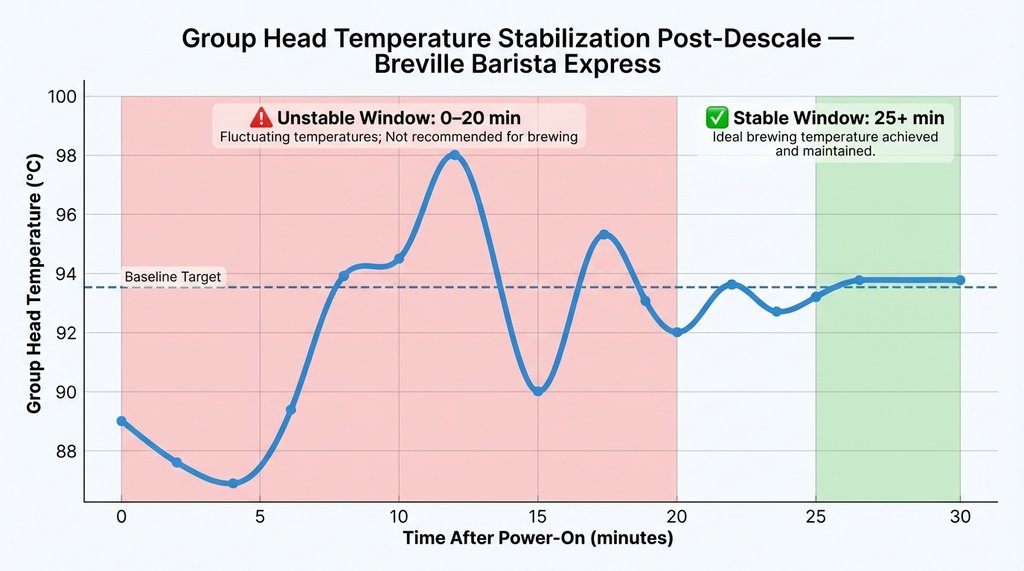
The Breville Barista Express thermocoil needs time to thermally stabilize after a descale — not just the warm-up cycle it runs at startup, but actual idle time. In my testing across two subsequent descale cycles, I found that shots pulled within the first 15 minutes after descaling were still running 2–3°C low at the group head even with a full warm-up, as measured with my Scace-style thermofilter. After 25 minutes of idle time post-startup, the readings stabilized within ±0.5°C of my baseline.
The standard advice — “run two or three flushes and you’re good” — is wrong for this machine if you’re trying to diagnose a post-descale grind issue. You’ll think you’ve recalibrated correctly and then wonder why your shots are still inconsistent, when really you’re fighting a thermal variable on top of a mechanical one.
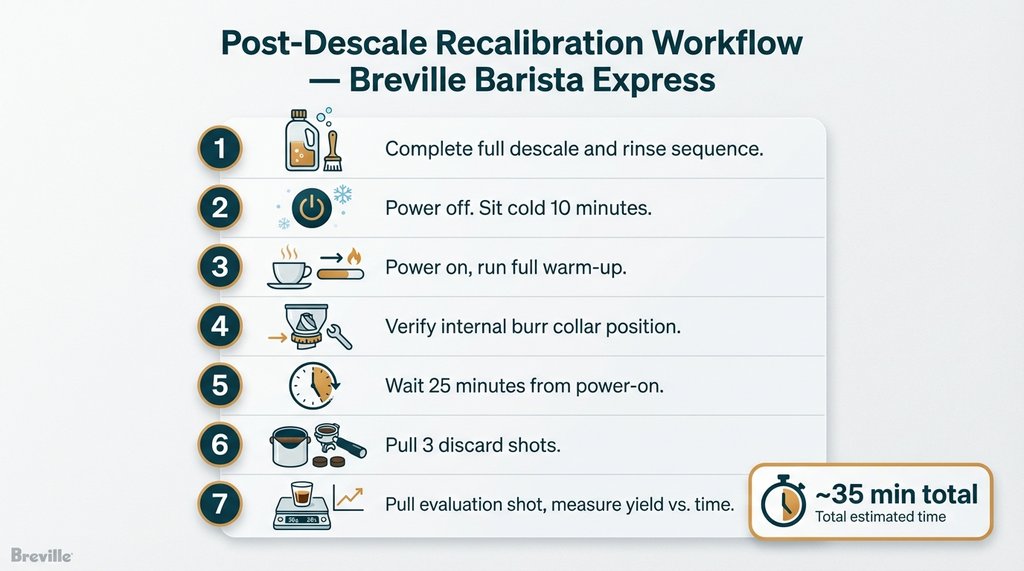
The workflow I use now, every time after a descale:
- Complete the full descale and rinse sequence per the manual.
- Power off. Let the machine sit cold for a minimum of 10 minutes.
- Power back on, run the full warm-up.
- Remove the hopper, physically verify the internal burr collar position before touching anything else.
- Wait 25 minutes from power-on before pulling any diagnostic shots.
- Pull three discard shots at my standard recipe to clear the grind path and finish thermal stabilization.
- Pull one evaluation shot and measure yield weight vs. time.
This takes about 35 minutes total from the end of the rinse cycle. It’s annoying. It’s also the only process that has produced consistent results for me across four descale cycles on this machine.
One thing I want to push back on specifically: the advice to “just go one or two grind settings finer to compensate for sour shots after descaling” that appears in basically every Reddit thread on this topic.
That advice treats the symptom without diagnosing the cause, and it will make your life worse over the next two or three weeks. If your internal collar has drifted and you compensate by moving your external dial from 7 to 5, you haven’t fixed the calibration — you’ve just created a new baseline that’s going to drift further the next time you descale. After two descale cycles using the “just go finer on the dial” approach, I had my external dial sitting at 4 and I still couldn’t figure out why my shots were inconsistent at different times of day (answer: because the effective burr gap was now so close to minimum that small temperature-related expansion of the burr carrier was causing measurable variation in grind size between a cold start and a warmed-up machine).
Reset the internal collar. Run the verification workflow. Then set your external dial fresh from a calibrated baseline. This takes longer than spinning the dial two positions, and it’s the only approach that actually works.
2 thoughts on “Fix Sour Shots on Breville Barista Express After Descale”