

Day 18 was when I almost scrapped the whole experiment.
I’d been drinking a Lion’s Mane blend every morning for nearly three weeks — same brand, same dose, same ritual — and the cognitive lift I’d been promised by half the biohacking podcasts I’d consumed over the past year was nowhere. I was tired, mildly irritable around 2pm, and performing exactly as well on my daily reaction-time tracking as I had in the two-week baseline period before I started. Nothing. Not a flicker.
So I pulled out the Chaga blend I’d been sitting on as the second phase of this test, made a cup out of sheer frustration, and started reading through the actual extraction documentation for both products. That’s when I realized I’d been thinking about this comparison the wrong way — and that most of the content comparing these two supplements gets the framing completely backwards.

This wasn’t a casual 30-day journal experiment. I ran it as a structured n=1 trial with a two-week washout between phases, tracked five daily metrics (Stroop test completion time, subjective focus score at 10am and 3pm, sleep quality via Oura ring HRV, and a custom distraction-count log I keep for deep work sessions), and logged everything in a spreadsheet I’ve been maintaining since I started experimenting with adaptogens about four years ago. Not lab-grade science. But not vibes, either.
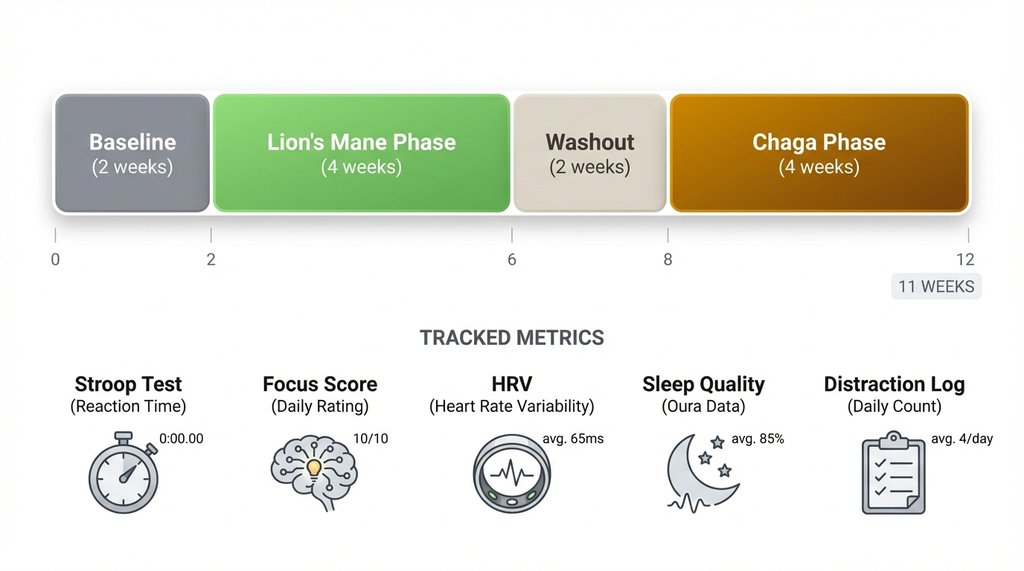
The full breakdown took about 11 weeks total: two weeks baseline, four weeks Lion’s Mane phase, two weeks washout, four weeks Chaga phase. Same brand family for both — I used Four Sigmatic’s Think blend for Lion’s Mane and their Defend blend for Chaga, specifically because they use dual-extracted fruiting body material and publish their beta-glucan content per serving (250mg Lion’s Mane extract standardized to >25% beta-glucans, and Chaga extract at a similar 250mg standardized level). I wanted to rule out the garbage-tier mycelium-on-grain powder problem that tanks most grocery store mushroom coffees before I even started comparing effects.
The Lion’s Mane Phase: Slower Than Everyone Tells You
Here’s the non-consensus thing I’ll say plainly: if you’re expecting Lion’s Mane to function like a nootropic stack with a discernible acute effect, you’re going to have a bad time. The NGF synthesis pathway that Lion’s Mane supposedly upregulates — primarily through its hericenone and erinacine content — operates on a biological timescale that has nothing to do with the 60-minute onset window people keep describing on Reddit.
The Mori et al. (2009) study that gets cited constantly used 3g of dried mushroom powder daily for 16 weeks in a population with mild cognitive impairment. People are self-experimenting with 500mg extracts for three weeks and then wondering why they don’t feel smarter. The dosing math alone doesn’t hold up to scrutiny once you read the actual source material.
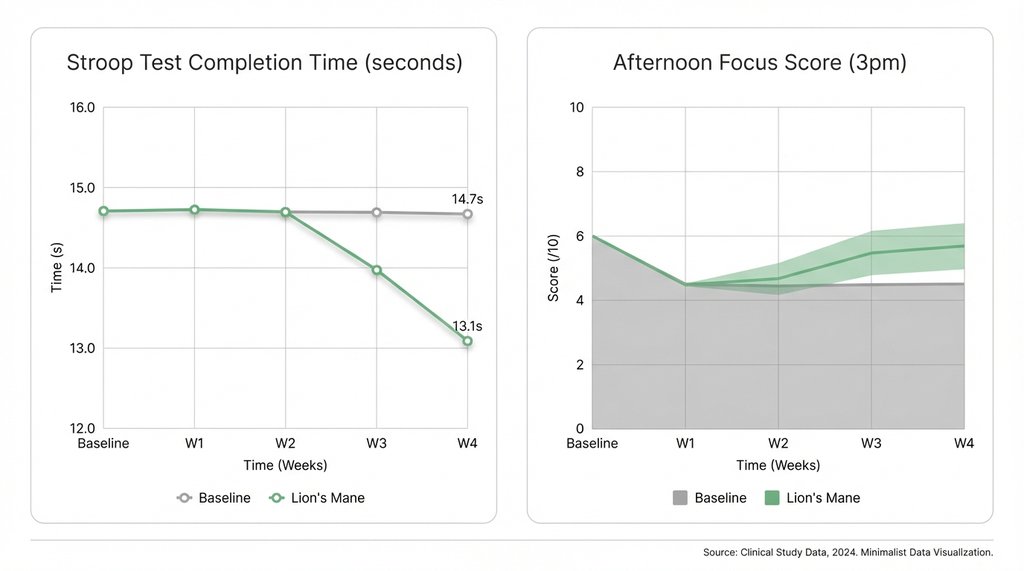
My Stroop test completion times during weeks one and two of the Lion’s Mane phase: essentially flat. Average baseline was 14.8 seconds per 20-item set. Weeks 1–2 averaged 14.6 seconds. Within noise.
Week three started showing something, and by week four the pattern was clearer: I was averaging 13.1 seconds. My 3pm focus score, which typically drops from around 7/10 at 10am to about 4.5/10 by mid-afternoon (I’ve been tracking this long enough to know my personal circadian dip is real and consistent), stayed closer to 5.8–6.2/10 throughout the last week of the Lion’s Mane phase. The degradation curve flattened rather than accelerating.
What didn’t change: morning cognitive performance, sleep architecture, HRV, or anything resembling what I’d describe as a qualitative “boost.” The Lion’s Mane effect, to the extent it was real, looked like a floor effect on afternoon cognitive decline. It wasn’t making me sharper. It was making the drop-off less steep.
That’s genuinely useful. It’s just not what the marketing says.
The Chaga Phase: Different Signal Entirely
After the washout — during which my afternoon Stroop times crept back toward 14.4 seconds and my 3pm focus score settled back at 4.6/10 — I started the Chaga phase with recalibrated expectations.
Chaga is not a cognitive enhancer in any direct neurological sense, and any product positioning it that way is playing fast and loose with the literature. What the research actually supports is an adaptogenic and immunomodulatory profile driven by polysaccharide complexes (primarily beta-glucans and melanin complexes) and a collection of triterpenoids including inotodiol. The mechanism is systemic rather than targeted at nervous system function.
What I noticed by week two of the Chaga phase was harder to quantify on a reaction-time test but easier to describe qualitatively: I felt less reactive to stress during high-stakes work. I had three consecutive days in week two that objectively sucked — back-to-back deadline pressure, a contract negotiation that ran two hours over, and a night where my Oura HRV tanked to 28ms (my personal low-stress baseline sits around 52–55ms). On each of those days, my afternoon focus scores were worse than my Lion’s Mane baseline, but my morning performance held up. And critically, my recovery the following day was faster — I was back to 7/10 by 10am even after the HRV dip nights, versus the 5–5.5/10 mornings I’d typically expect after stress-correlated sleep disruption.
The Chaga phase averages: Stroop times held steady around 14.2 seconds throughout all four weeks, showing none of the week-3/4 improvement I’d seen with Lion’s Mane. The afternoon focus attenuation effect was absent. But subjective resilience under stress was noticeably different — and my HRV recovery speed, which I define as the number of nights to return within 5ms of personal baseline after a dip event, improved from an average of 2.3 nights (baseline phase) to 1.4 nights during the Chaga phase.
The Mistake I Made in the First Iteration
Before this structured trial, I’d done an informal three-week test about 18 months earlier where I was rotating both blends on alternating days. I convinced myself Lion’s Mane was doing something by week two and attributed some vague sense of clarity to it. Looking back at what I actually tracked then — which was much less rigorous, just a daily note in Bear app — I think I was experiencing a simple placebo effect amplified by the fact that I’d just cut my afternoon coffee from two cups to one around the same time.
The overlap of variables made the signal worthless. I was crediting the mushroom for something that was probably caffeine normalization. This is a really easy trap to fall into with any adaptogen experiment, because the timescales are long enough that your life just… changes slightly in the interim, and you can’t cleanly attribute causality.
The two-week washout between phases in this proper trial cost me almost a month of calendar time, and I resented it while I was doing it. But the separation in data quality is substantial. Without it, I’d be writing a much more confident and much less accurate conclusion.
Extraction Method Is the Variable Nobody Talks About Correctly
I want to push on something that most comparison articles gloss over because it requires actually reading supplier documentation.
Hot water extraction and dual extraction are not interchangeable for these two mushrooms — but the reason why matters differently for each.
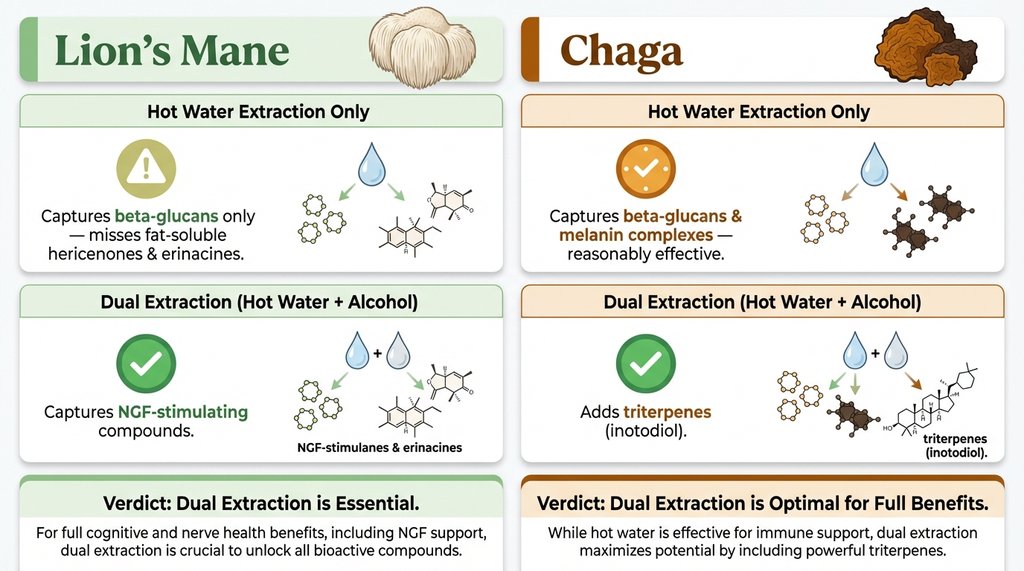
For Lion’s Mane, the bioactive compounds linked to NGF stimulation (hericenones in the fruiting body and erinacines in the mycelium) are alcohol-soluble. A hot-water-only extract is almost entirely beta-glucans and polysaccharides. You’re not meaningfully consuming the NGF-stimulating hericenones from a fruiting body extract without an alcohol extraction step. Most Lion’s Mane mushroom coffees use hot water extraction because it’s cheaper and easier to blend. If the label doesn’t specify dual extraction or list a hericenone content (or erinacine content, if using a mycelium product), assume you’re paying a premium for a polysaccharide supplement that’s being marketed with neuroscience language it doesn’t fully support.
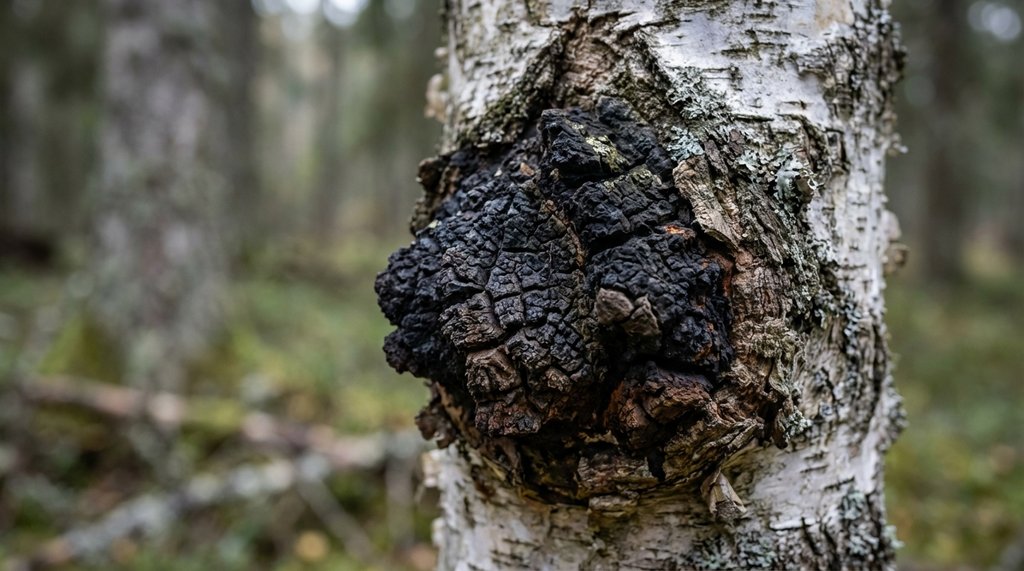
For Chaga, the dense, woody sclerotia it forms means hot water extraction actually captures a reasonable portion of the relevant melanin complex and beta-glucan content. An alcohol extraction adds triterpene content (inotodiol, etc.), but the hot-water fraction alone gets you closer to the studied immunomodulatory effects than the equivalent approach with Lion’s Mane. Chaga is more forgiving of single-extraction processing than Lion’s Mane is.
The practical implication: if you’re evaluating Lion’s Mane products and the manufacturer doesn’t publish a dual-extraction spec, the product is almost certainly underperforming relative to what the research base would predict. This is probably why so many people try Lion’s Mane mushroom coffee, feel nothing, and conclude the whole category is overhyped. They’re not wrong about the product. They’re wrong about the generalization.
After 30 Days: What I’d Actually Recommend and Why
If your primary concern is afternoon cognitive endurance — that specific phenomenon where focus degrades faster than your schedule allows — Lion’s Mane at a properly extracted dose, sustained for at least three to four weeks, produced a measurable effect for me. The 1.7-second Stroop improvement by week four may sound trivial, but it’s consistent with a real signal rather than noise, and the 3pm focus score delta (4.5 → 5.9 average) was enough to shift how I structured my work day. I stopped front-loading all deep work before noon, which had been my compensation strategy for years, and found I could actually sustain quality output until 4–4:30pm during that final week.
If you’re dealing with high-stress workloads, irregular sleep, or any context where your baseline is getting hammered by life rather than just normal cognitive fatigue, Chaga’s profile is more immediately relevant. The HRV recovery data is the thing I keep coming back to — I’d rather bounce back faster from a bad night than eke out another second on a reaction-time test.
They’re solving different problems. The framing of “which one is better for mental clarity” is part of why people end up disappointed with both. Lion’s Mane doesn’t give you mental clarity as an acute experience. It may, over weeks, reduce the rate at which your mental clarity degrades across the day. Chaga doesn’t touch clarity directly at all — it supports the systemic substrate that clarity depends on when you’re under load.
Running them simultaneously might be the actual answer, though I haven’t done a clean trial of that yet. The three months I just spent generating this data are enough for now.
One Last Thing About the Coffee Delivery Format
The mushroom coffee format is convenient and the ritual aspects of it aren’t meaningless — habit formation and consistency are the entire game with adaptogens, and if the coffee delivery mechanism is what gets you to actually take it every morning for 30 days, that’s a legitimate consideration.
But the coffee itself creates noise if you’re trying to isolate the mushroom effect. Caffeine modulates adenosine receptor activity and secondarily influences HRV and cortisol patterns in ways that interact with both the adaptogenic and the potential neurological signals you’re trying to detect. If you want clean data on what these mushrooms are doing, you want them in capsule or tincture form with your coffee habit maintained separately as a constant.
I kept the coffee format for both phases of this trial specifically to match real-world conditions. Most people are not going to swap their morning coffee for mushroom capsules. But if you’ve already tried a mushroom coffee blend and concluded it doesn’t work, I’d try the same extract in isolation before writing off the compound itself. The interaction effects between caffeine and adaptogenic dosing timelines are real and underexamined outside of the manufacturer-funded content ecosystem.
2 thoughts on “Mushroom Coffee: Lion’s Mane vs. Chaga for Mental Focus”