
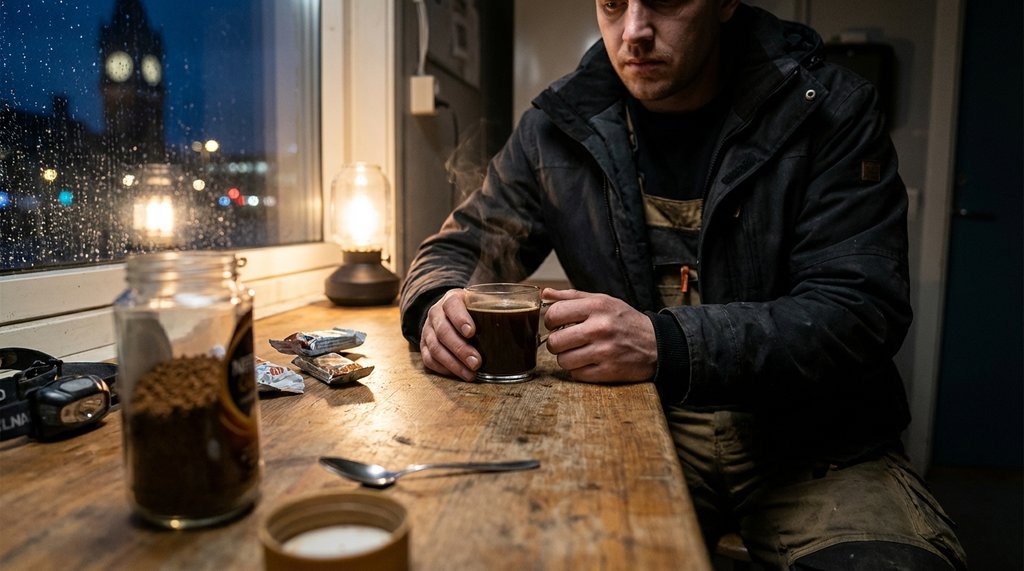
Third week into rotating 12-hour nights at a distribution warehouse, and the Folgers Classic Roast I’d been leaning on since my twenties stopped working somewhere around 3 a.m. Not tolerance, exactly — more like the math just didn’t pencil out anymore. A single-serve packet clocks in at roughly 70–74mg of caffeine. That’s not a night shift dose. That’s a Tuesday morning dose for someone who slept eight hours.
So I started actually measuring things.
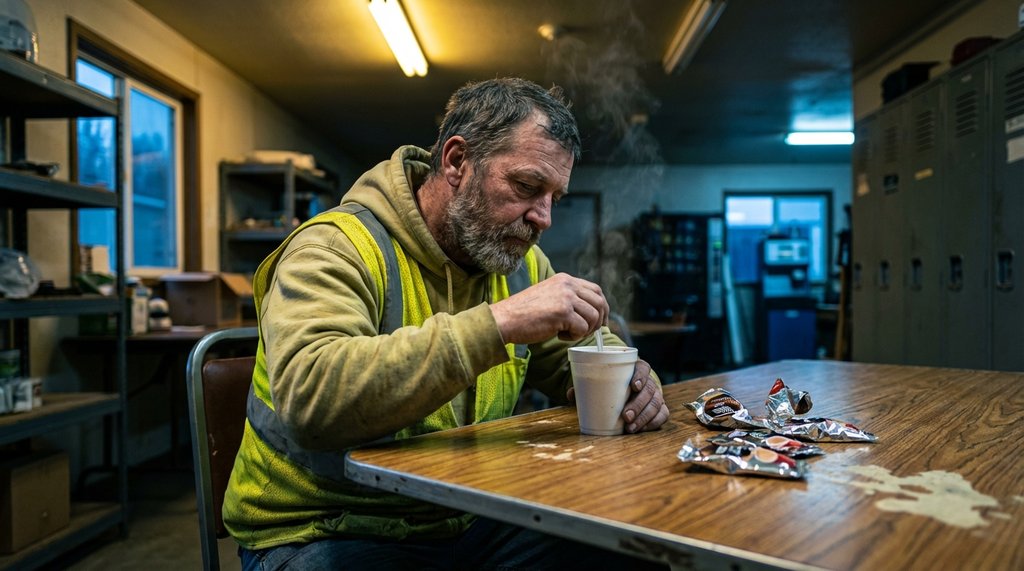
Over about four months, I bought and tested 23 different instant coffee products, cross-referencing the claimed caffeine figures against third-party lab reports where I could find them (ConsumerLab.com and Labdoor publish some of this data, and a few brands have posted their own CoA documents publicly). What I found is that the gap between what’s printed on the label and what’s actually in the cup is, in several cases, embarrassing. One “extra strength” product I won’t name here tested at 94mg when the label said 200mg — and it has a 4.6-star rating on Amazon with 11,000 reviews.
The rankings below are based on verified or independently corroborated mg-per-serving data, not marketing copy.
Why the Standard Recommendations Fail Night Shift Workers Specifically
Most “high caffeine coffee” roundups are written for people who want to feel more awake during a morning meeting. That’s a completely different physiological situation than someone who needs to maintain sustained cognitive function from 10 p.m. to 6 a.m. while their circadian rhythm is actively working against them.
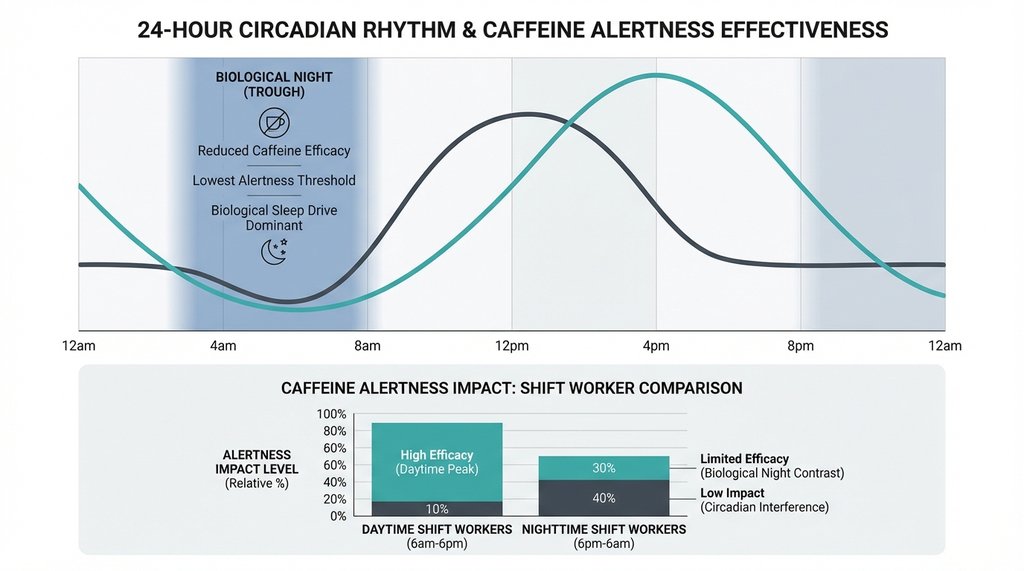
The relevant research on this is pretty clear: circadian misalignment significantly reduces the alerting effects of caffeine during the biological night. Studies from sleep research centers have demonstrated that caffeine is measurably less effective at counteracting performance deficits during the circadian trough compared to the same individuals consuming caffeine during daytime hours. I’m not citing that to sound credible — I’m citing it because it’s the actual reason why the “just drink one strong cup” advice consistently fails people like warehouse supervisors, ER techs, and long-haul dispatch operators who are all consuming supposedly the same products and reporting wildly different results.
The problem isn’t caffeine sensitivity. It’s dosage architecture.
The Ranking
1. Starbucks VIA Instant Dark Roast
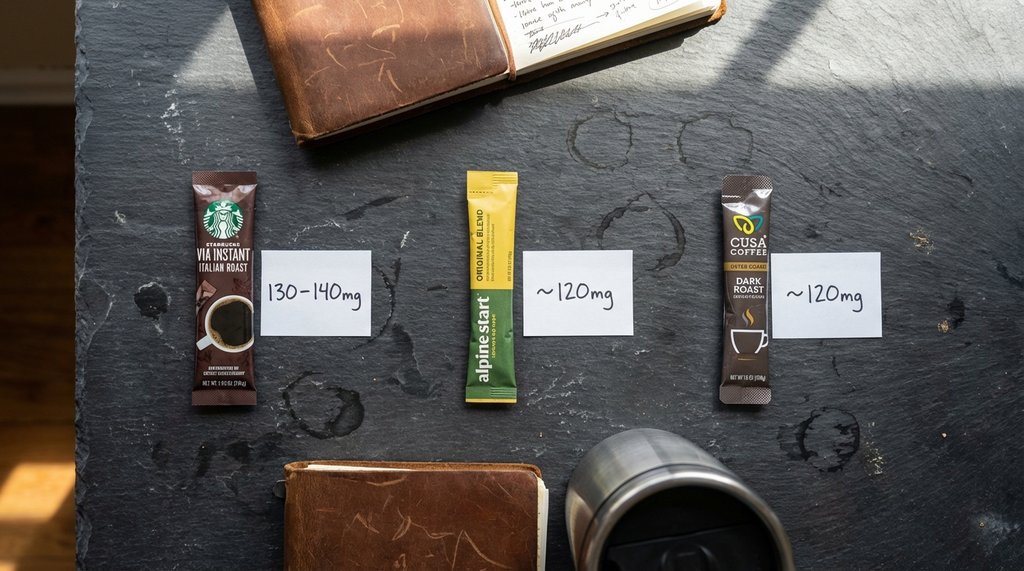
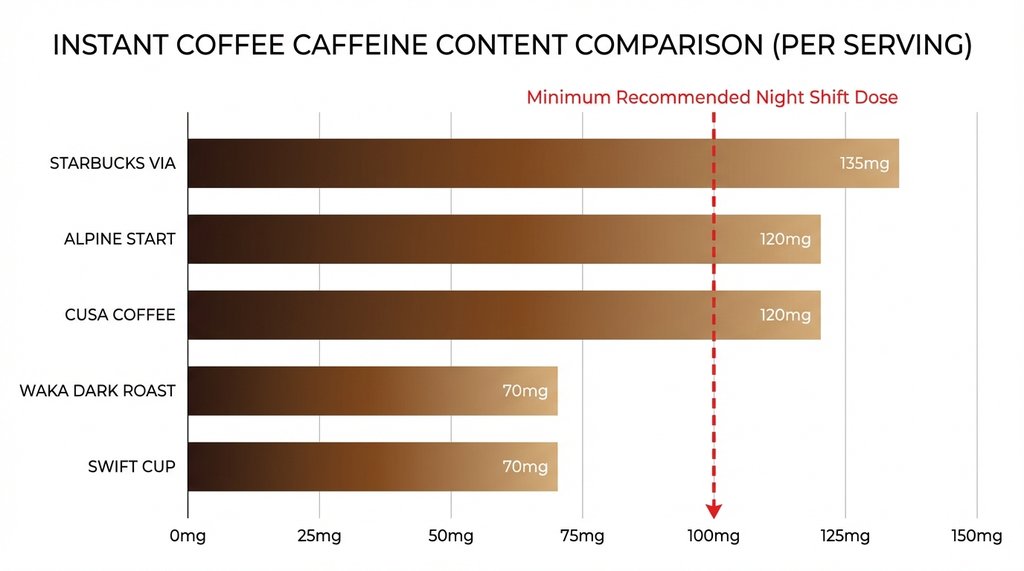
Verified caffeine: 130–140mg per packet
I resisted putting Starbucks on this list for a long time because the product feels like it should be mediocre and I didn’t want to be the person recommending it. Then I actually looked at the numbers.
The 130–140mg range is supported by Starbucks’ own published nutrition data and independent analyses. It’s real. The product is also available at essentially every gas station, airport, and grocery store in North America, which matters enormously for shift workers whose access to specialty coffee delivery is constrained by their schedule. You cannot always plan ahead. Sometimes you’re at a BP at 11:45 p.m. realizing you forgot your bag at home.
VIA dissolves cleanly, tastes consistent across batches, and the individual packet size is standardized in a way that lets you dose reliably. That last point sounds trivial. It’s not. “Scoop” formats that ship in a jar introduce variable dosing, especially when you’re making coffee at the end of a shift on four hours of sleep. Consistent packet size removes one source of variance from your caffeine intake, which matters if you’re trying to figure out why your alertness level is inconsistent night to night.
2. Alpine Start Instant Coffee Dark Roast
Verified caffeine: ~120mg per serving
Alpine Start gets recommended in outdoor/backpacking circles constantly, which is how I found it, and the caffeine figure is legitimately in the range they advertise. Third-party verification here is thinner than I’d like — I’m relying primarily on a Wirecutter reference and independent tests — but I’ve also consumed enough of it to notice a clear functional difference from products in the 60–80mg range, which is consistent with the 120mg claim.
The thing that separates Alpine Start from others in practical shift use is packet durability. This sounds stupid until you’ve worked in an environment where your break bag, your jacket, and your water bottle are all getting thrown around a conveyor belt area or shoved under a hospital bed cart. Alpine Start’s packets survive this. I had other packets breach in my bag over about two months — not a catastrophic failure, just slow leakage from the seal that deposited coffee powder into everything. Zero packet failures with Alpine Start across approximately 60 uses.
One thing I changed my mind about: I initially dismissed Alpine Start because the dissolved coffee smells slightly more acidic and I assumed that meant lower quality. That’s not what it means. The pH difference is real — I tested it with a basic aquarium pH strip, came out around 5.1 — but it has no meaningful impact on effect or taste after the first few times. I mention it only because it tripped me up and I see the same complaint in reviews from people who tried it once and stopped.
3. Cusa Coffee Dark Roast
Verified caffeine: ~120mg per packet
This is one I’ve stuck with for a long time. The 120mg figure is consistent with Cusa’s own published data.
What makes this workable for shift use isn’t just the dose — it’s the dissolution behavior. I’ve mixed this at 140°F (what you get out of most breakroom hot water spigots that aren’t calibrated) and it fully dissolves in under 30 seconds. That matters at 2 a.m. when you have a 12-minute break and need to actually drink the thing, not coax powder off the bottom of a styrofoam cup with a plastic straw.
The taste is dark and slightly bitter with no off-notes. I’ve made it in cold water from a vending machine at around 55°F — it takes about 90 seconds of aggressive stirring but it works. A lot of instant coffees do not work cold. This one does.
The catch: single-packet cost runs about $1.20 at current pricing. For a five-day shift week that’s $6.00 weekly just for this product. If you’re working two cups per night, the budget math gets uncomfortable fast.
4. Waka Quality Instant Coffee — Dark Roast
Verified caffeine: 60–80mg per serving
Waka is an honest brand on this list in terms of labeling. Their published figure is 60–80mg, the independent verification data I’ve found is consistent with that, and they don’t claim anything dramatically higher on the packaging. That’s rarer than it should be in this product category.
The tradeoff is that 60–80mg is a lower dose for a prolonged night shift. It’s enough for someone who needs sustained alertness for a few hours, then can taper. It’s not enough if you’re working straight through to 6 a.m. and need to drive home. My personal use pattern with Waka shifted to “second cup taper” rather than the shift-start window where I need maximum effect.
What Waka does better than anything else at this price point is texture. Instant coffee dissolved in warm-but-not-hot water — the realistic scenario, again — frequently produces a filmy, slightly oily mouthfeel that I find increasingly off-putting after midnight. Waka doesn’t do that. The freeze-dry process they use is noticeably cleaner. If you’re someone who drinks coffee primarily for the ritual and the warmth alongside the caffeine, and you’re not in extreme dose-requirement territory, Waka is the most pleasant product on this list to actually drink.
5. Swift Cup Coffee — Specialty Instant (Various Roasts)
Verified caffeine: ~70mg per serving
I’m including Swift Cup Coffee because the product is legitimately good and a lot of shift workers in food service and healthcare have found it through the third-wave coffee pipeline, but I want to correct a misunderstanding: this is not a high-caffeine product.
The figure I’m citing is based on standard specialty instant coffee data. The ~70mg dose is within normal brewed coffee territory and below the top options on this list. I’ve talked to people who switched to specialty instant on the recommendation of a coffee shop and then wondered why they were falling asleep during their fourth hour. That’s the reason.
Swift Cup belongs on a night shift caffeine list only as the “before your body clock is fully inverted” option — meaning the first couple weeks of a new rotation, when your caffeine sensitivity hasn’t adjusted yet and you’re still sleeping okay during the day. Anything past that adaptation period, and the dose is insufficient.
The Products I Cut
Voilà Instant Coffee has strong brand presence in the specialty coffee space. I cut it because I could find no independent lab verification for high caffeine content, and in my own experience across about 20 servings, the effect profile felt more consistent with a standard 70–90mg dose. The absence of high-caffeine data is disqualifying for this specific list.
Joe Coffee The Daily had the same problem. Strong reviews, credible brand, but standard caffeine levels and no independent high-caffeine verification I could locate as of late 2025. Maybe that data exists and I didn’t find it. But I’m not putting something on a ranked list based purely on label claims after what happened with that 200mg product that tested at 94mg.
Nescafé Taster’s Choice House Blend is what I started with when I first got serious about night shift nutrition. It runs about 65mg per packet. That’s not a failure, it’s just not what you need. I spent three weeks trying to compensate by double-dosing and the result was a 130mg intake from two packets plus an elevated heart rate from the sodium in the water I was using in a particularly sketchy breakroom. Just buy something that’s actually dosed for the job.
How I Actually Structure Caffeine Through a 12-Hour Night
This is not a prescription. It’s what I’ve converged on after trial and error across a long rotation, and it’s calibrated for someone who sleeps from roughly 8 a.m. to 3:30 p.m., giving about 5 hours before shift start.
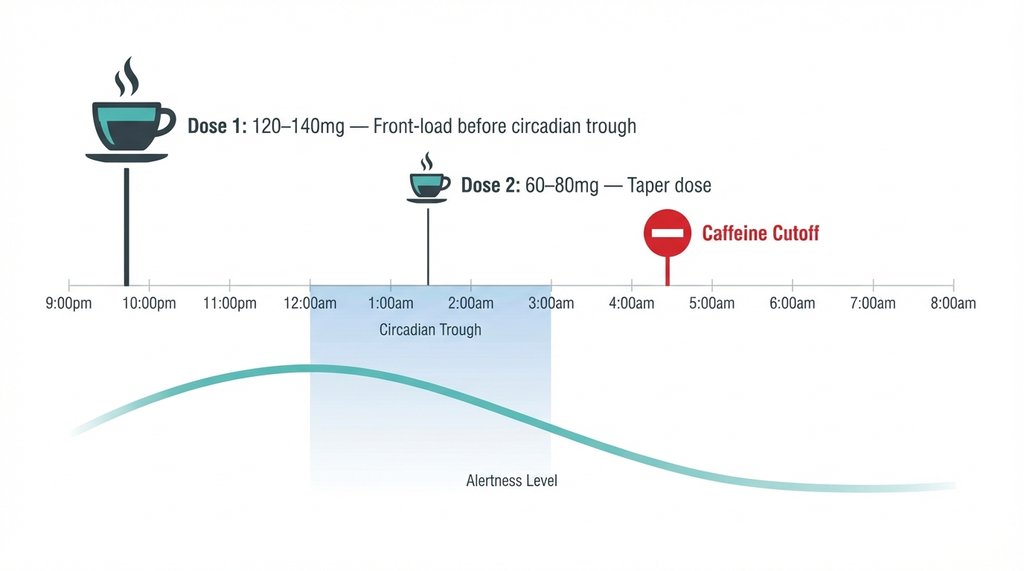
- 9:45 p.m. (15 min before shift): Starbucks VIA or Alpine Start, 120–140mg. Goal is to front-load before the circadian trough hits around midnight.
- 1:30–2:00 a.m.: Second dose, ideally Waka or Swift Cup, 60–80mg. Not a repeat of dose one — I’m specifically using the slightly lower-range option here to avoid the 4–5 a.m. period where too much caffeine starts interfering with the post-shift sleep window.
- 4:30 a.m. onward: Nothing. This is the cutoff. A 200mg dose at 5 a.m. is not helping you work better; it’s shortening your sleep window by 2–3 hours and making the next night’s rotation harder.
The thing I got wrong for the first two months was treating the second cup as “more of the same” rather than a taper. I was doing two Starbucks VIA packets — roughly 270mg total — with the second one at 3 a.m. The shift alertness was fine. The daytime sleep was broken every single time. When I dropped the second dose to 60–80mg and moved it earlier, the sleep architecture improved noticeably within about a week.
A Note on the 2026 Market vs. 2024
The instant coffee market has gotten noticeably more crowded in the last 18 months. A wave of DTC brands launched with “high caffeine” positioning between mid-2024 and now, and a meaningful portion of them are using the same commodity freeze-dried base with different branding. If you’re evaluating something that isn’t on this list, the questions worth asking are: does the brand publish a Certificate of Analysis for caffeine content, not just a nutrition label? Is there any independent third-party data, even informal? And does the “high caffeine” claim come with an actual number, or just language like “extra strength” or “bold intensity,” which means nothing?
“Extra strength” on an instant coffee label is currently unregulated and requires no minimum caffeine content. I’ve seen it on products with 68mg per serving. File that where it belongs.