

The first time I ran this discussion, I made the mistake almost every facilitator makes: I opened with “What did you think of the rules of the café?” Within about four minutes, we were deep in a logistics argument about time travel mechanics and had lost the entire emotional thread of the book. Forty-five minutes gone. Three people in the group never recovered their focus.
Kawaguchi’s novel is deceptively easy to misread as a story about time travel. It isn’t. The time travel is a locked room, and what the novel is actually studying is what people choose to carry into that locked room with them. These ten questions are designed to keep your group inside the emotional and philosophical architecture of the book rather than debating the scaffolding.
A few facilitation notes before the questions: this novel consistently provokes one particular split in reading groups, along lines that aren’t always predictable. Some readers find the rules of the café — you cannot change what happens, no matter what you do — deeply comforting. Others find them unbearable and interpret the entire conceit as a kind of cosmic cruelty. Both readings are defensible. Neither group tends to fully understand the other without direct prompting. Question 3 below is specifically designed to surface that divide before it becomes subterranean.
Also: the four stories are not equal in emotional weight for all readers. Don’t assume your group landed hardest on the same story. Ask before you assume.
Question 1: What do the characters actually want when they say they want to go back?
This sounds obvious until you push on it.
Fumiko doesn’t want to undo her breakup with Goro. She wants him to know her true feelings. Kohtake doesn’t want to reverse her husband’s dementia. She wants to receive the letter he wrote before his memory faded. Kei wants her unborn child to know she was loved. Not one of them, examined carefully, is actually trying to change an outcome. They’re trying to complete a communication that was severed.
Ask your group: is there a meaningful difference between wanting to change what happened and wanting to be witnessed in what happened? And if what they wanted was just to be witnessed — why did that require a time machine? Why couldn’t they have said it in the present?
This question tends to open up into something genuinely uncomfortable about how we use regret as a substitute for the harder work of expression. The café is only necessary because these characters couldn’t say the thing when saying it was still possible. That’s not the café’s tragedy. That’s ours.
Question 2: The novel argues, implicitly, that regret has a correct object. Do you agree?
Every character who uses the chair in the café is reaching back toward a specific moment, a specific person. The novel treats this as obviously meaningful — of course you know what you regret, of course you can locate it precisely in time and in relationship.
But I’ve never been in a reading group where everyone agreed that regret actually works this way. Some of the most interesting responses I’ve gotten to this book come from readers who say their own deepest regrets aren’t like that. They describe a more diffuse grief: regretting not who they talked to or didn’t talk to, but who they were during an entire decade. A quality of attention they sustained for years and can’t walk back to any single conversation.
The novel doesn’t have a seat for that kind of regret. There’s no specific moment to return to. Ask your group whether Kawaguchi is describing a universal truth about regret, or whether he’s describing a very specific, almost Japanese narrative form of regret — bounded, relational, locatable — that may not map onto everyone’s experience.
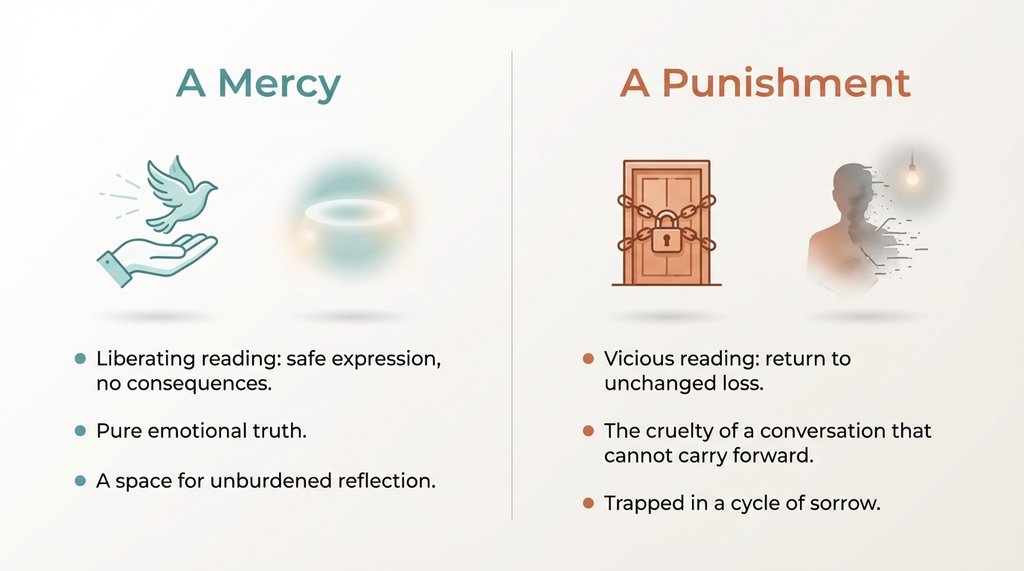
Question 3: Is the rule “you cannot change the present” a mercy or a punishment?
This is the question that surfaces the split I mentioned above, and it needs to be asked directly because the novel itself doesn’t fully adjudicate it. Kawaguchi clearly wants us to feel the rule as liberating — if nothing can change, then going back is “safe,” a space for pure emotional truth without consequence. Many readers receive it exactly that way.
Others, particularly readers who have experienced a specific kind of irreversible loss — a death under difficult circumstances, a relationship that ended before something crucial could be said — find the rule vicious. Not comforting. The idea that you could sit across from someone, have the conversation you needed, and then return to a present where they are still gone, still estranged, still unable to hear what you said in the room you came from — some readers find that worse than not going at all.
Don’t smooth this over. The disagreement is the discussion. Let people be in it.
Question 4: Hirai, the bar owner, uses the chair to confront her guilt over avoiding her sister. What does her story change about the novel’s argument?
Hirai goes back to see her sister after a tragic car accident. While her avoidance of her sister originally stemmed from a practical dispute over the family inheritance, her use of the chair is driven by grief and the need to apologize. Her story is arguably the most quietly devastating.
What Kawaguchi does with Hirai is subtle: she goes back burdened by regret, and what she discovers in the past isn’t just forgiveness, but that her sister loved her in a language she hadn’t learned to read. The chair doesn’t give her a way to change her sister’s fate. It gives her complexity.
Ask your group: does Hirai’s use of the chair suggest that the novel has a consistent theory of what the café is for, or is the café just a mirror that reflects whatever the character most needs to see? And is a mirror that shows you what you need to see the same as a mirror that shows you the truth?
Question 5: Kawaguchi never lets us see what doesn’t get resolved. Is that an aesthetic choice or a philosophical one?
Every character who uses the chair comes away with something. Not necessarily what they went back for — but something. The novel has an almost perfect record of delivering emotional resolution, even quiet resolution, to the people who sit in that seat.
The non-consensus reading I keep coming back to: I think this is the most ideologically loaded element of the book, and the one least often named directly. The novel is, at its core, a story about the sufficiency of expression — the idea that if you can just say the thing, to the right person, even in a pocket of time that won’t hold, something is repaired. That is a beautiful idea and a contestable one.
There are categories of regret — betrayals you caused, harm you did to someone who didn’t want your apology, situations where the communication was not severed but was in fact complete and the answer was no — that the café cannot accommodate. Not because of the rules. Because the novel’s emotional logic doesn’t have room for them.
Ask your group: what kinds of regret does this novel not know how to hold? And does that limitation diminish it, or is it just honest about what kind of book it set out to be?
Question 6: What is the novel saying about memory by making the past inaccessible to change but accessible to witness?
The philosophical tradition that haunts this book — and I think it’s worth naming even if Kawaguchi never names it explicitly — is something close to the Buddhist understanding of impermanence combined with the very Japanese aesthetic of mono no aware: the bittersweetness of transience, the beauty that is inseparable from the knowledge of ending.
The café’s rules enforce impermanence. You cannot hold the moment. The coffee gets cold; you return. But the experience of having been there doesn’t leave. What the characters gain isn’t the past itself but a new relationship to their memory of it.
Ask your group: is there a version of this that happens without a time machine? Can the practice of returning to a memory — really sitting with it, fully imagining the other person present — do some version of what the café does? And if so, what does the time-travel conceit add that the interior work of memory cannot?
Question 7: The novel punishes no one. Is that a feature or a flaw?
I keep noticing, across different reading groups, that nobody ever raises the ethical dimension of the characters’ original behavior — the choices that produced the regret in the first place. Fumiko let Goro walk away because of her pride. Kohtake avoided her husband’s diagnosis because it was too painful. Hirai’s relationship with her sister had gone silent because she wanted to escape the family business.
In each case, the character did something — didn’t do something — that contributed to the wound. The novel’s compassion is remarkable and consistent: it holds all of them gently, it never judges. But “holding gently” can slide into “explaining away,” and I think there’s a version of reading this book where its warmth becomes a permission structure for not examining what we’re actually responsible for.
Ask your group whether the café is, on some level, too easy. Not the physical constraints of the chair — the emotional constraints. Does the novel ever make a character reckon with their own agency in creating the situation they regret? Or does it consistently redirect toward the beauty of the reunion, the clarity of the expression, the tears that mean something has been released?
Question 8: What does it mean that Kazu, the one person who facilitates the time travel, never uses the chair for herself?
Kazu is the most interesting character in the novel precisely because she is structurally bound to the café’s primary offering. As the one who pours the coffee, she facilitates the journeys of others but doesn’t go back herself.
There’s something here about what happens to regret when you are the guardian of the experience. The scarcity of the experience — you only get to travel once — is what gives it weight for the other characters. They have to choose which regret to carry into that room. Kazu oversees this process, and the novel implies this makes her relationship to regret stranger and heavier than anyone else’s.
Ask your group whether Kazu’s role represents wisdom or a necessary burden — and whether those are meaningfully different things. While Kei uses the chair in the fourth story for something enormous, Kazu remains the steady facilitator. Why does her role as the pourer of the coffee change her relationship to the past?
Question 9: The novel presents grief and regret as essentially soluble through communication. What does your group believe?
This is the sharpest possible version of the question the book raises, and it should probably come near the end of your discussion when people are warmed up enough to be honest.
Kawaguchi’s premise is quietly radical: that what makes regret unbearable is not that things happened but that things weren’t said, and that if the saying can be completed — even in a room that time will not remember — the weight can be set down. This is a specific, secular, relational theory of healing. It has a lot of intellectual company (narrative therapy, most of the expressive arts therapeutic tradition, the psychological literature on closure). It also has critics who find it insufficient for certain kinds of loss.
Ask your group whether they believe it. Not whether they find it beautiful — most people find it beautiful — but whether they find it true. And then ask them to think about what kind of loss would require a different theory entirely. What would the café be unable to offer?
Question 10: If you could use the chair with the novel’s constraints fully intact, would you? And if not — what does that tell you about what you actually want from your own regrets?
The novel implicitly assumes that the chair’s offer is desirable, that most readers would say yes, of course, given the chance. In every group I’ve run, the actual answer has been messier than that.
Some people say no immediately. They can articulate a theory — that the person they’d want to see exists now in a form that a past-self wouldn’t recognize and couldn’t meet; that going back would require them to perform a version of themselves they’ve moved beyond; that what they want isn’t access to the past but for the past to somehow know the present.
Others say yes and then realize they can’t name who they’d visit, which is its own kind of revelation.
The novel is at its most honest here, I think: it built an architecture so specific and so constrained that it accidentally reveals which desires it cannot satisfy. Some of your group will discover, sitting with this question, that their regret isn’t actually located in the past. It lives in the present, in who they still are, in choices still being made.
The coffee got cold anyway. That was always the point.
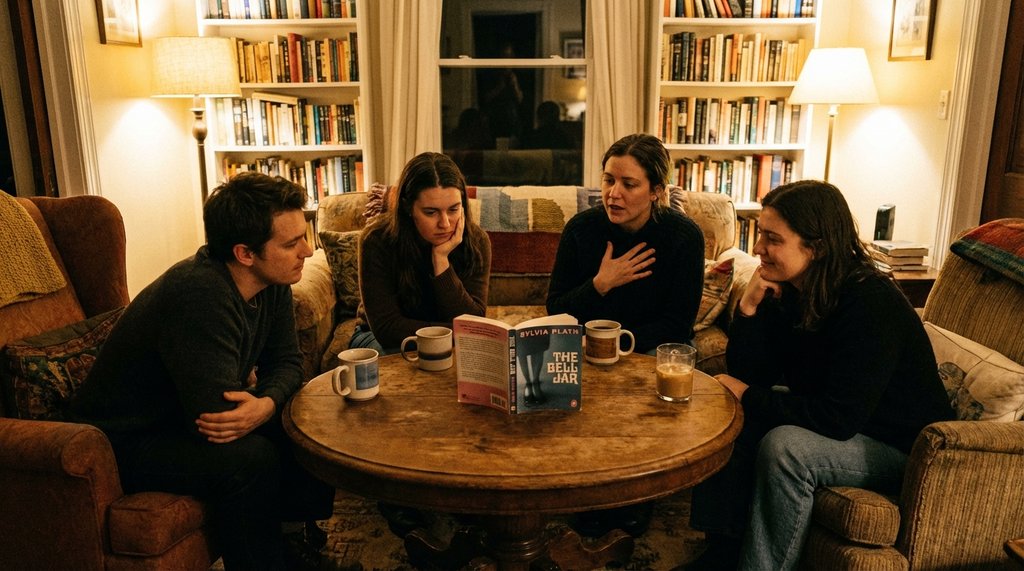
A note on pacing: These ten questions will run well over a standard ninety-minute session if you try to cover all of them. I’d recommend selecting five based on which stories generated the most response in your group, and keeping questions 3, 9, and 10 regardless of what you cut — those three tend to generate the most durable conversation and the most honest personal disclosure. Questions 5 and 7 together can function as a single paired discussion if time is short. Question 8 often gets cut but shouldn’t be; Kazu is where the novel actually lives.