
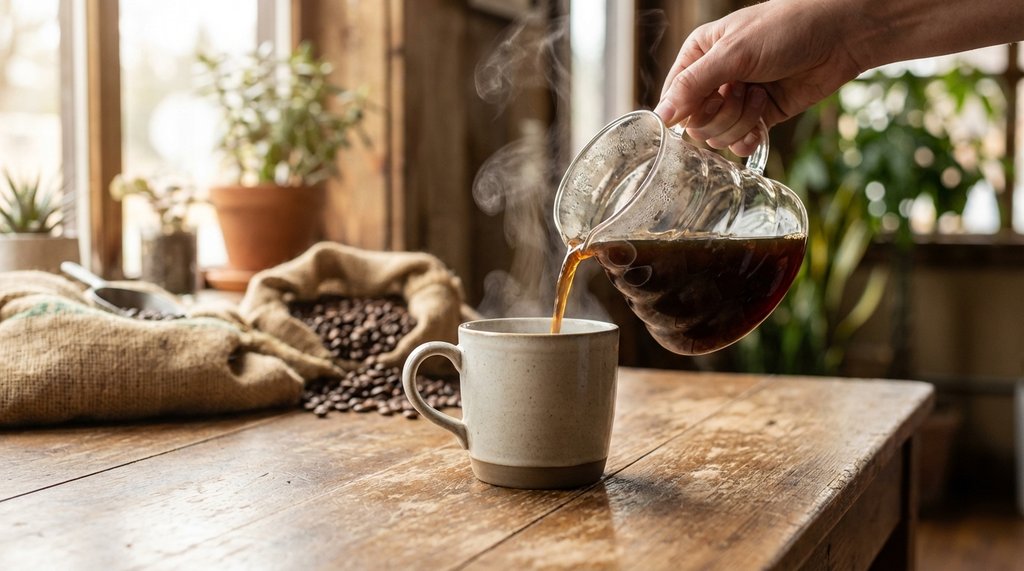
The batch I ruined last Tuesday is still sitting in my head. I’d been pulling the same 18g dose on my Timemore Chestnut C2 for probably four months straight — decent extractions, nothing that made me stop mid-sip. Then I ran out of my usual Ethiopian and grabbed a bag of a washed Guatemalan I’d been sitting on. Same dose, same grind setting, same water temperature. The cup tasted like a wet cardboard ashtray with a thin coating of something that was almost chocolate but gave up halfway through.
I didn’t change anything else. I went from 18g to 20g.
The next cup was genuinely different. Not “maybe my palate is in a better mood” different — actually, structurally different. The body filled out, the bitterness stopped dominating the back end, and for the first time with that bag I could taste why the roaster had written “brown sugar finish” on the label. Two grams. That’s it.
Here’s what took me embarrassingly long to accept: the brew ratio advice circulating in most home coffee communities is optimized for avoiding bad cups, not for building good ones. The “start at 1:15 and adjust” framework works fine as a floor. But it’s taught as a destination, and a lot of home brewers — myself included for longer than I want to admit — treat it that way.
The problem is that the optimal ratio for any given coffee isn’t fixed. It shifts with roast development, with the density of the bean, with your specific grinder’s particle distribution, and honestly with how far out from roast date you are. A 2-gram shift in your dose (with output held constant, so your ratio actually changes) can move your extraction point enough to expose or suppress entire flavor layers that your current “dialed in” setup is either over-extracting into bitterness or under-extracting into sourness and flatness.
Most guides tell you to adjust grind size to fix extraction. Grind size is the right lever most of the time. But there are specific cases where it’s the wrong variable to touch.
I had a Kenyan last spring — a Nyeri AB from a small roaster in Portland — where every grind adjustment made things worse. I was chasing brightness that kept tipping into sharpness, and every time I went coarser to soften it, I lost the body and got this thin, watery cup that tasted like fruit juice diluted with tap water. Going finer brought the syrupiness back but cranked the acidity back into astringent territory.
After probably 12 wasted doses, I stopped touching the grinder. I dropped from 20g to 18g, kept my output at 300ml (so I moved from a 1:15 ratio to roughly 1:16.7), and the cup immediately balanced out. The acidity didn’t disappear — it just stopped being aggressive. The fruit was there, the body was there, and the finish was actually pleasant.
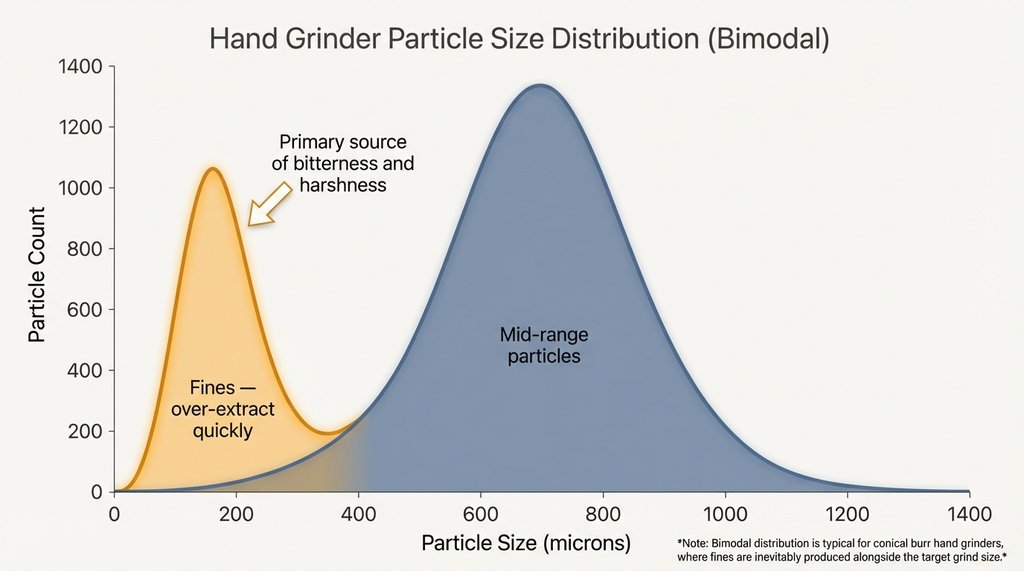
What was happening: that Kenyan was dense, with a relatively light roast that had a lot of intact cell structure. My grinder at that setting was producing a bimodal distribution — some very fine particles, a lot of mid-range. The fines were over-extracting badly and contributing to the harshness, but because the grind dispersion on a hand grinder isn’t perfectly uniform, I couldn’t fix it by going coarser without creating a different problem on the other end. By dropping my dose and increasing my ratio slightly, I effectively diluted the over-extraction contribution from the fines without needing to change particle size at all.
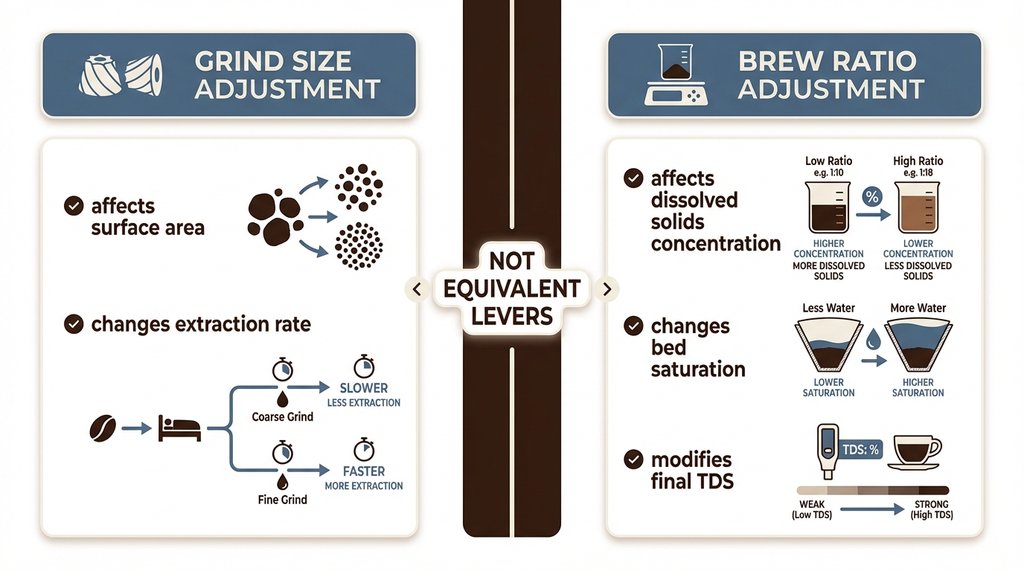
This is the thing nobody really talks about in the standard “dial it in by grind” framework: ratio adjustment and grind adjustment are not equivalent levers. They affect the cup differently because they change different aspects of the extraction chemistry. Grind size affects surface area and extraction rate. Ratio affects the concentration of dissolved solids relative to water volume, which changes both how saturated the coffee bed gets during brewing and — critically — the final TDS of your cup. When you’re dealing with a grinder that has significant fines (which is most home grinders under $200), ratio adjustment can sometimes solve the problem that grind adjustment creates.
The specific scenario where I see this most clearly is medium-dark roasts brewed on a V60 or similar open drain brewer. The conventional wisdom is to go coarser on darker roasts because they extract faster. That’s true. But a lot of people go coarser and keep their dose the same, which changes the ratio, which they don’t track because they’re only thinking about grind.
I tested this specifically last winter with a medium-dark Colombian. My baseline was 18g in / 270ml out (1:15), grind at setting 12 on the Timemore. Classic over-extraction problem: flat, bitter, one-dimensional. I tried coarser first — setting 14, same 18g / 270ml. Helped with the bitterness but the cup got thin and kind of papery.
Then I kept the grinder at 14 but moved to 20g in / 300ml out, back to 1:15 ratio. Entirely different result. The coarser grind reduced the extraction speed and cleaned up the bitterness. The higher dose gave the cup back its body and sweetness. The ratio stayed constant, so I wasn’t just adding water to a weak cup — I was actually brewing more coffee through the same ratio with a different particle profile.
The difference in the cup wasn’t subtle. I ran this back three times to make sure I wasn’t in a placebo spiral. Consistent result.

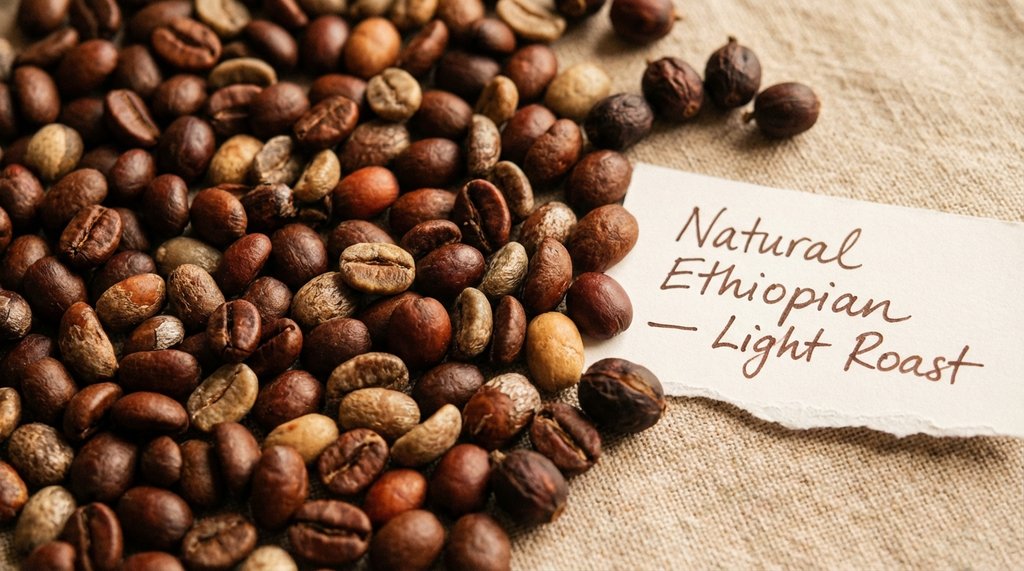
There’s a version of this advice I’d push back on, though, because I’ve seen it cause problems in the wrong context: if you’re working with a very light roast, especially a washed process with high acidity, increasing dose to fix flatness can backfire. I did exactly this with a natural Ethiopian last fall — fruity, very light roast, kept tasting hollow. Bumped from 18g to 20g. The cup got denser and more syrupy, which I wanted, but it also amplified the fermented fruit notes to the point where the cup tasted slightly boozy and off. Some coffees have volatile compounds that you want water to carry away, not concentrate. Going heavier on the dose concentrated them.
The fix in that case was coarser grind, not more coffee. The hollow quality I was tasting wasn’t under-extraction so much as a lack of sweetness development in the roast, and adding more coffee just gave me a more concentrated version of the same unpleasant quality.
The rule I’ve landed on: if the cup is thin and lacks body but the acidity isn’t aggressive, try adding dose first. If the cup is thin and the acidity is sharp or fermented-fruit-funky, try coarser grind first before touching the dose. These scenarios look similar in the cup but respond to different adjustments.
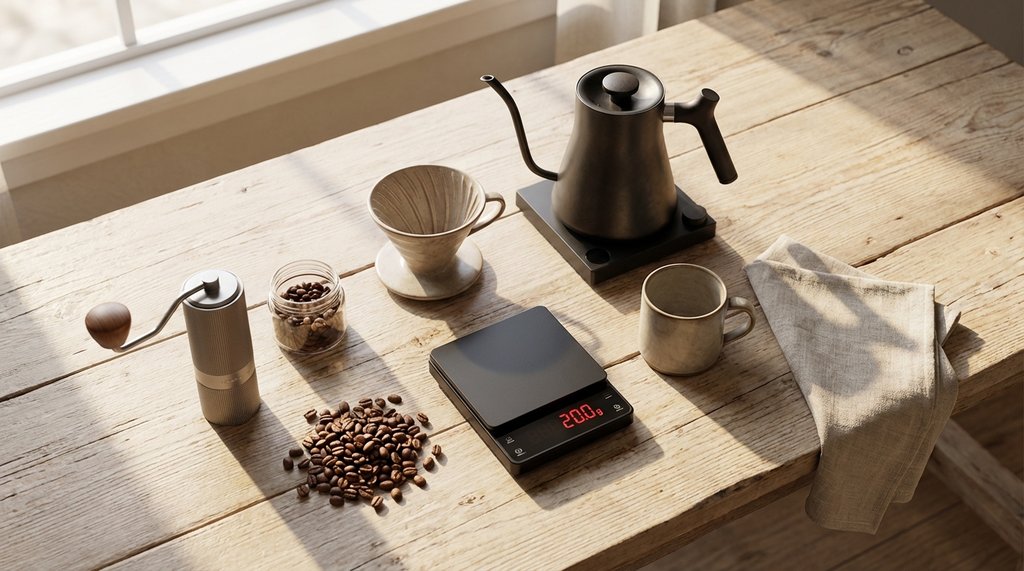
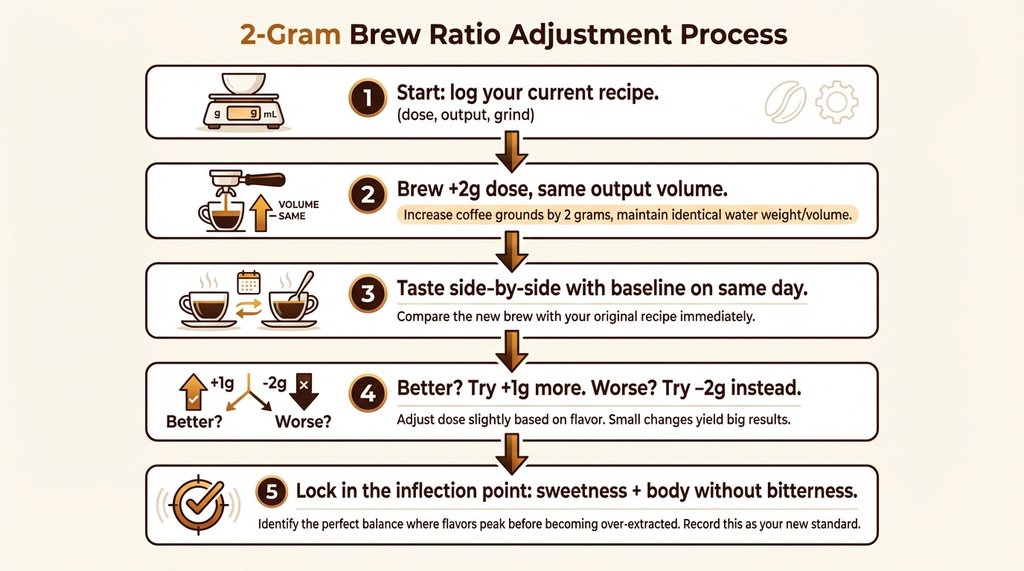
The actual mechanics of making the adjustment are boring and don’t require anything except a scale that reads to 0.1g (not 1g — the 0.1g resolution matters when you’re moving in 1-2g increments and need to repeat accurately). Start with your current recipe. Move dose up or down by exactly 2g, keep your output volume the same. Brew it back-to-back with your current recipe on the same day if possible, so your palate isn’t drifting between sessions. Don’t change anything else — not grind, not water temperature, not pour pattern.
If the 2g-up cup is better, try 1g up from there. If the 2g-down cup is better, try 1g down. You’re looking for the inflection point where sweetness and body are present without the extraction tipping into flatness, bitterness, or over-amplifying whatever flaw was already in the cup.
The reason 2g specifically is useful as a starting delta: on most V60-style brewers with an 18-20g dose range, 2g represents roughly a 10% change in dose, which produces a detectable but not dramatic shift in the cup. 1g is too small to taste reliably against session-to-session variance. 3g or more and you’re changing multiple things simultaneously (ratio, brew time, bed depth) and it gets harder to isolate what’s doing the work.
The longer I’ve been doing this, the more I think the home coffee conversation over-indexes on equipment and under-indexes on recipe variables. I spent probably eight months convinced my inconsistent cups were a grinder problem before I started tracking ratios systematically. Some of them were a grinder problem. But a lot of them were a ratio problem that a better grinder would have helped with but not solved, because better grind uniformity just means your extraction is more consistent — it doesn’t mean your ratio is right for the coffee you’re using.
The bag sitting on my counter right now is a Guatemalan Huehuetenango, light roast, washed. My current recipe is 19g / 290ml, which I landed on after four brews. The roaster’s suggested recipe on the bag is 20g / 300ml. One gram difference, same 1:15 ratio — and yet the two cups are noticeably different. Theirs, presumably dialed in on a more uniform commercial grinder, needs the full 20g. Mine, on a hand grinder with more fines, is cleaner and sweeter at 19g because I’m not over-extracting the fines into bitterness.
That’s the actual gap between a good cup and a great one at home. Not better beans, not a $400 grinder, not filtered water (though none of those hurt). It’s knowing that the recipe on the bag is a starting point calibrated to equipment you probably don’t have, and that two grams in either direction might be the difference between a cup you drink and a cup you remember.