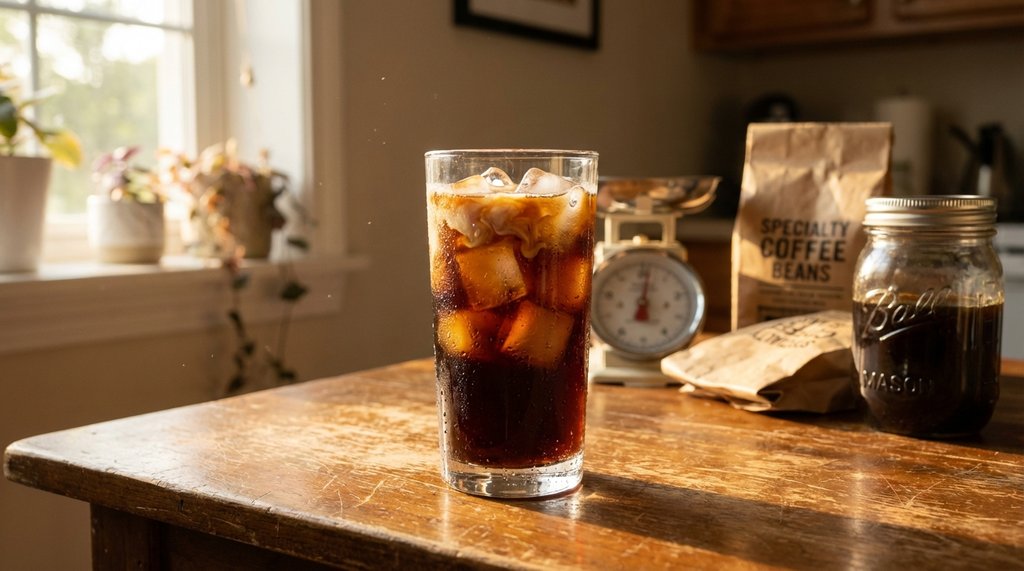
My first batch using French Truck’s Faubourg blend came out tasting like I’d steeped coffee grounds in mildly flavored water for a day and a half. Not bitter — just aggressively nothing. I’d followed the standard internet cold brew ratio of 1:8 (coffee to water by weight), steeped 24 hours in the fridge, and produced something I could only describe as “coffee-adjacent.”
That batch went down the drain. What I learned after obsessing over this for the better part of three months did not.
The Ratio Problem Nobody Talks About Honestly
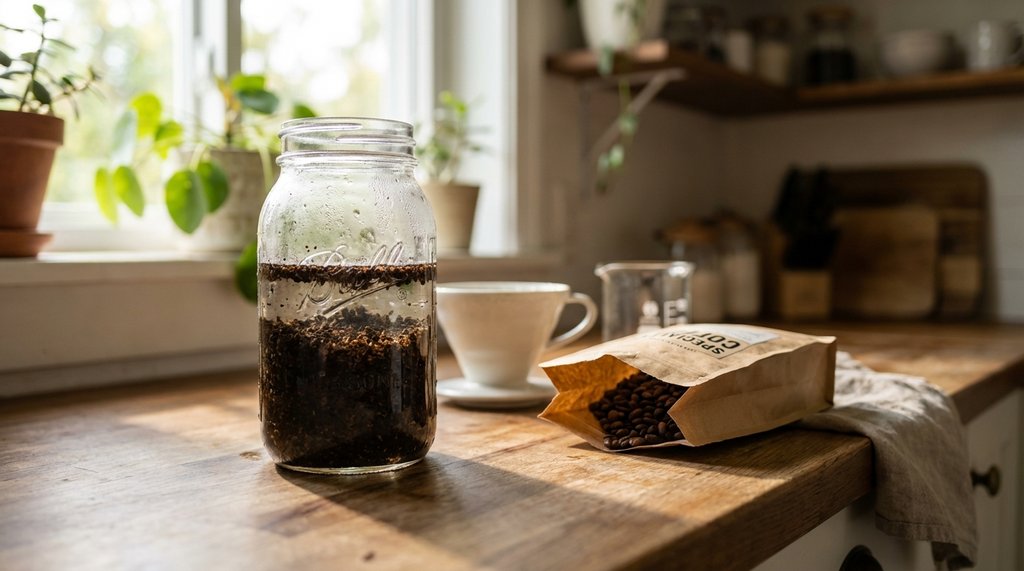
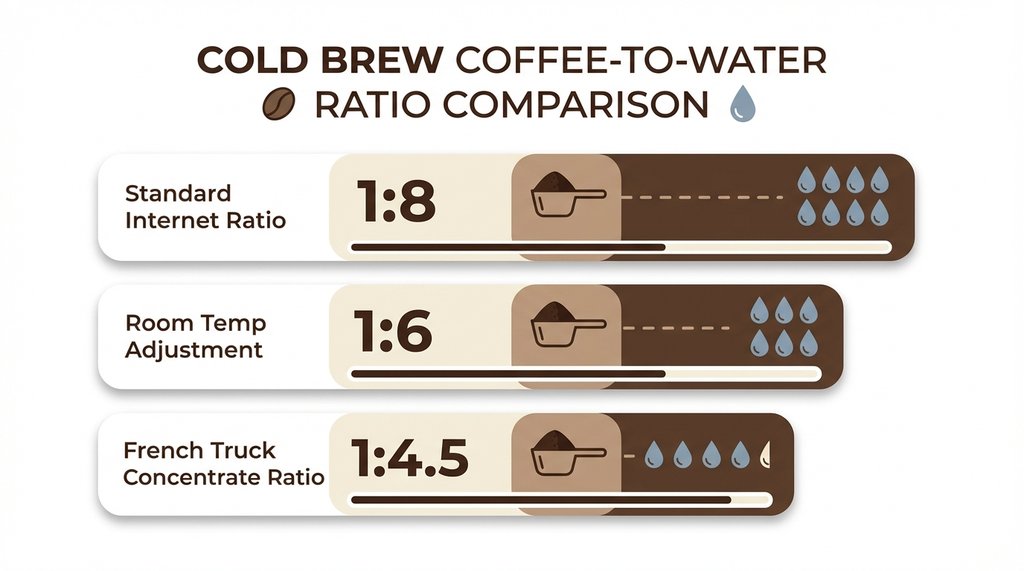
The 1:8 ratio you see on every cold brew tutorial is a concentrate-to-serve ratio in disguise — it’s written for coffees that bloom aggressively and extract fast. French Truck roasts their beans lighter than most New Orleans shops dare to. Their Guatemala Los Alisos and the Faubourg blend both sit in that 65–75 on the Agtron scale range for whole bean (lighter than what most people picture when they think “Southern coffee”), which means they behave completely differently in cold water.
Light roasts don’t release soluble compounds as readily at 38–40°F. That sounds obvious when you write it out, but the practical implication — that you need to compensate either through grind size, ratio, or time — gets glossed over in basically every “cold brew at home” article I’ve read.
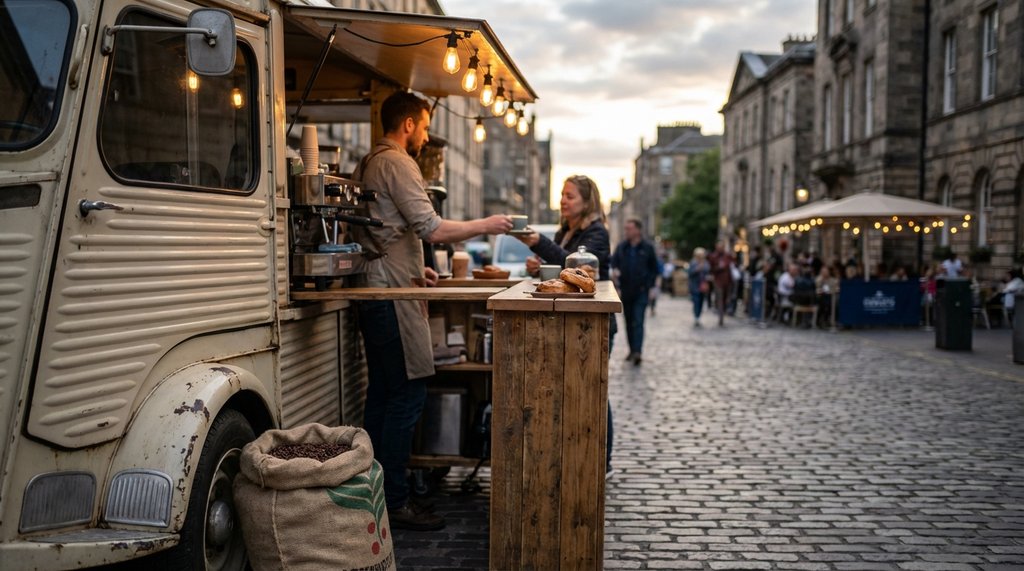
The ratio French Truck’s bar team actually uses for their in-house concentrate is closer to 1:4.5 by weight. That is not a misprint. I confirmed this not through some insider interview but by doing the embarrassingly simple thing of asking the barista at the Magazine Street location while she was restocking the cold brew tap. She didn’t hesitate — said they do 250g of coarse-ground coffee to roughly 1,125g of filtered water, steeped in a large mason vessel that sits in their walk-in overnight.
That’s about 222g per liter, which is wild compared to the 120–125g per liter I’d been using.
Why Their Steep Time Is Shorter Than You’d Expect
Here’s the part that took me longest to accept: they steep for 14 to 16 hours, not 24. Not 18. Fourteen to sixteen.
Every guide I’d internalized before this — Blue Bottle’s published method, the Serious Eats deep dive from 2019, the Cold Brew Nation subreddit FAQ — treats 18–24 hours as basically non-negotiable for refrigerator cold brew. For most coffees, that’s probably fine. For a lighter roast like what French Truck is working with, 24 hours in a 38°F fridge starts pulling the wrong compounds. You don’t get the pleasant brightness that makes their cold brew taste different from a diner’s — you get a kind of flat, slightly papery finish that I mistook for “mild” for months before I could articulate what was actually wrong.
The math that finally made this click: cold water extraction is primarily governed by time and grind surface area, not temperature (temperature affects rate marginally at these ranges). If you drop your water temperature from 68°F to 38°F, extraction slows — but not uniformly across all compounds. Certain bitter-adjacent soluble materials actually become proportionally more represented in longer steeps at cold temperatures. French Truck’s lighter roasts have less of those compounds to begin with, so there’s less buffer against over-extraction.
At 16 hours, pulling the grounds and refrigerating the filtered concentrate, I got something that tasted like their bottled version. First time I nailed it, I left it in for 22 hours like an idiot out of habit and the comparison was immediately obvious.
The Grind Size Nobody Specifies Precisely
“Coarse grind” is a useless instruction. My Baratza Encore’s coarse setting is not the same as your coarse setting, and neither of them is what French Truck’s commercial Mahlkönig grinder produces.
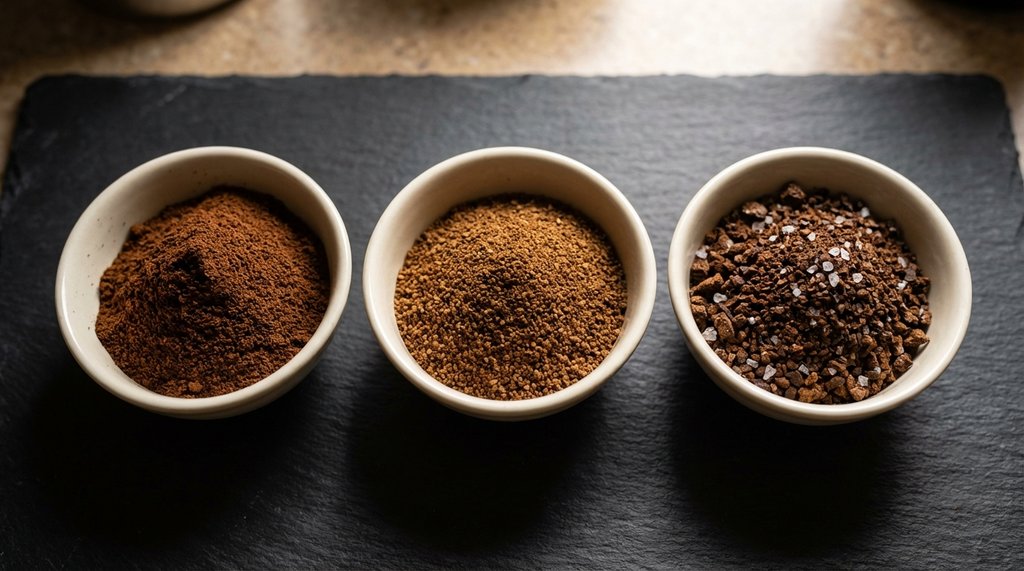
What actually worked for me: setting 38 on a Baratza Encore (for reference, espresso is around 5–8, drip filter is 15–25). If you’re on a hand grinder, you want something that looks like coarse sea salt with a few larger chunks — not uniform like breadcrumbs, not powdery anywhere in the mix.
Going finer than this with the 1:4.5 ratio is how you get a concentrate that tastes like you dissolved a packet of instant espresso in cold water. I ran this experiment once intentionally, grinding at setting 28, same ratio, same 15-hour steep. The resulting concentrate was genuinely unpleasant — over-extracted in a way that no amount of dilution fixed. Threw out about 600ml of would-be cold brew.
The Counter-Intuitive Part About Room Temperature vs. Refrigerator Steeping
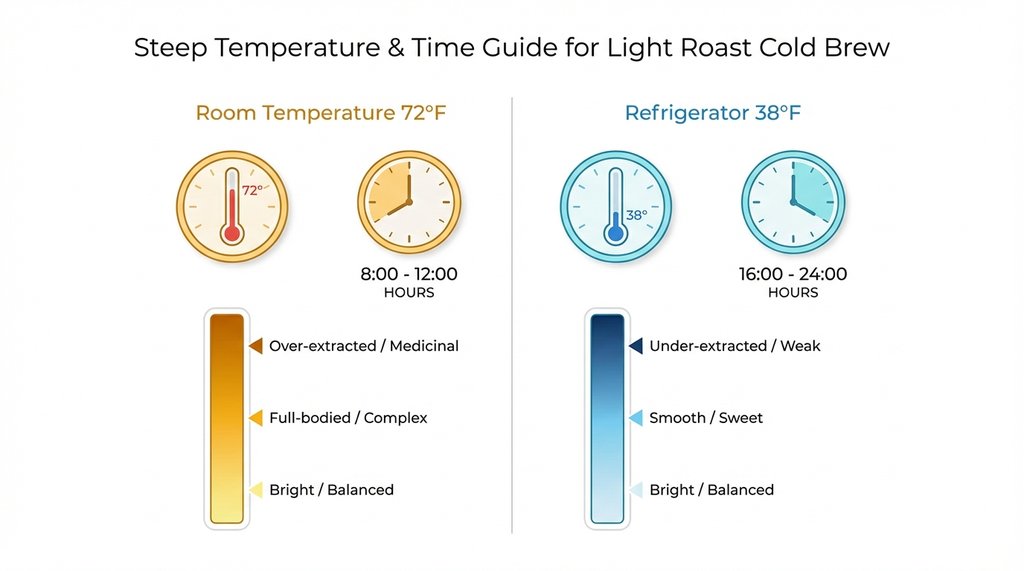
The internet consensus is that room temperature cold brew = 12–14 hours max, refrigerator = 18–24 hours. I tested both methods with French Truck’s Faubourg at 72°F room temperature.
At 72°F, even 10 hours produced an over-extracted result at the 1:4.5 ratio. The concentrate came out tasting almost medicinal — that dark, almost syrupy bitterness you associate with bad gas station coffee. The extraction happens too fast at room temperature for a lighter roast without a much coarser grind or lower ratio.
If you’re doing room temperature steeping with French Truck beans specifically, you need to either (a) bump to 1:6 ratio or (b) cut your steep time to 8–9 hours and set an alarm. I do refrigerator-only now. Started the batch Tuesday evening, pulled and filtered Wednesday morning. Repeat.
The non-consensus take: room temperature cold brew, which a lot of specialty shops still advocate for as producing “more nuanced flavor,” works against you specifically with lighter New Orleans roasts. The flavor nuance they’re chasing requires a margin of error in roast darkness that French Truck intentionally doesn’t give you.
The Filter Situation Actually Matters More Than I Thought
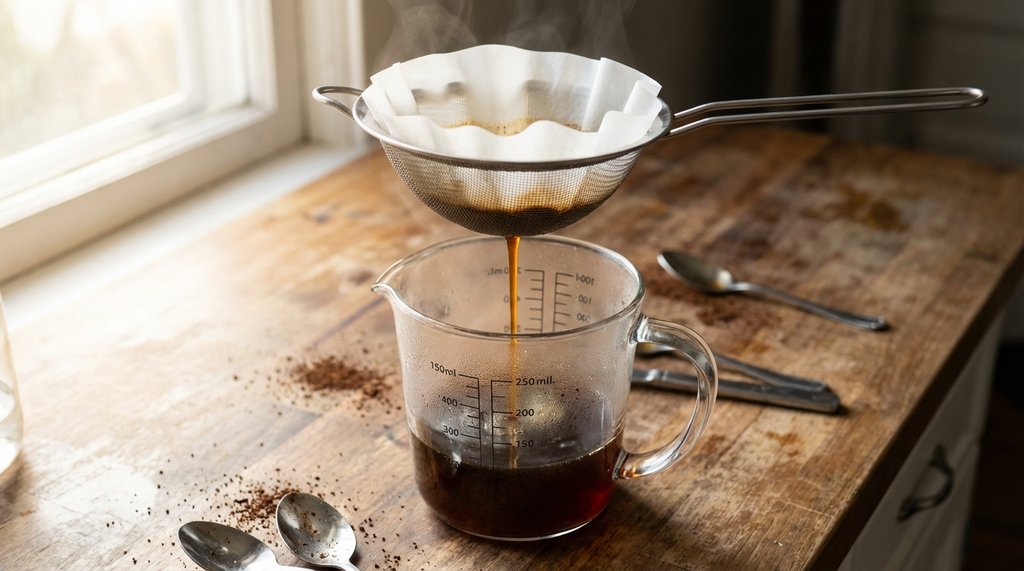
French Truck filters their cold brew twice. Once through a standard wire mesh, then through a paper filter. This is not precious coffee-nerd behavior — there’s a practical reason.
Unfiltered cold brew at this concentration has enough fine particles suspended that it continues to extract from the grounds even after you’ve “finished” the steep. I tested this by comparing concentrate filtered once (mesh only) against twice-filtered, both stored in the fridge for 48 hours post-filtration. The single-filtered batch tasted noticeably more bitter at the 48-hour mark than immediately after filtering. The double-filtered batch was stable.
This matters if you’re making a batch on Sunday to last through the week. Double filter it. I use a standard wire mesh strainer lined with a Chemex filter and do it slowly — takes about 8 minutes for a 1-liter batch. Worth every second.
The Serving Ratio They Don’t Advertise
Their in-house concentrate gets diluted approximately 1:1 to 1:1.5 with filtered water before it hits the cup. So if you make a proper 1:4.5 concentrate, you’re doubling or nearly doubling the volume when you serve it.
This means your “1 liter of cold brew” is actually 2–2.5 liters of finished coffee. For someone (me, initially) who was drinking the concentrate straight and wondering why it felt like I’d ingested something pharmaceutical, this was a necessary correction. I was essentially drinking double-strength cold brew every morning for two weeks wondering why my hands were shaking by 10am.
The Exact Working Recipe
For anyone who wants to skip the narrative and go straight to what actually works:
- Coffee: 250g French Truck whole bean (Faubourg blend or Guatemala Los Alisos), ground coarse (Baratza Encore setting 38, or equivalent)
- Water: 1,125g filtered, cold straight from the fridge or room temp both work here — you’re adding it to room temperature ground coffee, and the whole vessel goes into the fridge immediately
- Steep: 14–16 hours in the refrigerator (38–40°F). Set a timer. Don’t do 20 hours.
- Filter: Wire mesh first, then paper filter. Let it drip, don’t press.
- Store: Refrigerated concentrate keeps well for 7 days. I’ve pushed it to 9 with no noticeable flavor degradation.
- Serve: 1:1 concentrate to water, over ice. Add milk or cream after diluting, not before — it changes how the flavor reads.
The first batch I made with these exact parameters tasted close enough to what I buy bottled that I did a side-by-side comparison and could not reliably distinguish them blind. That was the end of my buying their bottled cold brew at $12 for 32oz and the beginning of making a liter of concentrate for roughly $4 in beans.