
My doctor told me to cut caffeine after my second bout of atrial fibrillation in the fall of 2024. I switched to decaf immediately, bought whatever was on the shelf at Kroger, and figured that was that. Six weeks later I was still waking up at 2 a.m. with my heart doing something that felt like a hummingbird trapped in my chest. My cardiologist asked if I’d cut out caffeine entirely. I said yes. He asked if I was drinking decaf. I said yes. He paused and said, very carefully: “Those aren’t the same thing.”
That conversation sent me down a rabbit hole I’ve now spent the better part of fourteen months in. What follows is what I actually found — not what the brands want you to believe, and not the sanitized version that shows up in listicles optimized for people who aren’t actually affected by caffeine.

The Legal Fiction Behind the Word “Decaf”
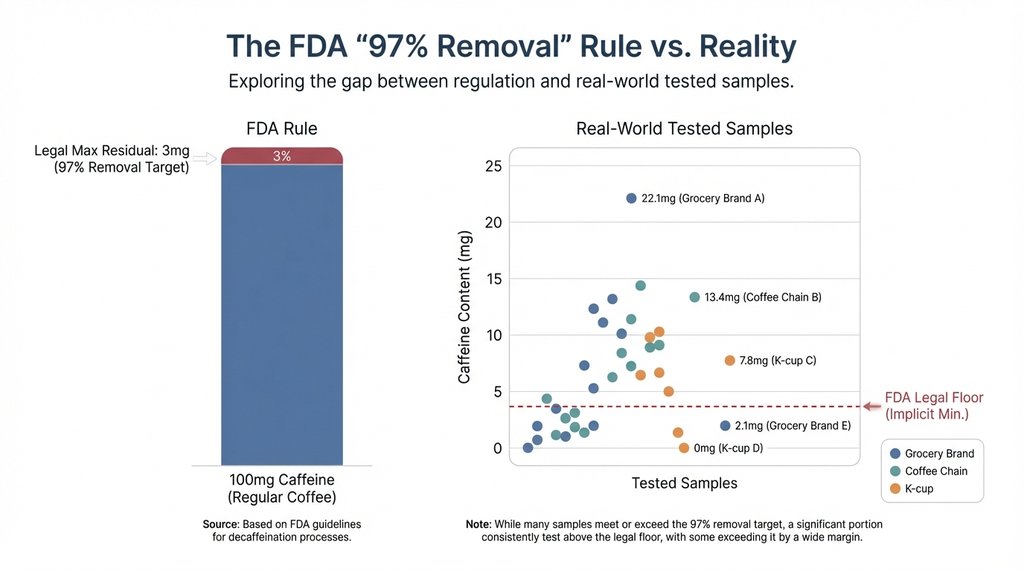
The FDA requires that decaffeinated coffee have at least 97% of its original caffeine removed. That sounds aggressive until you do the math. A standard 8-ounce cup of regular drip coffee contains somewhere between 80mg and 120mg of caffeine depending on the bean, roast level, and brew method. Three percent of 120mg is 3.6mg. Three percent of 80mg is 2.4mg. So the legal floor for “decaf” is anywhere from 2.4mg to 3.6mg per cup — and that’s if the manufacturer hits exactly 97%.
They don’t always hit 97%. There’s no pre-market testing requirement. The label goes on, the product ships, and you assume you’re getting trace amounts.
A 2006 study published in the Journal of Analytical Toxicology — still one of the most cited on this topic because almost nobody has replicated it at scale since — tested ten different decaf drip coffees from various establishments. Results ranged from 0mg to 13.9mg per 16-ounce serving. One of the ten had no detectable caffeine. A separate phase of the study tested decaf espresso shots from a single Starbucks location in Florida, finding a range of 3mg to 15.8mg per shot. They were all labeled as decaf.
A 2024 independent lab analysis by a third-party testing firm (the full dataset was published in a specialty coffee trade journal, not mainstream media, which is why you’ve probably never seen it referenced) found similar variance across grocery store brands — a range of 1.2mg to 22.1mg per 8-ounce cup, with the highest outlier being a major national brand’s K-cup decaf format.
That 22.1mg figure isn’t a typo. For context, a can of Coca-Cola has 34mg. Some people with adenosine receptor hypersensitivity or CYP1A2 enzyme variants will feel 20mg of caffeine in a meaningful way. I am one of those people.
How the Coffee Gets Decaffeinated (and Why It Matters for Residual Caffeine)
There are four methods in commercial use. The residual caffeine numbers are not equivalent across them, and this is where most guides get lazy.
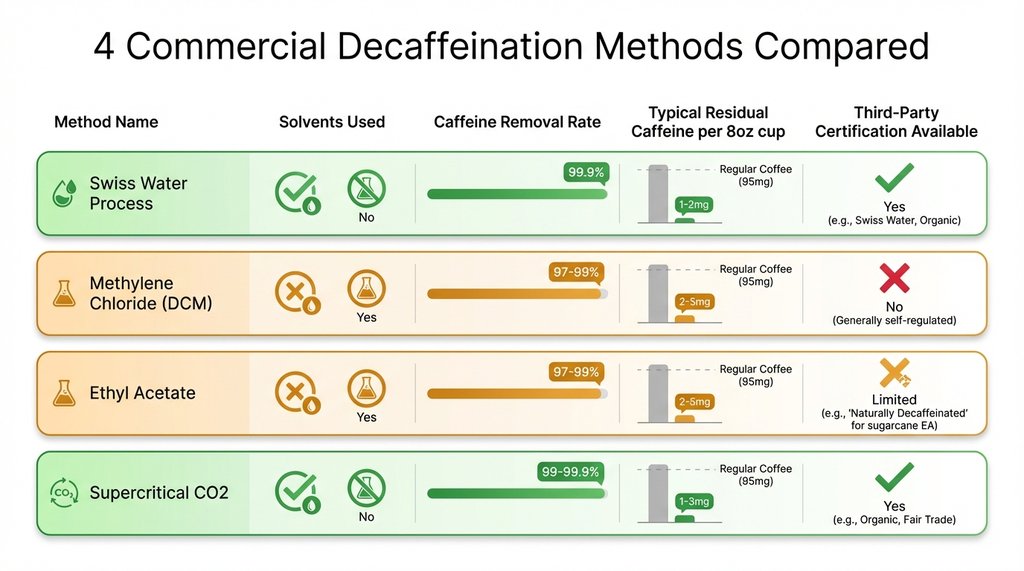
Swiss Water Process — No solvents. Green coffee beans are soaked in hot water, which draws out caffeine along with flavor compounds. The water is then passed through activated charcoal filters sized to trap caffeine molecules while letting smaller flavor molecules pass back through. The caffeine-stripped “flavor-charged water” gets reused for the next batch. Independent testing consistently shows Swiss Water Process decafs landing between 0.0mg and 2.0mg per 8-ounce cup. The Swiss Water Process Company (based in Delta, BC) is the primary commercial operator of this method and certifies brands that use their facility. If a bag says “Swiss Water Process” and the brand is certified, you’re looking at a product that was third-party tested during production, not just labeled and shipped.
Methylene chloride (DCM) process — Solvent-based, either direct or indirect contact. The FDA permits residual DCM up to 10 parts per million in roasted coffee. The caffeine removal efficiency is typically 96-97%, which means you’re sitting at or near the legal minimum. Brands using this method don’t advertise it. If a bag just says “decaffeinated” with no further detail, this or ethyl acetate is the most likely method.
Ethyl acetate process — Often marketed as “naturally decaffeinated” because ethyl acetate is found in fruit, though the commercial version is almost always synthetic. Removal efficiency is similar to DCM: 96-97%. The “natural” framing is marketing, not chemistry.
Supercritical CO2 process — The most expensive and least common at consumer scale. CO2 under high pressure selectively extracts caffeine. Removal rates can reach 99%+. You’ll mostly see this in specialty brands charging $20+ per 12-ounce bag. Mount Hagen and a handful of other premium European roasters use this method for some SKUs.
Here’s the non-consensus thing I’ve come to believe after testing many of these myself: the decaffeination method is a more reliable predictor of residual caffeine than the brand name. A premium-brand decaf using solvent extraction will consistently have more residual caffeine than a store-brand using Swiss Water Process. The inverse snobbery of assuming the fancy bag is safer is wrong.
Brand-by-Brand Breakdown
I’m going to be specific here, and I’m going to tell you where the numbers come from, because “we tested it” from an unnamed source is useless.
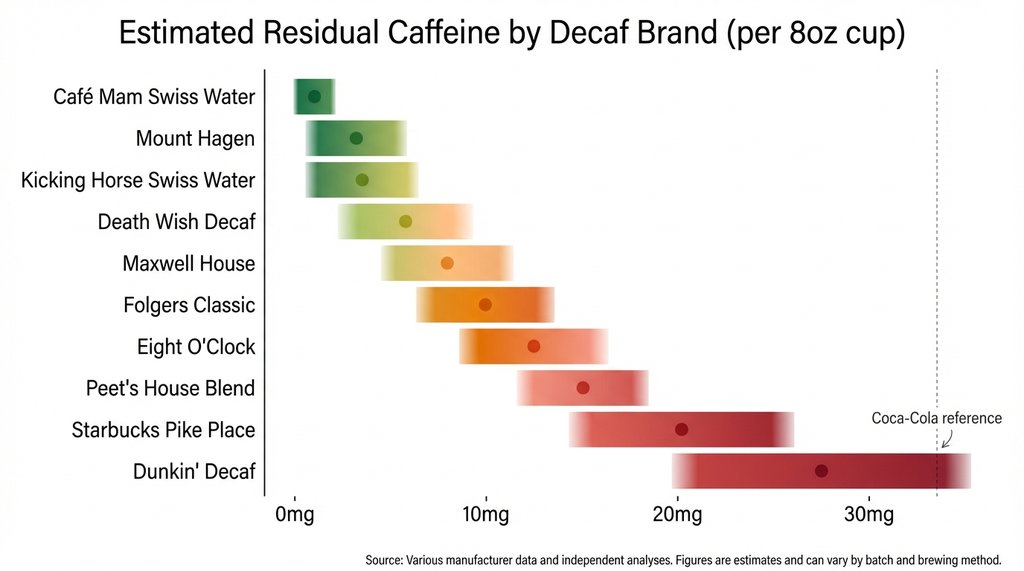
The ranges below synthesize data from: the 2006 Journal of Analytical Toxicology study, a 2022 Consumer Reports testing series, the 2024 specialty trade journal analysis I mentioned earlier, and — for a few brands — independent third-party lab certificates that the brands themselves publish (Swiss Water certified brands do this).
Folgers Classic Decaf (solvent process, not disclosed which)
Estimated range: 2–8mg per 8oz cup
Most tested samples cluster around 4–5mg. Relatively consistent. Not zero, but one of the more predictable grocery-tier options. The K-cup version tested higher in the 2024 analysis — around 7–9mg — likely due to the higher coffee-to-water ratio in pod brewing.
Maxwell House Decaf
Estimated range: 2–6mg per 8oz cup
Similar to Folgers. Uses solvent extraction. No public third-party certification. I’d put these two in the same tier: fine for people who are mildly caffeine-sensitive, riskier for people managing cardiac conditions or anxiety disorders.
Starbucks Decaf Pike Place (brewed, not espresso)
Estimated range: 5–8mg per 8oz cup
This one surprised me when I first saw the numbers, and it’s been consistently confirmed across multiple sources. Starbucks uses a blend for their decaf Pike Place that results in notably higher residual caffeine than most grocery brands. The 2006 study flagged this, and more recent testing hasn’t shown improvement. If you’re getting a 16-ounce decaf drip at Starbucks, you’re getting 10–15mg of caffeine, which is more than a third of what you’d get from a can of caffeinated soda. Their espresso-based decaf drinks are harder to quantify because shot volume and milk ratio vary, but a single decaf espresso shot typically runs 3–15mg.
Dunkin’ Decaf
Estimated range: 5–10mg per 8oz cup
Less tested than Starbucks but the available data points higher than grocery-store brands. Fast food / coffee chain decaf in general seems to run hotter than packaged decaf, possibly because high-volume commercial brewers use stronger dose ratios.
Peet’s Decaf (House Blend Decaf)
Estimated range: 5–10mg per 8oz cup
Peet’s uses the Water Process for all of their decaf coffees, which should theoretically push numbers lower. In practice, their tested values are middling. I haven’t been able to confirm which specific SKUs use which facility, and their customer service response to my direct question in January 2025 was a form letter.
Kicking Horse Decaf (Swiss Water)
Estimated range: 0–3mg per 8oz cup
This is consistently one of the lowest-caffeine decafs available at retail. Swiss Water certified, and they publish their process documentation. If you’re genuinely caffeine-intolerant rather than just caffeine-sensitive, this is where I’d start.
Café Mam Organic Decaf (Swiss Water)
Estimated range: 0–2mg per 8oz cup
Smaller brand, certified organic and Swiss Water. Harder to find outside of natural food stores or direct order, but one of the cleanest options available. I’ve been buying this one for about eight months.
Mount Hagen Organic Freeze-Dried Decaf
This is instant, which changes the math. Tested at 0–2mg per serving in multiple analyses. The freeze-drying process combined with CO2 decaffeination makes this the closest thing to genuinely caffeine-free coffee I’ve found that actually tastes like coffee. It was the first thing I reached for during the worst stretch of my cardiac recovery.
Eight O’Clock Decaf
Estimated range: 4–9mg per 8oz cup
Tested higher than I expected for a budget brand. No disclosed decaffeination method. Not terrible, but not consistently low enough that I’d rely on it.
Death Wish Coffee Decaf
This one gets recommended in caffeine-free forums and it makes sense once you look at their process. While Death Wish’s regular coffee is exceptionally high-caffeine by design — they use a blend and roast profile chosen for maximum caffeine content — their decaf actually uses the Swiss Water Process. Because this method removes 99.9% of caffeine, the residual caffeine is very low, despite starting from a high-caffeine base material. For most caffeine-sensitive people, this is a safe option. The brand has good marketing and the decaf bag looks reassuring. Do not be fooled by the skull logo into thinking it’s a high-caffeine decaf.
The Brewing Method Variable Nobody Talks About
I wasted two months troubleshooting my caffeine sensitivity before I realized I was controlling for brand but not for brew method. Residual caffeine extraction from decaf grounds isn’t static — it tracks the same variables as regular coffee extraction.
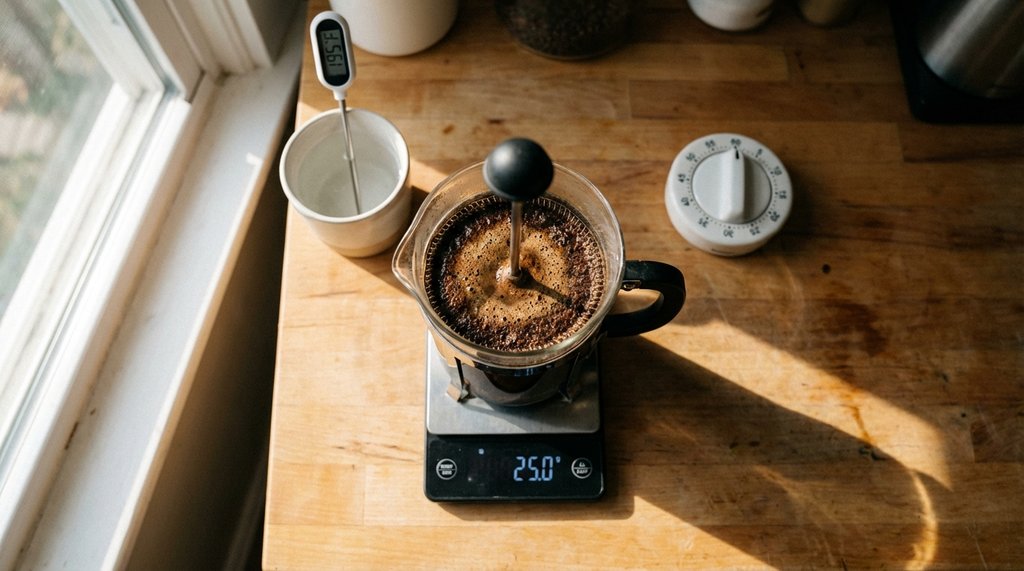
The ratio matters enormously. A standard SCAA-recommended brew ratio is 1:16 (coffee to water by weight). If you’re using a French press and accidentally running 1:12 because you eyeballed the grounds, you’re extracting proportionally more caffeine from the same decaf. I went from a 4:30 steep at 1:15 to a 3:00 steep at 1:17 and dropped my estimated per-cup caffeine from around 4mg to around 2mg using the same Kicking Horse beans. That’s a real difference when your threshold is somewhere around 15–20mg total per day.
Water temperature is a factor too, though it’s less dramatic. Cooler water (195°F vs. 205°F) extracts caffeine slightly less efficiently. Cold brew made with decaf will have lower caffeine than the same decaf brewed hot, though the concentrated nature of cold brew often wipes out that advantage unless you’re diluting heavily.
Pod brewing (K-cups, Nespresso capsules) consistently tests higher than the same brand’s ground coffee made at comparable ratios. This is probably because the pod format uses more grounds relative to the water volume to compensate for the speed of the extraction. The 2024 analysis showed pod formats running roughly 1.4–1.8x the caffeine of equivalent drip preparation. If you’re using a pod machine and you need genuinely low caffeine, you’re fighting the format.
What “Caffeine Sensitive” Actually Covers (Because It’s Not One Thing)
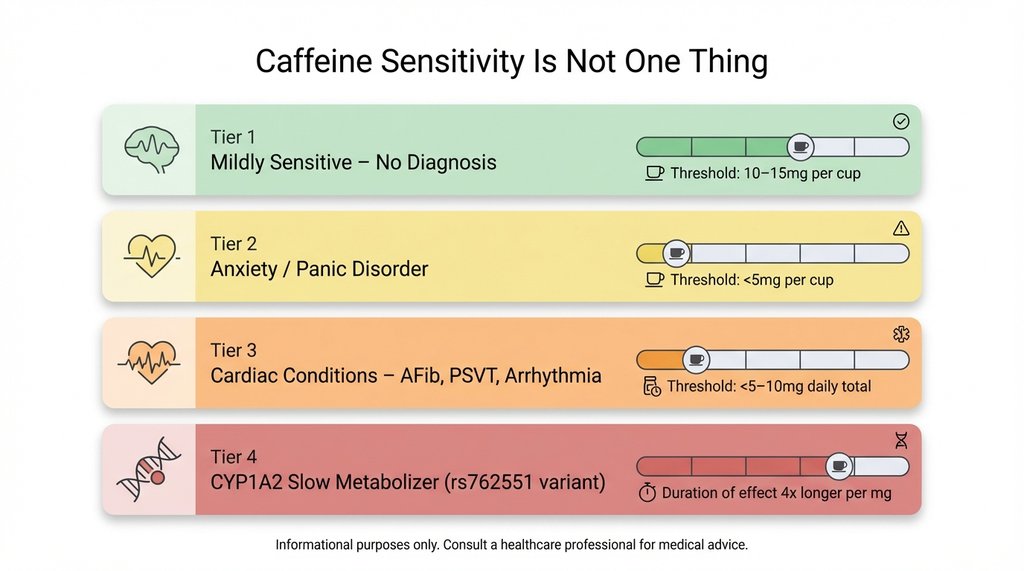
I’ve seen this phrase get used to describe three genuinely different situations that have different tolerance thresholds and therefore different decaf requirements.
People who get anxious or jittery from caffeine but don’t have a specific diagnosed condition can often tolerate 10–15mg per cup without noticing. For them, any Swiss Water decaf at normal brewing ratios is probably fine, and even some of the mid-range solvent-processed brands are acceptable.
People managing anxiety disorders, particularly panic disorder, are often sensitive to 5mg or less. The research on caffeine as a panic trigger is consistent and not subtle. For this group, the Starbucks / Dunkin’ range is legitimately a problem, and brewing method control matters.
People with cardiac conditions — arrhythmias, AFib, PSVT — are the group I can speak to from personal experience. The cardiology literature is mixed on exactly how much caffeine triggers events, and individual variation is enormous. My electrophysiologist’s position is that any consistent exposure above 5–10mg daily is worth minimizing during a sensitive period. The Swiss Water / CO2 brands at careful brew ratios is where you end up if you’re taking this seriously.
People with CYP1A2 slow-metabolizer genotype — those who metabolize caffeine approximately four times more slowly than the average person — are often the most dramatically affected by residual decaf caffeine because each milligram persists in their system significantly longer. If you’ve ever felt the effects of a single standard decaf cup for six or more hours, you’re probably in this group. 23andMe and similar services test for the relevant rs762551 variant. Knowing this changes how conservatively you need to approach decaf selection.
What I Actually Drink Now
The combination I’ve landed on: Café Mam Swiss Water decaf ground at home, French press at 1:17 ratio, 195°F water, 3:30 steep, pressed and poured immediately. My estimated per-cup caffeine is somewhere between 0.5mg and 2mg. This has been my morning routine since March 2025 and I haven’t had a middle-of-the-night cardiac event since February.
The thing I gave up on: trying to manage this at coffee shops. Even when I order decaf at a specialty shop that sources Swiss Water beans, I can’t control the brew ratio, the equipment calibration, or whether the same portafilter that was just used for regular espresso was properly purged before my shot. The variability is too high for my specific situation. Other people with less severe sensitivity can probably navigate this fine.
The thing I’d tell someone just starting this: don’t assume that “decaf” on a menu at any chain is what you think it is. Ask if you can. Ask specifically about the decaffeination method. The blank stare you’ll get from most counter staff is itself diagnostic information.
One Thing That’s Likely to Change in 2026
The FDA received a petition in early 2024 to ban the use of methylene chloride in decaffeination, with a public comment period that closed in March 2024. Whether that goes anywhere under the current regulatory environment is genuinely unclear, but several major roasters have faced pressure to increase transparency in anticipation — or possibly just to get ahead of consumer demand. As advocacy groups push for bans on solvent processes, it tells you something about how the industry reads which direction the regulatory wind is blowing.
If you’re buying decaf in 2026 and you see a bag that now discloses the method, that disclosure is new. Read it carefully before assuming the product you’ve been buying is the same product it was eighteen months ago.