

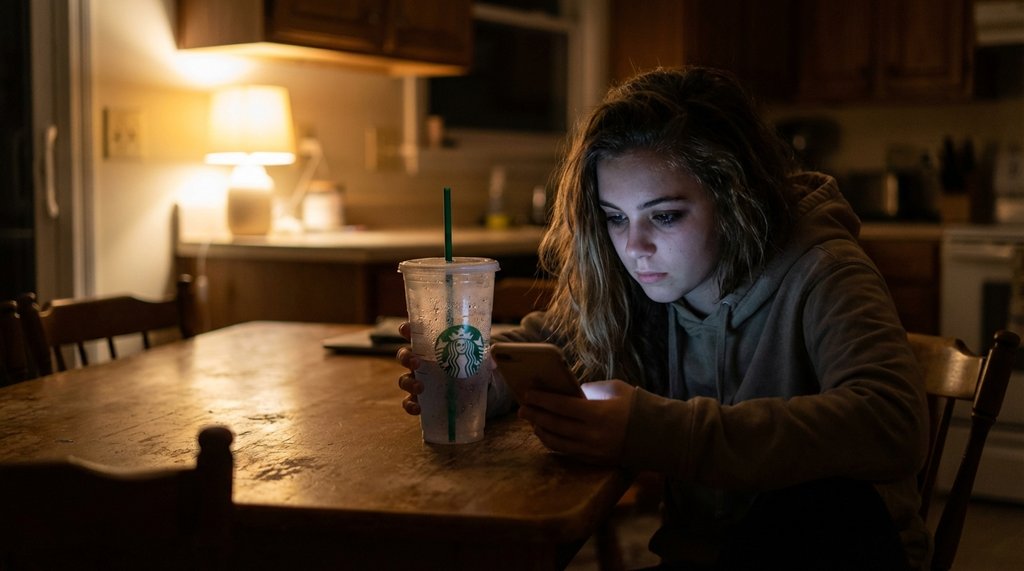
My daughter came home last September with a Starbucks cup that, I later discovered, contained 300 milligrams of caffeine. She was 14. She’d ordered an iced venti Caramel Macchiato with an extra shot “because everyone does it,” and then couldn’t fall asleep until 2:30 in the morning before a Wednesday. That one incident sent me down a research rabbit hole I’ve been living in for the better part of a year, and what I found was significantly more complicated—and more alarming—than the breezy “a little coffee is fine for teenagers” line that pediatricians tend to offer in 10-minute appointments.
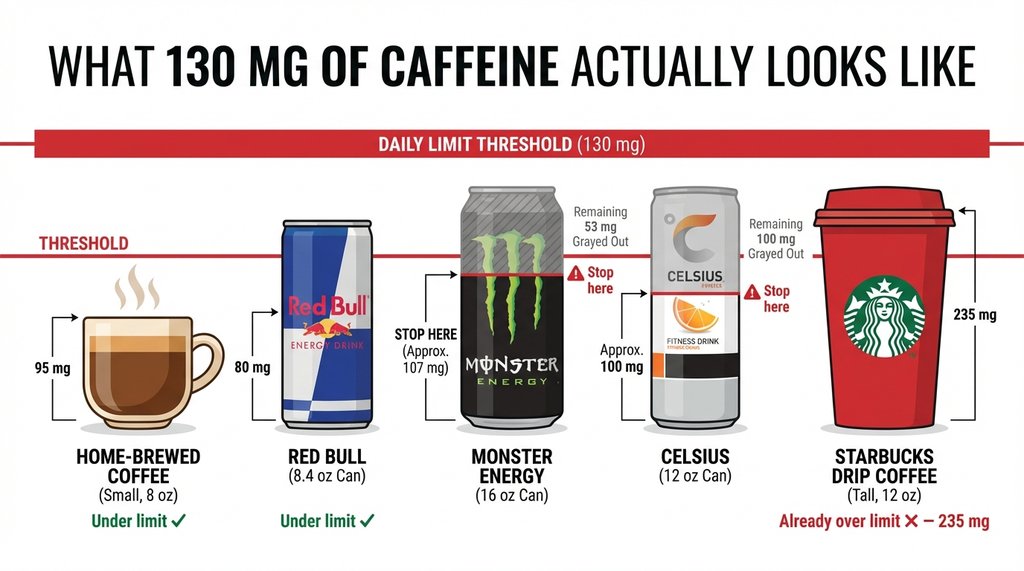
The official threshold for adolescents ages 12 and up is 2.5 mg of caffeine per kilogram of body weight per day. That’s the figure Health Canada uses, and it’s cited consistently across most peer-reviewed literature on adolescent caffeine metabolism. For an average 14-year-old weighing around 52 kg, that works out to roughly 130 mg per day—maximum. Not average. Maximum. The American Academy of Pediatrics hasn’t published a formal upper limit for teens (their official position is to discourage caffeine use entirely for under-18s, which is medically defensible but practically useless for parents of actual teenagers), but 100 mg/day shows up repeatedly in adolescent sports medicine literature as the conservative safe ceiling.
Here’s where the “one cup of coffee” rule that everyone casually repeats falls apart: coffee is not a standardized product, and the variance is wild. A tall (12 oz) Pike Place at Starbucks runs about 235 mg. A medium drip from your independent local café—the kind of place that takes its roasting seriously—can land anywhere between 150 and 400 mg depending on brew ratio and roast origin. A standard 8 oz home-brewed Folgers clocks in around 95 mg. When a pediatrician says “a cup of coffee is fine,” they’re almost certainly picturing that last scenario. Your 14-year-old is almost certainly not drinking that.

The energy drink situation is its own category of problem, and I don’t think parents are tracking it accurately. Monster Energy (16 oz can, the standard one that every high schooler treats like a water bottle) contains 160 mg. Bang Energy, which is popular with teen athletes because it’s positioned as a fitness product, contains 300 mg per 16 oz can. Prime Energy—the Logan Paul brand that became ubiquitous in middle and high schools over the past couple of years—contains 200 mg in a 12 oz can. A kid who drinks one Bang before afternoon soccer practice has already exceeded the safe daily threshold before dinner, before any coffee, before the chocolate bar at the vending machine.
That last one matters more than people realize. A standard 1.5 oz dark chocolate bar contains 25–35 mg of caffeine. A grande hot chocolate from Starbucks contains around 25 mg. Certain headache medications—including some over-the-counter formulations like Excedrin—contain 65 mg per pill. A kid who takes two Excedrin pills for a tension headache, eats a dark chocolate bar at lunch, and has a single can of Red Bull (80 mg) after school has consumed approximately 240 mg before dinner, without anyone—including the kid—identifying any of those as a “caffeine decision.”
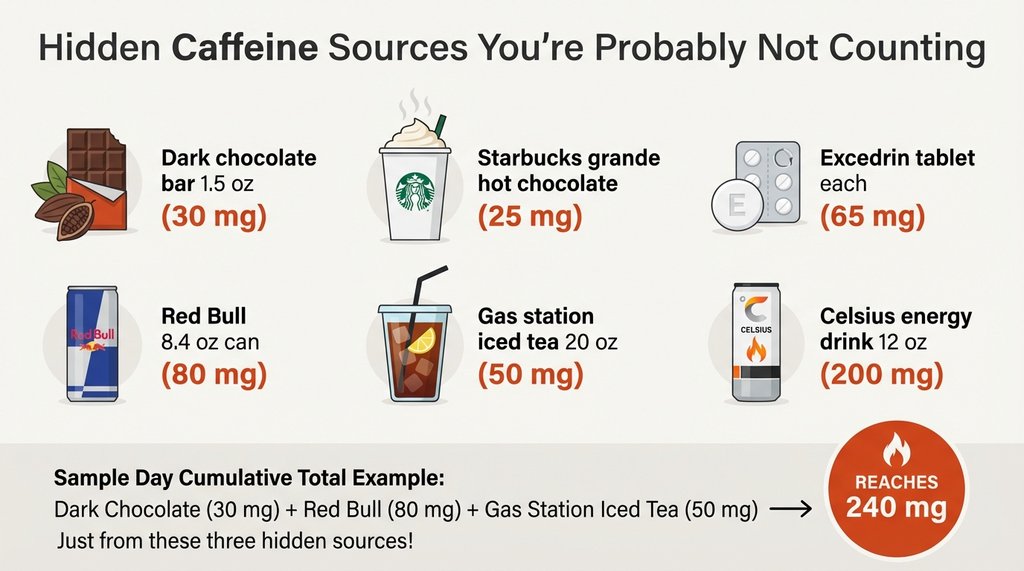
I tracked my daughter’s actual daily caffeine intake across two weeks in November using a spreadsheet and product labels. The median was 148 mg. There was one day at 312 mg that she had zero awareness of, because it was distributed across a Celsius (200 mg, which she treated as a healthier alternative to Monster), a dark chocolate bar, and a gas station iced tea. The only day she came in under 100 mg was a Sunday when she didn’t leave the house.
The sleep disruption is the issue I’d push hardest on, and specifically the way it intersects with where 14-year-olds are biologically. Caffeine’s half-life in adults averages 5–6 hours. In adolescents, the research is genuinely less settled—some studies suggest slower metabolism during peak growth periods due to hepatic enzyme competition with the sex hormones surging through the system—but 6–7 hours is a conservative estimate. That means a 160 mg Monster consumed at 4 PM still has roughly 80 mg active in the bloodstream at 10 PM, and 40 mg active at 4 AM. Against a backdrop where adolescents already experience a biological circadian phase delay (their melatonin onset genuinely shifts later at puberty, which is why your 14-year-old isn’t tired at 9:30 PM), adding caffeine on top of that creates a compounding problem. The recommended sleep for 14-year-olds is 8–10 hours. The actual national average is closer to 6.5–7 hours. The caffeine isn’t the only cause of that gap, but it’s a reliable contributor.

There’s also a bone density angle that deserves more attention than it gets in popular parenting coverage. Caffeine increases urinary calcium excretion—the mechanism is well-documented, and it’s one of the reasons coffee consumption is associated with lower bone density in adults who don’t compensate with dietary calcium. At 14, your child is in the middle of the most intense bone-accrual period of their life. Roughly 40% of peak bone mass is laid down during adolescence. The research on whether moderate caffeine intake meaningfully impacts this in otherwise calcium-sufficient teenagers is genuinely mixed—a 2001 study in the American Journal of Clinical Nutrition found that women with high caffeine intake and low calcium intake had measurably lower bone density, but that the effect was attenuated in women meeting calcium recommendations. The takeaway isn’t “caffeine destroys bones.” It’s “caffeine plus inadequate calcium intake during peak bone development is a combination worth taking seriously,” and most teenagers are not meeting calcium recommendations anyway.
The non-consensus position I’ve landed on after going through the research: the standard advice to “limit your teen to one coffee” is not wrong exactly, but it’s wrong in its framing. It treats coffee as the threat and ignores everything else, which means parents who implement it feel like they’ve handled the issue while their kid is still pulling 200+ mg from energy drinks and pre-workout products and functional beverages that have successfully repositioned themselves as “wellness.” The actual intervention that works is total daily milligram tracking, not product-category restriction.
Practically, here’s what 100 mg looks like in real products your 14-year-old is likely to encounter: one tall Starbucks drip coffee (slightly over at 235 mg—so actually, one tall Starbucks drip coffee already blows the conservative limit). One and a quarter Red Bulls. About two-thirds of a standard Monster. Half a Celsius. If the goal is staying under 130 mg (the 2.5 mg/kg ceiling for a ~52 kg teen), you’re looking at the equivalent of one small home-brewed coffee or one Red Bull, nothing else, on days when those are consumed.
The conversation I eventually had with my daughter wasn’t about banning coffee. It was about showing her the spreadsheet. She looked at the 312 mg day and said “I didn’t even feel that much more awake.” That’s actually the point—at higher doses, the perceived alertness benefit doesn’t scale linearly, but the cardiovascular load and sleep interference do. She’s not abstaining. She’s now reading labels and has a rough sense of her running daily total. That’s the realistic outcome, and it’s a better one than a rule she’ll circumvent the moment she’s not at home.
The one hard limit I’d hold regardless of body weight or tolerance: no caffeine after 3 PM on school nights. Given typical adolescent sleep timing and caffeine half-life, anything consumed after 3 PM is almost certainly still active when a 14-year-old needs to be asleep. That’s the rule that actually correlates with sleep quality, and it’s the one that makes the biggest practical difference.