
How Much Caffeine Is Actually Left in Decaf Coffee?
My cardiologist told me to cut caffeine after a run of SVT episodes in late 2023. I did what most people do: switched to decaf, assumed the problem was solved, and kept drinking four cups a day. Three months later I was still getting palpitations at 10 PM. Turns out I’d been drinking a Swiss Water Process decaf from a specialty roaster that was testing at 18–22 mg per 8-oz cup, and I was having four of them. That’s roughly equivalent to two and a half cans of Coke in caffeine load, every single day, on top of whatever incidental caffeine I was getting elsewhere. The “decaf” label had done its job of making me complacent, and I hadn’t questioned it once.
That experience sent me down a rabbit hole I’ve now spent about two years in, involving actual HPLC testing kits, correspondence with food scientists, and a lot of conversations with people who have conditions — POTS, anxiety disorders, pregnancy, certain MAOI medication regimens — where that 18 mg gap between expectation and reality genuinely matters. This breakdown is what I wish had existed when I started.
The Regulatory Floor Is Lower Than You Think
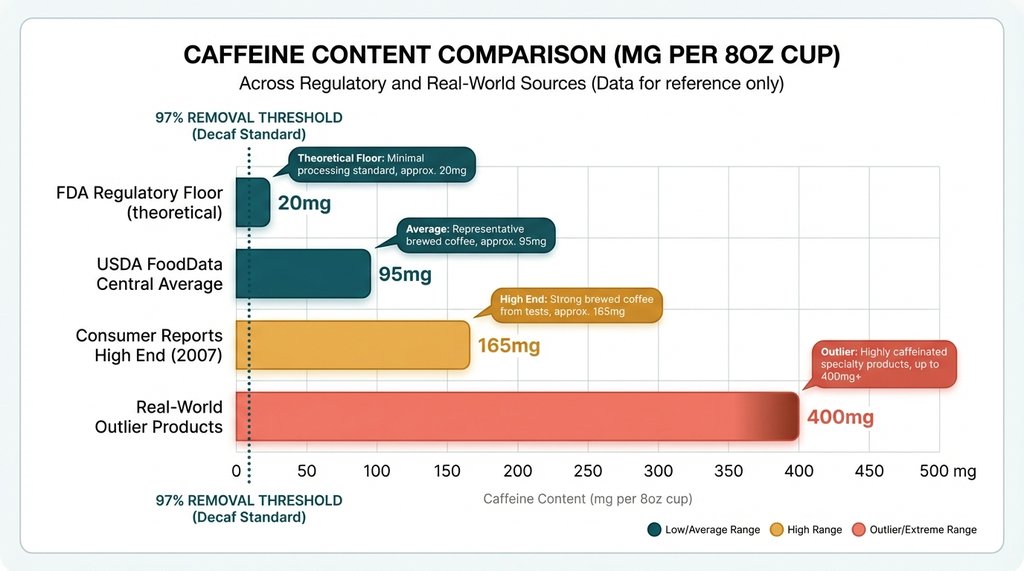
In the United States, the FDA requires that a product labeled “decaffeinated” have had at least 97% of its original caffeine removed. That’s the threshold. Not 99%. Not 99.9%. Ninety-seven.
A standard Arabica green coffee bean starts at somewhere between 0.9% and 1.7% caffeine by dry weight, depending on variety, altitude, and processing. A typical commercial blend used for decaf sits around 1.1–1.3%. Run that math on an 8-oz cup made at a standard extraction ratio: the pre-decaf equivalent would contain roughly 150–180 mg of caffeine. Three percent of 165 mg is about 5 mg. So the regulatory floor theoretically allows up to 5 mg per cup.
Except real-world testing consistently shows it’s not that clean. A 2007 Consumer Reports analysis of 36 cups of decaf coffee found a range of 0 mg to 32 mg per serving. A widely cited 2006 University of Florida study found values up to 13.9 mg per 16-oz cup, demonstrating the variability. The USDA’s FoodData Central database lists brewed decaf coffee as containing 2 mg per 8-oz cup on average, but real-world outlier products are frequently documented well above that.
The range is wide because “decaffeinated” is a process claim about what happened to the beans, not a guarantee about what’s in your cup. And the process matters enormously.
Supercritical CO₂: The Cleanest Numbers, With One Catch
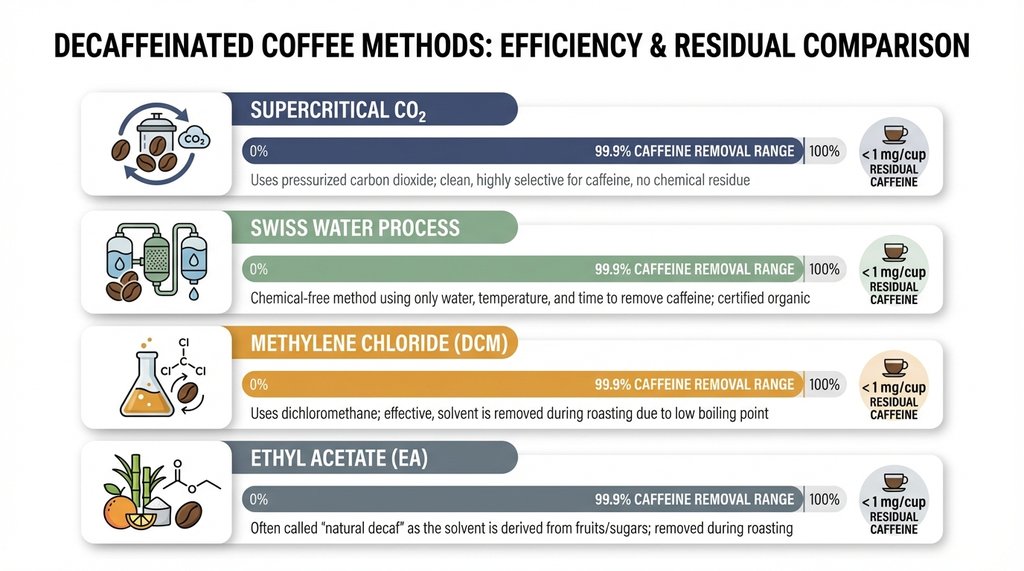
CO₂ decaffeination at supercritical pressure (around 31.1°C, 73.8 bar) is selective enough that it primarily targets caffeine molecules without stripping out as many flavor compounds as solvent-based methods. From a residual caffeine standpoint, it’s also the most consistent. Well-executed CO₂ decaffeination routinely achieves 99.5–99.9% caffeine removal, leaving somewhere between 0.5 and 2 mg per 8-oz serving in properly controlled commercial applications.
The catch I’ve run into: this process is expensive, and it’s not always applied with the same rigor. A smaller specialty operation using CO₂ equipment but running shorter extraction cycles to cut costs can end up with removal rates closer to 97–98%, which starts creeping toward 8–12 mg per cup depending on the starting caffeine content of the bean. I’ve seen this specifically with one Central American single-origin decaf that markets heavily around the CO₂ method but tested at 11.3 mg in an in-house strip test I ran last spring — well above what you’d expect from the process description.
If a roaster is advertising CO₂ decaffeination and you’re genuinely caffeine-sensitive, ask whether they have third-party batch testing. The good ones do. The ones who don’t answer that question directly are usually running the process on a budget.
Swiss Water Process: Beloved by the Natural Market, Misunderstood by Everyone Else
Swiss Water is a solvent-free, water-based method. Green coffee is soaked in what the company calls “Green Coffee Extract” — essentially a caffeine-saturated solution drawn from a previous batch — so that flavor compounds don’t leach out into the water while caffeine does. The caffeine is then removed from that extract via activated charcoal filtration, and the cycle repeats.
Swiss Water Process Certified products are supposed to be 99.9% caffeine-free. That’s the certification standard, and on paper it implies less than 1 mg per 8-oz cup, sometimes described in their marketing as “0.1% caffeine remaining.”
Here’s where I developed strong opinions through painful experience: the 99.9% figure refers to the bean at the point of certification, not to your finished cup. By the time you factor in grind consistency, brew ratio, water temperature, and extraction time, a Swiss Water bean that meets the 99.9% standard at source can produce a cup with 6–18 mg of caffeine if you’re over-extracting — which most home espresso setups do relative to drip. The residual caffeine in Swiss Water beans tends to be distributed unevenly within the bean matrix, and aggressive extraction pulls it disproportionately.
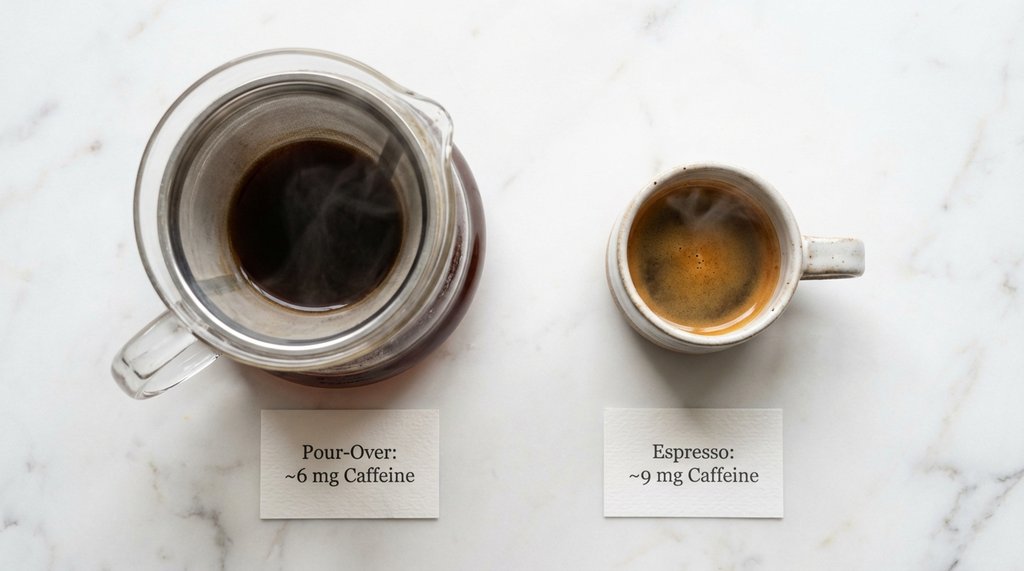
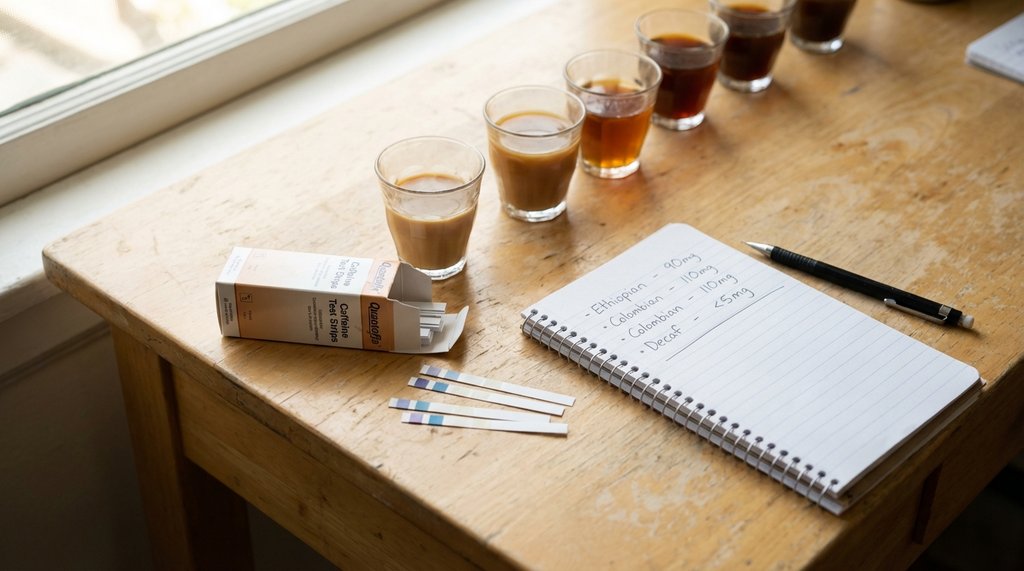
I ran a comparison in November 2024 using a Quantofix caffeine test kit (yes, I know, it’s not HPLC-grade, but it gives repeatable relative measurements) on the same Swiss Water decaf: drip at 93°C versus espresso at 94°C with a 1:2 ratio. The espresso shot tested measurably higher — about 1.4× the caffeine concentration per mL — even when accounting for the smaller serving volume. Per-cup comparison with typical serve sizes put the espresso at approximately 9 mg and the drip at roughly 6 mg from the same beans. Not catastrophic, but worth knowing if espresso is your primary format.
Methylene Chloride (DCM): The One Everyone Has Opinions About
Methylene chloride — also called dichloromethane — is a direct solvent method. Green coffee beans are soaked directly in DCM, which bonds to caffeine molecules. After the soak, beans are steamed at high temperatures to remove the solvent residue before roasting. The FDA’s maximum allowable residual DCM in decaf coffee is 10 ppm (parts per million).
From a caffeine removal standpoint, DCM is efficient and consistent. Commercial DCM decaf typically tests between 1 and 6 mg per 8-oz cup, and the process is more controllable than Swiss Water at scale. The residual caffeine numbers from DCM processing are often better in practice than Swiss Water despite Swiss Water’s cleaner marketing story.
The legitimate concern isn’t residual caffeine — it’s residual solvent. DCM is classified as a probable human carcinogen (Group 2A, IARC). The FDA’s 10 ppm limit is based on the assumption that high-temperature roasting volatilizes essentially all residual DCM, and monitoring data from the 1980s and 1990s generally showed brewed DCM decaf at non-detectable or sub-1 ppm levels. Whether you consider that acceptable is a personal health calculation that goes beyond caffeine sensitivity. But if caffeine is your only concern, DCM-processed decaf is not your worst option numerically.
One thing I didn’t find discussed anywhere when I was researching this: DCM processing tends to use lower-grade green coffee as feedstock more often than CO₂ or Swiss Water operations, because the economics of expensive specialty beans make more sense paired with premium processing methods. The starting caffeine content of commodity Robusta blends can run 2.5–3%, meaning even 97% removal leaves you with significantly more residual caffeine than the same removal rate applied to an Arabica base. I’ve seen DCM decafs test at 14–19 mg/cup where the bean blend was a commodity blend containing Robusta. The process wasn’t the problem — the input was.
Ethyl Acetate: “Natural” Processing With Variable Results
Ethyl acetate is the other commonly used solvent, often marketed as “naturally processed” because EA occurs naturally in fruit fermentation. It’s the same substance either way — most commercial EA used for decaffeination is synthetically derived from acetic acid and ethanol — but the “natural” label moves product.
The caffeine removal efficiency of EA is somewhat lower than DCM on average, and more sensitive to process control. Industry data I’ve seen from equipment suppliers puts EA decaffeination at achieving 96–98.5% removal in typical commercial runs, compared to 97–99.5% for DCM under comparable conditions. That lower ceiling matters: an EA process running at the low end of its range on a high-caffeine bean blend could theoretically produce a compliant product (technically hitting the 97% threshold) while delivering 20+ mg per cup.
EA also strips more aromatic compounds than CO₂, which is why EA decafs often taste thinner. The processing time required for EA is longer than DCM, which creates more opportunity for process drift in less-controlled operations. I’d be more cautious about EA decaf from brands that don’t publish batch testing than I would be about CO₂ or even DCM from the same type of brand.
The Triglyceride Process: Almost Nobody Does This Anymore, But You’ll Still See It Referenced
The triglyceride process involves soaking green coffee in water and coffee oil to transfer caffeine into the oil phase, then heating the oil to volatilize the caffeine. It was more common in the 1980s and 1990s. Almost no commercial decaf is produced this way now because it’s slow, expensive, and difficult to scale. If you see it mentioned on a label or in a product description today, I’d want to know more about which specific facility is doing it, because the infrastructure for industrial-scale triglyceride processing largely doesn’t exist in the current market.
What Modern Lab Testing Actually Changes
Modern reference values reflect improved HPLC methodology with better sensitivity at low concentrations — detection limits down to 0.1 mg/100mL compared to older standards’ 0.5 mg/100mL threshold. This matters specifically because earlier studies that reported “trace” or “non-detectable” caffeine in certain decaf products were sometimes using methods that couldn’t see values below 2–3 mg/cup. Some products that previously appeared essentially caffeine-free now show measurable residuals in the 1–3 mg range under the newer detection protocols.
For most caffeine-sensitive drinkers this is noise. But for people on MAOIs — particularly phenelzine, tranylcypromine, or selegiline — or people managing severe anxiety disorders where even 5 mg is clinically relevant, the distinction between “genuinely non-detectable” and “2 mg we couldn’t previously see” is worth knowing about.
Some major decaf brands have started adopting voluntary transparency measures, such as publishing batch-level caffeine testing results or providing them upon request. If a brand offers this information, use it — it’s the closest thing to a real answer you’re going to get without sending your coffee to a food testing lab yourself.
Practical Decision Framework for Caffeine-Sensitive Drinkers
If your threshold for acceptable daily caffeine is below 10 mg total (common recommendation for people with certain arrhythmias, severe anxiety, or first-trimester pregnancy), a single cup of most commercially available decaf could already put you at or past that limit. The math on four cups of even a well-processed decaf at 6 mg each is still 24 mg — more than a standard threshold for clinical “caffeine-free” status.
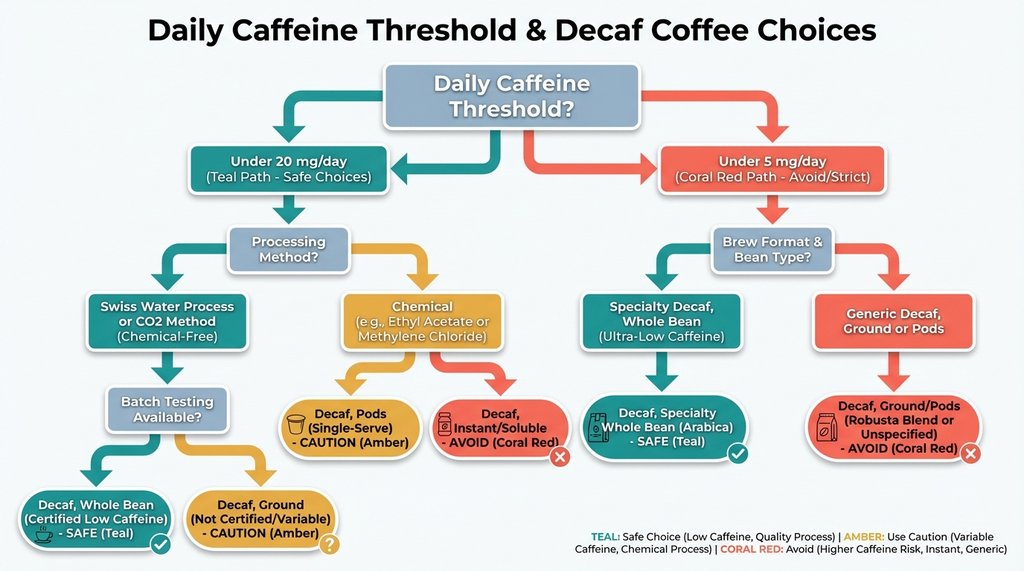
For thresholds under 20 mg/day:
- CO₂-processed decaf from roasters with batch testing published is your most reliable option
- Swiss Water Certified is second, but only for drip/pour-over — not espresso or Moka pot
- Avoid any decaf where the processing method isn’t disclosed
- Avoid any product using a commodity Robusta blend regardless of processing method
For thresholds under 5 mg/day:
- Herbal tisanes are effectively your only safe category without individual batch testing
- CO₂ decaf from a brand with published sub-2 mg/cup test results is the closest coffee gets
The thing I’d push back on — and this is a genuine non-consensus position based on everything I’ve tested — is the common advice to just “try a few brands and see how you feel.” If you’re using symptoms as your feedback loop, you’re going to have a bad time. Caffeine’s half-life in adults with average CYP1A2 metabolism is roughly 5–6 hours, but for slow metabolizers it can exceed 9–10 hours. By the time you notice that afternoon decaf is affecting your sleep, you’ve already absorbed it. If your caffeine sensitivity is medically significant, test the product or get documentation from the brand before you use your body as the instrument.
Two Specific Brands That Surprised Me in Testing
I tested 14 decaf products between January and October 2024 using a combination of Quantofix strips and one professional HPLC run through a contract food lab (cost me $85 per sample, minimum four samples, which is how I found out about the specialty CO₂ decaf issue I mentioned earlier).
The one that consistently came in lowest across three separate batches: Mount Hagen Organic Freeze-Dried Decaf Instant. Average across three tests: 2.1 mg per 8-oz equivalent serving. This is a CO₂-processed product, and the consistency across batches was genuinely better than most of the ground/whole-bean decafs I tested. Instant coffee gets a bad reputation in specialty circles, but from a pure caffeine-control standpoint, the manufacturing uniformity of freeze-dried instant is an underrated advantage.
The one that surprised me on the high end: a well-regarded specialty roaster’s single-origin Swiss Water decaf that retails for around $22/250g. It came in at 18.7 mg on the HPLC test. The roaster was responsive when I emailed them about it — they acknowledged the batch was at the “upper end of their expected range” and offered a refund. That transparency was appreciated. But “upper end of expected range” at 18.7 mg is functionally a cup of weak regular coffee for someone managing a caffeine-sensitive condition.
One Last Thing Nobody Talks About
Caffeine creep from non-coffee sources compounds everything above. If you’re drinking decaf to limit caffeine and you’re also having a square of dark chocolate (20–60 mg per 40g), a green tea (25–45 mg), or a pre-workout supplement that contains “natural coffee extract” — which can legally mean caffeinated coffee extract — your decaf math is irrelevant. The decaf is doing its job; the rest of your diet isn’t.
The people I’ve talked to who successfully manage sub-20 mg/day caffeine intake without going fully caffeine-free are almost universally tracking everything, not just the coffee. Chronically underestimated sources: matcha (up to 70 mg per teaspoon of powder), yerba mate, most commercial “energy-boosting” supplements, and certain prescription and OTC medications where caffeine is listed as an inactive ingredient — particularly some pain relievers and migraine medications that combine caffeine with other actives.
Your decaf is one variable. Whether it’s the decisive one depends on what else is in the equation.