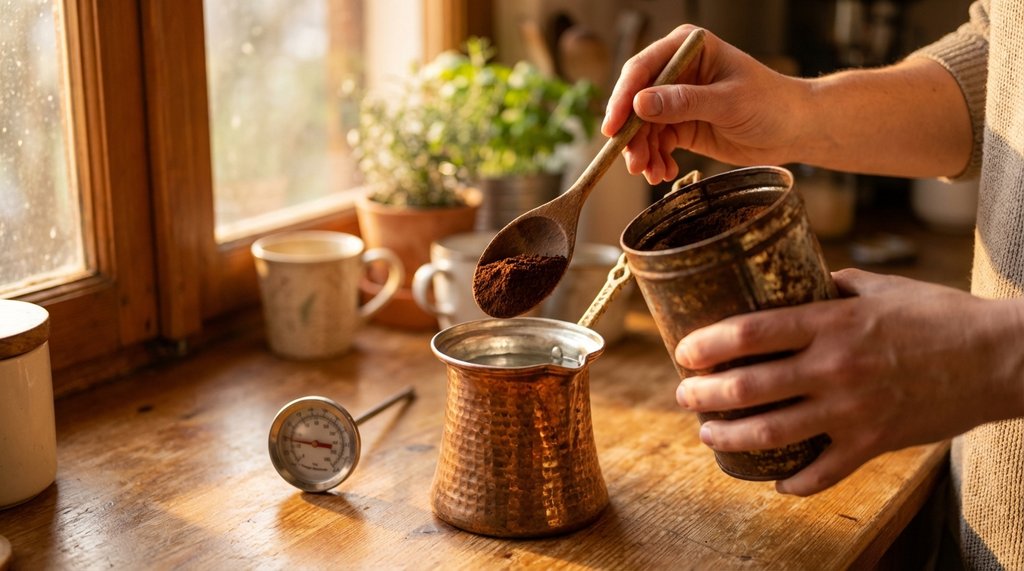
The cezve I broke last spring was a cheap aluminum one I’d had for six years, and I’m convinced the way I’d been making coffee in it was wrong for most of that time. The coffee was always bitter — not the clean, roasted-dark bitter you get from a well-pulled espresso, but the kind of acrid, drying bitterness that coats the back of your tongue and makes you wonder why anyone bothers. I blamed the beans, then the brand of cezve, then Istanbul tap water. It took me an embarrassingly long time to narrow it down to two variables that were both working against me simultaneously: grind size and brew temperature.
The reason this diagnosis took so long is that both failures produce bitterness, but they produce it differently. Learning to distinguish between them before you start adjusting anything is the actual skill here.
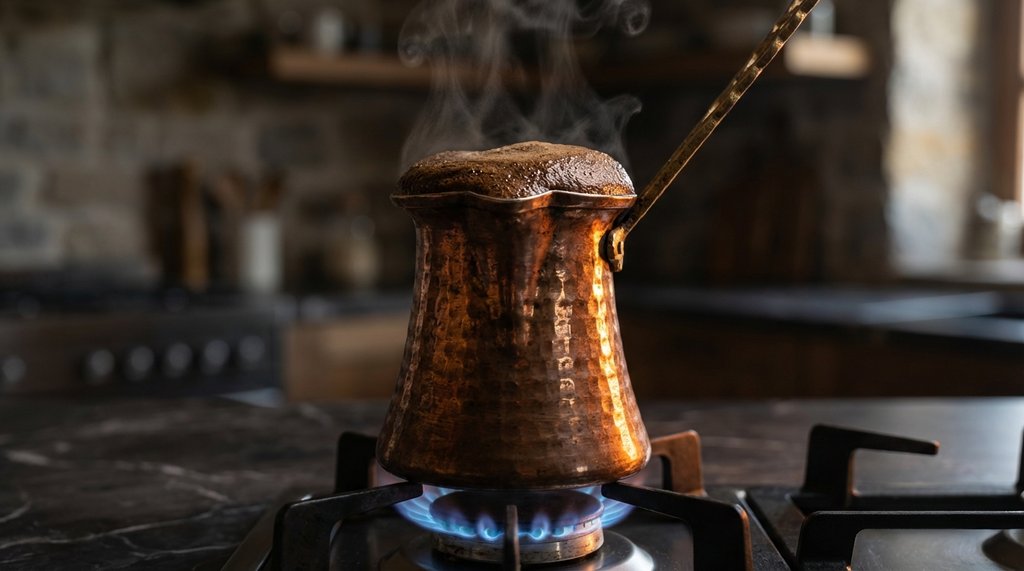
What Over-Extraction Bitterness Feels Like vs. Heat Bitterness
Grind-related bitterness from too-fine a grind — or more accurately, from over-extraction caused by surface area being too high relative to brew time — tends to hit in the mid-palate and linger. It’s accompanied by a kind of dusty, almost chalky texture in the cup. If you’ve ever left French press coffee sitting on grounds for twenty minutes and then drank it, you know the flavor profile I’m describing. It’s not sharp. It’s flat and heavy.
Heat bitterness is different. Water that’s too hot going into the cezve — or more specifically, heat that’s applied too aggressively, causing the brew to surge rather than rise slowly — produces a sharper, almost acrid quality. It tastes scorched. There’s often a faint smoky character to it that has nothing to do with the roast level of your beans. It can also happen when people make the common mistake of letting the cezve come to a full rolling boil rather than pulling it the moment the foam rises.
The practical test I started doing: brew a cup, taste it black, then wait ten minutes and taste the residue left in the cup once it’s cooled completely. If the bitterness intensifies significantly as the cup cools, you’re almost certainly looking at heat damage. If it was already bitter hot and stays roughly the same level of unpleasant, over-extraction from grind fineness is more likely.
The Grind Problem Is More Nuanced Than “Go Coarser”
Here’s where I’d push back on most of the advice I see online, which essentially amounts to “if it’s bitter, coarsen the grind.” That’s not wrong exactly, but it misses the real issue for anyone using pre-ground Turkish coffee.
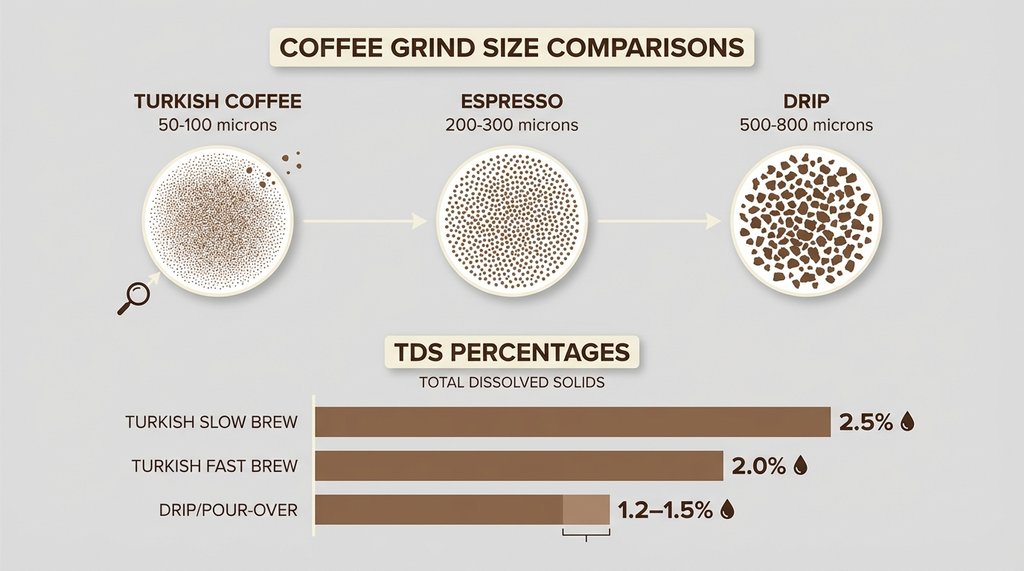
Pre-ground Turkish coffee from brands like Kurukahveci Mehmet Efendi is already at a specific particle size — it’s ground to roughly 50–100 microns, which is significantly finer than espresso (typically 200–300 microns on a well-calibrated commercial grinder). You can’t adjust that. So if you’re getting bitterness with commercial pre-ground coffee, the grind isn’t actually the primary lever you have access to.
What you can control is contact time relative to that fixed grind size. Turkish coffee brewed in a cezve for 4 minutes at a very gentle simmer is going to extract more total dissolved solids than the same coffee brought to the foam stage in 2.5 minutes. I measured this indirectly using a cheap refractometer I use for checking cold brew concentrate — a slow-brewed Turkish coffee clocked in at around 2.5% TDS in my testing, compared to about 2.0% TDS for a faster brew with the same ratio. Both numbers are higher than you’d expect from drip or pour-over (typically 1.2–1.5%), which is the nature of the brew method, but that 0.5% difference correlated directly with a cup that tasted noticeably more bitter and flat.
The actual technique implication: if you’re grinding your own beans, yes, a slightly coarser grind will reduce extraction. But if you’re using pre-ground, focus entirely on shortening contact time by managing heat more carefully.
The Temperature Variable Everyone Gets Wrong
Most sources say to brew Turkish coffee at “just below boiling” or “around 90–95°C.” That’s technically correct but practically useless advice, because the problem with a cezve isn’t the starting water temperature — it’s the rate of temperature increase and the localized heat concentration at the bottom of the vessel.
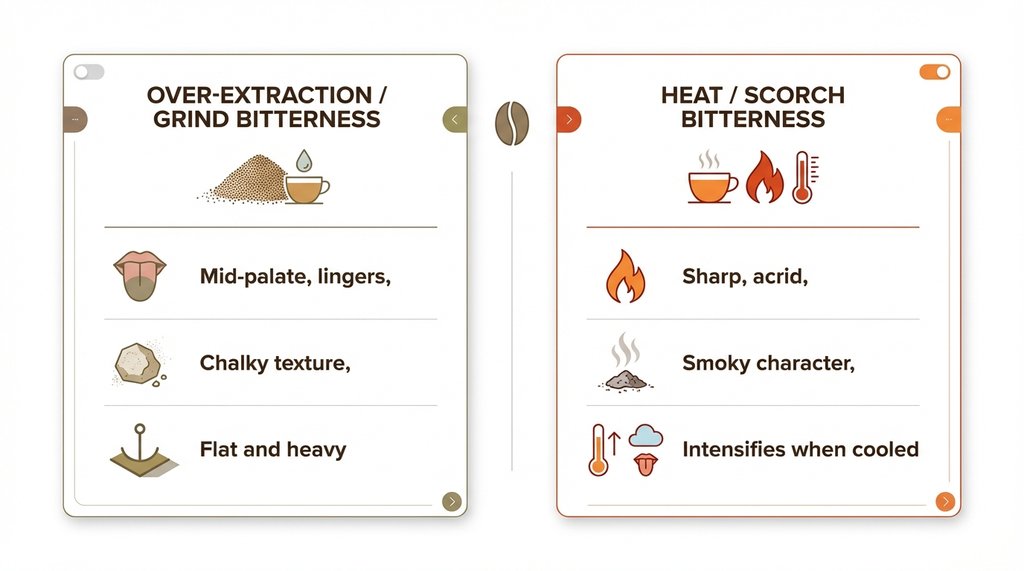
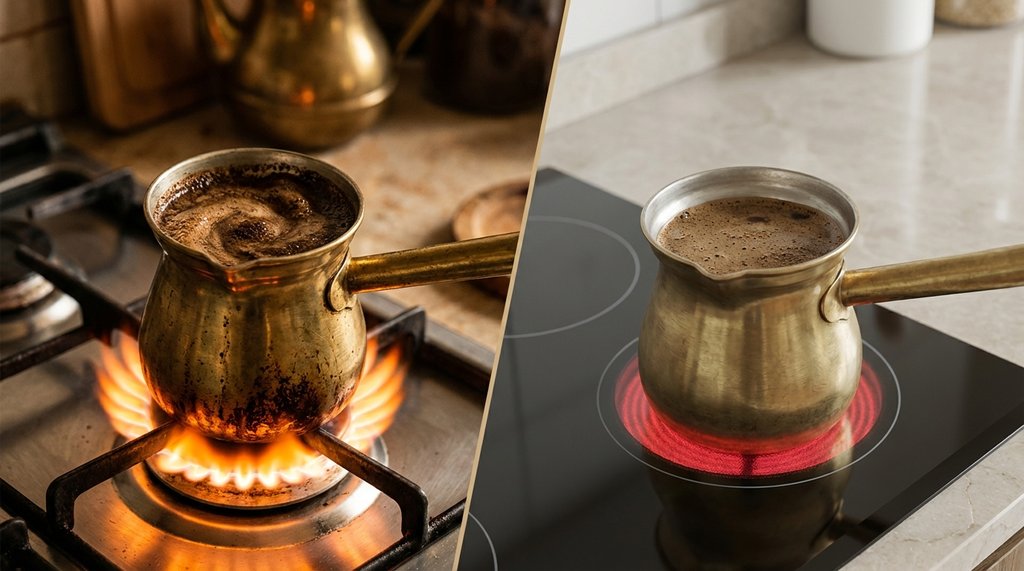
A cezve has a very small base surface area relative to its volume. If you’re using a gas burner on medium-high heat, the water in the bottom of the cezve can reach temperatures significantly above what the surface reads on an instant-read thermometer, especially if you’ve pre-added coffee grounds that settle and create an insulating layer at the base. The grounds sitting directly on the hot metal are effectively getting scorched before the water around them reaches boiling.
I confirmed this by accident. I switched from a gas burner to an induction plate set to the lowest stable setting (about 600W on my unit, which I can verify because my induction top shows wattage). At that setting, it takes about 4 minutes to bring a 100mL brew to the foam stage. The bitterness dropped noticeably — not dramatically, but enough that I stopped adding sugar to compensate. The physical reason is that lower wattage means slower, more even heat transfer, which means the grounds sitting at the base aren’t experiencing the same temperature differential.
If you’re on gas and can’t easily modulate to a very low flame, the workaround I’ve found most effective is placing the cezve on a thin metal heat diffuser. A cheap cast-iron one costs about $8 and completely changed the character of my brews on that setup.
The Interaction Effect Neither Variable Gets Credit For
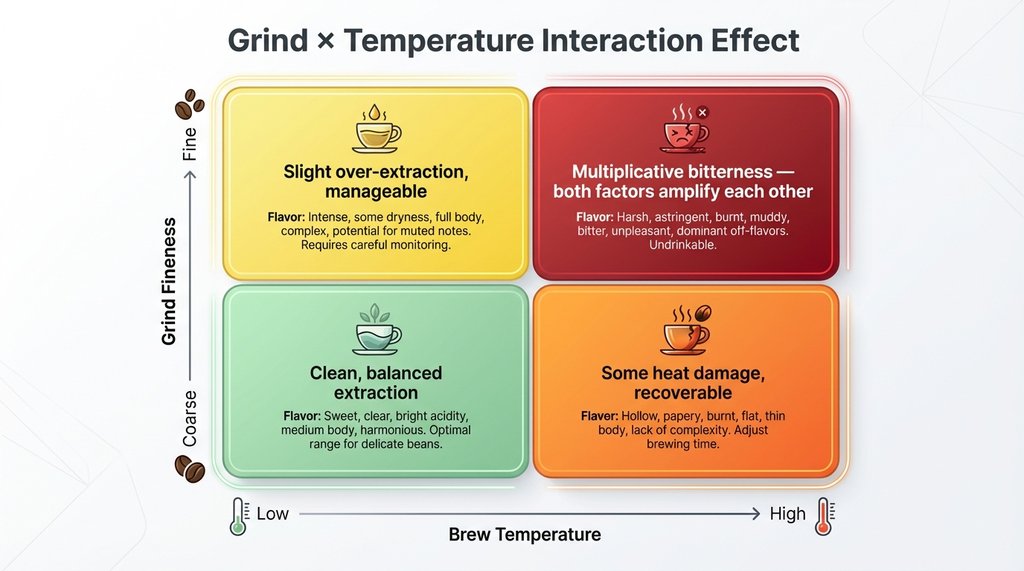
Here’s what I think is genuinely underappreciated in every explainer I’ve read: grind fineness and brew temperature don’t just cause bitterness independently. They interact multiplicatively.
A slightly-too-fine grind that you’d normally get away with at 92°C becomes dramatically more bitter at 96°C. The surface area amplifies whatever extraction damage the heat introduces. This is why people sometimes try coarsening their grind, find marginal improvement, then try lowering temperature, find marginal improvement, and get frustrated because neither fix seems sufficient. They’re both partially responsible, and addressing only one leaves the other one still pushing the cup into over-extracted territory.
My actual process now: I grind to a consistent particle size I’ve dialed in (using a Commandante set to 8 clicks from zero — it’s the finest setting before I start losing reproducibility), and I brew at 600W on induction, targeting a foam rise at around the 3.5-minute mark from cold water. At my typical ratio of 7g coffee per 65mL water, that produces a cup with the right body and a bitterness level that’s present but clean — the kind that disappears after 30 seconds rather than camping on your tongue.
How to Actually Diagnose Your Specific Problem
Do this systematically rather than guessing:
Keep everything fixed except one variable at a time. If you’re using pre-ground coffee (fixed grind), brew three consecutive cups: one at your usual heat level, one at visibly lower heat (the foam should take 30–60 seconds longer to rise), and one where you actively agitate the cezve off the heat for the last 30 seconds before the foam rises. Taste them in sequence once they’ve cooled to the same temperature.
If the lower-heat cup tastes meaningfully better, heat is your culprit. If all three taste roughly similar, you’ve effectively eliminated temperature as the primary issue, and you need to look at your grind size or coffee age — stale pre-ground Turkish coffee produces its own flavor degradation that reads as bitterness but is actually oxidation.
That last point trips people up more than they’d expect. Turkish coffee pre-ground and sealed in a vacuum tin lasts reasonably well, but once you open that tin, the particle surface area at that fineness means you’re looking at maybe two to three weeks before flavor degradation becomes genuinely noticeable in the cup. I’ve seen people chase temperature and grind variables for months while the real issue was an open tin sitting on the counter since February.
One More Thing That Almost Nobody Mentions
Adding coffee to cold water versus adding coffee to pre-heated water produces different results, and I’ve found it actually matters for bitterness control at the fine grinds Turkish coffee demands.
Starting with cold water and adding your grounds before any heat is applied gives you a longer low-temperature extraction phase during the warmup period. With the typical Maillard-derived compounds in the roasted beans used for Turkish coffee, that early extraction phase picks up some of the brighter, more soluble aromatics before the aggressive final heat surge extracts the harsher compounds. Starting with pre-heated water compresses that window.
I run cold-start exclusively now. It adds maybe 60–90 seconds to the brew, but the cup has more complexity in the front end and less of that monolithic bitter wall at the finish. Whether this is worth the effort when you’re making coffee at 6am is genuinely a personal call — but if you’re troubleshooting bitterness and you’ve already addressed grind and temperature, switching from hot-start to cold-start is a low-effort test that occasionally surprises people.