
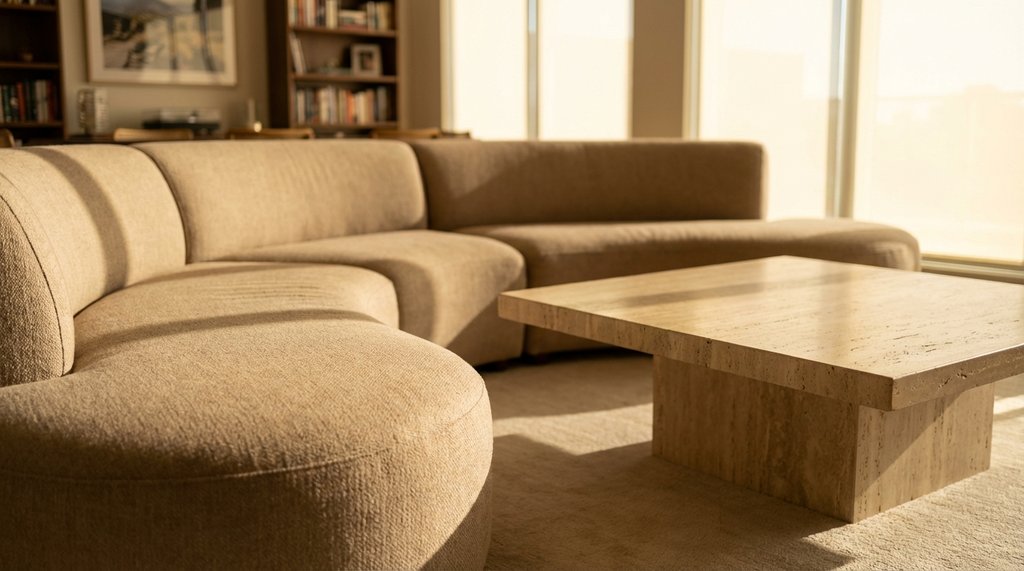
My last client fired me over a coffee table. Not really — she was too polite for that — but she did call me three weeks after installation to say the living room “felt wrong,” and when I drove back out to look at it, I knew immediately what I’d gotten wrong. The table was rectangular. The sofa was a curved RAF sectional with a 112-inch radius. The table was a beautiful slab of travertine, 54 inches long, and it sat in the negative space of that curve like a parking barrier.
That was 2023. Since then I’ve done forty-plus curved sectional configurations, and the proportion math I now use is different from almost everything you’ll find on design blogs.
Why the Standard “Two-Thirds Rule” Breaks Down With Curved Sectionals
The two-thirds rule — your coffee table should be roughly two-thirds the length of your sofa — was developed for linear sofas, and it’s been parroted so many times that even decent shelter magazines apply it to curved configurations without adjustment. It doesn’t work. The problem is that curved sectionals don’t have a “length” in any useful sense. A 140-inch curved piece might only span 90 inches of wall, with the curve consuming the remaining geometry in a third dimension. If you calculate two-thirds of the total seating rail and drop a table that size into the concave space, you’re either fighting the curve or sitting 26 inches from your coffee table — which is about 8 inches too far for comfortable use without leaning forward.
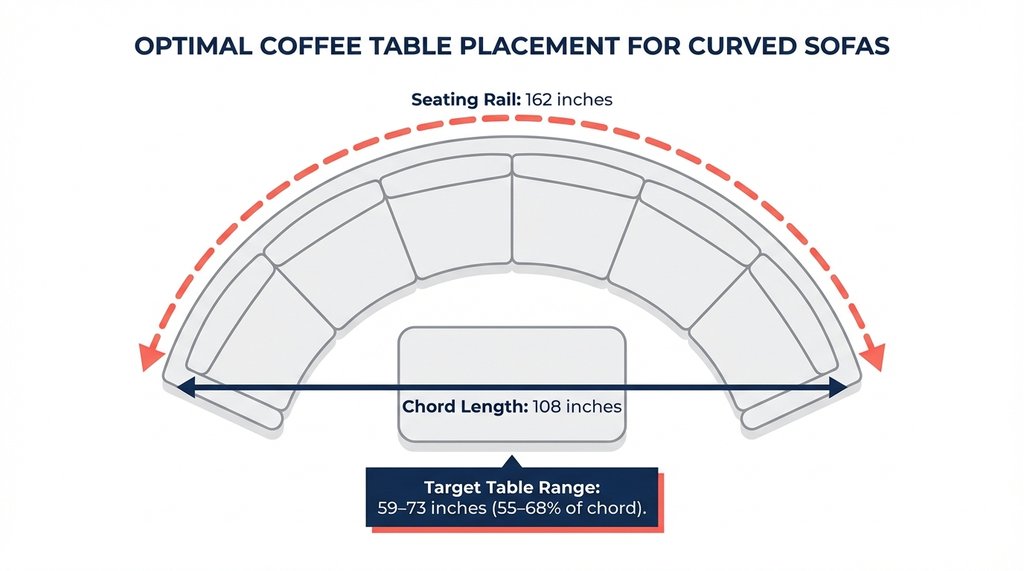
The measurement that actually matters is the chord length: the straight-line distance between the two ends of the curved sectional when it’s in its installed position. That’s your working reference dimension. Your coffee table’s longest dimension should fall between 55% and 68% of the chord length, not the seating rail.
Here’s a real example: a Natuzzi B968 sectional I specified last April had a seating rail of 162 inches but a chord measurement of 108 inches. The 55–68% range off chord gives me a table between 59 and 73 inches. A standard two-thirds calculation off the rail would suggest 108 inches — a table that would have been absurdly oversized and would have broken the visual enclosure the curve creates.
The Clearance Numbers That Actually Matter in 2024
The general guidance of 12–18 inches between sofa and coffee table is fine for straight configurations. For curved sectionals, you need to think about this differently because the clearance is not constant — it varies across the table depending on where you’re measuring from.
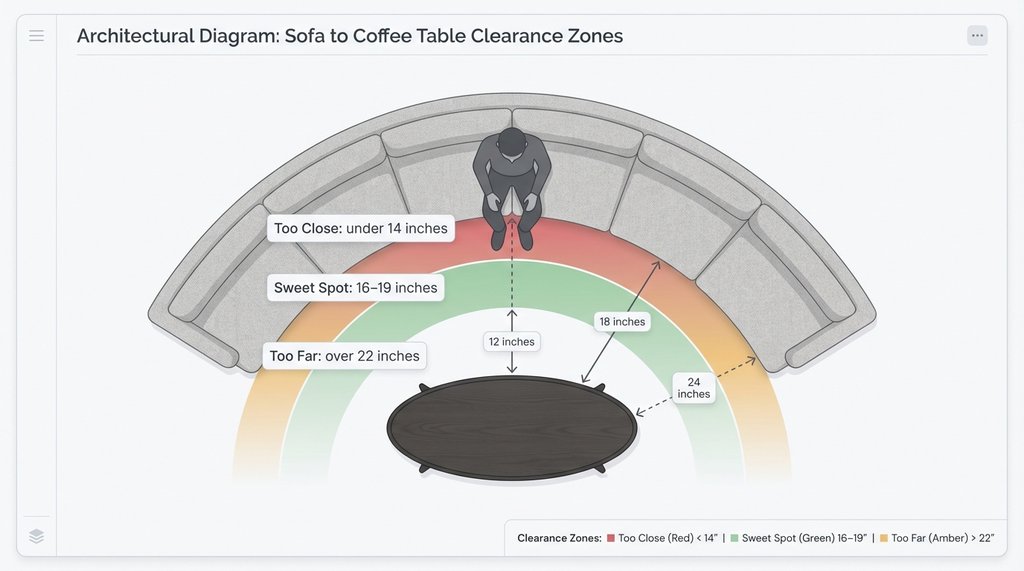
What you want is a minimum of 14 inches at the closest point of approach, which on a curved sofa will be at the apex of the curve. If you’re using a round or oval table centered in the concave space, the apex-to-table edge distance determines whether people sitting in the middle of the sectional can reach their drinks without leaning uncomfortably. I’ve found that below 14 inches, people start using the table as a footrest because they’ve already shifted their posture to accommodate the proximity.
The maximum useful reach from a seated position is about 22 inches. If your table edge is more than 22 inches from the apex of the curve, the person sitting in the center of that sectional will never use it, and you’ll end up with a decorative object that floats in the room rather than functioning as a surface. This happens constantly with oversized round tables in wide curved configurations — the table looks proportionally correct from a floor plan, but the actual use experience is that the middle third of the seating is functionally tableless.
The sweet spot for apex clearance in most residential curved sectional installations is 16–19 inches. I’ve settled on 17 as my default starting point, then adjust based on whether there are young children (push toward 19 to accommodate toys and traffic) or whether the clients entertain formally (push toward 15 to keep drinks reachable during conversation).
Shape Selection: Where Most Designers Get This Wrong
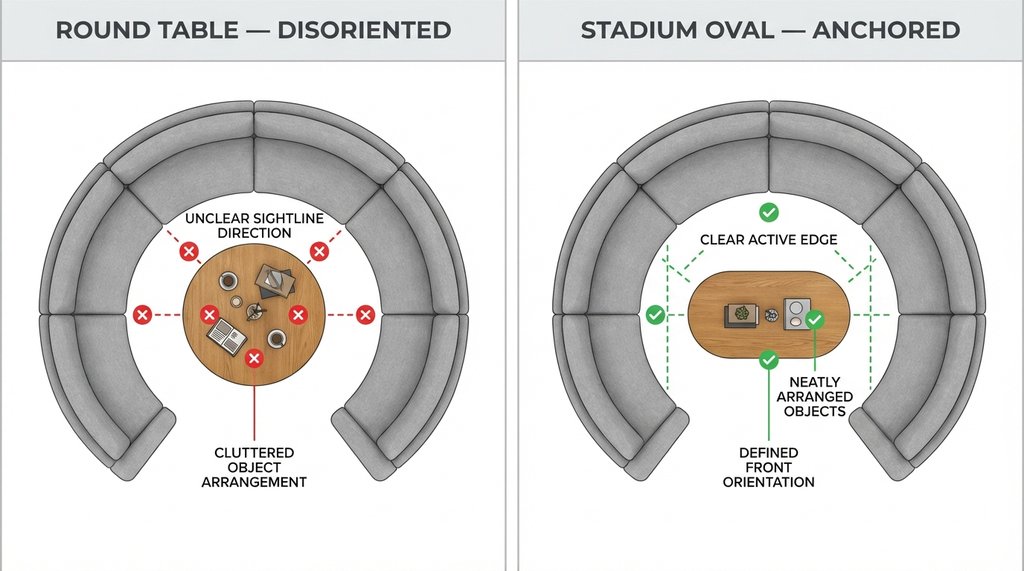
Round tables are the automatic recommendation for curved sectionals, and I used to follow that instinct. I’ve since changed my position significantly, specifically for concave-facing sectionals — the kind where the open side of the curve faces the room rather than a wall.
Round tables do mirror the curved geometry, but they create a problem with sightline and anchor. A curved sectional creates a strong directional focus — it’s essentially a theater seating arrangement — and a round table in that context lacks a clear face. There’s no “front” to orient toward. In rooms where the television or fireplace sits opposite the concave opening, this matters. When I put a round table in that configuration, clients would rearrange objects on the table constantly, without knowing why. The table had no orientation, so nothing on it ever felt settled.
What works better, in my experience with rooms under 400 square feet of living space, is a soft rectangular or stadium-oval table with the long axis parallel to the chord of the sectional. This sounds counterintuitive — you’d think a curved sofa wants a curved table — but the rectangle actually provides visual counterweight to the sectional’s softness and gives the seating arrangement a clear front and back. The long edge of the table that faces the concave opening of the sectional is the “active” edge; that’s where people sit forward and reach for drinks.
The exception is rooms over approximately 420 square feet of living area, where the proportional mass of a large oval or round table becomes necessary to hold the composition. In those larger rooms, a 48–54 inch oval table in the curved configuration works well — but you need the 54-inch version far more often than designers admit, because anything smaller reads as fussy and inadequate in the space.
Height: The Spec That Gets Fudged
Standard coffee table height is 16–18 inches. The design press has spent the last four years pushing lower tables — 12 to 14 inches — as a contemporary aesthetic signal. That works fine if your sofa has a low seat height. Most curved sectionals do not.
Curved sectionals, because of how the internal frame has to accommodate the sweep geometry, tend to run higher than standard sofas. The Restoration Hardware Cloud Sectional, which is probably the most common curved piece I encounter in client homes right now, has a seat height of 18.5 inches. A 13-inch coffee table in front of an 18.5-inch seat means the table surface is 5.5 inches below the seated thigh — reach-down territory that feels fine for about 20 minutes before it becomes mildly aggravating. I’ve had clients who swore they loved a coffee table for six months and then suddenly declared the living room “uncomfortable” without being able to identify why.
The practical rule: your coffee table height should be within 2 inches of your sectional’s seat height, either direction. If your sectional seats at 18.5 inches, your coffee table should be between 16.5 and 20.5 inches. I default to matching seat height exactly on curved sectionals because the curved seating tends to bring people into a more upright position than a deep linear sofa, which means the reach-forward moment is more vertical than a lounge position would create.
The Leg Configuration Question Nobody Discusses
Pedestal tables — single central base — are frequently recommended for curved sectionals because the lack of corner legs supposedly allows seating flexibility and reduces visual clutter. I believed this for a long time. Then I installed a 48-inch round pedestal travertine table in a curved sectional configuration and watched the clients bump the base of it seventeen times in the first three weeks because the base diameter was 16 inches, leaving an actual clearance of only 16 inches from the edge, far less than the unobstructed legroom they expected. The base comes in significantly farther than people anticipate when they’re navigating by table edge.
Four-leg tables with legs set inward from the corners create better real-world traffic flow in curved configurations, particularly if there are people moving through the concave opening regularly. The visual information (legs defining the corners of the table) accurately signals where the physical obstacle is. Pedestal tables create a gap between visual expectation and physical reality.
The one situation where a pedestal legitimately outperforms is a curved sectional arranged in a room where all traffic approaches from a single direction — usually a wide opening on one side of the room. In that case, the central base is out of the traffic path and the argument for legs falls apart.
Material Weight and Visual Gravity
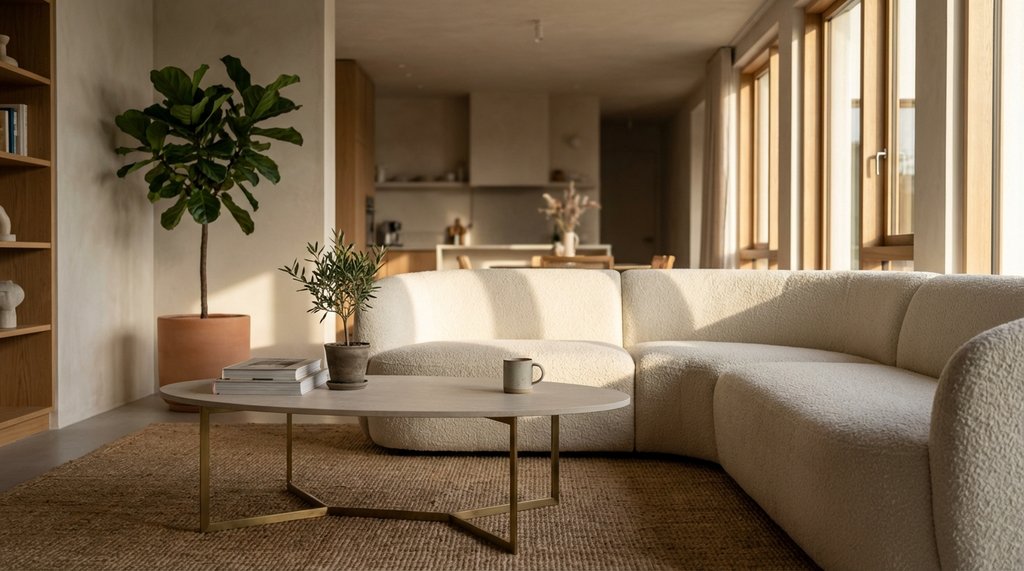
Curved sectionals, by their nature, carry a lot of visual mass. They wrap. They claim floor space. They create an enclosure. Putting a heavy material coffee table inside that enclosure — solid marble, thick travertine, dense dark wood — can compress the visual air of the room significantly.
The interior design industry in 2024 has moved hard toward what’s being called “visual lightness”: glass, cane, sintered stone that reads thin at the edge, metal frames with open profiles. For curved sectionals specifically, this trend has a functional basis rather than just aesthetic preference. A table with a visually light profile allows the curve of the sofa to read as the primary architectural gesture in the room. A heavy table fights that reading.
My practical threshold: if the table material has an edge thickness greater than 2.5 inches or a visual density that exceeds the arm surface of the sectional, I push back. The table should feel like it’s inside the curve, not competing with it.
One Configuration That Almost Never Works
I want to be specific about this because I’ve seen it in four different client homes in the past year, and in every case it was the result of someone following advice from a mood board rather than measuring: two small coffee tables — usually a 24-inch round and a 20-inch round, staggered at different heights — used in place of a single larger table in a curved sectional configuration.
The pairing looks excellent in styled photography. It photographs beautifully. In actual use, it fails for a specific reason: curved sectionals create a seated arc of anywhere from five to eight feet, and two small tables placed within that arc cannot serve more than two or three people simultaneously before someone has to lean or reach across someone else to access the farther table. The surface area adds up on paper — a 24-inch round is about 452 square inches, a 20-inch round is about 314 square inches, total roughly 766 — but the effective use surface for any single seated person is far lower because only the nearest table is actually accessible.
A single 48-inch oval table positioned correctly gives 1,320 square inches with better distribution. It’s not even close. The two-table configuration is a styling decision, not a use decision, and I think it’s honest to call it that rather than presenting it as a functional choice.
The Actual Workflow I Use Now
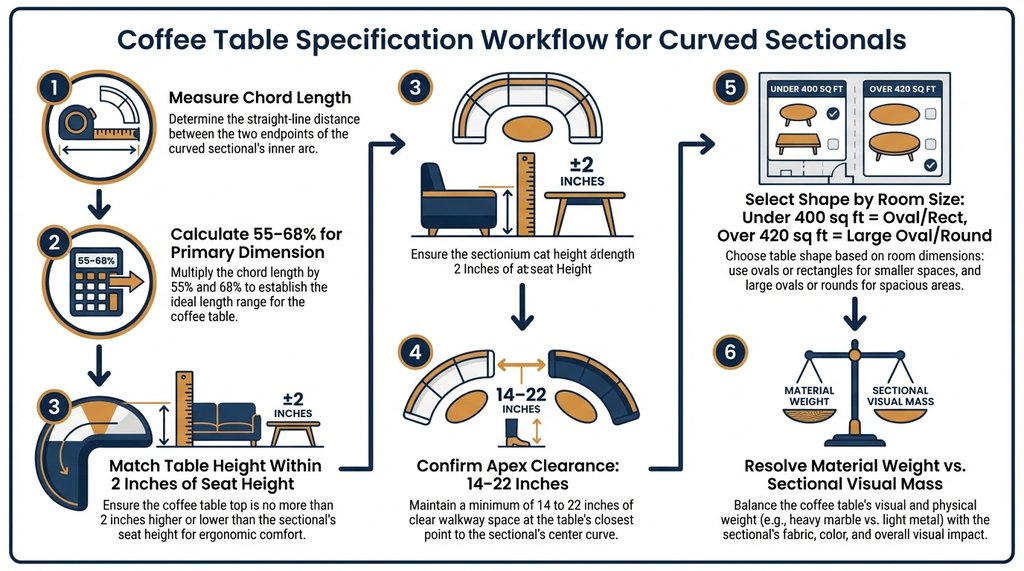
When I’m specifying a coffee table for a curved sectional, the order of operations is:
Measure chord length first. Calculate 55–68% of that for the table’s primary dimension. Verify seat height of the sectional, then target table height within 2 inches of that number. Measure the apex clearance I have to work with given the room dimensions, and confirm that a table at the calculated primary dimension leaves 14–22 inches of apex clearance. Then choose shape based on room size: under 400 square feet of living area, stadium oval or softly rectangular; over 420 square feet, consider a large oval or round. Then resolve the material weight question against the visual mass of the sectional.
That sequence prevents most of the errors. The travertine table and the fired client — that would have been caught at step one. The chord was 94 inches. My 54-inch rectangular table was within range on the primary dimension, but the rectangular geometry was wrong for that specific curved configuration, and I hadn’t yet developed the visual-weight criterion that would have told me the table was too heavy for the room.
The thing about furniture proportion is that when it’s right, nobody notices it. The room just feels like it works. When it’s wrong, people describe the room as uncomfortable or cold or somehow “off,” and they rearrange objects compulsively trying to solve a problem they can’t name. Getting these numbers right is less glamorous than the styling decisions, but it’s the part that determines whether the room actually functions as a place people want to be.