

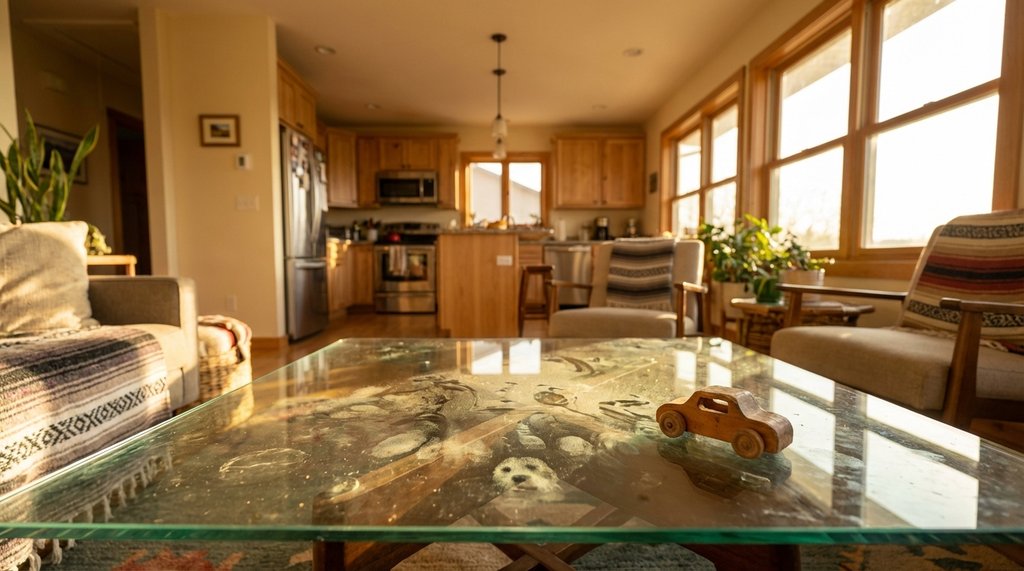
My client called me on a Tuesday afternoon, genuinely upset. She’d spent $1,400 on a clear tempered glass coffee table from a mid-range furniture showroom in Atlanta, and three weeks into living with it, she was wiping it down four times a day and still hating how it looked by 6 PM. She has two kids under ten, a dog who apparently enjoys pressing his nose directly onto horizontal surfaces, and an open-concept floor plan where the living room, kitchen, and dining area bleed into each other with zero visual separation. The table sat dead center in all of it.
I’d seen this exact situation probably a dozen times before I started being more direct with clients upfront. So let me actually break this down in a way that’s useful.
The Physics of Why This Matters More Than You Think
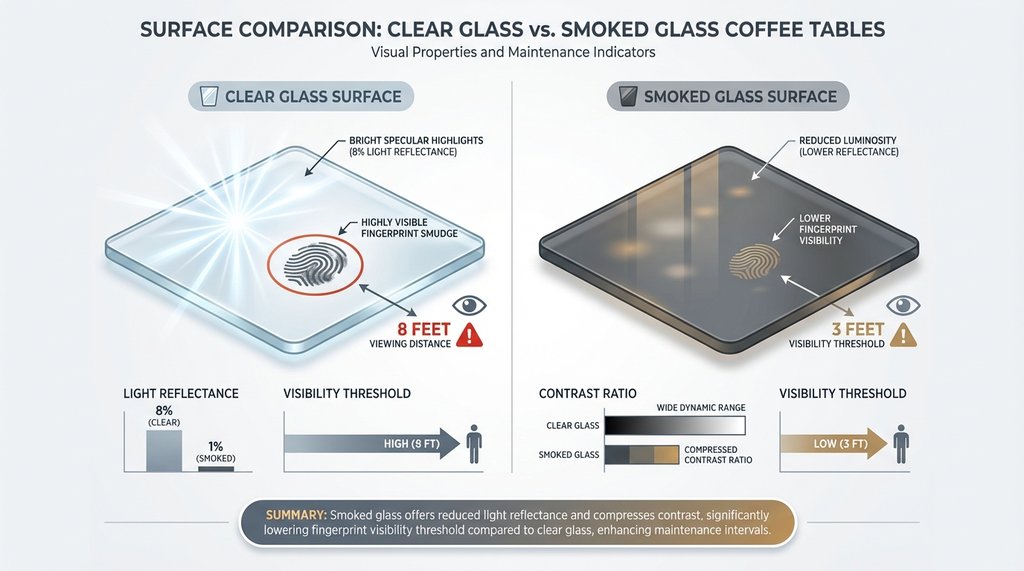
Fingerprints on glass aren’t really about the glass — they’re about sebum and skin oil depositing in a thin film on the surface. Under direct or ambient light, those deposits scatter light at a different angle than the surrounding clean glass, which is what makes them visible. Clear glass with a polished edge finish has a total light reflectance of roughly 8% (about 4% per surface on standard float glass), meaning it bounces back a significant portion of ambient light in a specular, mirror-like way. That directional reflection is exactly what makes every single smudge pop.
Smoked glass — specifically, gray-tinted glass that’s either body-tinted during manufacturing or surface-treated — reduces this problem through two separate mechanisms, not one. Most people assume it just “hides” dirt by being darker. That’s partially true but it’s the less important factor. The more significant effect is that the tinting reduces overall surface luminosity, which compresses the contrast ratio between a clean area and a smudged area. When you drop the base luminance of the surface, a sebum deposit that would have shown up as a bright streak on clear glass instead shows up as… a slightly different shade of medium gray. Your eye is much less sensitive to that kind of tonal variation than it is to a bright smear on a high-contrast clean background.
I had a client in a Decatur, Georgia rental renovation project where I was specifying furniture for a staged open-concept unit — roughly 800 square feet of continuous living space with massive south-facing windows. I tested this side by side with swatches pulled directly from the showroom floor: a clear 10mm tempered top and a gray smoked 10mm top of equivalent thickness and polish finish. Under afternoon direct sun through those south windows, the clear glass showed fingerprints from approximately 8 feet away. The smoked glass? I had to get within about 3 feet, and even then I was partially convinced by what I knew was there rather than what I was actually seeing.
Where Smoked Glass Wins, and Where It Doesn’t
The advantage is real but it’s not universal. And here’s the part that gets skipped in basically every buying guide I’ve ever read:
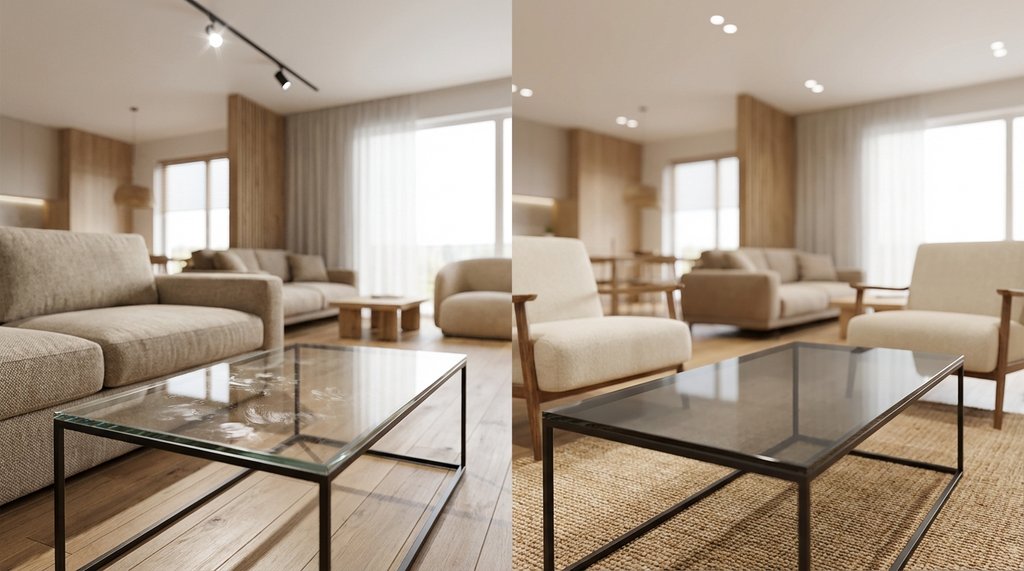
Smoked glass performs significantly better in high-ambient-light situations — exactly the kind you get in open-concept spaces with recessed lighting, kitchen pendants spilling into the living area, and large windows. That’s the scenario where most fingerprint visibility problems actually live. But in lower-light conditions — evening ambiance lighting, dimmer setups, spaces that rely heavily on table lamps or candles — the advantage narrows considerably. In those conditions, neither surface reflects enough light to make smudges legible from a conversational distance anyway.
I learned this the frustrating way when I recommended smoked glass for a client whose loft space in a converted building had almost no natural light and relied on warm-toned Edison bulb fixtures at 2700K. She came back to me three months later saying the fingerprints were still very visible. Walked the space, saw immediately that the problem wasn’t the glass choice — it was that she’d added a focused overhead accent light on a track system directly above the table, essentially creating a spotlight that made any surface deposit visible regardless of tint level.
The actual variable wasn’t smoked vs. clear. It was the lighting direction and concentration. Diffuse ambient light is forgiving. Directed point sources are unforgiving, full stop, and no glass tint is going to save you from a direct overhead spotlight hitting your coffee table at a steep angle.
The 45-Degree Rule Nobody Tells You About
There’s a practical test I now walk every client through before they finalize a glass coffee table purchase. Stand at one end of the table, position yourself so your eyes are above table height, and look across the surface at a 45-degree angle toward your primary light source. This is the angle at which fingerprints are most visible on any glass surface. Now do the same with a smoked sample.
In this specific viewing geometry, clear glass with heavy finger traffic looks almost unbearable — you’re essentially looking down the length of every smear simultaneously. Smoked glass in the same test still shows fingerprints, but they’re significantly less legible. In my experience, smoked glass passes this test at roughly 60-70% of the contamination level that would make clear glass visually objectionable from a normal seated viewing distance.
What this means practically: smoked glass doesn’t eliminate the maintenance burden, it extends the time between maintenance intervals. If clear glass in a high-traffic open-concept space needs a wipe-down every day to look presentable, smoked glass in the same environment typically holds up acceptably for two to three days between cleanings. That’s actually meaningful if you’re living with it.
The Case Where Clear Glass Wins Anyway
There’s one scenario where I will still recommend clear glass over smoked even knowing all of the above: spaces under 400 square feet where visual weight matters more than surface maintenance.
Smoked glass in a compact room adds visual density. It reads as a solid object. Clear glass in the same space disappears, allowing you to see the floor underneath and maintain a sense of openness. I’ve had clients in smaller open-concept apartments where the smoked table made the living area feel measurably more compressed — not just aesthetically but functionally, because you couldn’t gauge spatial relationships to surrounding furniture the same way.
In those situations, I’ve pushed clients toward clear glass with an ultra-thin anti-fingerprint coating instead. Pilkington’s Optiwhite with a factory-applied anti-smudge treatment, or tables from manufacturers using Schott Amiran anti-reflective glass, perform noticeably better than standard clear. The Amiran coating brings total light reflectance down from approximately 8% to around 1%, which does a significant portion of what the tinting accomplishes through a completely different mechanism. It’s considerably more expensive — expect to add $200-400 to the base cost for a quality piece — but it preserves the visual lightness of clear glass while cutting fingerprint visibility by a meaningful margin.
I’ve used this solution on three projects now. The cleanest result was in a Midtown Atlanta condo, 620 square feet, south and west exposure, client with two teenagers and a work-from-home situation that meant the space was in near-constant use. The treated clear glass held up visually from normal seated viewing distance for two full days of regular family use before it needed attention. That’s not magic — but it’s better than the untreated clear glass that preceded it, which she was wiping down before dinner every single evening.

Texture Matters More Than Tint in the Worst Cases
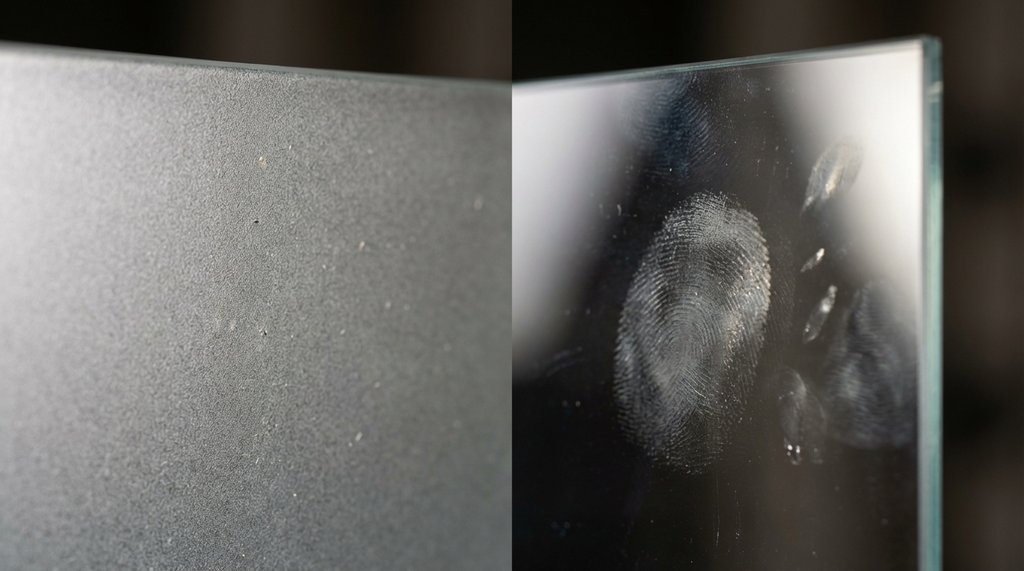
If you’re dealing with genuinely extreme traffic — a household where the coffee table is also a homework surface, a snack surface, a dog resting surface, and a feet-up surface — neither smoked nor clear glass is actually your answer. Frosted or acid-etched glass surfaces scatter light so aggressively that fingerprints become almost completely invisible until the contamination is severe enough to create localized glossy patches in the matte surface. At that point it’s a different kind of ugly, but you’re talking about weeks rather than days.
The tradeoff is that frosted glass shows dust and dry debris more readily than polished glass — particles sit on top of the texture rather than getting optically blended into a reflective surface. For a high-traffic open-concept space with kids, I’ve found that’s often the better tradeoff. You can see what needs wiping rather than constantly second-guessing whether the smear you’re looking at is old or new.
I’ve specified frosted glass tops exactly twice in client projects. Both times the clients were initially resistant because frosted glass photographed for social media looks flat and unsophisticated compared to the polished high-gloss look. Both times, at the six-month follow-up, they told me it was one of the best recommendations I made for their space. One of them had switched to clear glass on their own after the frosted piece got damaged during a move, regretted it within two weeks, and called me to source a replacement.
The answer most people want — some clear ranking of smoked over clear that applies universally — doesn’t exist. The answer that’s actually useful is that your lighting setup matters more than the glass type, your maintenance tolerance matters more than either, and for open-concept high-traffic situations, the smoked glass advantage is real but it’s measured in days between cleanings, not in being maintenance-free. Go in with that expectation and you’ll make a better decision for your specific space.