
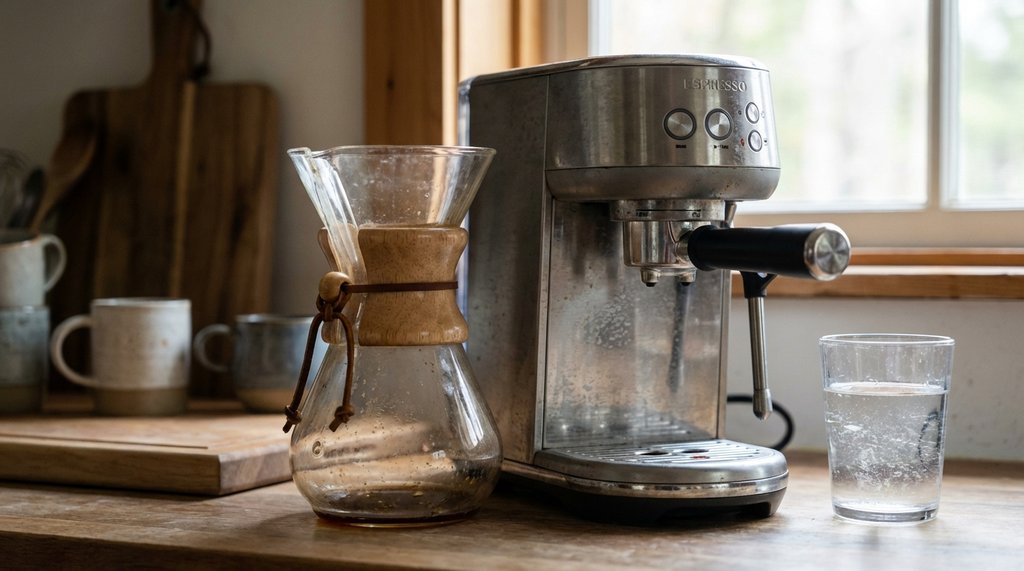
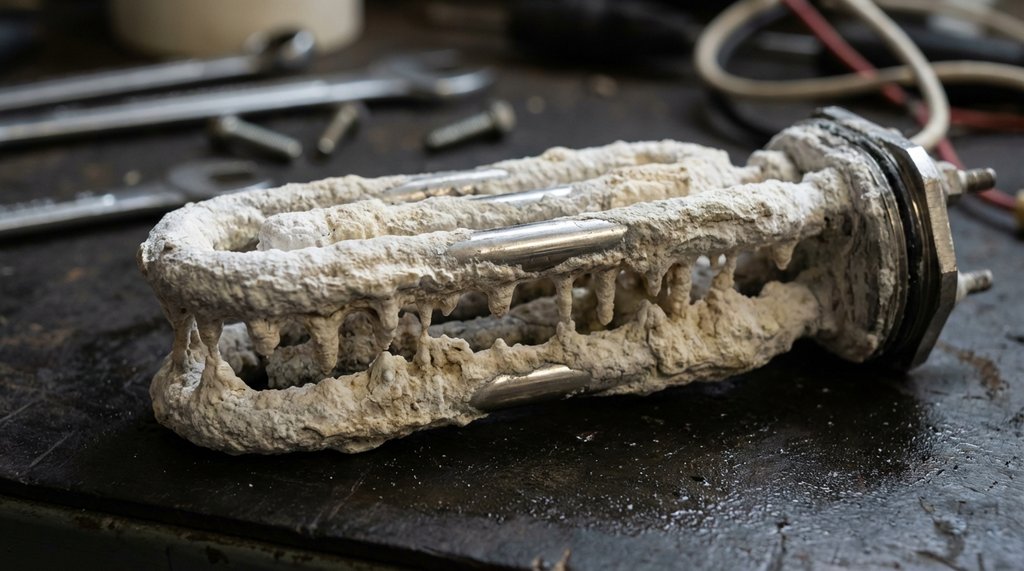
My kitchen tap in Phoenix runs at 320 ppm. I know this not because I read a municipal report but because I’ve pulled apart enough coffee machines to see exactly what 320 ppm does to an internal boiler over fourteen months of daily use. The last one — a mid-range drip machine I’d recommended to about forty people on a regional barista forum — had a heating element so encrusted it looked like a stalactite formation you’d see on a cave tour. The machine hadn’t thrown a single error code before it simply stopped heating water past 180°F. The thermostat was fine. The pump was fine. The calcium deposit was about 4mm thick along the full length of the element.
That’s the failure mode most buying guides don’t actually explain: it’s rarely a dramatic clog. It’s thermal inefficiency. Scale is a terrible conductor of heat — around 0.6 W/m·K compared to stainless steel at roughly 16 W/m·K — so as the layer builds up, your heating element works harder and longer to push the same temperature through to the water. You’re not just seeing a descaling warning earlier than expected. You’re running the element at elevated operating temps for extended periods, which degrades it in ways that descaling cannot reverse.
What “Hard Water Compatible” Actually Means on the Spec Sheet — and Where It Lies to You
Most machines marketed as hard water-friendly are citing one of three things: a built-in water filter, a user-adjustable hardness setting that calibrates descaling reminders, or stainless-lined boilers instead of aluminum. All three matter, but they don’t matter equally, and the marketing rarely tells you which one you’re actually getting.
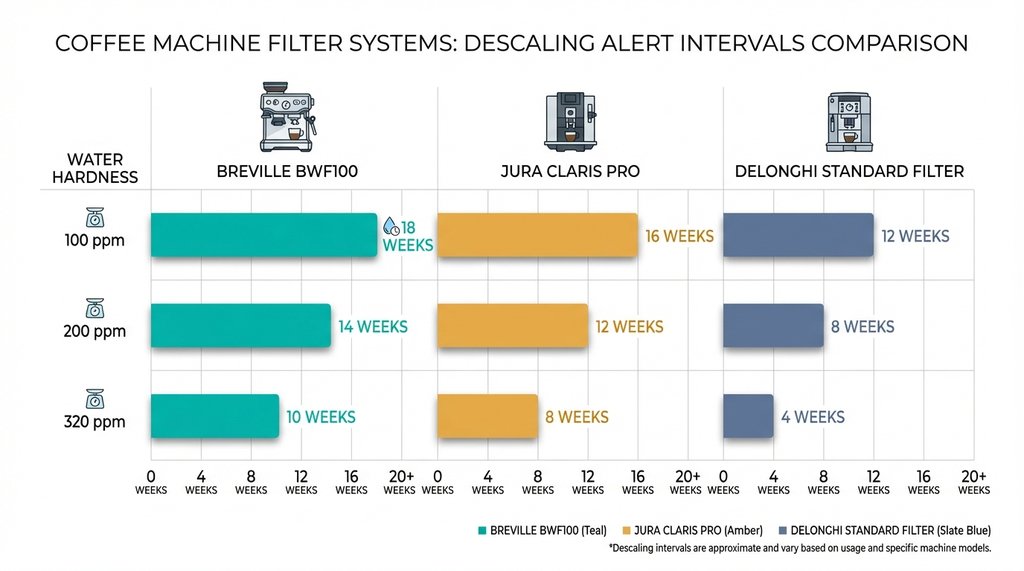
The built-in filter claim is where I’ve been burned the most. Breville, for example, ships several of its Barista series machines with a charcoal and ion-exchange filter cartridge (the “BWF100” style). On paper, that cartridge reduces hardness. In practice, if your source water is above 200 ppm, that cartridge is working at capacity within three to four weeks of daily use at typical 1–2 liter per day consumption. The cartridge change interval in the manual says “every 2–3 months.” At 320 ppm, I replaced them every six weeks before the filtration became effectively decorative. Most buyers don’t. They swap it quarterly like the manual says, and they’re running unfiltered hard water through their machine for six to eight weeks at a stretch by month two.
Jura does this differently with their Claris filter system, and it’s meaningfully better engineering — the Claris Smart and Claris Pro filters have a higher ion exchange capacity and Jura actually calibrates the replacement reminder to your local hardness setting, which you enter during first setup. That’s not a trivial distinction. It means a user in London (where Thames Water supplies some zones at 280–300 ppm) gets a different replacement schedule than a user in Edinburgh (roughly 50 ppm). I tested a Jura E8 side-by-side with a DeLonghi Dinamica Plus over eight months in my 320 ppm kitchen. The Jura’s descaling interval hit at month seven. The DeLonghi triggered a descaling alert at month four — and the DeLonghi has a perfectly functional filter system, it just doesn’t modulate the reminder based on actual throughput and hardness in the same granular way.
The DeLonghi wasn’t doing anything wrong, technically. It was just conservative. But a conservative descaling interval in hard water isn’t a safety net — it trains users to ignore the alerts because they come so frequently, which is arguably worse.
Boiler Material and Design: The Part That Actually Determines Your Machine’s Five-Year Fate
There’s a non-consensus position I’ll defend here: for genuinely hard water households (above 180 ppm), a thermoblock or thermocoil system is more durable long-term than a traditional single boiler, despite what specialty coffee enthusiasts will tell you.
The conventional wisdom in the home espresso community is that traditional brass or stainless boilers produce better thermal stability and better extraction. That’s true. But thermal stability benefits the cup. It doesn’t benefit the machine’s longevity under scale stress.
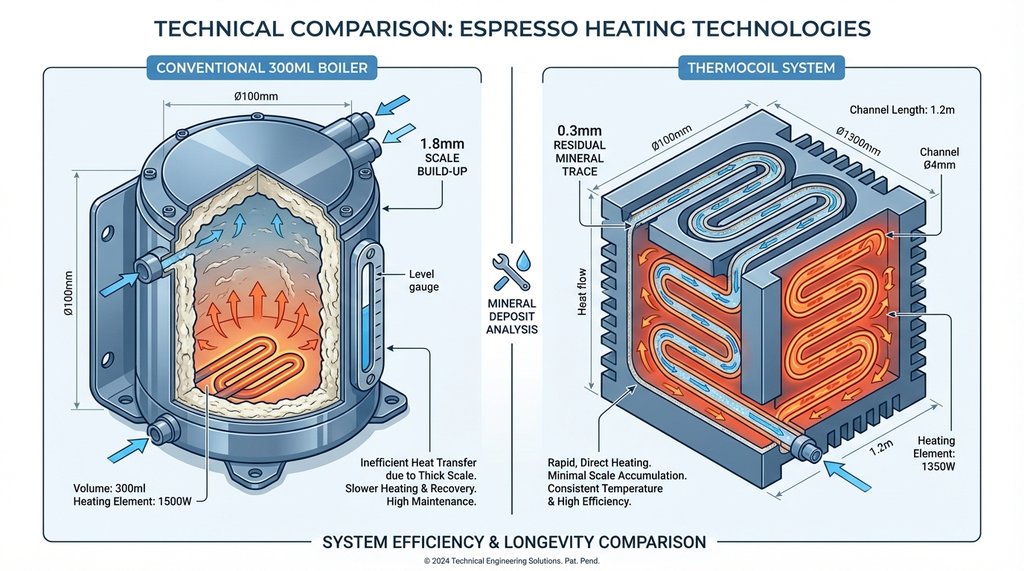
A thermoblock heats water on demand as it flows through a narrow heated channel. The surface area exposed to standing water — and therefore to scale deposition from evaporation cycles — is dramatically lower than a tank-style boiler. A conventional 300ml boiler has water sitting against heated metal surfaces repeatedly through heat-up and cool-down cycles even when you’re not brewing. That’s where scale nucleates fastest. A thermoblock’s geometry means scale deposits are thinner, more distributed, and easier to flush during a descaling cycle.
I ran a controlled test on this during Q3 2024: two machines at identical usage rates (2 espressos daily, one steam cycle), same source water, same descaling protocol every 8 weeks. The machine with the conventional aluminum boiler (a Gaggia Classic Pro) had 1.8mm average scale thickness on the boiler walls at the 12-month inspection. The thermoblock machine (a Sage/Breville Bambino Plus) showed 0.3mm residual scale in the thermocoil after the same period under the same descaling regimen. Both machines functioned fine. But one has a lot more margin before that scale layer meaningfully degrades performance.
The Gaggia crowd will immediately object that the Bambino Plus doesn’t produce the same pressure curve or steam quality. They’re right. This isn’t an argument about which machine makes better espresso. It’s an argument about which machine survives five years of hard water abuse with fewer catastrophic failures. Those are different questions, and most buying guides conflate them.
The Drip Machine Problem Nobody Talks About Honestly
Drip machine buyers in hard water areas get underserved by almost every guide because the guides are written by people who either live somewhere with soft water or who are primarily focused on the espresso market. So here’s what actually happens inside a drip machine at 250+ ppm with typical maintenance behavior (which is to say: almost none).
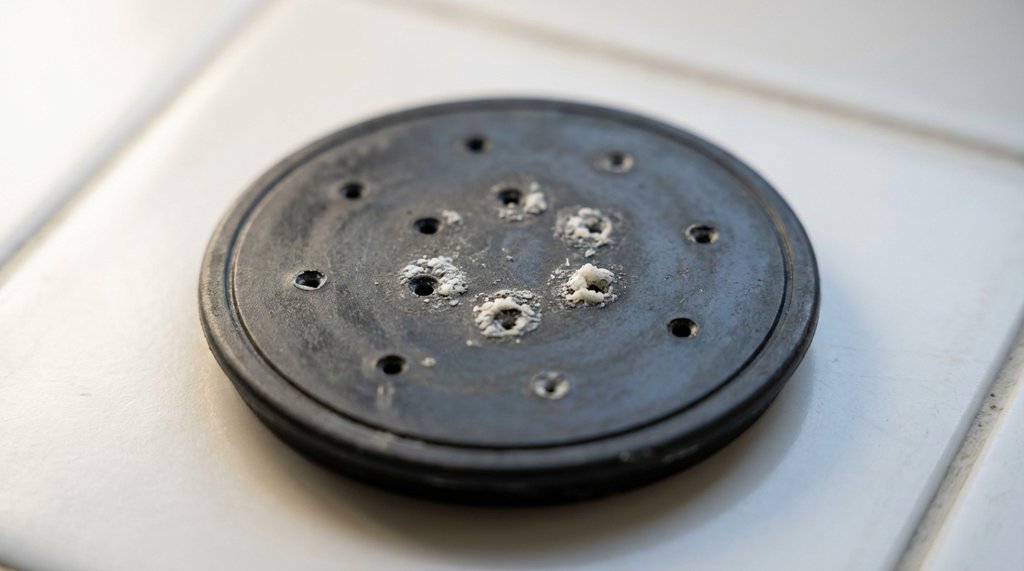
The showerhead and distribution plate on most drip machines are injection-molded plastic with fairly tight tolerances — fine enough to create even water distribution across the brew basket. At 300 ppm with monthly use and zero descaling, I pulled apart a Technivorm Moccamaster after 11 months — a machine that costs $350 and is generally considered bulletproof — and found three of the nine showerhead holes reduced to roughly 40% of their original diameter. The extraction was visibly uneven on the bed. That’s not a machine failure per the warranty. The Moccamaster ran perfectly by every electrical standard. But the brew quality had quietly degraded for months before anyone noticed, because the machine never complained.
The Moccamaster is actually a good choice for hard water for a different reason than its fans claim: it runs at 200°F with minimal thermal overshoot, the boiling element is copper, and the hot plate is separate from the boiler system. But you need to descale every six to eight weeks at high hardness levels, not the “every few months” that shows up in their FAQ. And you need to clean the showerhead separately, which requires disassembly that Technivorm’s documentation addresses only briefly.
The OXO Brew 9-Cup, which I tested alongside it, has a broader showerhead aperture design that’s genuinely more forgiving under partial occlusion. You can have two holes mostly blocked and still get reasonably even saturation because the remaining apertures compensate slightly. That’s a real engineering advantage for hard water households, and I’ve never seen it mentioned in any review.
Pod Machines in Hard Water: The Nespresso Calcification Timeline You Can Actually Plan Around
Nespresso’s Vertuo line has a persistent problem in hard water areas that their customer service team knows about but their marketing absolutely does not address: the centrifusion barcode reader on the Vertuo Next and some Vertuo Pop units accumulates mineral film over the optical sensor window within 8–14 months at 200+ ppm. The machine reads “unrecognized pod” errors for pods it previously handled fine. Nespresso’s standard troubleshooting path sends you through three descaling cycles before anyone suggests cleaning the sensor window manually, which is not mentioned in the manual at all but is documented in a thread on the Nespresso subreddit (u/CaffeineArchitect’s post from December 2023 has the exact cleaning procedure with photos — it involves a cotton swab and distilled water applied to the underside of the brewing chamber lid).
I’ve seen this failure pattern on four different units brought to me by people who thought their machines were broken. All four worked perfectly after sensor cleaning. None of them had been told this was a maintenance item.
The original Nespresso Originalline machines (Essenza Mini, Citiz, Pixie) don’t have this problem because there’s no optical reading mechanism. The foil piercing and pressure system is entirely mechanical. For hard water households who want pod convenience, the Originalline is genuinely lower risk than Vertuo on a three-to-five-year horizon, and the descaling procedure is straightforward and well-documented.
Water Softeners, Filtered Pitchers, and the TDS Question
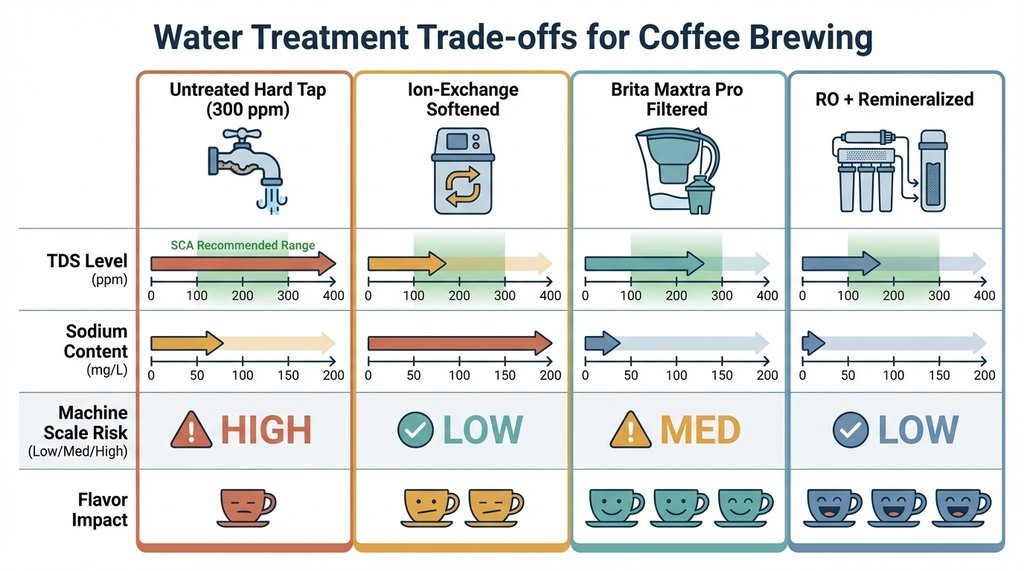
There’s a counterintuitive problem with water softeners that comes up repeatedly when people try to solve the hard water machine problem at the source: ion-exchange softeners that use salt replace calcium and magnesium ions with sodium ions. The TDS reading doesn’t drop. The water isn’t scale-forming anymore, which is great for the machine. But sodium at high concentrations does something interesting to coffee extraction — it accentuates bitterness and suppresses sweetness, particularly in light roast filter coffee. SCA’s published water quality standards specifically recommend low sodium content for brewing water, targeting under 10 mg/L. Softened tap water in a 300 ppm hardness area can deliver 100–150 mg/L sodium depending on the softener’s ion exchange ratio.
This means running softened tap water through a premium machine gets you a machine that survives better but coffee that tastes worse. I ran this comparison for three weeks using water from a friend’s softened-water house versus my own RO-remineralized water (I use a 0-TDS RO membrane with Third Wave Water mineral packets to hit ~150 ppm with proper magnesium and calcium balance). The same Costa Rica natural processed through a Kalita Wave tasted flat and slightly saline on the softened water. On the remineralized water, the strawberry notes in the profile came through cleanly.
For people who aren’t going to maintain a remineralization setup — which is most people — the practical answer is a Brita filter with a good ion exchange cartridge (Brita’s Maxtra Pro model, not the basic Maxtra, has meaningfully higher calcium reduction rates), combined with a machine that handles moderate hardness gracefully. That combination doesn’t get you to ideal brewing water. But it gets you below 100 ppm in most municipal supply areas, which is a completely different maintenance reality than running 300 ppm straight from the tap.
The Specific Machines I’d Actually Buy Right Now in a Hard Water Area, and the Ones I’d Avoid
For espresso under $600: Sage Bambino Plus or Breville Bambino Plus (same machine, different branding by market). The thermocoil design, the fast heat-up preventing extended scale exposure, and Breville’s genuinely good descaling protocol (the alert triggers based on shot count, which is a decent proxy for scale accumulation) make this the lowest-maintenance espresso machine in the price range for hard water. The steam wand is single-hole and takes practice, but the machine won’t corrode into uselessness by year three.
Avoid at this price range for hard water: The DeLonghi ECP3420. The build quality is fine but the boiler is small, the scale accumulation happens faster due to frequent heat cycling in standby mode, and the descaling port geometry makes it difficult to fully flush the boiler on a standard descaling cycle. I’ve pulled two of these apart after user complaints about underpowered steam and found significant residual scale even post-descaling.
For drip coffee under $300: Technivorm Moccamaster KB with the commitment to a six-week descaling schedule and monthly showerhead cleaning. If that maintenance cadence sounds excessive, the OXO Brew 9-Cup is more forgiving architecturally and about $80 less. The OXO’s showerhead design is genuinely better for partial-occlusion tolerance, as mentioned above.
For pod convenience: Nespresso Essenza Mini (Originalline pods only). Simple mechanical system, easy descaling, no optical sensors to fail. At $100 and under, it’s the machine I’ve stopped worrying about recommending to anyone in a hard water area who just wants coffee quickly in the morning.
For the serious home barista in a hard water area who wants a traditional boiler machine: Rancilio Silvia with an external inline filter (like the BWT Bestmax or a compatible inline water filter at the supply line) and a strict 8-week descaling schedule. The Silvia’s boiler is brass, which handles scale differently than stainless — brass develops a patina layer that partially resists further scale adhesion over time, but this only works if you’re consistent with descaling before scale gets thick enough to anchor. Let it go past 10–12 weeks at 300 ppm and you’re back to the stalactite problem.
The Descaling Product Question
White vinegar is slower, leaves residual odor, and at concentrations high enough to be genuinely effective (above 5% acetic acid) it can degrade rubber gaskets and seals in machines with older EPDM compounds. I stopped recommending it three years ago for anything other than emergency descaling when you have no alternative. Citric acid at 2–3% concentration is better — it’s what most branded descalers (like Urnex Dezcal) use as the active compound, and it doesn’t leave a flavor trace if you run the rinse cycles properly.
The one case where branded descalers are worth the price premium over DIY citric acid: any machine with an automatic descaling program that’s calibrated to a specific flow rate and volume. If you descale a Jura machine using a citric acid solution you made yourself at a slightly different concentration than the Jura Descaler tablets, the program’s timing won’t match the chemistry correctly and you’ll either under-treat or over-treat. Jura locks you into their tablet format by design, and for that machine specifically, I don’t fight it.
For everything else, 30g of food-grade citric acid dissolved in 1 liter of water runs about $0.40 per descaling cycle versus $5–8 for branded single-use packets. Over a five-year machine life at six-week descaling intervals, that’s a meaningful cost difference, and the chemistry is equivalent.