
Somewhere around my third visit to the Black Sheep on Tottenham Court Road, I started tracking my sleep onset times after afternoon drinks. Not systematically — just a notes app habit. What I found after about six weeks of intermittent logging was consistent enough that I stopped ordering anything past 2pm there, which is a rule I don’t apply anywhere else in London.
That’s not a complaint. It’s the starting point for understanding what their Robusta-first sourcing actually does to you physiologically, and why comparing it to your usual Arabica flat white requires more than just looking at the menu caffeine estimates — which, based on what I’ve seen, are routinely underspecified.
The raw numbers, before they get complicated
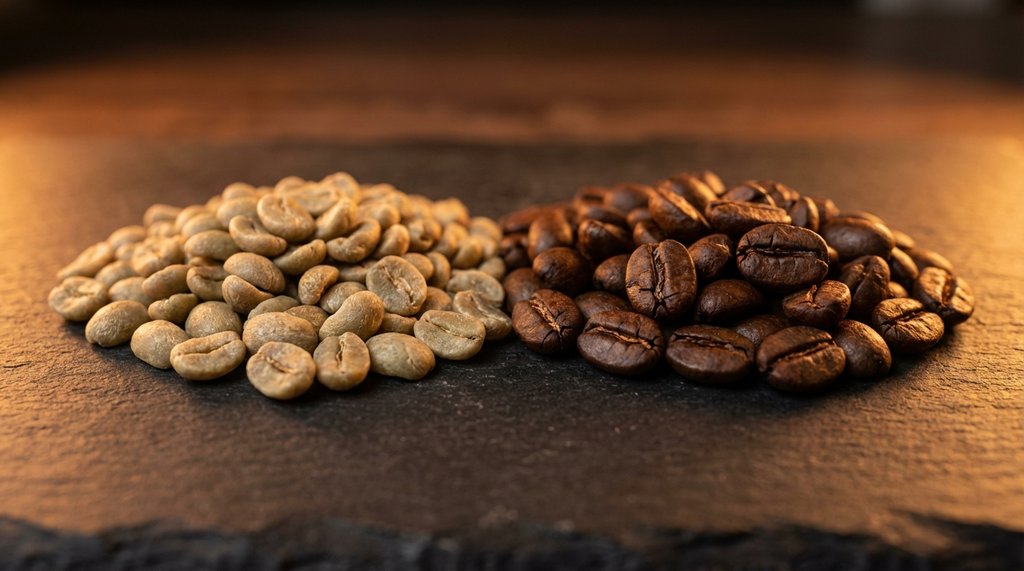
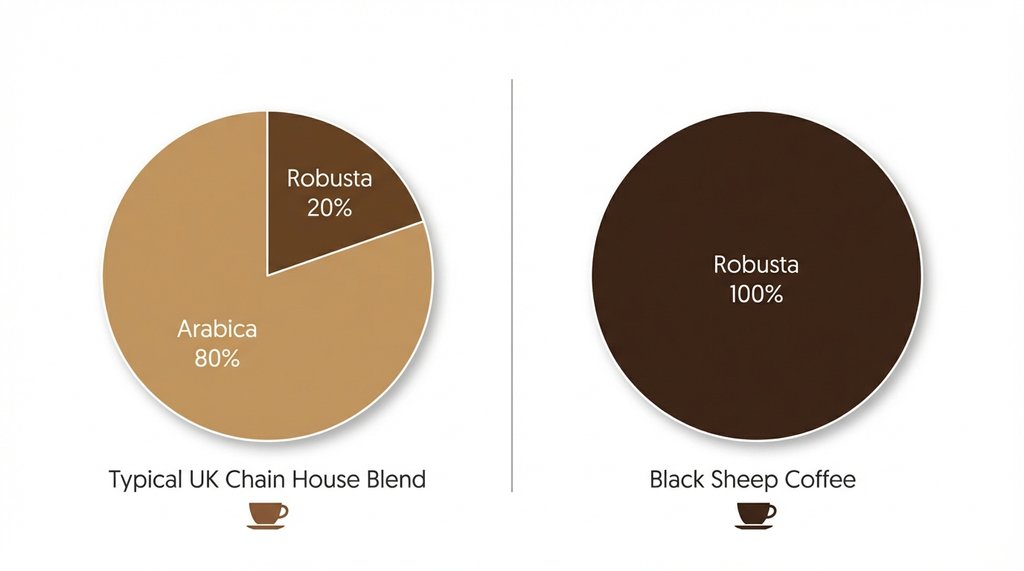
Robusta (Coffea canephora) carries roughly 2.7% caffeine by dry bean weight. Arabica (Coffea arabica) sits around 1.5%. That differential — almost exactly 1.8x — is consistent enough across varieties that you can use it as a working multiplier. Black Sheep uses 100% Robusta across their core espresso menu. Most independent specialty shops in the UK, and all the major chains, run Arabica-dominant blends, with maybe 10-20% Robusta for crema stability and body.
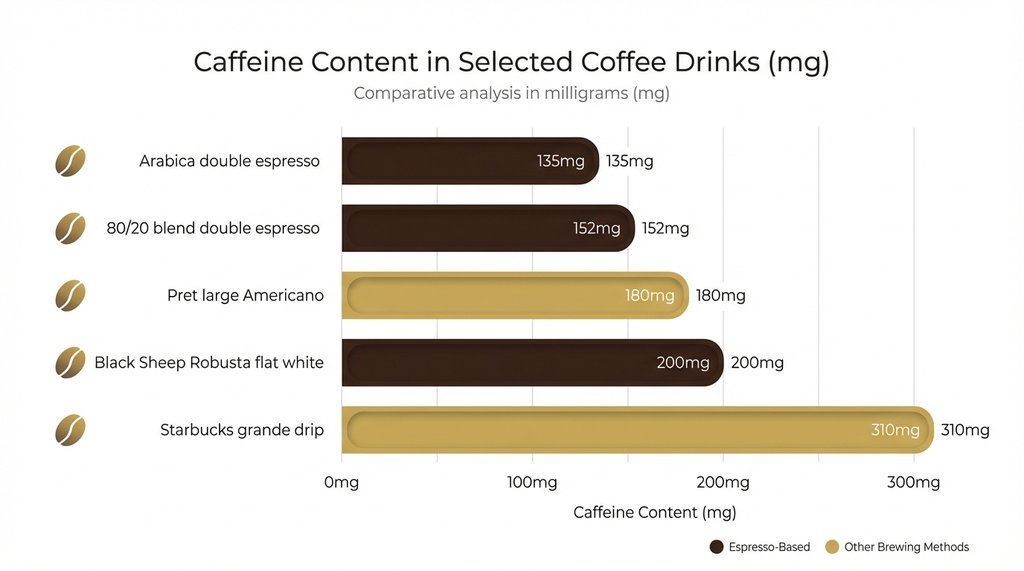
Run the arithmetic on a double espresso pull. Standard dose is 18g of grounds for a double. At 1.5% caffeine content, a full Arabica double extracts roughly 120-150mg of caffeine depending on extraction rate. At 2.7%, the same 18g dose from a Robusta blend yields 180-270mg. Black Sheep’s published estimate for a flat white is around 200mg. That tracks.
For context: a standard Pret Americano runs about 180mg for a large. A Starbucks grande drip sits at roughly 310mg. So Black Sheep’s numbers aren’t unprecedented — but the delivery mechanism is different, and that matters in ways the headline figure doesn’t capture.
What I assumed was wrong
My initial read was that the caffeine curve would be steeper but similarly shaped — hit harder, fade at the same rate. That’s not what I logged. The subjective onset felt compressed, maybe 15-20 minutes post-drink versus the 30-45 I’m used to from Arabica espresso. I initially chalked it up to the higher absolute dose, but there’s a plausible biochemical wrinkle worth knowing about.
Robusta has nearly double the chlorogenic acid content of Arabica — some analyses put it at around 7-10% of dry weight versus 4-6% for Arabica. Chlorogenic acids partially inhibit glucose absorption and modulate gastric emptying rate. There’s research suggesting they can actually accelerate gastric motility in some contexts, which would push caffeine toward the small intestine — the main absorption site — faster. I can’t point to a clean RCT that confirms this is the operative mechanism in espresso-format drinks specifically, but it aligns with what I was logging well enough to take seriously.
The counterpoint I’d heard — that Robusta’s higher acid content slows absorption — appears to be based on a misapplication of chlorogenic acid research from oral glucose tolerance studies. Different context entirely.
The comparison most people make is slightly wrong
The standard framing is “Robusta has more caffeine than Arabica.” That’s true but incomplete in practice, because commercial Arabica blends aren’t pure Arabica. Many of the Lavazza and Segafredo blends that most cafés use for house espresso are typically 85-90% Arabica with a Robusta component for crema. Costa’s house blend runs closer to 80/20 Arabica-Robusta. So the real comparison isn’t Arabica vs. Robusta — it’s predominantly Arabica blends vs. pure Robusta.
That gap is larger than people expect. An 80/20 Arabica-Robusta blend at 18g dose yields roughly 145-160mg caffeine. Pure Robusta at the same dose: 190-245mg. The overlap in the middle — particularly if a café is pulling slightly shorter shots, which some do with Robusta to manage bitterness — can bring numbers within 20-30mg of each other. But at Black Sheep’s typical extraction parameters, you’re consistently looking at a 40-70mg premium over a comparable-sized drink from a mainstream chain.
The bitterness problem and what it actually means for caffeine concentration
Here’s the part that bit me early on. Robusta tastes more bitter than Arabica at the same extraction ratio. The reflex response from baristas who aren’t calibrated for Robusta is to pull shorter — reduce extraction time to cut the perceived harshness. I’ve watched this happen at shops outside of Black Sheep that briefly experimented with Robusta-heavy blends. What happens when you pull a shorter shot from the same dose of Robusta grounds? You extract a slightly lower percentage of total caffeine, but because your yield volume is also lower, the caffeine per milliliter goes up. The drink tastes less bitter but delivers a more concentrated caffeine load in a smaller liquid volume. People drink it faster. The effect is front-loaded.
Black Sheep’s baristas are trained specifically for Robusta dialing-in, so this isn’t an issue at their own stores. But it’s worth understanding if you’re trying to replicate the experience elsewhere or calibrate expectations from a café using Robusta who clearly isn’t.
Who actually notices the difference, and under what conditions
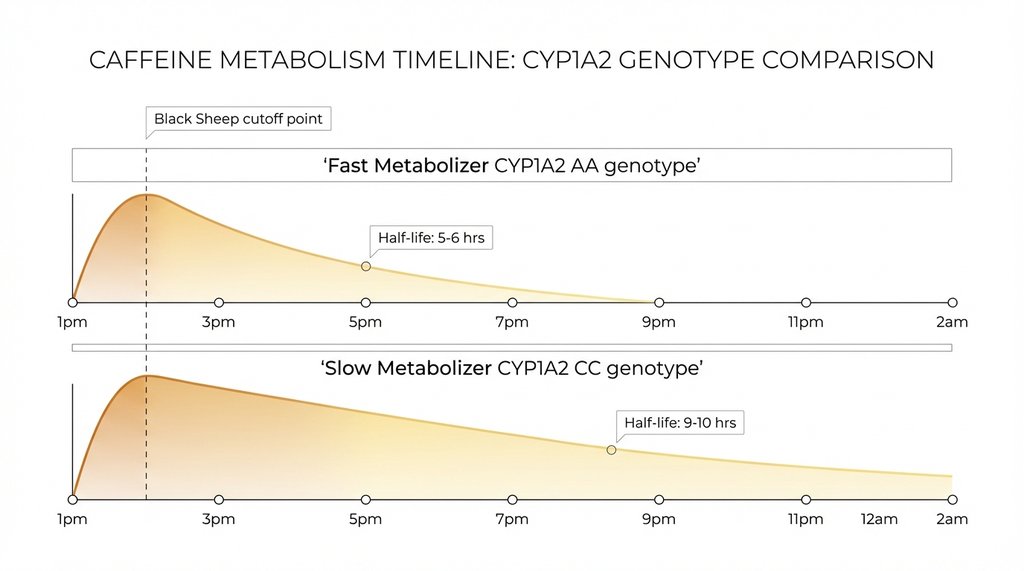
Caffeine sensitivity varies by CYP1A2 genotype — slow metabolizers hold caffeine in plasma significantly longer than fast metabolizers. For slow metabolizers (roughly 50% of the population), the effective half-life can stretch to 9-10 hours rather than the standard 5-6. A 200mg drink at 1pm doesn’t fully clear until somewhere between 11pm and 1am for slow metabolizers. The elevated baseline from a Robusta drink — call it 50mg higher than an equivalent Arabica drink — translates directly to a proportionally extended clearance window.
I’m a slow metabolizer. Confirmed through 23andMe CYP1A2 variant — the rs762551 CC genotype. The 2pm cutoff rule isn’t arbitrary anxiety; it’s me applying what I know about my own clearance rate to a drink that sits measurably higher than what I’d normally order.
If you’re a fast metabolizer, Black Sheep’s Robusta likely feels strong for 90 minutes and then levels out without particularly disrupting your evening. If you’re not — and there’s no reliable way to know without genetic testing — the afternoon window matters more than the absolute caffeine number.
What Black Sheep is actually selling
The Robusta positioning is deliberate brand differentiation in a market where every independent specialty café is competing on single-origin Arabica provenance. It’s also genuinely cheaper to source high-quality Robusta than equivalent-grade Arabica — the premium Ugandan and Vietnamese Robusta Black Sheep sources doesn’t command the same auction premiums as Ethiopian or Colombian specialty Arabica. The value proposition is real. The caffeine argument (“more caffeine, better value”) is one they lean into in their marketing, and it’s not dishonest — it just requires the context above to mean anything useful to a consumer.
The one thing their marketing underplays is the flavor mechanism. Robusta’s intensity isn’t just caffeine. The lower lipid content means a different extraction dynamic on espresso machines calibrated for Arabica. The crema is visually richer — more CO2 trapped in the emulsion — and dissolves slower. The body is heavier but the sweetness ceiling is lower. People who describe Black Sheep as stronger are usually conflating multiple sensory signals, not just caffeine perception. That’s worth separating out, because “strong-tasting” and “high-caffeine” don’t always move together, and at Black Sheep they happen to correlate in the same direction.
A practical comparison if you’re making a decision
If you’re switching from a daily Starbucks latte (about 150mg for a grande) to a Black Sheep flat white (circa 200mg): that’s a 33% increase in caffeine dose, delivered in a slightly faster-absorbing format from a Robusta extraction. It won’t wreck you if you’re a morning drinker. If your current café is a smaller independent pulling Arabica double espresso drinks, the gap is narrower — maybe 30-50mg — and whether you notice it will depend almost entirely on your individual sensitivity and what time of day you’re drinking.
The headline figure of nearly double the caffeine of Arabica that circulates online is technically accurate at the bean level but functionally misleading for drink comparisons, because nobody is comparing pure Arabica to pure Robusta in equivalent real-world drinks. The actual difference, drink to drink, is meaningful but not dramatic — unless you’re comparing to one of the coffee-shop chains running very conservative extraction ratios on light Arabica roasts, in which case you might be looking at a genuine 60-80% increase. At that range, you’d feel it even with average sensitivity. Plan accordingly.