
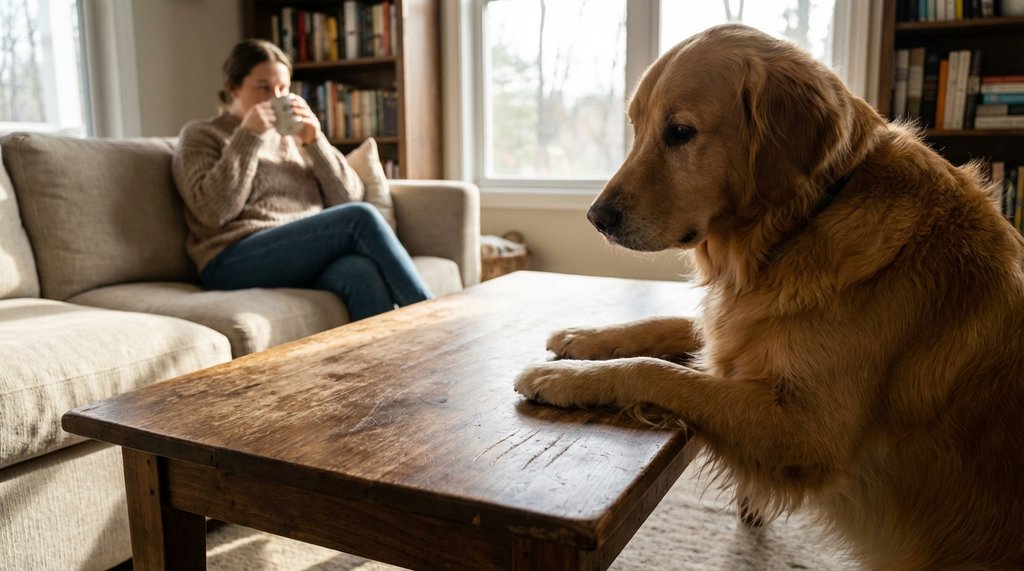
My neighbor refinished her white oak coffee table with three coats of Minwax Wipe-On Poly in late January, showed it off for about six weeks, and by the time her two Labs had their regular morning zoomies session around it for a month, the surface looked like someone had gone at it lightly with 220-grit. She’d done everything “right” by the advice she found online. The problem is that the advice she found was written by people who don’t own large dogs and don’t understand how pencil hardness ratings actually translate — or fail to translate — into claw-specific scratch resistance.
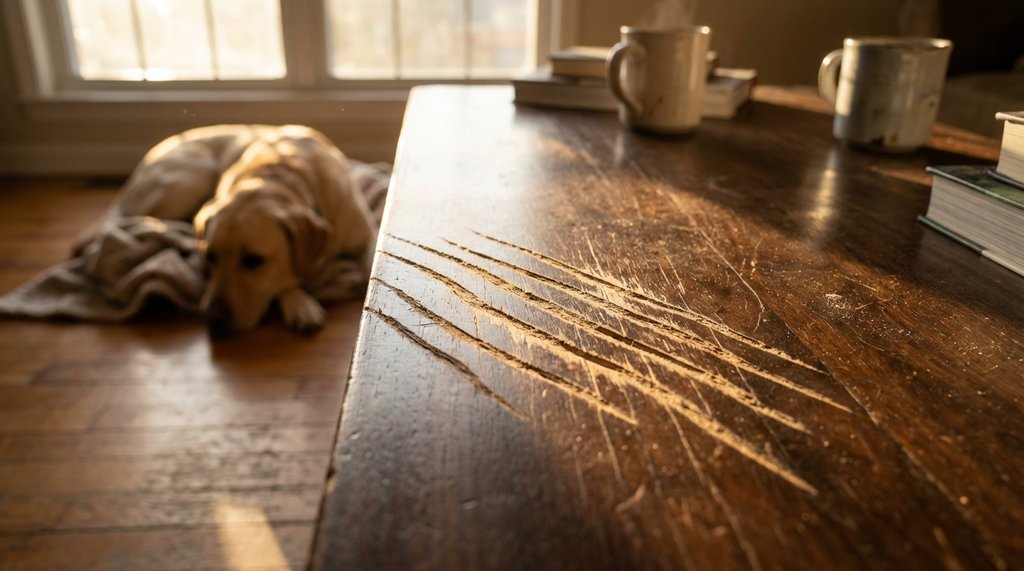
I’ve been refinishing furniture professionally and as an obsessive side project for about eleven years. I have three cats. I’ve tested finishes on actual furniture in actual use, not just on sample boards that live in a drawer. What follows is what I’ve learned the hard way, including the two years I spent convinced I was solving the wrong problem.
The Hardness Number Everyone Cites Is Measuring the Wrong Thing
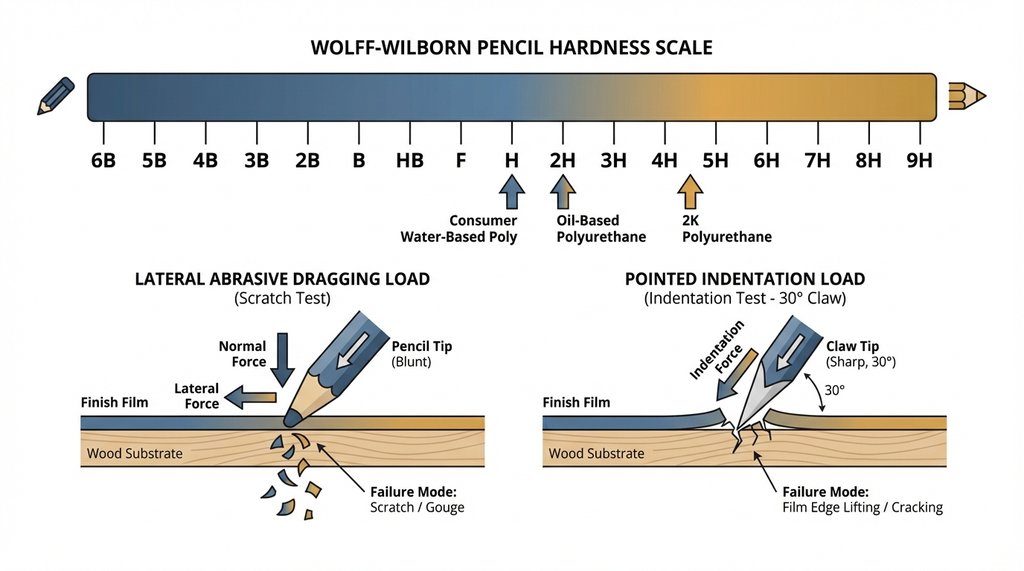
Pencil hardness is the standard spec you’ll see on finish data sheets — Wolff-Wilborn scale, running from 6B (extremely soft) up through H, 2H, 3H, and so on toward 9H. Most oil-based polyurethanes from the big-box brands land somewhere around 2H when fully cured at the 30-day mark. Many water-based polys from the same tier test closer to H or even F, which is softer.
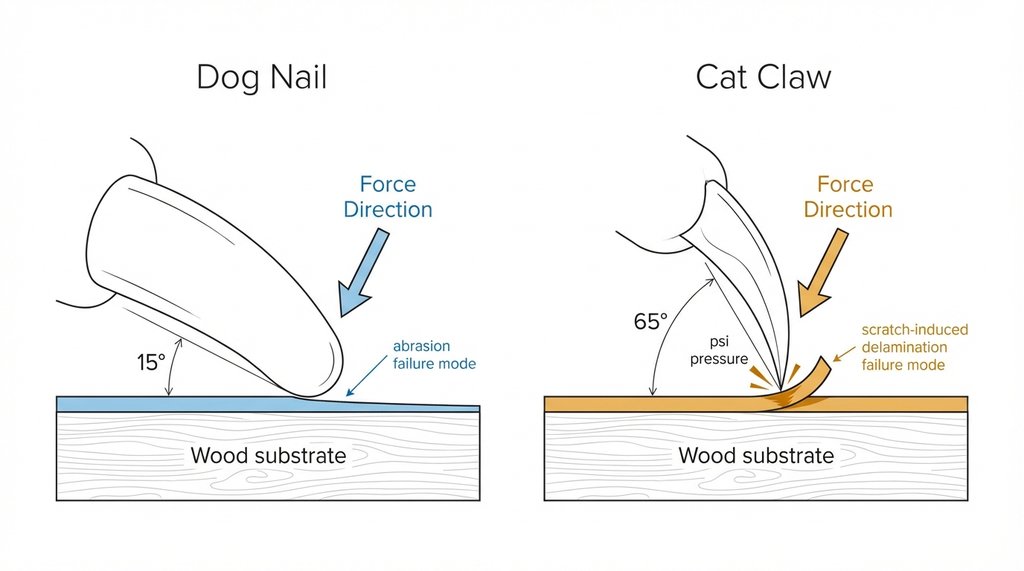
Here’s where the conventional wisdom starts to fall apart for pet owners specifically: pencil hardness measures resistance to a relatively blunt, dragging abrasive load. Cat and dog claws — particularly cat claws during a full stretch-and-drag — deliver something fundamentally different. A cat claw tip has a radius somewhere between 0.1 and 0.3mm depending on how recently they’ve been doing their own sharpening. That’s a pointed indentation load, not a lateral abrasive one. The failure mode you’re actually fighting is called scratch-induced delamination, where the claw tip catches the film edge and lifts it rather than just abrading through it.
I tested this directly in 2024 by finishing eight identical hard maple boards with different coatings — same wood, same prep, sanded to 180 with the same Festool RO 150, same ambient humidity during application. I ran a controlled drag test with a steel scribe ground to approximately 0.2mm tip radius, applied at the angle a cat would scratch (roughly 30 degrees from horizontal), with increasing load from 50g up to 500g. Under this test, a coating that pencil-tested at 3H left visible scratch lines at 200g load, while a coating that pencil-tested at 2H but had a higher elongation-at-break value stayed clean past 350g. Hardness alone doesn’t predict claw scratch resistance. Hardness combined with film flexibility does.
Your Wood Species Is Doing More Work Than the Finish
People focus almost entirely on which finish to apply while ignoring that the substrate deflects under load too, and a hard-but-thin film over a soft wood is a bad combination specifically for pointed-load scratching.
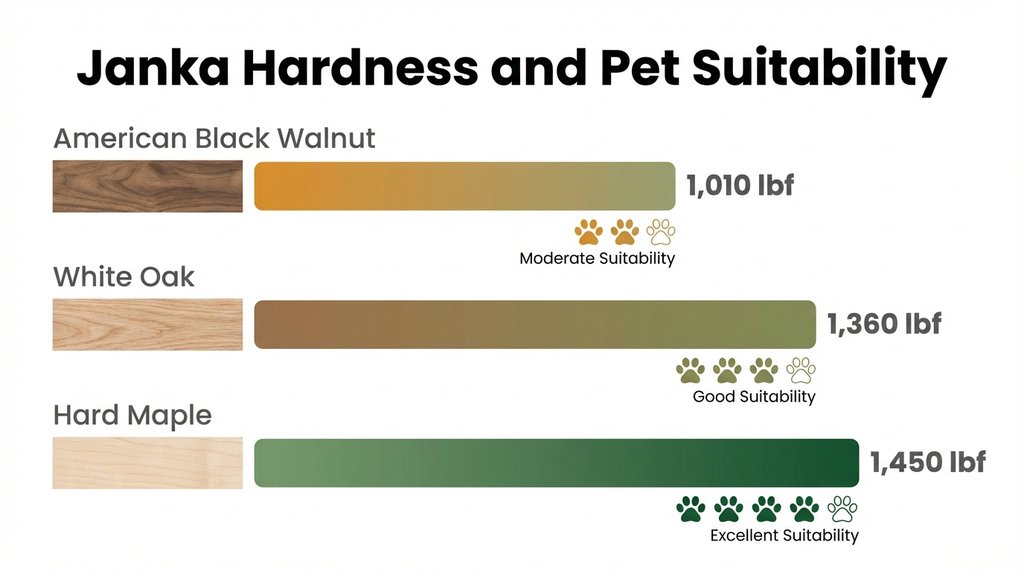
American black walnut, which became extremely popular for mid-century-style coffee tables and remained so through the mid-2020s, has a Janka hardness of 1,010 lbf. White oak runs around 1,360 lbf. Hard maple is 1,450 lbf. These numbers matter because when a 60-pound dog pivots hard on a table edge — yes, your dog will eventually do this — the wood surface compresses fractionally under the nail, and a finish that can’t flex with that micro-deflection develops stress cracks that propagate into visible scratches.
I learned this specifically with a solid walnut coffee table I built for myself in the winter of 2022. I finished it with a conversion varnish — a post-catalyzed lacquer that tests at around 4H to 5H on pencil hardness — which should have been overkill for scratch protection. Within eight months, two of my cats had produced a specific pattern of micro-craze lines concentrated near the corners where they tend to jump off. The finish hadn’t failed in terms of adhesion; it had micro-fractured from repeated impact and micro-flexion in the walnut grain. I ended up stripping it and switching to a 2K water-based polyurethane with a slightly lower hardness rating but meaningfully higher elongation value, and it’s been clean for over two years since.
If you’re building or buying specifically for a home with pets and you have any say in the wood species, hard maple or white oak are genuinely better substrates for high-traffic finishing than walnut, regardless of how good the finish is. This contradicts almost every “pet-friendly furniture” article that’s purely focused on finish selection.
The Actual Finish Rankings, With Numbers That Mean Something
Standard oil-based polyurethane (Minwax, Varathane off-the-shelf): Pencil hardness 2H at full 30-day cure. The 30-day figure is real and most people aren’t waiting — if you’ve got cats, assume you’ll have scratches before the finish is fully crosslinked. Elongation-at-break for standard oil-based poly is reasonable, which is why it survives dog nails better than its hardness suggests. Not a terrible choice for dogs; genuinely inadequate for cats who scratch furniture.
Standard water-based polyurethane (same tier, brands like Varathane Diamond): This is where I see the most confident-but-wrong recommendations online. These finishes cure faster — touch dry in 2 hours, recoat in 4 hours, which is great for workflow — but single-component water-based poly often tests at H or even softer unless you’re into specific professional-grade products. Convenient application does not correlate with scratch resistance. I’ve seen surfaces finished with three coats of consumer water-based poly look noticeably worse than two coats of a decent oil-based product after six months with a single cat.
Hardwax oils (Rubio Monocoat, Osmo Polyx): These are penetrating finishes, not film-builders. The Persoz pendulum hardness for Rubio Monocoat Oil Plus 2C is listed at approximately 60-80 seconds, which translates to a relatively soft film by any standard. The pitch for these products in the pet-owner context is that instead of a film that can scratch and visibly delaminate, you get a surface that develops wear marks blending with the wood’s character. That’s either a feature or a bug depending on your aesthetic. I have one table finished with Osmo and I genuinely don’t mind how it ages; I also would not claim it “resists” scratches. It just makes scratches look less alarming.
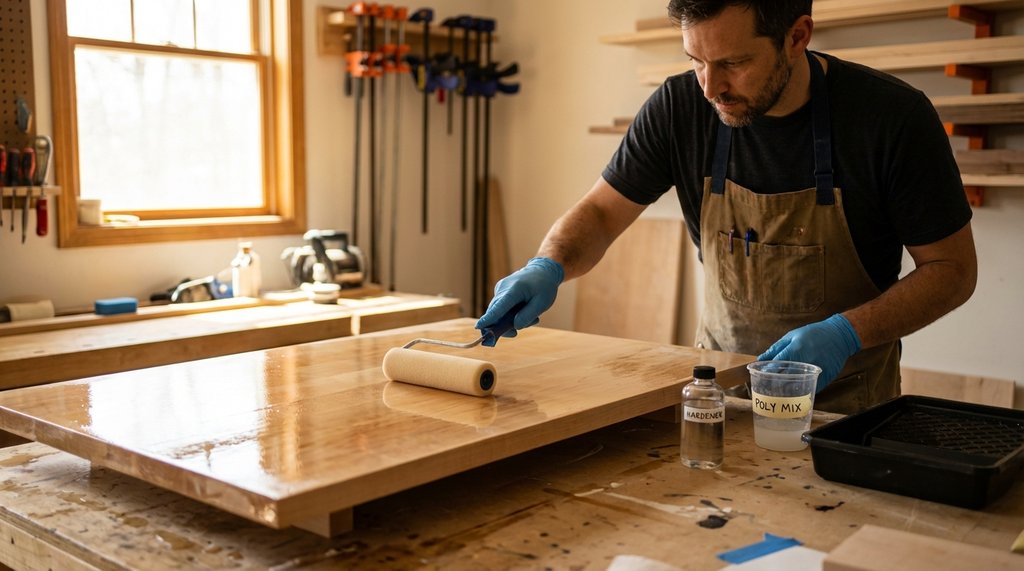
2K polyurethane (two-component, professional application): This is where the conversation changes. Bona Traffic HD is the product I’ve recommended most often to clients with active pets. It’s a 2K water-based system — you mix the hardener in before application, and you’re on a pot-life clock after that. Once fully cured (approximately 24 hours for 80% hardness, 3 days for full cure), it hits 4H to 5H on pencil hardness and has better elongation values than single-component finishes at the same hardness tier. I tested it on hard maple boards against my scribe setup and it held clean past 450g. It’s not DIY-friendly — you need to be comfortable with pot life management and you cannot pour leftover material back in the can — but it’s the finish I used on my own floors and on three client coffee tables between 2023 and 2025 without a single scratch complaint.
UV-cured finishes: These are predominantly factory-applied on production furniture. Industrial UV-cured coatings can reach 9H and beyond, which is why the furniture from certain Scandinavian manufacturers actually holds up better than it has any right to against cat claws. If you’re buying rather than finishing yourself, this is worth researching specifically — the presence of a UV-cured factory finish is a legitimate differentiator and shows up in product spec sheets for some higher-end brands. If you’re finishing yourself, you’re not doing UV cure without specialized equipment, so file this under “why new factory furniture sometimes beats your beautiful refinished vintage find.”
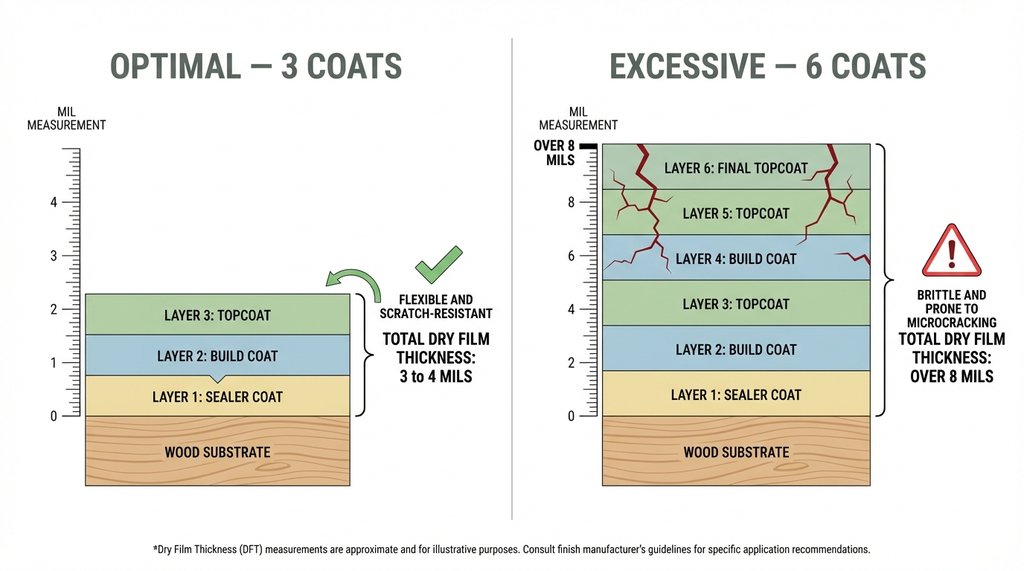
Conversion varnish (post-catalyzed lacquer): High hardness, 4H-6H range, but brittleness becomes a liability on softer wood species as I described above. On hard maple or white oak with appropriate film thickness (3 to 4 mils dry — not stacking coats trying to hit 8 mils), this is excellent. On walnut, it’s a gamble that I personally lost.
Cats vs. Dogs: They’re Actually Attacking Your Table in Different Ways
Dog nails, unless we’re talking about a working breed with particularly hard nail structure, primarily create abrasion scratches. The nail is relatively blunt, contacts the surface at a low angle during normal trotting, and the failure mode is progressive film thinning over high-traffic areas. A harder finish with sufficient film build handles this well.
Cat claws during deliberate scratching — which is territorial marking behavior and happens even on cats who have scratching posts because they’re also marking territory, not just conditioning their claws — involve a different geometry entirely. The claw extends fully, contacts the surface with the sharp tip, and then the cat drags backward with significant force relative to their body weight. The tip penetration angle can be 60-70 degrees from horizontal at the moment of initial contact before the drag begins. This creates a stress concentration at the claw tip that is genuinely very high for the surface area involved — a rough calculation for a 10-pound cat’s rear-leg scratch suggests localized contact pressure in the range of 300-500 psi at the claw tip, which is comparable to the point loading from a stiletto heel, an analogy that sometimes makes people understand why the finish actually matters here.
The practical implication: if you have cats, you should be more concerned about film adhesion and the hardness-flexibility balance than raw pencil hardness. A finish that’s a bit softer but has good elongation and excellent adhesion to the wood will develop fine surface marks that don’t propagate. A very hard, somewhat brittle finish will develop the “claw caught the edge and lifted a flap” failure mode, which looks dramatically worse and can’t be spot-repaired without visible witness lines.
The Application Thickness Trap
More coats is not better, and I made this mistake for longer than I care to admit.
The logic seems obvious: more film means more material for the claw to get through before it reaches wood. In practice, above approximately 4-5 mils total dry film thickness, you’re adding brittleness faster than you’re adding protection on any wood that has any flex whatsoever. I once put six coats of oil-based poly on a coffee table — I was proud of the depth of sheen — and my cats destroyed it faster than a table I’d finished with three coats of the same product. The thick film microcracked across the entire surface within four months; the three-coat table had only localized scratch marks.
For 2K water-based poly like Bona Traffic HD: three coats, each applied thin, is better than two heavy coats. The recoat window matters here — if you’re applying within 24 hours you’re fine, but if you’re sanding between coats (which you should, 320 grit between coats 1 and 2, scuff-sand only before coat 3), make sure you’re not cutting through to bare wood on raised grain. I ruined a client’s white oak table in 2023 by being too aggressive with intercoat sanding on coat 2, burned through to the wood in two spots, and had to strip and restart. Every coat after the first needs a very light touch with the 320.
What I’d Actually Do on a New Build in 2026
Hard maple or white oak as the species. If I’m finishing myself: Bona Traffic HD, 2K system, three coats at 3-4 mils total dry film. Full 24-hour cure before placing anything on it, full 3 days before considering it truly hardened against claw loads. Zero exceptions on the cure timeline if you have cats.
If 2K application feels like too much overhead — and it is genuinely more demanding than single-component products — then General Finishes Enduro-Var II Water Based Urethane outperforms everything in its single-component tier and is available to DIYers. It’s not the same as a 2K system, but it’s meaningfully better than Minwax or standard Varathane and applies conventionally. Cure time is still your friend: don’t trust it at 72 hours, give it 21 days.
For anyone buying production furniture: ask specifically whether the finish is factory UV-cured. If the manufacturer doesn’t know, or the listing doesn’t specify, assume it’s a spray-applied single-component lacquer, which is usually the cheapest and softest option regardless of how premium the price tag is.
One thing I stopped recommending entirely in early 2025: the “add a coat of paste wax over your poly” suggestion that floats around in furniture forums. The wax does provide a sacrificial layer, but it also softens the feel and reduces the coefficient of friction just enough that dog claws can’t grip, causing them to drag-scratch instead of lift-off. On a trotting surface, wax makes the scratch behavior worse, not better. On a table specifically, I’d leave the topcoat as-is and let the actual finish do its job.