
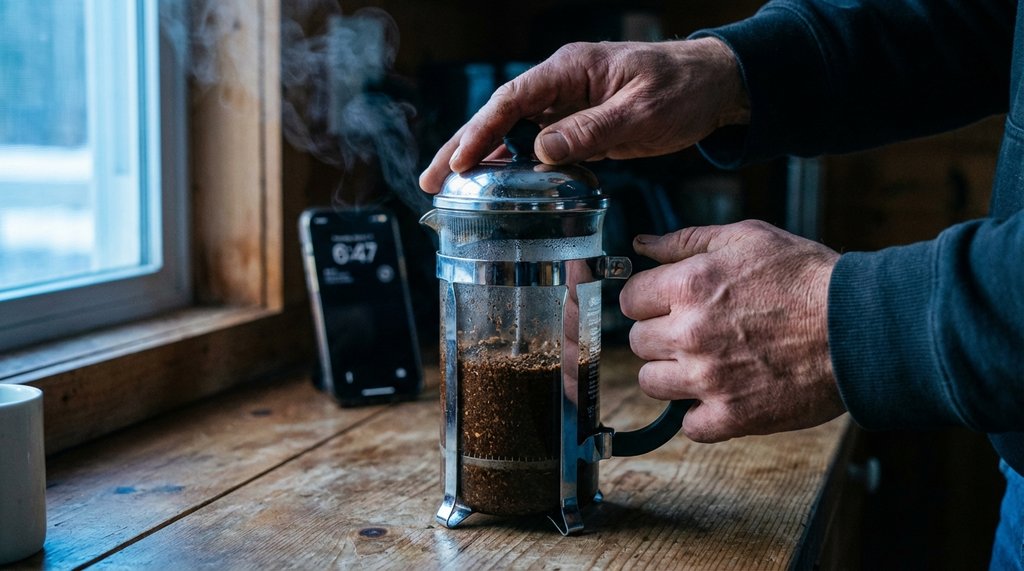
For most of my adult life, I set a French press going before I even brushed my teeth. 6:47 AM, coffee in hand, feeling like I was optimizing my morning. I genuinely believed I was ahead of everyone who needed two cups just to “wake up” — because I only needed one. It took an endocrinologist friend reviewing my salivary cortisol results over lunch to tell me, fairly bluntly, that I’d been accidentally blunting my natural morning cortisol awakening response every single day for probably a decade.
That was a strange thing to hear.
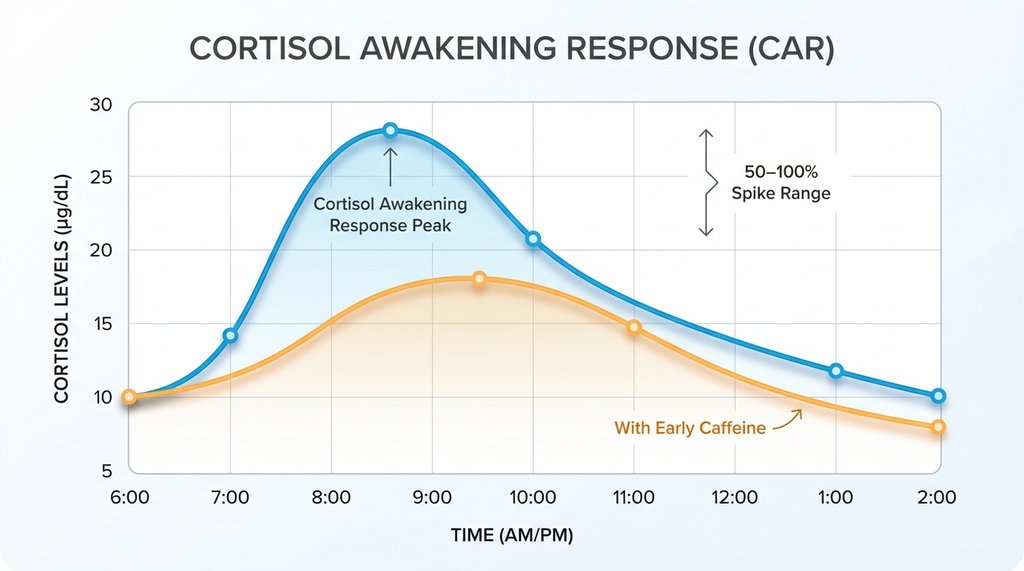
The mechanism here isn’t complicated once you stop thinking about caffeine as a stimulant and start thinking about it as an adenosine blocker with a cortisol interaction problem (especially relevant if you are factoring in changes to your caffeine metabolism over time). Your body already makes its own stimulant. Within 30 to 45 minutes after waking — with the precise clock time varying by chronotype — cortisol peaks as part of the cortisol awakening response (CAR). This is a hard spike, not a gradual rise. In healthy individuals, cortisol levels can jump 50–100% during this window, sometimes reaching 10–25 nmol/L in saliva (or 15–25 µg/dL in blood serum) depending on baseline.
What caffeine does during that window is compound the spike. You are boosting the response while simultaneously signaling your adenosine receptors to back off. The downstream problem isn’t that you feel worse in the moment; it’s that you’re accelerating tolerance to this combined cortisol peak. You train your body to expect an external chemical assist at the exact moment it should be performing autonomously. Over months and years, this matters. I had a mid-morning energy crash that I’d always attributed to “just how I am” — turns out I’d manufactured it.
The 9:30 AM figure that gets cited a lot comes from Andrew Huberman’s popularization of research on the CAR, though the underlying data on cortisol timing goes back considerably further in the chronobiology literature. For people waking between 6:00 and 7:00 AM, the 90-minute delay lands you at roughly 7:30–8:30 AM as a minimum, with 9:30 functioning as a conservative upper bound. If you’re waking at 7:30, that pushes the recommendation closer to 9:00–9:30.
Here’s where I’ll push back on something: the “just wait until 9:30” advice gets applied too rigidly, and for a specific group of people it creates a worse outcome than just drinking coffee at 7:00 AM. I’ve talked to several chronotype-late individuals — people who genuinely don’t feel awake until 8:30 or 9:00 AM — who were told to push their coffee to 10:30 or 11:00 AM. What happened in practice wasn’t enhanced cortisol sensitivity. It was disrupted work performance in the two hours before their first cup, followed by caffeine consumed too close to lunch, which then collided with their post-lunch circadian dip and made the afternoon worse, not better.
The research that the 90-minute rule rests on assumes a relatively “normal” chronotype with a waking time in the 6:00–7:30 AM range. For late chronotypes who wake at 8:30 or later, the CAR timing is shifted accordingly, and the 9:30 AM benchmark becomes almost meaningless. The honest application of this research is: wait 90–120 minutes after your wake time, not after a socially imposed alarm time.
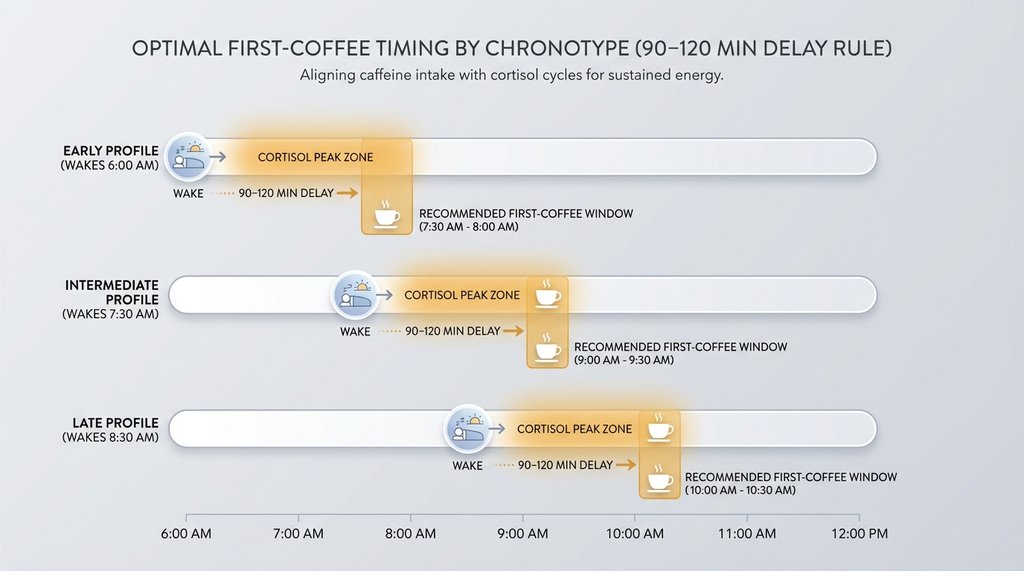
When I actually changed my habit — and this took about three weeks to stop feeling like deprivation — I moved my first coffee to around 9:15 AM. I wake at 7:10 most days, so that’s roughly 125 minutes post-wake. What changed wasn’t dramatic. I didn’t suddenly feel like a different person. What I noticed around day ten was that the mid-morning slump I’d experienced almost daily at around 10:45–11:00 AM became inconsistent, then largely disappeared. My second coffee — which I’d been having at around 12:30 — became genuinely optional maybe three or four days a week rather than a necessity.
The more measurable change came when I did a follow-up salivary cortisol test eight weeks after shifting the timing. I was using the DUTCH Plus test (which includes salivary sampling alongside the Dried Urine Test for Comprehensive Hormones), which samples cortisol at multiple points across the day. My morning cortisol came back at the high end of normal, whereas the previous test had shown a blunted response. That’s not a controlled study — too many variables changed across those eight weeks for me to attribute it cleanly to coffee timing. But it correlated with how I felt, and my practitioner flagged it as directionally consistent with what we’d expect.

A few practical things that don’t get mentioned in the headline versions of this advice:
Light first, coffee second. Getting outside or in front of a bright light source within ten minutes of waking helps sharpen the CAR timing. If your cortisol response is sluggish to begin with — which is common in people who’ve been doing the early-coffee thing for years — you’ll feel more of a functional difference from adding morning light than from adjusting coffee timing alone. These aren’t competing interventions. They’re additive.
The “but I can’t function without it” problem is real, but it’s temporary. The first four to seven days of pushing coffee back feel materially worse, especially if you’ve been waking and dosing caffeine within 30 minutes for years (which is heavily influenced by the exact caffeine dose in your cup). While this may involve mild withdrawal symptoms, it’s also your body relearning that the CAR is supposed to do the lifting. The grogginess in those first mornings is uncomfortable but it resolves. If it genuinely doesn’t resolve after two weeks, that’s worth looking at separately; chronic low-grade cortisol dysfunction is a real thing that coffee timing won’t fix.
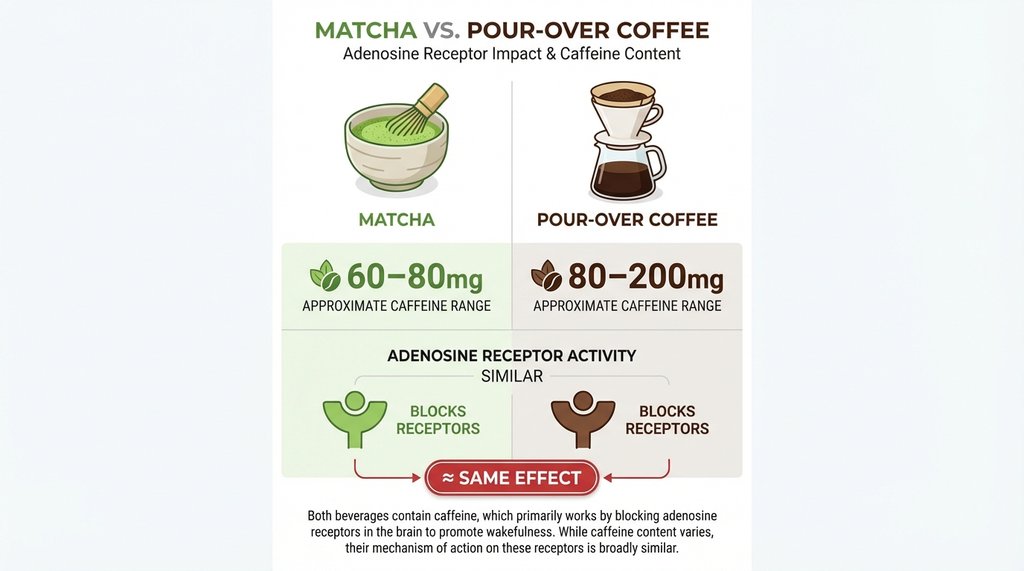
Don’t replace the coffee with tea and count it as waiting. I did this for about a week before realizing I was just administering caffeine in a format that felt more virtuous. A cup of matcha at 7:15 AM isn’t meaningfully different from a cup of pour-over at 7:15 AM in terms of adenosine receptor activity. If you want something warm in the immediate post-wake window, water, or a short black decaf if you need the ritual, but don’t outsmart yourself with the green tea workaround.
The version of this advice that circulates most widely oversimplifies in a specific direction: it treats the 9:30 AM guideline as a universal optimization rather than a starting point calibrated to a specific chronotype. It also tends to understate how much individual variation exists in CAR timing — not just by chronotype but by season, sleep quality, stress load, and age. Cortisol rhythm in someone dealing with chronic sleep disruption looks very different from the idealized curve that the 90-minute guideline is built around.
If you’ve been drinking coffee before 8:00 AM for years and you’re skeptical that the timing genuinely matters, the most honest thing I can tell you is: run the experiment for three weeks and actually track your energy curve across the day. Not how you feel at 7:30 AM with the coffee, but what your 10:30 AM and 2:00 PM states look like across two to three weeks of shifted timing. That’s where the difference shows up, and that’s what took me the longest to notice — because the early morning felt fine. It was the middle of the day where I’d been quietly paying the bill.