
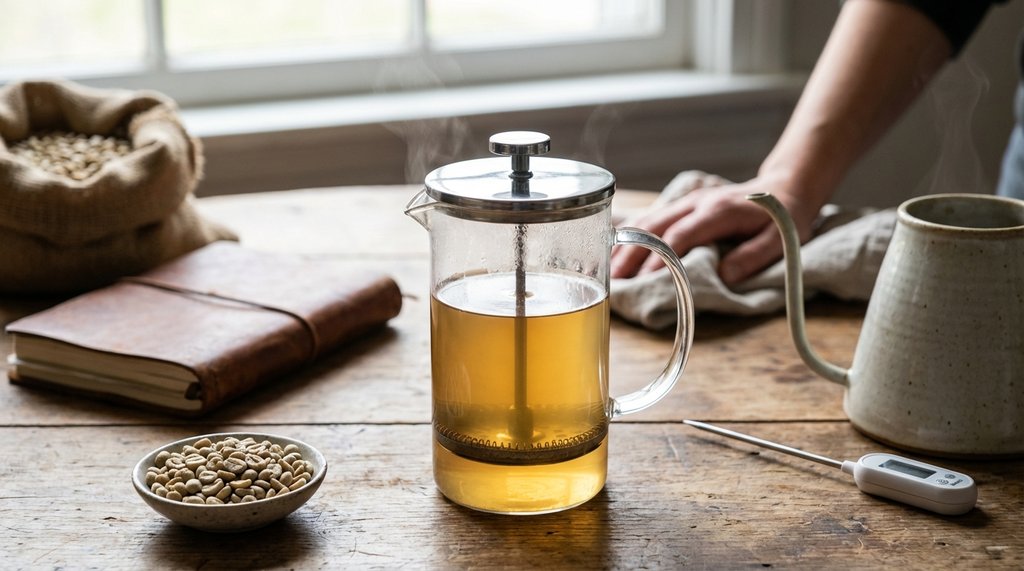
The first time I tried to brew a washed Ethiopian Yirgacheffe in a French press, I got hot leaf water with a faint memory of something floral. The bloom smelled incredible — jasmine, bergamot, a little stone fruit — and then the cup delivered almost none of it. I thought I’d gotten a bad bag. I hadn’t.
The problem was that I was treating a light roast exactly like I’d treat a medium, and French press has almost no tolerance for that mistake.
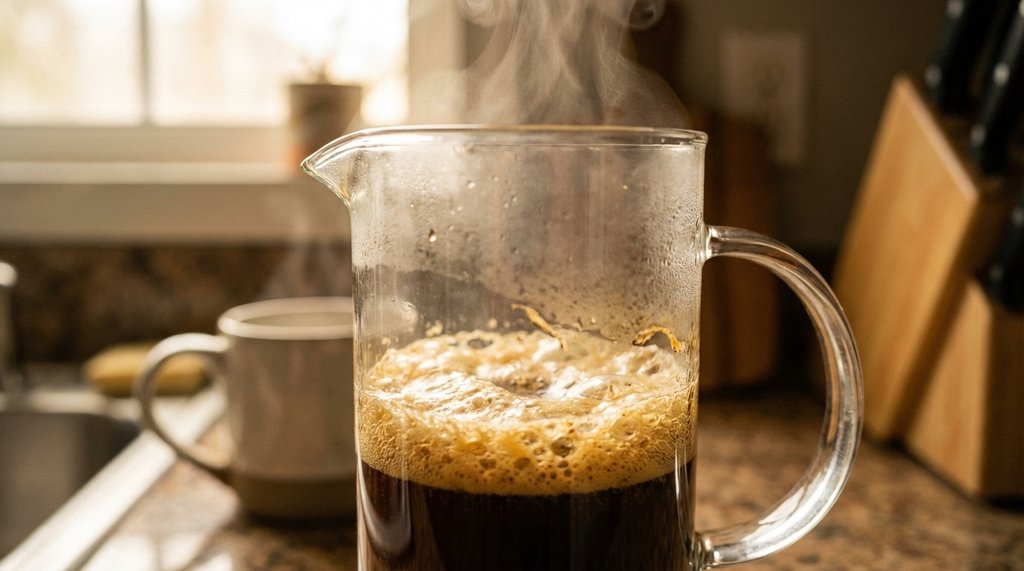
Why Light Roasts and French Press Fight Each Other (And Why You Should Make Them Work Anyway)
French press is a full-immersion brew method with no paper filter. That’s its whole personality. You get oils in the cup, you get body, you get sediment if you’re not careful. For medium and dark roasts, that texture carries the flavor. For light roasts — especially high-grown naturals and washed African coffees — the aromatic compounds that make them interesting are volatile, delicate, and the first to leave if your water is too hot or your steep time is wrong.
The conventional wisdom is “French press isn’t for light roasts.” I’ve heard this from baristas who should know better. What they mean is that their default French press technique doesn’t work for light roasts. That’s not the same thing.
A French press can produce a genuinely floral cup from a light roast. I’ve done it reliably enough to write down the parameters. But the margin for error is much smaller than people expect, and the failure mode is specific: you don’t get bitterness, you get nothing. A flat, watery cup that wastes whatever you paid for the coffee.
The Temperature Problem Is More Specific Than “Don’t Use Boiling Water”
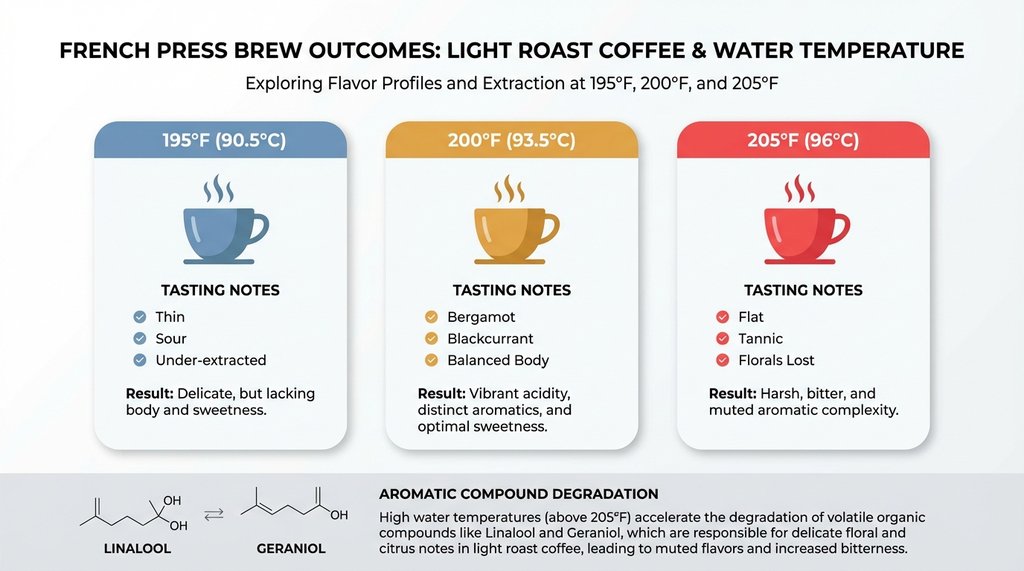
Every article you’ll find says something like “use water around 195°F–205°F for light roasts.” That range is basically useless. 195°F and 205°F produce noticeably different cups in a French press, and for a light roast trying to preserve floral volatiles, those ten degrees matter more than they would in, say, a pour-over with a paper filter mediating the extraction.
My current target for light roast French press is 200°F (93°C), measured with a thermometer at the moment of pour, not at boil. If you’re going off-kettle without a thermometer, that’s roughly 30–35 seconds off boil at sea level — though at anything above 4,000 feet, you’d need to rethink this entirely because your boil point is already lower.
I landed on 200°F after running the same Kenyan AA from a roaster I trust (Onyx Coffee Lab’s Kenyan Gakuyuini, picked up in November last year) at 195°F, 200°F, and 205°F across three consecutive mornings. Same grind, same ratio, same steep time. At 195°F, the florals were there but the cup was thin and slightly sour — under-extracted. At 205°F, the florals were gone and I got a flat, slightly tannic cup. At 200°F, I got bergamot and blackcurrant in the finish and enough body that it felt intentional rather than accidental.
The reason higher temperatures kill floral notes isn’t mysterious — aromatic compounds like linalool and geraniol, which are responsible for the jasmine and rose character in Ethiopian and Kenyan coffees, are easily masked by heavier, bitter compounds that extract quickly above 200°F.
Grind Size: Coarser Is Not Always Better
This is where I see the most confident wrong advice.
“Grind coarse for French press” is true for medium and dark roasts because they extract quickly and a fine grind causes over-extraction and bitterness. Light roasts are denser and harder to extract. A grind that’s appropriate for a medium roast in a French press is actually under-extracting a light roast — you get sourness and flatness, not the fruit and florals you’re after.
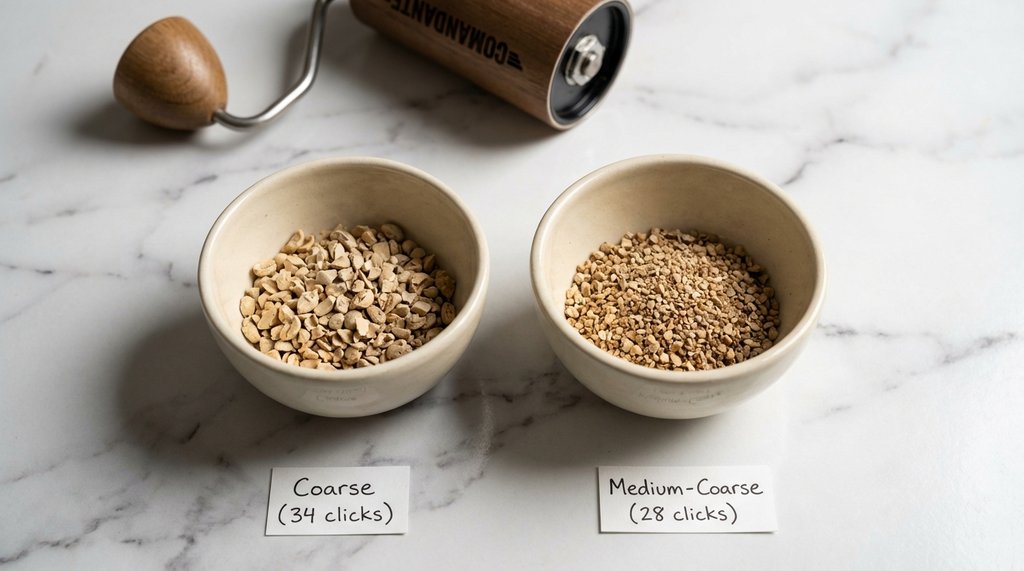
For light roast French press, I go medium-coarse, not coarse. On my Comandante C40 (stock axle), that’s around 28–30 clicks. On a Baratza Encore, that’s roughly 22–24. If you’re using a blade grinder, you can’t reliably do this — not because blade grinders are bad in a moral sense, but because the particle size distribution is too inconsistent to get predictable extraction from a dense light roast bean.
The distinction between “coarse” and “medium-coarse” sounds trivial until you measure it. Coarse on my Comandante is 33–35 clicks. Those 5–7 clicks represent a meaningful difference in surface area and extraction rate. When I first switched to light roasts in my French press, I was grinding at 34 clicks because that’s what worked for everything else. My cups were consistently under-extracted — low TDS, sour finish, no development. Dropping to 28 clicks at the same temperature and steep time fixed it. That was the primary variable.
Steep Time and the Bloom Step That Most French Press Users Skip
Standard French press advice: add water, stir, wait 4 minutes, press. For a medium roast, this is roughly fine.
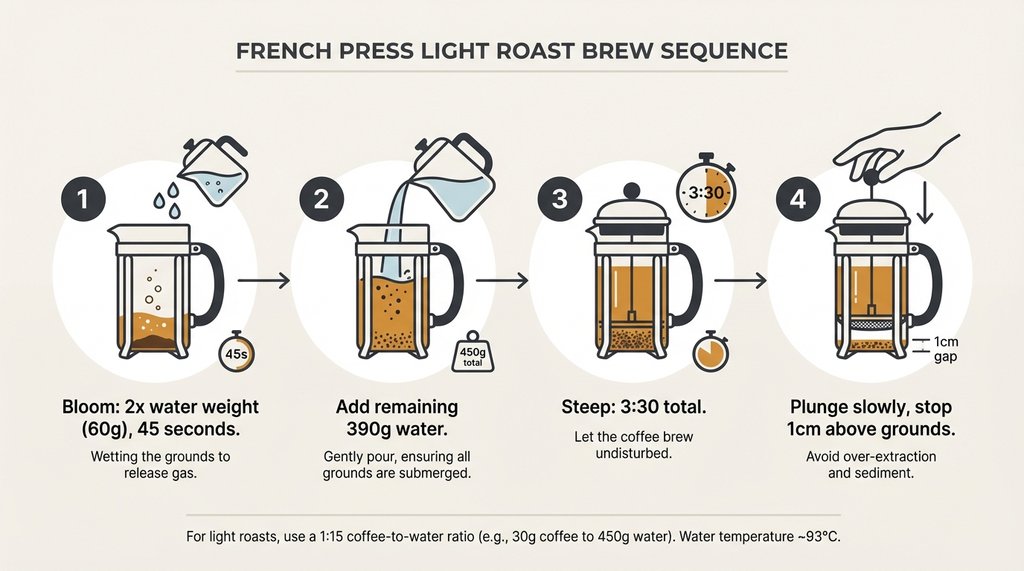
For a light roast, I add a bloom step that most people associate with pour-over. Here’s the sequence I’ve settled on:
- Pre-wet your grounds. Add about twice the weight of water to grounds (so for a 30g dose, add 60g of water), give it a quick stir to saturate all the coffee, and wait 45 seconds. This is the bloom. CO2 releases, the coffee bed de-gasses, and extraction starts evenly rather than in patches.
- Add remaining water and steep for 3:30. Not 4 minutes. 3:30 total from initial water contact, including the bloom. Light roasts, when ground medium-coarse and hit with 200°F water, extract faster than you’d expect. I’ve gone to 4 minutes and consistently gotten a slightly over-developed, flat cup. 3:30 hits differently — there’s brightness and lift in the finish.
- Don’t plunge hard. Press slowly and stop before the plunger hits the grounds. Forcing the last bit of water through the puck at the bottom stirs up fines and muds the cup. Leave a centimeter of space at the bottom and pour without tilting the press all the way.
The bloom step makes a noticeable difference with light roasts specifically because they’re denser and more uniform in size (specialty light roast tends to be better sorted), so the CO2 release is more vigorous. Skipping it means your first 60 seconds of extraction are uneven.
Ratio: This One Is Non-Negotiable
I use 1:15 by weight for light roast French press. 30g coffee, 450g water in a standard 600ml press.
The 1:17 ratio that’s common for pour-over produces a cup that’s too thin for immersion brewing — you lose body entirely and the cup starts tasting like expensive water. 1:15 gives you enough concentration to feel the oils and texture while still letting the florals register.
If your usual French press ratio is by volume (scoops), stop. A scoop of light roast coffee weighs meaningfully more than a scoop of dark roast because the beans are denser and less expanded. You’re probably over-dosing.
The One Thing That Will Still Ruin a Good Technique
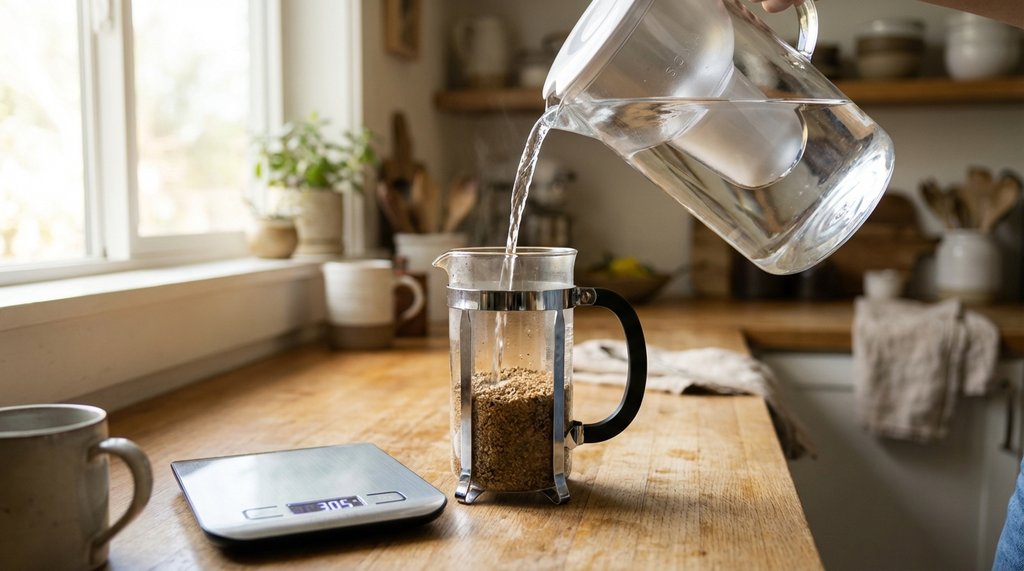
Water quality. I’m not going to do the full mineral lecture, but if you’re in a city with heavily chlorinated water, your floral notes are getting murdered before you ever touch temperature or grind. Chlorine and chloramine suppress aromatic perception. A Brita helps. Third Wave Water or similar mineral packets in filtered water are better if you’re serious.
I ran a side-by-side with tap water (NYC tap, which isn’t terrible) versus filtered water from a Soma pitcher using the same coffee, same everything. The tap water cup tasted clean but flat. The filtered cup had a clear jasmine note on the nose and a brighter finish. Same exact technique. The water was the only variable.
Quick Reference Parameters
For when you’ve already read all of this and just need the numbers:
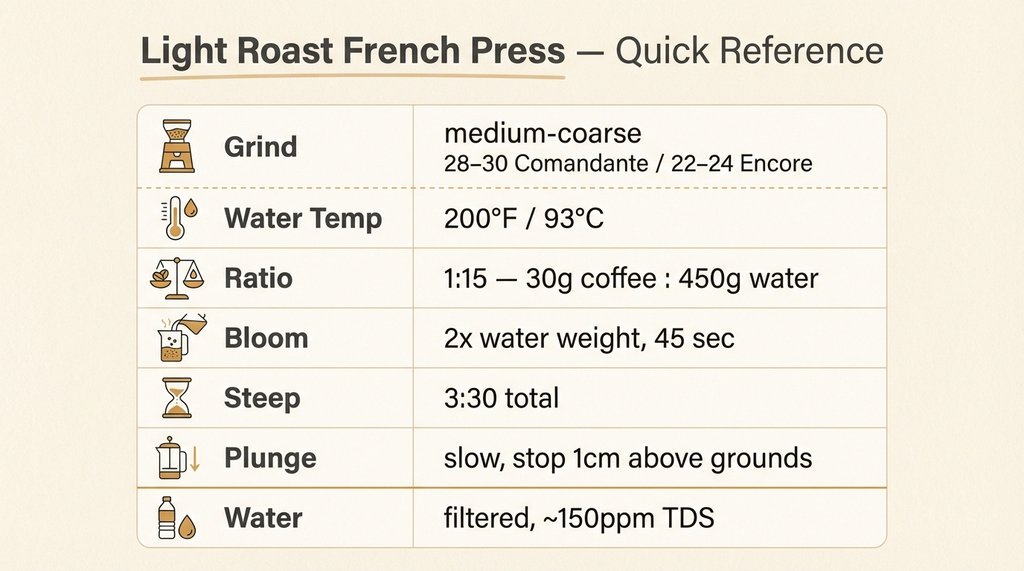
- Grind: Medium-coarse (28–30 on Comandante C40 / ~22–24 on Baratza Encore)
- Water temp: 200°F / 93°C at pour
- Ratio: 1:15 (30g coffee : 450g water)
- Bloom: 2x water weight, 45 seconds
- Total steep: 3:30 from first water contact
- Plunge: Slow, stop 1cm above grounds
- Water: Filtered, ideally 150ppm TDS with balanced calcium and magnesium
The coffees this works best on are washed Ethiopians, Kenyans, and Colombian naturals from high-elevation farms. It’s less rewarding on lighter-roasted Central Americans, which tend to be more nutty than floral and don’t benefit as dramatically from the temperature precision.
One thing I still tinker with: steep time in colder ambient temperatures. Brewing in a kitchen that’s 62°F in January versus 75°F in summer actually affects your cup temperature curve enough that I’ve started adding 15–20 seconds to my steep time in winter. French press retains heat reasonably well but not perfectly, and with a volatile-forward light roast, that temperature drop during steep matters. Pre-warming the press with hot water before adding your grounds isn’t optional — it’s the difference between your water dropping from 200°F to 190°F mid-steep versus 200°F to 196°F.