
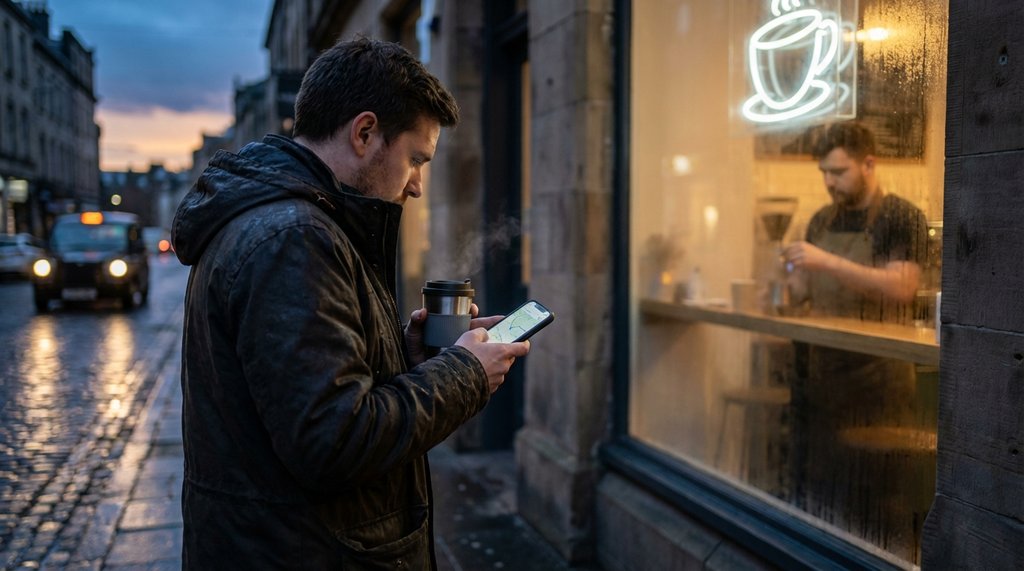
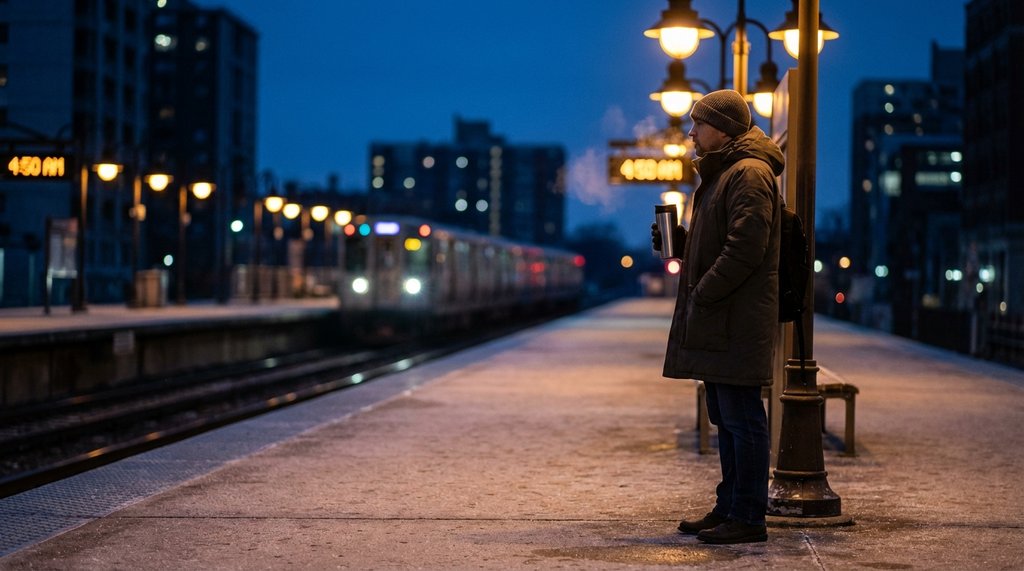
My alarm goes off at 4:47 AM. Not 4:45, not 5:00 — 4:47, because those three extra minutes feel psychologically meaningful when you’re dragging yourself out of bed to catch a 5:38 train into the city. The first thing I want is coffee. Not airport-kiosk coffee, not the sludge from the vending machine on Platform 3. Actual coffee. And finding it — reliably, on a route I’m already taking — took me an embarrassing number of failed mornings to figure out properly.
Here’s what I learned, most of it the hard way.
Why Google Maps Lies to You at This Hour (And How to Work Around It)
The single biggest mistake I made for the first six months of an early commute was trusting Google Maps’ listed opening hours without verification. Seems obvious in retrospect. But when you’re searching “coffee near me open now” at 5:15 AM and the map shows a green dot next to a place 400 meters from your train station, you assume that green dot means something.
It often doesn’t.
Google’s “open now” status for small cafés and independent coffee shops is pulled from a combination of self-reported hours, user-suggested edits, and algorithmic inference from check-in patterns. The algorithm doesn’t know that the owner of that place on Clearwater Street decided last October to push her opening time back from 5:30 to 6:00 because the 5:30 crowd wasn’t profitable enough to justify the early start. The listing still says 5:30 AM because nobody updated it, including Google’s own scraper, which apparently can’t distinguish between a café that opens at 5:30 and one that used to open at 5:30.
I’ve shown up to locked doors three times using nothing but the Maps green dot as confirmation. Twice in the same week during a stretch where I was trying a new route.
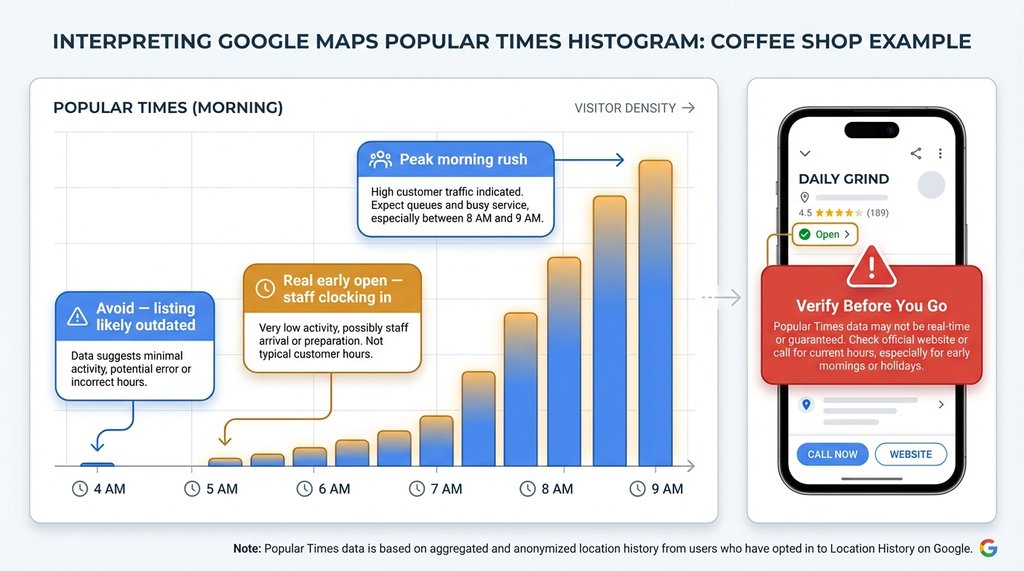
The workaround that actually works: Google Maps’ “Popular Times” histogram. If you pull up a café’s listing and the histogram shows zero or near-zero activity in the hour you plan to arrive, the listed opening time is almost certainly wrong — or the place opens but has essentially no customers because nobody knows it opens that early. Both are useful data points. A place with a thin but real activity bar at 5:30 AM is a place where staff are actually clocking in at 5:00 and the machines are running.
Cross-reference that with the “Reviews mentioning hours” section — scroll down, search for “early” in the review text. If multiple people mention getting coffee before 6, the hours are real.
The Chain vs. Independent Tradeoff Before Dawn
Here’s where I’ll say something that goes against the “support local” instinct: for reliable pre-6 AM coffee on a commute route, chains win on consistency and lose on quality in a way that matters less than you’d think at that hour.
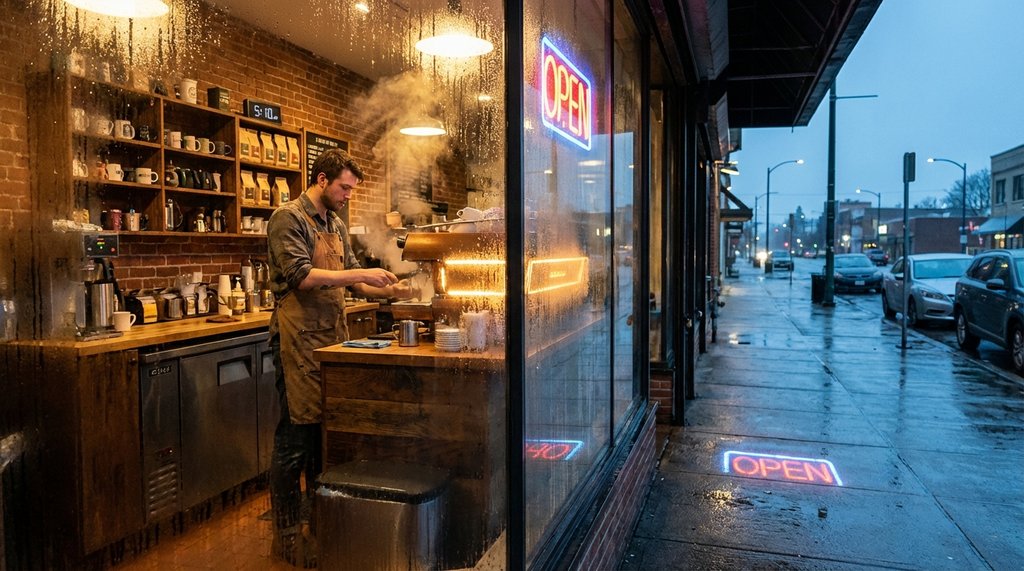
The reason isn’t snobbery in reverse. It’s operational. A McDonald’s McCafé or a Tim Hortons (if you’re in Canada) or a Dunkin’ opens at whatever corporate says it opens at, because there are staffing systems, franchise compliance audits, and a regional manager who will absolutely hear about it if Location #4472 isn’t serving customers by 5:00 AM. An independent café’s 5:30 AM opening time is entirely dependent on whether the owner or their most reliable employee set their own alarm correctly.
That said — and this is the actual non-consensus part — the independent spots that do reliably open before 6 tend to cluster around specific location types that are worth knowing:
Train station adjacents. Not inside the station (those are overpriced and often don’t control their own hours), but within a two-block radius of a major commuter rail hub. The economics of serving 6:15 AM trains justify the early start. A place in this position that’s survived more than 18 months almost certainly has its pre-dawn logistics figured out.
Hospital-adjacent cafés. Night shifts end, day shifts begin, and medical staff don’t run on polite hours. A coffee shop that’s positioned to catch hospital workers has likely been opening at 5 or earlier for years. I found one of my most reliable spots — a Vietnamese-owned café that does a genuinely excellent cà phê sữa đá alongside its drip menu — because it’s two blocks from a regional hospital and has been opening at 4:45 AM since 2014.
24-hour diner spinoffs. Some diners that serve breakfast all night have a coffee bar or a machine that’s technically accessible without ordering a full meal. The quality varies wildly, but at 5:20 AM a diner that’s been running since 11 PM the night before will at minimum have fresh-ish drip coffee because they cycle the pot on a timer.
For chain coffee drinkers: How to bypass the 20-minute mobile order backlog during the morning rush.
The Step-by-Step Route Audit (How I Actually Do This Now)
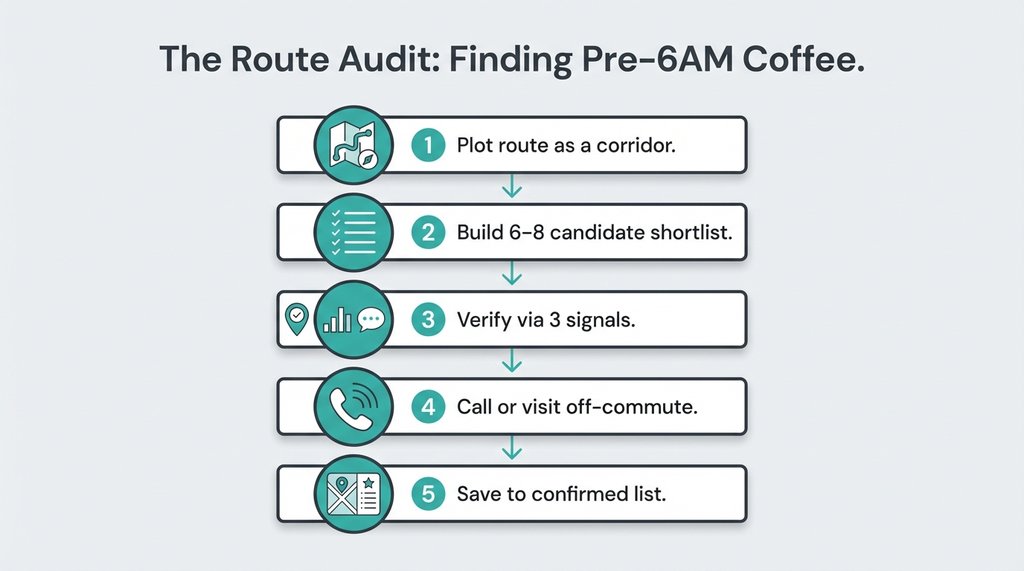
When I moved and had to establish a new commute route last spring, I built my coffee stop discovery process from scratch. Here’s the actual sequence:
Step 1: Plot your route as a corridor, not a point search.
Open Google Maps, drop your starting point and destination, and instead of searching “coffee near me,” zoom into the route itself and look for cafés that sit within about a 3-minute walk of any point on your path. You’re not looking for the best café; you’re looking for one that doesn’t cost you time. A 90-second detour is fine. A 7-minute detour means you’re either catching a later train or rushing, and both of those outcomes erode the value of the stop.
I use the Maps “search along route” feature for this initial pass, though I’ve found it misses smaller independent listings about 30% of the time because their map presence is weak. For the gaps, I’ll manually scroll along the route at street level.
Step 2: Build a shortlist of six to eight candidates.
Don’t narrow to one. You need redundancy. The first time your top choice has a plumbing issue or the owner is sick, you need a backup you’ve already vetted — not one you’re trying to find on your phone while power-walking to the platform.
Step 3: Check hours via three signals, not one.
Listed hours on Maps or Yelp (treat as approximate), Popular Times histogram (treat as behavioral evidence), and at least two reviews that specifically mention early-morning visits (treat as confirmation). If a place has all three pointing toward pre-6 AM operation, it’s on your confirmed shortlist.
Step 4: Call or visit once outside your commute.
This sounds like overkill but it takes four minutes and saves you from the walk-of-shame-back-to-the-car-because-the-door-is-locked scenario. Call during the specific opening window — if they say 5:30 AM, call at 5:31 on a non-commute day just to hear someone pick up. Or stop in on a Saturday morning. Either works.
Step 5: Mark your confirmed spots in a custom Google Maps list.
I have a private list called “Early Opens — Confirmed” with seven locations across my commute corridor. Three of them have never failed me in eight months. Two I’ve used as backups. Two I haven’t needed yet but they’re there.
What “Open Before 6 AM” Actually Means for Coffee Quality
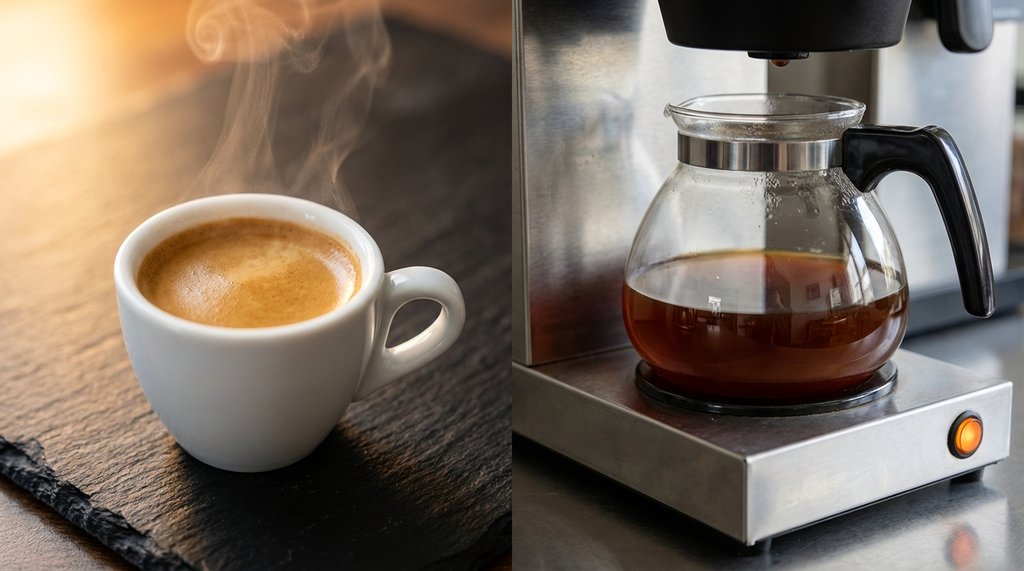
One thing most guides skip: opening time and espresso availability aren’t always the same.
A café that opens at 5:15 AM but whose espresso machine takes 25 minutes to reach proper temperature is technically open but not serving what you want until 5:40. I’ve been handed a flat, slightly sour shot at 5:22 AM at a place that was clearly rushing their warm-up time — the portafilter was barely heated through and the extraction ran visibly fast, around 18 seconds when it should have been closer to 27-30 for their typical dose. The barista knew it wasn’t right and apologized. Nice person, bad coffee, and I can’t blame them — their machine needed another 15 minutes.
The cafés that handle early openings cleanly tend to run their espresso machine warm-up as the first thing when they arrive, often 30-45 minutes before the door unlocks. If you find a spot that opens at 5:30 and the espresso is consistently good at 5:35, that means someone is walking in at 4:50 to start the machine. That’s a place with real operational discipline, and those are worth being loyal to.
Drip coffee sidesteps this entirely and is often better than it’s given credit for early in the morning. A well-dialed batch brew from a place that uses decent beans is meaningfully better than a rushed espresso pulled on a half-warm machine. I switched to ordering drip at my main stop before 5:45 AM after I realized I was getting a better cup and saving about 90 seconds of wait time.
Apps That Actually Help (and One That Doesn’t)
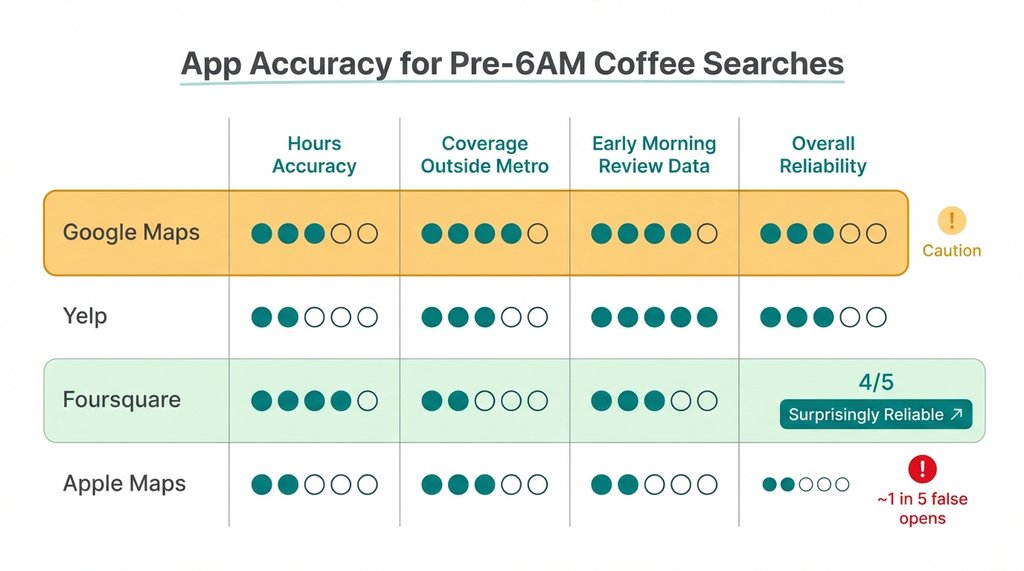
Yelp’s “Open Now” filter with hours sort is more reliably accurate than Google’s for cafés that have an active owner managing their listing. The tradeoff is that Yelp’s coverage is thinner outside major metro areas, and the review volume for early-morning experiences is usually low enough that you’re working from limited data.
Specialty coffee finder apps aren’t useful for this specific use case — they are designed to find quality-focused shops, not early openers, and high-quality independents are statistically less likely to open before 6 because their customer base skews toward mid-morning professionals and afternoon remote workers, not pre-dawn commuters.
Foursquare / Swarm has surprisingly accurate business hours for a product most people think is dead. I’ve used it twice to verify hours that conflicted between Google and Yelp, and both times Foursquare had the correct current hours. The reason is probably that Foursquare licenses its POI data to other apps and has financial incentive to keep it accurate in ways that Google (which generates the data through crowdsourcing) doesn’t always have.
Apple Maps’ “Open now” filter is nearly useless for pre-6 AM specifically. In my testing across about 40 searches during early-morning commutes over three months, it returned closed establishments as “open” at a rate of roughly 1 in 5. That’s not a safe margin when you have a train to catch.
The Seasonal Complication Nobody Mentions
Opening hours drift. This is the thing that will get you even after you’ve done all of the above.
The café that reliably opens at 5:15 in January — because it’s catching the morning rush of people who don’t want to stand on a freezing platform longer than necessary — may quietly shift to 5:45 in July when the demand curve changes and the owner decides the extra 30 minutes of sleep is worth losing a few customers who’ll just grab something at the station.
I’ve had two confirmed spots effectively close their early window on me between March and June without any update to their digital listings. One moved from 5:30 to 6:15. The other cut their early open entirely on Mondays, which is exactly the day I needed them most.
The fix is an annual or semi-annual re-verification, or — better — establishing a relationship with the staff. If they know your face and your order, they’ll tell you before they change the hours. That sounds like a soft benefit but it’s practically the most reliable early-warning system available.
Building a Backup System Worth Actually Using
The goal isn’t to find one perfect coffee spot before 6 AM. That’s a single point of failure and it will eventually fail you. The goal is to never be caught without an option on your route.
My current setup: one primary (opens at 5:00 AM, never missed in eight months, espresso is solid by 5:15), one secondary 400 meters in a different direction from the primary (opens at 5:30, drip only, but consistent), and one tertiary that’s a 24-hour diner with a coffee counter that isn’t remarkable but is always there (the drip here is cycled every 90 minutes per a handwritten sign taped to the counter, which I respect).
The primary covers 85% of mornings. The secondary covers most of the rest. The diner has been used exactly twice in a year, both times because the primary had an unexpected closure. Both times I caught my train.
That’s the actual system. Not an app, not a single “best” spot — a mapped corridor of verified options with enough redundancy that a closed door is an inconvenience, not a crisis.