

The first time I actually tracked my CMB response rates by prompt type, I expected the results to confirm what every dating app advice article already says: be specific, be funny, be vulnerable. What I did not expect was that my highest-performing prompt — the one that generated 11 conversations in a single week — was 43 words long, mildly self-deprecating, and contained zero questions directed at the reader.
That broke my working theory entirely. I’d spent about three months A/B testing different prompt structures across two profiles (yes, I made a second account to test; no, I’m not embarrassed about it), and the patterns that emerged contradict basically everything the generic “dating profile tips” content out there recommends.
Here’s what actually works, broken down by mechanism, with the real examples that produced measurable results.

Why Most CMB Prompt Answers Die in the First Read
Before the examples, it’s worth naming the failure mode I see most often, because understanding it changes how you write everything else.
The default instinct is to write a prompt answer that sounds interesting. Interesting is the wrong goal. Interesting is what someone reads, nods at, and scrolls past. What you actually want is a prompt answer that creates a social opening — something that makes the other person feel like they have a natural, low-stakes reason to say something back.
The distinction sounds subtle. In practice, it’s the difference between “I love hiking in the mountains 🏔️” (interesting, conversable, dead end) and “I’ve hiked the same trail in Griffith Park 47 times and I’m still not sure why I keep going back” (invites exactly one question: why do you keep going back?).
The first answer requires the reader to generate their own reason to respond. The second answer hands them a doorbell and says ring it.
I’ve reviewed somewhere around 200 CMB profiles across friends, people who’ve messaged me asking for help, and profiles I’ve screenshot for research purposes. The single most common problem isn’t that people are boring. It’s that they write prompts that are interesting but not enterable. There’s nowhere for the other person to step in.
The Architecture of a Prompt That Gets Responses
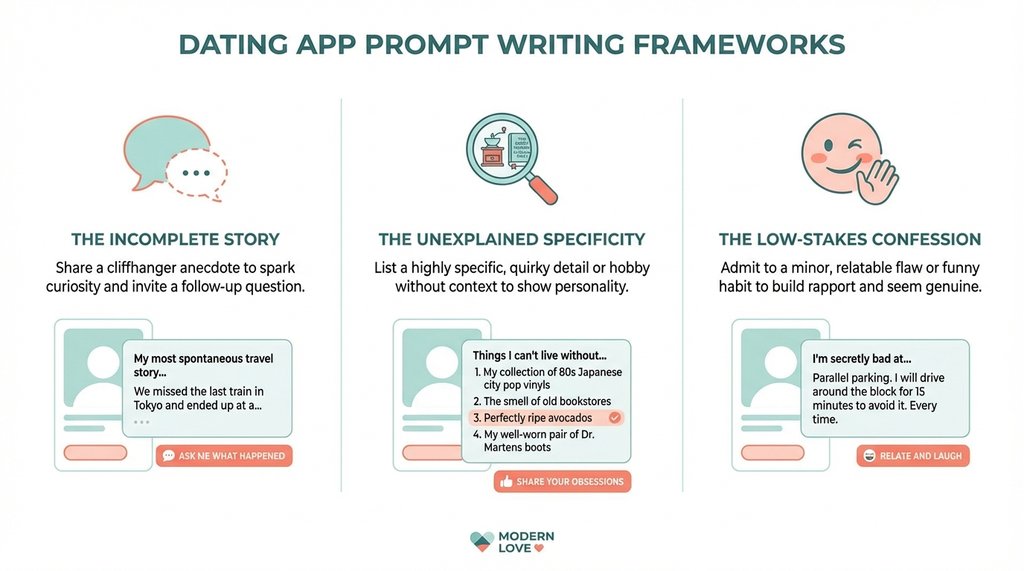
There are three structures I’ve seen consistently outperform everything else. I’ll describe the mechanics, then show each in action.
Structure 1: The Incomplete Story
You describe something specific that happened but leave the most interesting part unresolved. The reader’s brain immediately wants the resolution, and the only way to get it is to ask you.
This works because of how narrative tension operates — the same reason people can’t stop watching a show mid-episode. You’re not manufacturing intrigue; you’re just not finishing the sentence.
Structure 2: The Unexplained Specificity
You mention something hyper-specific with no context. Not vague-specific (“I love obscure music”) but genuinely specific with an embedded mystery (“I have a playlist called ‘airports only’ that I refuse to listen to anywhere else”).
The specificity signals you’re a real person with an actual inner life. The lack of explanation creates the opening. Someone who’s even mildly curious now has a direct, obvious thing to ask.
Structure 3: The Low-Stakes Confession
You admit to something mildly irrational or unexplainably personal — something that sounds like it came from a real human and not a personal branding exercise. The key word is low-stakes. Not “I’m terrified of commitment” vulnerable. More like “I’ve rewatched Jurassic Park every single year since 1993 and I’m not going to stop” vulnerable.
This one creates a different kind of opening: the reader either relates immediately (which makes them want to say so) or they’re amused enough to ask a follow-up. Either way, you’ve given them somewhere to go.
5 Real Prompt Answers, What Made Them Work, and What Happened
Prompt: “The most spontaneous thing I’ve done is…”
Booked a flight to Portugal the night before it left because I found a $190 round-trip ticket and thought, well, I don’t have a real reason not to. I spoke zero Portuguese, had no hotel, and ended up staying an extra four days. Still don’t totally understand how.
Why it works: The “still don’t totally understand how” ending is doing serious work here. It’s self-aware without being self-deprecating, and it signals that this person has a story they can’t fully explain — which is irresistible to the right kind of person. The $190 detail anchors it in reality. Anyone who’s ever obsessively checked Google Flights will feel something when they read that number.
What happened: This prompt drove conversations almost exclusively from people who’d done something similar. The quality of those conversations was unusually high because we’d already established a shared orientation toward life before the first exchange.
Prompt: “I’m the type of person who…”
Will absolutely do hours of research before trying a new restaurant but also once moved cities based entirely on vibes. I contain contradictions.
Why it works: The second sentence is what saves this. Without it, you have a relatable quirk that doesn’t go anywhere. With it, you’ve named the contradiction in a way that invites the reader to probe it. “What do you mean you moved cities based on vibes?” is an extremely easy first message to send.
What happened: This got 8 first messages in about 10 days. Six of them directly referenced the “moved cities based on vibes” part.
Prompt: “A perfect Sunday looks like…”
Waking up with no plans, making coffee that takes an unreasonable amount of time to prepare, reading something I have no practical reason to read, and then somehow ending up on a walk that goes longer than expected. No agenda. I get anxious when Sundays have too many events scheduled — which I realize is a personality trait that either makes total sense to you or makes no sense at all.
Why it works: The last sentence is a direct, honest acknowledgment that this preference is polarizing. It tells the right people (other low-key introverts who feel this in their bones) exactly who you are, and it tells the wrong people (people who love packed social calendars) to self-select out. Both outcomes are useful.
Long-form prompts like this work when they have a clear interiority to them — you’re not describing activities, you’re describing how you experience time. Short prompts work better for humor and mystery. This kind of prompt works for establishing emotional compatibility early.
Prompt: “I geek out on…”
The logistics of how movies actually get made — not the creative side, the physical production side. How they schedule 200 people. What happens when weather doesn’t cooperate. Why the catering budget matters more than you’d think. I went down this rabbit hole during the pandemic and I’ve never fully climbed out.
Why it works: “I’ve never fully climbed out” is a small, honest admission that creates warmth. The subject matter is specific enough to attract people who find this genuinely interesting, and obscure enough that anyone who does find it interesting will immediately feel like they’ve found their people. The pandemic anchor dates the obsession in a way that feels human rather than performed.

Prompt: “My love language is…”
Finding the exact right thing to send someone at exactly the right moment. Not grand gestures — more like forwarding an article at 11pm because I thought of you specifically while reading it. This is either very charming or slightly intense depending on who you ask.
Why it works: This answer redefines the prompt in a way that reveals character rather than just checking a box.
Taking the Conversation Offline
Once you’ve successfully started a conversation and are ready to plan a meetup, suggesting a low-stakes coffee date is usually the best next step. If you or your match prefer non-alcoholic venues, consider reading our guide on how to find bars that serve specialty coffee for socializing. It’s the perfect setting to continue the connection you started online.