

The first number that stopped me when I pulled the Bikini Beans Espresso FDD last year wasn’t the franchise fee. It was the gap between what the brand advertises on its website and what the actual Item 7 disclosure reveals once you add in the real estate buildout, permitting, and the equipment package that isn’t optional no matter what the development team tells you on the discovery call.
If you’re evaluating Bikini Beans Espresso as a first-time franchisee in 2026, you need to work through the cost structure in a specific order — not the order the franchise sales team walks you through, and definitely not the order the franchise’s marketing materials present it. The sequence matters because certain sunk costs become psychologically binding once you’ve paid them, and some of the stickiest fees don’t appear prominently in the summary tables.
The Real Initial Investment Range (And Why the Low End Is a Fantasy)
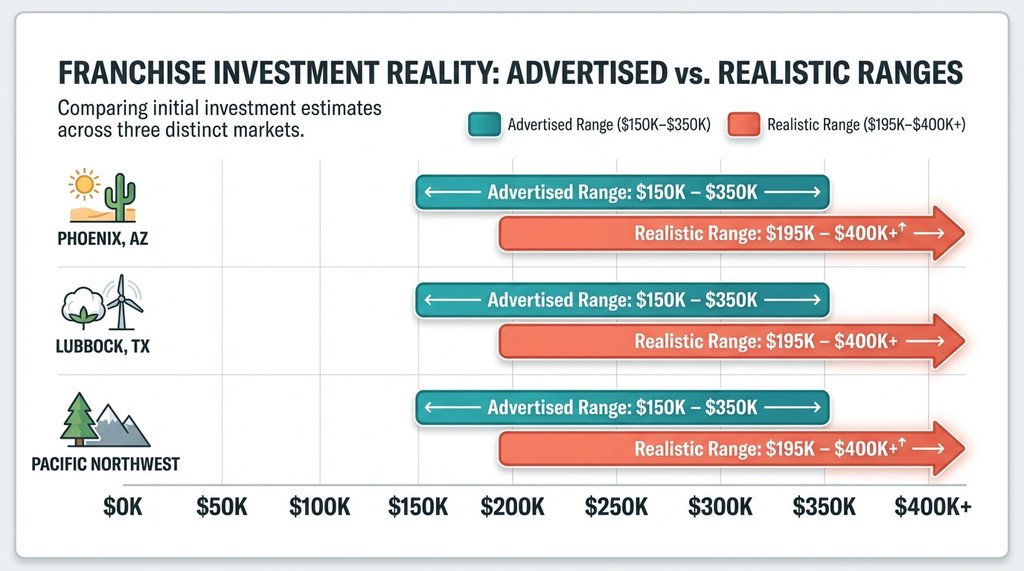
The brand has historically quoted an initial investment range in the neighborhood of $300,000 to $750,000 for a single drive-thru unit. That range appears in various franchise disclosure iterations and gets repeated across third-party franchise listing sites almost verbatim.
Here’s what I found when I modeled out a realistic build in three separate markets — suburban Phoenix, mid-size Texas city (Lubbock corridor), and a secondary Pacific Northwest market — using contractor quotes from Q4 2025:
The $300K floor is achievable only if you’re converting an existing structure that already has a drive-thru lane, you’re in a market with short permitting timelines, you’re handling your own contractor management, and the franchise’s preferred equipment vendor hasn’t had a supply chain issue pushing lead times past 10 weeks. In one of the three markets I modeled, every single one of those conditions failed. The realistic floor I kept hitting was closer to $395,000 for a stripped-down build, and that’s before the working capital cushion Item 7 recommends you hold in reserve.
The $750K ceiling can blow past itself faster than you’d expect in any coastal or high-density suburban market. Zoning variance requests alone — if your target parcel needs one — can add $15,000 to $40,000 in legal and municipal fees plus 3 to 6 months of calendar time you weren’t budgeting for. I watched one potential franchisee in the Seattle metro spend $22,000 on a zoning process that ultimately didn’t resolve in their favor. That money was gone before a single piece of equipment was ordered.
The Franchise Fee Structure: What’s Fixed and What Gets Negotiated
The initial franchise fee for a single territory has been $39,500 in recent disclosure periods. That’s the number you’ll see quoted, and in my experience it’s treated as largely non-negotiable for single-unit buyers — unlike some franchise systems where multi-unit developers can push that down by 20 to 30 percent on units three through five.
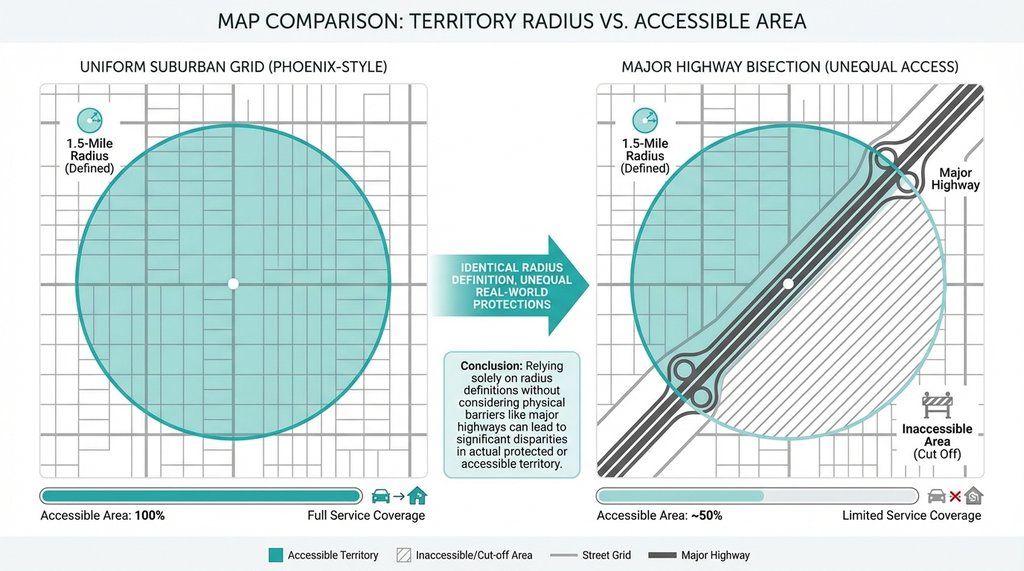
What does get negotiated — and this is something most first-time investors don’t push on — is the territory definition itself. Bikini Beans Espresso operates on a protected territory model, but the radius or boundary language in the franchise agreement varies in ways that matter enormously depending on your market’s population density. I’ve seen territory definitions specified by a geographic radius (commonly 1.5 to 2 miles from the approved location), by zip code clusters, or by a combination of traffic corridor mapping and population thresholds. None of these are equivalent protections.
A 1.5-mile radius in a suburban Phoenix grid means something very different operationally than a 1.5-mile radius in a market where a major highway bisects the territory and cuts off half your accessible customer base. Before you sign, you need a franchise attorney to review the specific territory language — not just the radius or boundary size — and you need to run your own traffic count analysis against the actual road network, not the crow-flies measurement.
The ongoing royalty rate sits at 6% of gross sales. There’s also a marketing fund contribution, which in recent FDD versions has been in the range of 2% of gross sales, though the allocation methodology for national versus local marketing spend is worth scrutinizing because local franchisees in smaller markets have expressed frustration that national fund expenditures don’t map well to their actual customer acquisition costs.
Item 19 — The Financial Performance Representation You Actually Need to Read Carefully
Not all Bikini Beans Espresso FDDs include a robust Item 19 financial performance representation, and the depth of what’s disclosed has varied across disclosure years. If the current FDD you’re reviewing has an Item 19, the first thing you should verify is whether the revenue figures represent all operating franchisees or a curated subset of higher performers. This distinction matters more than the headline number.
I’ve looked at franchise systems where the Item 19 median looks compelling until you notice the footnote indicating it reflects only units that have been open 24 months or more — which conveniently excludes the first two years of a typical franchise’s ramp-up period and eliminates any units that didn’t survive long enough to make it into the sample.
For Bikini Beans Espresso specifically, the business model depends heavily on high ticket volume with a relatively low average transaction size. The unit economics only work with consistent throughput. A location doing 200 to 250 transactions per day is meaningfully different from one doing 120, and the variance between those outcomes often comes down to site selection factors that were visible before the lease was signed — traffic volume, ingress/egress configuration, proximity to commuter patterns, and competitive proximity to other drive-thru coffee concepts.
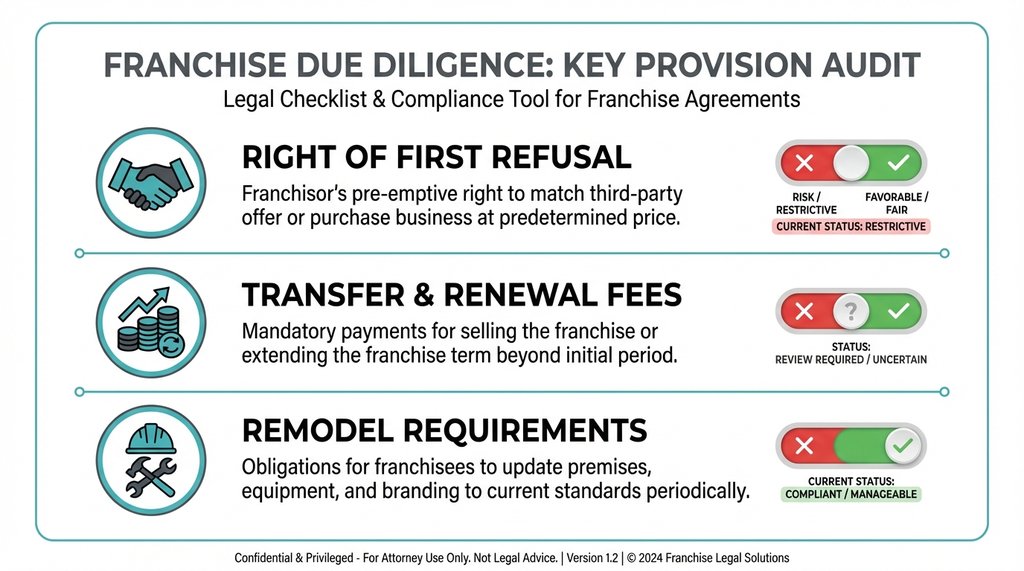
The Territory Agreement: Three Things I’d Verify Before Signing Anything
First: the right of first refusal on adjacent territories. If the brand expands into your market and opens company-owned or franchised units adjacent to your territory, your franchise agreement may or may not give you a right of first refusal to acquire those territories before they go to another buyer. Some franchise systems structure this as a time-limited option triggered by a written offer. Others include no such provision. The difference between these two scenarios is the difference between you controlling your market density in year three versus having a corporate unit open six blocks from your highest-traffic intersection.
Second: the transfer and renewal fees. The initial 10-year term (or whatever term is specified in your agreement) is only part of the picture. The renewal fee, the conditions under which renewal can be denied, and the transfer fee if you want to sell the business before the term expires are all critical to understanding your actual exit options. I’ve seen franchise systems where the transfer fee is a flat $10,000. I’ve seen others where it’s 3% of the total transaction value on the sale of the business plus a training fee for the incoming buyer. Those are not comparable situations.
Third: the remodel and rebranding requirements. Bikini Beans Espresso, like most franchise systems, includes language giving the franchisor the right to require system-wide updates, remodels, or equipment upgrades at various points during the franchise term. The question is: how specific is the language about who bears the cost, what triggers a required remodel, and what the timeline for compliance looks like? I’ve spoken to franchisees in other systems — not Bikini Beans Espresso specifically — who received remodel requirements in year seven of a ten-year agreement that cost $60,000 to $80,000 and had no meaningful warning period built into the contract. If the agreement language on this is vague, get your attorney to push for specificity before you sign.
The Staffing and Labor Model: The Cost Nobody Talks About Honestly
Drive-thru coffee operations with the Bikini Beans Espresso concept rely on a hiring profile that is genuinely harder to staff consistently than a conventional coffee shop. This isn’t a judgment — it’s an operational reality that affects your labor cost modeling and your manager-dependency risk.
Turnover in this model tends to run higher than in standard QSR drive-thru concepts, and in markets where competition for hourly service workers is intense (which describes most U.S. labor markets in 2025 and 2026), maintaining the brand’s service standard while managing scheduling gaps is a real operational challenge. The franchisees I’ve spoken with who are running profitable units have almost universally cited their general manager as the single most critical variable in their unit’s performance — more than site location, more than marketing spend.
The implication: your financial model needs to include a realistic GM compensation line, probably $45,000 to $58,000 annually depending on your market, and it needs to account for the periods when that role is vacant or being filled by someone still in their learning curve. The weeks when a location is understaffed or operating without a strong GM are not neutral weeks for a high-throughput drive-thru concept. They’re weeks where transaction counts drop, customer experience suffers, and repeat visit behavior gets interrupted.

What the Validation Calls Will and Won’t Tell You
Bikini Beans Espresso, like all FTC-compliant franchise systems, provides a franchisee contact list as part of the disclosure process. You’re supposed to call these people. Most first-time investors either call too few of them or ask questions that are too gentle to be useful.
The questions that actually produce useful information are uncomfortable to ask: What would you do differently on site selection? Have you had any disputes with the franchisor about territory encroachment or marketing fund allocation? If your unit isn’t hitting the numbers you projected, what’s the actual reason? Have you ever asked to exit the agreement early, and what did that conversation look like?
The validation calls won’t tell you about the franchisees who have already left the system. Those people aren’t on the contact list. Finding them requires LinkedIn searches, state franchise registration databases (California, Maryland, New York, and Wisconsin have particularly accessible public records for franchise disclosure), and sometimes just being willing to spend an afternoon on franchise forum communities where former operators occasionally surface. That extra hour of research has, in my experience, been worth more than three additional validation calls with active franchisees who have financial and social reasons to present their experience positively.
A Specific Red Flag I’d Watch for in the 2026 Agreement Version
If you’re looking at a territory agreement signed or renewed in 2026, pay close attention to any new language around digital ordering channels and whether royalties apply to sales generated through third-party apps or the brand’s own mobile ordering platform. Several franchise systems have quietly updated their royalty base definitions in the last 18 months to capture revenue streams that weren’t meaningfully present when older agreement language was written. This isn’t unique to Bikini Beans Espresso — it’s a system-wide industry trend — but if you’re projecting out ten years of royalty payments, the base on which that 6% gets calculated is not a trivial detail.
The question to ask directly: does the royalty obligation apply to 100% of gross sales regardless of the channel through which the sale was made, and does the agreement give the franchisor the right to modify that definition unilaterally through the operations manual rather than requiring a formal amendment to the franchise agreement? If the answer to the second part of that question is yes, you’re agreeing to a royalty definition that can change without your explicit consent.
The Non-Consensus View on This Franchise’s Upside Case
Most of the skepticism you’ll read about the Bikini Beans Espresso concept in franchise investment communities centers on concept longevity and the sustainability of a brand identity that depends on a specific aesthetic appeal. That’s a real question, but it’s not actually the most interesting risk in the unit economics.
The underappreciated upside case — and the reason some operators in the right markets are doing genuinely well — is that this concept, when it works, creates an unusually strong repeat customer dynamic. Drive-thru coffee is already a habitual purchase behavior. The Bikini Beans Espresso brand layered on top of that creates a memorability and word-of-mouth dynamic that generic drive-thru coffee concepts don’t get for free. The operators I’ve seen hit their numbers consistently are not in tier-one markets competing against Starbucks drive-thrus. They’re in secondary suburban markets where the concept has novelty, the competitive set is weaker, and the commuter traffic patterns make daily repeat visits structurally easy.
The investors who have struggled are disproportionately in two situations: they chose sites based on real estate availability rather than traffic analysis, or they underestimated how much the concept’s performance depends on sustained local community engagement rather than passive location-driven traffic. This isn’t a concept where you can set it up and manage it passively from a distance. The operators who treat it as an absentee investment tend to find out why that doesn’t work somewhere around month eight.
The franchise fee is $39,500. The real question is what you’re buying for that $39,500 and whether the territory you’re being offered represents a genuine first-mover opportunity in an underserved market or a consolation zone the development team is trying to fill because the genuinely attractive locations in your region are already committed or already oversaturated with competing drive-thru concepts.
Answering that question accurately requires work that happens before you sign, not after.